Species · Flowering plants
Djirrie Rogeria longiflora
The scientific name of the Djirrie is Rogeria longiflora. It is a species of flowering plant in the family Pedaliaceae (pedalium family or sesame family), order Lamiales.
- Scientific name
- Rogeria longiflora (D.Royen) J.Gay ex DC.
- Common name
- Djirrie
- Genus
- Rogeria
- Family
- Pedaliaceae (Pedalium Family Or Sesame Family)
- Order
- Lamiales
- Class
- Magnoliopsida
- Recorded in
- 2 countries
- Name status
- accepted in the Catalogue of Life
Overview
Rogeria longiflora, also known as the white djirrie, is a species of flowering plant in the genus Rogeria. It is native to Namibia and the northern Cape Provinces of South Africa.
Classification of the Djirrie
| Kingdom | Plantae |
|---|---|
| Subkingdom | Pteridobiotina |
| Phylum | Tracheophyta |
| Class | Magnoliopsida |
| Order | Lamiales |
| Family | Pedaliaceae (Pedalium Family Or Sesame Family) |
| Tribe | Pedalieae |
| Genus | Rogeria (Djirries) |
| Species | Rogeria longiflora (D.Royen) J.Gay ex DC. |
Where the Djirrie is found
Checklists and occurrence records place Rogeria longiflora in 2 countries across Africa. GBIF holds 579 georeferenced records of it.
Countries
Regions and cities with the most records
- Northern Cape, South Africa 241
- Karas Region, Namibia 123
- Erongo Region, Namibia 97
- Hardap Region, Namibia 46
- Khomas Region, Namibia 11
Range as the checklists state it
Namibia; South Africa (N-Cape Prov.)
A number beside a place is its count of GBIF occurrence records. A place without a number comes from a checklist alone. Records show where a species has been observed or collected, which can include escapes and vagrants.
Common names
English
- Djirrie
- Desert Foxglove
- White Djirrie
- White Rogeria
- Whiteflower Rogeria
Names in 1 other language
- Afrikaans
- witblom
Synonyms
7 other scientific names have been used for this species and are now treated as synonyms of Rogeria longiflora.
- Basonca longiflora (D.Royen) Raf.
- Martynia capensis Gloxin
- Martynia longiflora D.Royen
- Martynia longiflora L.
- Pedalium longiflorum (D.Royen) Decne.
- Rogeria longiflora var. triloba Engl.
- Rogeria rangeana Engl. ex Dinter
Related species
- Pink DjirrieRogeria adenophylla
- Yellow DjirrieRogeria bigibbosa
- Apricot DjirrieRogeria armeniaca
-
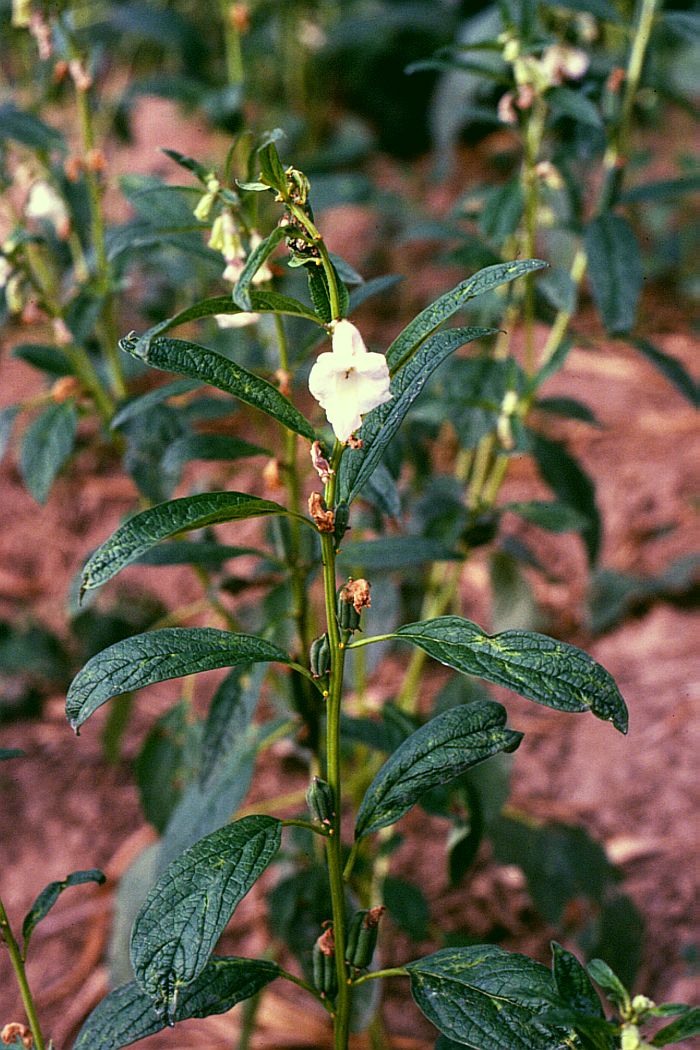 SesameSesamum indicum
-
 Winged-seed SesameSesamum alatum
-
 Mousetrap TreeUncarina grandidieri
-
 Sesame-bushSesamothamnus lugardii
- Kunene SesameSesamum marlothii
Compare
Questions and answers
What is the scientific name of the Djirrie?
The scientific name of the Djirrie is Rogeria longiflora. Written with its author, the full name is Rogeria longiflora (D.Royen) J.Gay ex DC..
Which family does the Djirrie belong to?
Rogeria longiflora belongs to the family Pedaliaceae, in the order Lamiales and the class Magnoliopsida.
Where is the Djirrie found?
Checklists and occurrence records place Rogeria longiflora in 2 countries: Namibia and South Africa.
What other names does the Djirrie have?
Rogeria longiflora is also known in English as Desert Foxglove, White Djirrie, White Rogeria and Whiteflower Rogeria.
Sources
Data
- Catalogue of Life, 2026-10-16 XR cc by
- Global Biodiversity Information Facility CC BY 4.0
- Wikidata CC0
- English Wikipedia CC BY-SA 4.0
- GeoNames CC BY 4.0
- Within the Catalogue of Life, this name comes from Synonymic Checklists of the Vascular Plants of the World cc by
References
- J.Gay ex DC. (1845). Prodr. [A.P. de Candolle] 9: 257 (1845). where the name was published
This species in other databases
- Catalogue of Life B42BC
- Wikidata Q17715868
- iNaturalist 338734
- World Flora Online wfo-0001091454
- GRIN 5273
Page built on 26 November 2026. See how the catalog is made and all sources and licences.
Cite this page
ScientificNames.org. (2026). Rogeria longiflora (Djirrie). Retrieved November 26, 2026, from https://scientificnames.org/species/rogeria-longiflora
“Rogeria longiflora (Djirrie).” ScientificNames.org, 2026, scientificnames.org/species/rogeria-longiflora. Accessed 26 Nov. 2026.
ScientificNames.org. “Rogeria longiflora (Djirrie).” Accessed November 26, 2026. https://scientificnames.org/species/rogeria-longiflora.
@misc{scientificnames_rogeria_longiflora_djirrie,
  author = {{ScientificNames.org}},
  title = {Rogeria longiflora (Djirrie)},
  year = {2026},
  url = {https://scientificnames.org/species/rogeria-longiflora},
  note = {Accessed 2026-11-26}
}