Species · Flowering plants
Transvaal Sesame Bush Sesamothamnus lugardii
The scientific name of the Transvaal Sesame Bush is Sesamothamnus lugardii. It is a species of flowering plant in the family Pedaliaceae (pedalium family or sesame family), order Lamiales.
- Scientific name
- Sesamothamnus lugardii N.E.Br. ex Stapf
- Common name
- Transvaal Sesame Bush
- Genus
- Sesamothamnus
- Family
- Pedaliaceae (Pedalium Family Or Sesame Family)
- Order
- Lamiales
- Class
- Magnoliopsida
- Red List category
- LC Least Concern
- Recorded in
- 4 countries
- Name status
- accepted in the Catalogue of Life

Overview
The Transvaal Sesame Bush (Sesamothamnus lugardii N.E.Br. ex Stapf) is a succulent, spiny shrub or small tree in the family Pedaliaceae. It grows in hot, dry environments in southern Zimbabwe, eastern Botswana, Limpopo, Mpumalanga and North West provinces. It is distinguished by its swollen trunk base, thick ascending branches and large, trumpet-shaped flowers that open in the evening.
Written 26 November 2026 from the sources listed below. Each statement was checked against the passage it cites; statements that could not be supported were removed.
Appearance
The leaves are obovate and occur in alternate, petiolate arrangements on long shoots or sessile clusters on short shoots. They fold upward along their midribs, with green upper surfaces and paler lower surfaces covered with short, greyish hairs.[1][2]
The flowers are large, showy, trumpet-shaped and solitary in the leaf axils. Their petals are white, pink or cream-colored, sometimes with a purplish exterior tinge, and the flowers have a curved corolla tube with a spur at the base.[3][4][5]
The fruit is a flattened, woody capsule notched at the base and containing winged seeds.[6]
The shrub or small tree can reach a height of 4 metres, and its swollen trunk base can reach 1 metre in diameter. The curved flower corolla tube measures approximately 10 centimetres long.[7][8][9]
Habitat
The Transvaal Sesame Bush grows in hot, dry environments. It occurs in alluvial plains, Kalahari sand, rocky soils and areas with hard loamy soil.[10][11]
The species commonly occurs alone or in scattered small groups. Associated plants include Commiphora, Catophractes alexandri, Acacia tortilis, Acacia senegal, Balanites, Salvadora australis and Mundulea sericea.[12][13][14]
Behaviour
The flowers open in the evening.[15]
Following herbivory, the species can recover its bark and produce epicormic resprouts.[16]
Reproduction and life cycle
Flowering occurs between September and December. Successful sexual reproduction depends entirely on cross-pollination by the convolvulus hawkmoth, Agrius convolvuli, which is the plant's primary pollinator.[17][18][19]
The convolvulus hawkmoth has a proboscis long enough to reach nectar at the base of the flower's 10-centimetre corolla tube.[9][20]
Seedlings are rarely observed in wild populations. A study comparing populations from 2005 to 2014 recorded a decrease in seedling numbers.[21][22]
Conservation
The South African National Biodiversity Institute assesses the species as Least Concern in the Red List of South African Plants. This classification was assigned automatically because the species was not selected for detailed assessment during screening.[23][24]
Dependence on a single pollinator species and obligate outcrossing are potential extinction vulnerabilities. Low seedling recruitment and slow population turnover also contribute to demographic vulnerability.[25][26]
Longevity and vigorous resprouting help buffer populations during periods of reproductive failure. Increasing herbivore populations in protected areas such as Mapungubwe National Park could potentially cause local extinction of the species.[27][28]
Similar species
Sesamothamnus seineri, published in 1910, is considered a synonym of Sesamothamnus lugardii.[29]
Classification of the Transvaal Sesame Bush
| Kingdom | Plantae |
|---|---|
| Subkingdom | Pteridobiotina |
| Phylum | Tracheophyta |
| Class | Magnoliopsida |
| Order | Lamiales |
| Family | Pedaliaceae (Pedalium Family Or Sesame Family) |
| Tribe | Sesamothamneae |
| Genus | Sesamothamnus |
| Species | Sesamothamnus lugardii N.E.Br. ex Stapf |
Where the Transvaal Sesame Bush is found
Checklists and occurrence records place Sesamothamnus lugardii in 4 countries across Africa. GBIF holds 230 georeferenced records of it.
Countries
Regions and cities with the most records
- Limpopo, South Africa 122
- Central, Botswana 27
- Musina, South Africa 13
- Mpumalanga, South Africa 11
- Ghanzi, Botswana 9
- Beitbridge, Zimbabwe 4
Range as the checklists state it
Zimbabwe; Botswana; South Africa (Limpopo, North-West Prov., Mpulamanga)
A number beside a place is its count of GBIF occurrence records. A place without a number comes from a checklist alone. Records show where a species has been observed or collected, which can include escapes and vagrants.
Common names
English
- Transvaal Sesame Bush
- Eastern Sesamebush
- Sesame-bush
- Sesamebush
Names in 3 other languages
- Afrikaans
- Transvaal-sesambos, Transvaalse Sesambos, sesambos, transvaalsesambos
- Tswana
- moboana, seboaboana, siboana
- ven
- tshinonzhe, tshinėonzhe
Synonyms
One other scientific name has been used for this species and is now treated as a synonym of Sesamothamnus lugardii.
- Sesamothamnus seineri Engl.
Related species
-
 Kaoko SesamebushSesamothamnus benguellensis
-
 Thickstem SesameSesamothamnus guerichii
- Sesamothamnus rivae
- Sesamothamnus busseanus
- Namib SesamebushSesamothamnus leistneri
-
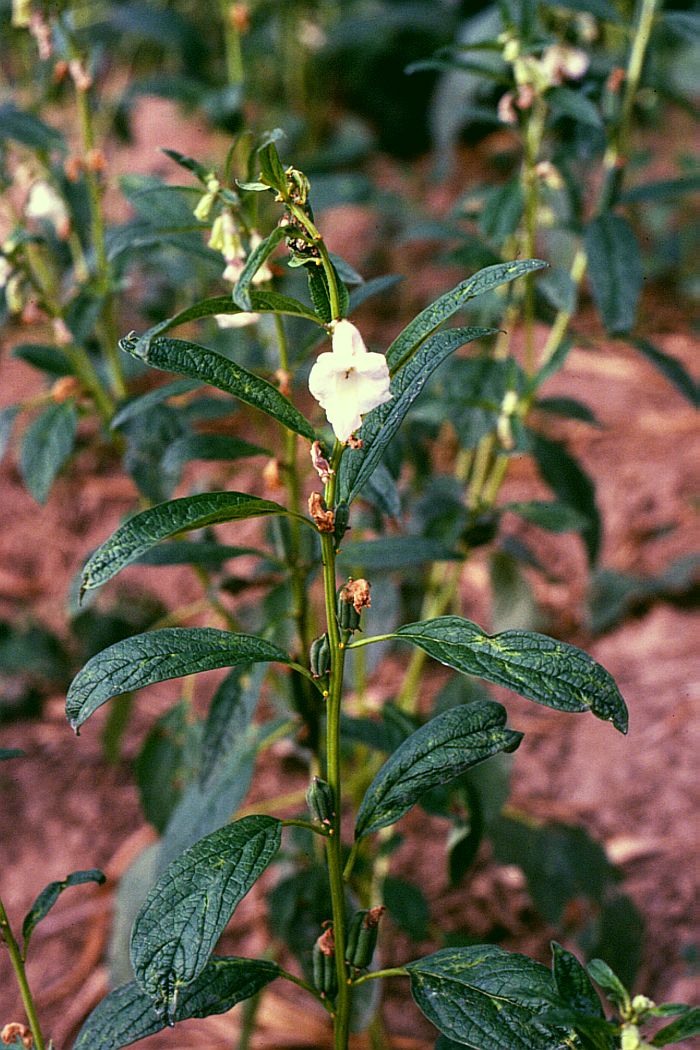 SesameSesamum indicum
-
 Wingseed SesameSesamum alatum
-
 Mousetrap TreeUncarina grandidieri
Compare
Questions and answers
What is the scientific name of the Transvaal Sesame Bush?
The scientific name of the Transvaal Sesame Bush is Sesamothamnus lugardii. Written with its author, the full name is Sesamothamnus lugardii N.E.Br. ex Stapf.
Which family does the Transvaal Sesame Bush belong to?
Sesamothamnus lugardii belongs to the family Pedaliaceae, in the order Lamiales and the class Magnoliopsida.
Where is the Transvaal Sesame Bush found?
Checklists and occurrence records place Sesamothamnus lugardii in 4 countries: South Africa, Botswana, Namibia and Zimbabwe.
What is the conservation status of the Transvaal Sesame Bush?
The IUCN Red List category recorded for Sesamothamnus lugardii is Least Concern (LC).
What other names does the Transvaal Sesame Bush have?
Sesamothamnus lugardii is also known in English as Eastern Sesamebush, Sesame-bush and Sesamebush.
Sources
Passages the profile rests on
- Its leaves are obovate and occur in alternate, petiolate arrangements on long shoots or sessile clusters on short shoots. Source passage: “Leaves are obovate (egg-shaped with the narrower end at the base), occurring in two forms: alternate and petiolate on long shoots, or sessile and clustered (fasciculate) on short shoots.” — English Wikipedia
- The leaves fold upward along their midribs and have green upper surfaces and paler lower surfaces covered with short, greyish hairs. Source passage: “The leaves fold upward along the midrib, are green above and paler below, with both surfaces covered in short, greyish hairs.” — English Wikipedia
- Its flowers are large, showy, trumpet-shaped and solitary in the leaf axils. Source passage: “The flowers are large and showy, solitary in the leaf axils. They are trumpet-shaped” — English Wikipedia
- The flowers have white, pink or cream-colored petals, sometimes with a purplish exterior tinge. Source passage: “The flowers are white, pink, or cream-colored, often with a purplish tinge on the exterior.” — English Wikipedia
- Its flowers have a curved corolla tube and a spur at the base. Source passage: “They are trumpet-shaped with a long, curved corolla tube measuring approximately 10 cm (3.9 in) in length, and possess a spur at the base.” — English Wikipedia
- The fruit is a flattened, woody capsule notched at the base and containing winged seeds. Source passage: “The fruit is a flattened, woody capsule, notched at the base, containing winged seeds.” — English Wikipedia
- The shrub or small tree can reach a height of 4 metres. Source passage: “grows up to 4 m (13 ft) tall.” — English Wikipedia
- The swollen trunk base can reach 1 metre in diameter. Source passage: “reaching up to 1 m (3.3 ft) in diameter” — English Wikipedia
- The curved flower corolla tube measures approximately 10 centimetres long. Source passage: “measuring approximately 10 cm (3.9 in) in length” — English Wikipedia
- The species grows in hot, dry environments. Source passage: “The species grows in hot, dry areas” — English Wikipedia
- It occurs in alluvial plains, Kalahari sand, rocky soils and areas with hard loamy soil. Source passage: “including alluvial plains, Kalahari sand, rocky soils, and areas with hard loamy soil.” — English Wikipedia
- The species commonly occurs alone or in scattered small groups. Source passage: “often occurring alone or in scattered, small groups.” — English Wikipedia
- Associated plants include Commiphora, Catophractes alexandri and Acacia tortilis. Source passage: “Associated plant species include Commiphora, Catophractes alexandri, Acacia tortilis” — English Wikipedia
- Other associated plants include Acacia senegal, Balanites, Salvadora australis and Mundulea sericea. Source passage: “Acacia senegal, Balanites, Salvadora australis, and Mundulea sericea.” — English Wikipedia
- The flowers open in the evening. Source passage: “Flowers open in the evening” — English Wikipedia
- The species can recover its bark and produce epicormic resprouts following herbivory. Source passage: “However, the species demonstrates resilience through bark recovery and epicormic resprouting.” — English Wikipedia
- Flowering occurs between September and December. Source passage: “Flowering occurs from September to December.” — English Wikipedia
- The species relies entirely on cross-pollination by the convolvulus hawkmoth for successful sexual reproduction. Source passage: “The plant is an obligate outcrosser, meaning it relies entirely on cross-pollination by A. convolvuli for successful sexual reproduction.” — English Wikipedia
- The convolvulus hawkmoth (Agrius convolvuli) is the plant's primary pollinator. Source passage: “Research has identified the convolvulus hawkmoth (Agrius convolvuli) as the primary pollinator.” — English Wikipedia
- The convolvulus hawkmoth has a proboscis long enough to reach nectar at the base of the flower's 10-centimetre corolla tube. Source passage: “This species possesses a proboscis long enough to access the nectar at the base of the 10 cm (3.9 in) corolla tube” — English Wikipedia
- Seedlings are rarely observed in wild populations. Source passage: “Seedlings are rarely observed in wild populations.” — English Wikipedia
- A study comparing populations from 2005 to 2014 recorded a decrease in seedling numbers. Source passage: “A study comparing populations between 2005 and 2014 noted a decrease in the number of seedlings” — English Wikipedia
- The South African National Biodiversity Institute assesses the species as Least Concern in the Red List of South African Plants. Source passage: “The South African National Biodiversity Institute (SANBI) assesses Sesamothamnus lugardii as Least Concern in the Red List of South African Plants.” — English Wikipedia
- The Least Concern classification was assigned automatically because the species was not selected for detailed assessment during screening. Source passage: “This automated status was assigned as the taxon was not selected for detailed assessment in screening processes.” — English Wikipedia
- Dependence on a single pollinator species and obligate outcrossing are potential extinction vulnerabilities. Source passage: “These include pollinator specialization (dependence on Agrius convolvuli) and obligate outcrossing” — English Wikipedia
- Low seedling recruitment and slow population turnover contribute to demographic vulnerability. Source passage: “Low seedling recruitment rates and slow population turnover also contribute to demographic vulnerability.” — English Wikipedia
- Longevity and vigorous resprouting help buffer populations during periods of reproductive failure. Source passage: “the species offsets these risks through longevity and vigorous resprouting ability, which buffer populations during periods of reproductive failure.” — English Wikipedia
- Increasing herbivore populations in protected areas such as Mapungubwe National Park could potentially cause local extinction of the species. Source passage: “increasing herbivore populations in protected areas such as Mapungubwe National Park could reach a critical threshold where the species loses its resilience, potentially leading to local extirpation.” — English Wikipedia
- Sesamothamnus seineri, published in 1910, is considered a synonym of Sesamothamnus lugardii. Source passage: “A later name, Sesamothamnus seineri published by Adolf Engler in 1910, is considered a nomen nudum and a synonym of S. lugardii.” — English Wikipedia
Data
- Catalogue of Life, 2026-10-16 XR cc by
- Global Biodiversity Information Facility CC BY 4.0
- Wikidata CC0
- GeoNames CC BY 4.0
- Wikimedia Commons per image; credit shown with each image
- Within the Catalogue of Life, this name comes from Synonymic Checklists of the Vascular Plants of the World cc by
References
- N.E.Br. ex Stapf. (1906). Fl. Trop. Afr. [Oliver et al.] 4(2): 568 (1906). where the name was published
This species in other databases
Page built on 27 November 2026. See how the catalog is made and all sources and licences.
Cite this page
ScientificNames.org. (2026). Sesamothamnus lugardii (Transvaal Sesame Bush). Retrieved November 27, 2026, from https://scientificnames.org/species/sesamothamnus-lugardii
“Sesamothamnus lugardii (Transvaal Sesame Bush).” ScientificNames.org, 2026, scientificnames.org/species/sesamothamnus-lugardii. Accessed 27 Nov. 2026.
ScientificNames.org. “Sesamothamnus lugardii (Transvaal Sesame Bush).” Accessed November 27, 2026. https://scientificnames.org/species/sesamothamnus-lugardii.
@misc{scientificnames_sesamothamnus_lugardii_transvaal_sesame_bush,
  author = {{ScientificNames.org}},
  title = {Sesamothamnus lugardii (Transvaal Sesame Bush)},
  year = {2026},
  url = {https://scientificnames.org/species/sesamothamnus-lugardii},
  note = {Accessed 2026-11-27}
}