Species · Fishes
Pacific Bonito Sarda lineolata
The scientific name of the Pacific Bonito is Sarda lineolata. It is a species of fish in the family Scombridae (albacores), order Scombriformes. The name dates from 1858.
- Scientific name
- Sarda lineolata (Girard, 1858)
- Common name
- Pacific Bonito
- Genus
- Sarda
- Family
- Scombridae (Albacores)
- Order
- Scombriformes
- Class
- Teleostei
- Environment
- marine
- Recorded in
- 2 countries
- Name status
- accepted in the Catalogue of Life

Overview
Sarda lineolata inhabits open ocean environments along the Pacific coasts of the United States, Mexico, Peru, and Chile. It has a blue to violet upper body with a metallic sheen, ten or eleven oblique stripes on its back, and a silver underside.
Written 26 November 2026 from the sources listed below. Each statement was checked against the passage it cites; statements that could not be supported were removed.
Appearance
The Pacific Bonito has a blue to violet upper body with a metallic sheen that transitions to silver on the underside. Its back has ten or eleven oblique stripes extending forward from the dorsum.[1][2]
The first dorsal fin is continuous with the second dorsal fin and is longer than the head. The body is covered entirely in scales and has a slender caudal peduncle.[3][4]
The species has no teeth on its vomer. The caudal peduncle has a small keel on each side of its median keel, while its dorsal and ventral surfaces each bear six to eight finlets.[5][6][7]
Habitat
The Pacific Bonito inhabits open ocean environments and can occur at depths of up to 110 m. It is most abundant within approximately 24 km of the coast, although it can occur several hundred miles offshore.[8][9]
Younger individuals commonly inhabit shallow kelp forests, harbors, and bays.[10]
Diet
Fish and squid constitute the main diet of the Pacific Bonito. The Northern anchovy and market squid are principal prey species.[11][12]
Other recorded prey include rockfish, hake, sardines, saury, and mackerel. During January through June, the spawning season, Pacific Bonito have been observed consuming equal amounts of mackerel and squid.[13][14]
Behaviour
Pacific Bonito commonly travel in schools in the open ocean. The species is highly migratory and moves along the coast according to seasonal changes, with migrations of up to approximately 970 km.[15][16][17]
The species generally moves south during winter and north during summer.[18]
Reproduction and life cycle
Male Pacific Bonito reach maturity at approximately three years of age, around two years earlier than females. Females reach maturity at approximately 55 cm, compared with approximately 50 cm for males.[19][20]
Pacific Bonito display courtship behaviour before releasing gametes simultaneously. Observed spawning behaviour includes fish swimming together in a circle before releasing gametes.[21][22]
Pacific Bonito can reproduce over multiple years, and older individuals begin spawning earlier in the season than younger individuals. The species produces free-floating eggs that hatch after approximately three days.[23][24][25]
Conservation
The Pacific Bonito population is currently believed to be stable, although its conservation status remains incompletely understood. Further research is required for a more reliable assessment.[26][27]
Pacific Bonito are considered relatively resilient to overfishing because they grow quickly.[28]
Uses
Pacific Bonito are commercially important fish. Commercial fishing uses trolling and purse seine nets.[29][30]
Recreational anglers commonly target Pacific Bonito using feather lures, spoons, and live bait. Their meat requires immediate preparation because it spoils quickly.[31][32]
Classification of the Pacific Bonito
| Kingdom | Animalia |
|---|---|
| Phylum | Chordata |
| Subphylum | Vertebrata |
| Infraphylum | Gnathostomata |
| Parvphylum | Osteichthyes |
| Gigaclass | Actinopterygii |
| Superclass | Actinopteri |
| Class | Teleostei (Teleost) |
| Order | Scombriformes |
| Suborder | Scombroidei |
| Family | Scombridae (Albacores) |
| Subfamily | Scombrinae |
| Genus | Sarda (Bonitos) |
| Species | Sarda lineolata (Girard, 1858) |
Where the Pacific Bonito is found
Checklists and occurrence records place Sarda lineolata in 2 countries. GBIF holds 60 georeferenced records of it.
Countries
Regions and cities with the most records
- San Diego, United States 25
- Coronado, United States 21
- Carson, United States 4
- Encinitas, United States 4
- Lomita, United States 4
- Long Beach, United States 4
- Seal Beach, United States 4
- West Carson, United States 4
- Compton, United States 3
- Lakewood, United States 3
- Paramount, United States 3
A number beside a place is its count of GBIF occurrence records. A place without a number comes from a checklist alone. Records show where a species has been observed or collected, which can include escapes and vagrants.
Common names
English
- Pacific Bonito
Synonyms
2 other scientific names have been used for this species and are now treated as synonyms of Sarda lineolata.
- Pelamys lineolata Girard, 1858
- Sarda chiliensis lineolata (Girard, 1858)
Related species
-
 Atlantic BonitoSarda sarda
-
 Striped BonitoSarda orientalis
-
 Australian BonitoSarda australis
-
 Eastern Pacific BonitoSarda chiliensis
-
 Atlantic Bluefin TunaThunnus thynnus
-
 WahooAcanthocybium solandri
-
 Yellowfin TunaThunnus albacares
-
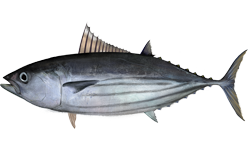 Skipjack TunaKatsuwonus pelamis
Compare
Questions and answers
What is the scientific name of the Pacific Bonito?
The scientific name of the Pacific Bonito is Sarda lineolata. Written with its author, the full name is Sarda lineolata (Girard, 1858).
Which family does the Pacific Bonito belong to?
Sarda lineolata belongs to the family Scombridae, in the order Scombriformes and the class Teleostei.
Where is the Pacific Bonito found?
Checklists and occurrence records place Sarda lineolata in 2 countries: United States and Mexico.
Sources
Passages the profile rests on
- The Pacific bonito is blue to violet on its upper body, with a metallic sheen that transitions to silver on its underside. Source passage: “The Pacific Bonito is colored blue to violet above, with metallic luster becoming silvery ventrally.” — English Wikipedia
- The species has ten or eleven oblique stripes on its back that extend forward from the dorsum. Source passage: “It has ten or eleven stripes on its back running obliquely from the dorsum forward” — English Wikipedia
- The first dorsal fin is continuous with the second dorsal fin and is longer than the head. Source passage: “The first dorsal fin is contiguous with the second and longer than the head.” — English Wikipedia
- The Pacific bonito has a slender caudal peduncle and scales covering its entire body. Source passage: “The caudal peduncle is slender, and the body entirely scaled.” — English Wikipedia
- The species has no teeth on its vomer. Source passage: “It has no teeth on the vomer.” — English Wikipedia
- The caudal peduncle has a small keel on each side of its median keel. Source passage: “It has a small keel on either side of the median keel on the sides of the caudal peduncle” — English Wikipedia
- The dorsal and ventral surfaces of the caudal peduncle each bear six to eight finlets. Source passage: “six to eight finlets on the dorsal and ventral surfaces of the caudal peduncle.” — English Wikipedia
- The Pacific bonito inhabits open ocean environments and can occur at depths of up to 110 m. Source passage: “Pacific bonito usually travel in schools in the open ocean and live up to depths of 110 m (360 ft).” — English Wikipedia
- The species is most abundant within approximately 24 km of the coast, although it can occur several hundred miles offshore. Source passage: “The species can be found up to several hundred miles off the coast, but is most abundant in areas 15 miles (24 km) or less off the coast.” — English Wikipedia
- Younger individuals commonly inhabit shallow kelp forests, harbors, and bays. Source passage: “Younger individuals are more often found in shallower areas such as kelp forests where they have places to hide, additionally being found inside harbors and bays.” — English Wikipedia
- Fish and squid constitute the main diet of the Pacific bonito. Source passage: “Fish and squid are the main diet of the Pacific bonito” — English Wikipedia
- The Northern anchovy and market squid are principal prey species of the Pacific bonito. Source passage: “primarily the Northern anchovy and market squid.” — English Wikipedia
- Other recorded prey include rockfish, hake, sardines, saury, and mackerel. Source passage: “They have also been known to eat rockfish, hake, sardines, saury and mackerel.” — English Wikipedia
- During January through June, the spawning season, Pacific bonito have been observed consuming equal amounts of mackerel and squid. Source passage: “From January to June, during their spawning season, they have been found to eat equal amounts of mackerel and squid.” — English Wikipedia
- Pacific bonito commonly travel in schools in the open ocean. Source passage: “Pacific bonito usually travel in schools in the open ocean” — English Wikipedia
- The species is highly migratory and moves along the coast according to seasonal changes. Source passage: “This species are considered highly migratory, and migrates up the coast with the seasons.” — English Wikipedia
- Pacific bonito can migrate distances of up to approximately 970 km. Source passage: “They can migrate up to 600 miles (970 km)” — English Wikipedia
- The species generally moves south during winter and north during summer. Source passage: “move south in the winter where temperatures are warmer and north for the summer.” — English Wikipedia
- Females reach maturity at approximately 55 cm, compared with approximately 50 cm for males. Source passage: “Females are larger than males at maturity at around 55 cm (22 in) vs 50 cm (20 in).” — English Wikipedia
- Male Pacific bonito reach maturity at approximately three years of age, around two years earlier than females. Source passage: “males reach maturity around two years sooner, at three years compared to one.” — English Wikipedia
- Pacific bonito have been observed displaying courtship behaviour before releasing gametes simultaneously. Source passage: “This species has been observed performing some courtship behavior and has been observed releasing gametes simultaneously” — English Wikipedia
- Observed spawning behaviour includes fish swimming together in a circle before releasing gametes. Source passage: “after swimming together in a circle.” — English Wikipedia
- Pacific bonito can reproduce over multiple years. Source passage: “Pacific bonito can spawn multiple years” — English Wikipedia
- Older Pacific bonito begin spawning earlier in the season than younger individuals. Source passage: “begin spawning earlier in the season the older they get.” — English Wikipedia
- The species produces free-floating eggs that hatch after approximately three days. Source passage: “They produce eggs which are free floating and take around three days to hatch.” — English Wikipedia
- The Pacific bonito population is currently believed to be stable, although its conservation status remains incompletely understood. Source passage: “Currently, their population is believed to be in stable condition.” — English Wikipedia
- The species' conservation status requires further research for a more reliable assessment. Source passage: “Not much information on their status is currently known, and more research will need to be done to know for sure.” — English Wikipedia
- Pacific bonito are considered relatively resilient to overfishing because they grow quickly. Source passage: “Pacific bonito are a fast-growing species which makes them more resilient to overfishing.” — English Wikipedia
- Pacific bonito are commercially important fish. Source passage: “They are popular as a game fish and commercially important.” — English Wikipedia
- Commercial fishing for Pacific bonito uses trolling and purse seine nets. Source passage: “In commercial markets, it is caught by trolling or purse seine nets.” — English Wikipedia
- Recreational anglers commonly target Pacific bonito using feather lures, spoons, and live bait. Source passage: “Recreationally, fishing using feather lures, spoons, or live bait is popular for the species.” — English Wikipedia
- Pacific bonito meat requires immediate preparation because it spoils quickly. Source passage: “requires immediate preparation due to the nature of the bonito's quickly spoiling meat.” — English Wikipedia
Data
- Catalogue of Life, 2026-10-16 XR cc by
- Global Biodiversity Information Facility CC BY 4.0
- Wikidata CC0
- GeoNames CC BY 4.0
- Wikimedia Commons per image; credit shown with each image
- Within the Catalogue of Life, this name comes from World Register of Marine Species cc by
This species in other databases
Page built on 27 November 2026. See how the catalog is made and all sources and licences.
Cite this page
ScientificNames.org. (2026). Sarda lineolata (Pacific Bonito). Retrieved November 27, 2026, from https://scientificnames.org/species/sarda-lineolata
“Sarda lineolata (Pacific Bonito).” ScientificNames.org, 2026, scientificnames.org/species/sarda-lineolata. Accessed 27 Nov. 2026.
ScientificNames.org. “Sarda lineolata (Pacific Bonito).” Accessed November 27, 2026. https://scientificnames.org/species/sarda-lineolata.
@misc{scientificnames_sarda_lineolata_pacific_bonito,
  author = {{ScientificNames.org}},
  title = {Sarda lineolata (Pacific Bonito)},
  year = {2026},
  url = {https://scientificnames.org/species/sarda-lineolata},
  note = {Accessed 2026-11-27}
}