Species · Fishes
Atlantic Bonito Sarda sarda
The scientific name of the Atlantic Bonito is Sarda sarda. It is a species of fish in the family Scombridae (albacores), order Scombriformes. The name dates from 1793.
- Scientific name
- Sarda sarda (Bloch, 1793)
- Common name
- Atlantic Bonito
- Genus
- Sarda
- Family
- Scombridae (Albacores)
- Order
- Scombriformes
- Class
- Teleostei
- Red List category
- LC Least Concern
- Environment
- brackish, marine
- Recorded in
- 43 countries
- Name status
- accepted in the Catalogue of Life

Overview
Sarda sarda occurs in shallow waters of the Atlantic Ocean, Mediterranean Sea, and Black Sea. It has dark oblique stripes on its back and can reach 75 centimetres in length.
Written 26 November 2026 from the sources listed below. Each statement was checked against the passage it cites; statements that could not be supported were removed.
Appearance
The Atlantic Bonito has a completely scaled, compressed body, with larger scales typically occurring around the pectoral fins and along the lateral line. It lacks teeth on the roof of its mouth.[1][2]
Its dorsal fins are positioned very close together or separated by only a narrow gap. Its back has dark oblique stripes.[3][4]
The Atlantic Bonito can reach 75 centimetres in length. Individuals weighing 5–6 kilograms are reported at this length, and the recorded world-record weight is 8.3 kilograms.[5][6][7]
Habitat
The Atlantic Bonito occurs in shallow waters of the Atlantic Ocean, Mediterranean Sea, and Black Sea. It is commonly found offshore near New York City.[8][9]
Diet
The Atlantic Bonito feeds on mackerel, menhaden, alewives, silversides, and sand lances. It also consumes squid.[10][11]
The Atlantic Bonito is a ram ventilator and must swallow its prey whole.[12]
Behaviour
The Atlantic Bonito is a strong swimmer and normally travels in fairly large schools. It is known to jump out of the water.[13][14][15]
Reproduction and life cycle
The Atlantic Bonito spawning season is June. Atlantic Bonito measuring 12–15 centimetres have been caught off Long Island in September.[16][17]
Uses
The Atlantic Bonito is commercially fished and targeted as a game fish. It is sometimes used as bait.[18][19]
The Atlantic Bonito is consumed as a food fish in the Mediterranean and can be canned for consumption. It is prepared as escabeche in Algeria and Spain.[20][21][22]
Classification of the Atlantic Bonito
| Kingdom | Animalia |
|---|---|
| Phylum | Chordata |
| Subphylum | Vertebrata |
| Infraphylum | Gnathostomata |
| Parvphylum | Osteichthyes |
| Gigaclass | Actinopterygii |
| Superclass | Actinopteri |
| Class | Teleostei (Teleost) |
| Order | Scombriformes |
| Suborder | Scombroidei |
| Family | Scombridae (Albacores) |
| Subfamily | Scombrinae |
| Genus | Sarda (Bonitos) |
| Species | Sarda sarda (Bloch, 1793) |
Where the Atlantic Bonito is found
Checklists and occurrence records place Sarda sarda in 43 countries. GBIF holds 2,930 georeferenced records of it.
Countries
- Algeria 9
- Angola 9
- Antigua and Barbuda 4
- Bahamas 14
- Belgium 5
- Benin 10
- Cameroon 43
- Canada 12
- Croatia 271
- Cuba 35
- Democratic Republic of the Congo 11
- Denmark 13
- Equatorial Guinea 19
- France 253
- Gabon 77
- Germany 3
- Ghana 79
- Greece 13
- Guernsey 10
- Guinea 39
- Guinea-Bissau 22
- Ireland 19
- Italy 86
- Ivory Coast 75
- Liberia 64
- Mauritania 4
- Mayotte 3
- Mexico 19
- Morocco 4
- Nigeria 118
- Norway 31
- Portugal 149
- Republic of the Congo 11
- Senegal 5
- Sierra Leone 45
- South Africa 31
- Spain 368
- Sweden 18
- Togo 12
- U.S. Virgin Islands 7
- Ukraine 14
- United Kingdom 26
- United States 870
Regions and cities with the most records
- Catalonia, Spain 92
- Friuli Venezia Giulia, Italy 49
- Koper, Slovenia 49
- Trieste, Italy 49
- Massachusetts, United States 30
- Alaquàs, Spain 28
- Albal, Spain 28
- Alboraya, Spain 28
- Aldaia, Spain 28
- Alfafar, Spain 28
- Benetússer, Spain 28
- Catarroja, Spain 28
- Mislata, Spain 28
- Paiporta, Spain 28
- Picassent, Spain 28
- Quart de Poblet, Spain 28
- Silla, Spain 28
- Torrent, Spain 28
- Valencia, Spain 28
- Xirivella, Spain 28
- Burjassot, Spain 25
- Manises, Spain 25
- Massamagrell, Spain 25
- Moncada, Spain 25
- Paterna, Spain 25
- Sesimbra, Portugal 25
- Azeitão, Portugal 24
- Quinta Do Conde, Portugal 24
- Primorje-Gorski Kotar, Croatia 20
- Puerto del Carmen, Spain 20
- Yaiza, Spain 20
- Rijeka, Croatia 19
- Arrecife, Spain 18
- San Bartolomé, Spain 18
- Teguise, Spain 18
- Tías, Spain 18
7 more countries have a few records outside this range
These countries hold a few records of Sarda sarda but lie outside the range the checklists give for it. Such records are often zoo or garden specimens, museum material or vagrants, so the species is not counted as occurring there.
A number beside a place is its count of GBIF occurrence records. A place without a number comes from a checklist alone. Records show where a species has been observed or collected, which can include escapes and vagrants.
Common names
English
- Atlantic Bonito
- Belted Bonito
- Boston Mackerel
- Pelamid
- Skipjack
- Bloater
- Bone Jack
- Bonito
- Common Bonito
Names in 29 other languages
- Albanian
- Palamita Bianca, palamidi, palamiti
- Arabic
- Balamit, Blamto, Ghazâl, Mezit, Palameit
- Basque
- egalushe, lanpo haginzorrotz
- Bulgarian
- Паламуд
- Catalan
- bonítol
- Chinese
- 大西洋狐鰹, 狐鰹
- Croatian
- Plumbeta
- Czech
- pelamida obecná
- Danish
- rygstribet pelamide
- Dutch
- Atlantische boniter, Atlantische bonito, bonito
- Finnish
- sarda
- French
- Bonite, bonite à dos rayé, pélamide
- Galician
- bonito
- German
- Atlantischer Bonito, Atlantischer Pelamide, Pelamide, Ummri, unechter Bonito
- Greek
- Koini, Palamia, Tepelikağit Baliği, Torik, Tork, Παλαμίδα
- Hebrew
- בוניטו אטלנטי
- Italian
- Bonnicou, Cavaritu imperiali, Ovas secas, Paamia, Palamatu, Palametidd, Palametto, Palamida
- Japanese
- Hagatsuo, Kigsungegatsuo
- Maltese
- Pelamit, Plamtu
- Norwegian
- Stringa, stripet pelamide
- Norwegian Bokmål
- stripet pelamide
- Norwegian Nynorsk
- stripa pelamide
- Portuguese
- Bonito do atlântico, Bonito-atlântico, Bonito-de-lombo-listado, Bonito-do-atlântico, Cavala, Cerda, Sarrajao, Sarrajâo
- Russian
- Atlanticheskaya Pelamida, Lacherda, Атлантическая пеламида, Пеламида атлантическая
- Spanish
- Bonito del sur, Bonitol, Bonitu, Cabaña Blanca, Cabaña Cariba, Cabaña de Dientes, bonito, bonito atlántico
- Swedish
- Ryba-utochka, ryggstrimmig pelamid
- Turkish
- Palammete cuvarita, Picaggia, Sirviola, Tordo rosso, Zilleyq, palamut
- Ukrainian
- Пеламіда атлантична
- Welsh
- Bonitoau
Synonyms
17 other scientific names have been used for this species and are now treated as synonyms of Sarda sarda.
- Palamita sarda (Bloch, 1793)
- Palamita sarda Bonaparte, 1831
- Pelamis sarda (Bloch, 1793)
- Pelamis sarda Valenciennes, 1844
- Pelamys sarda (Bloch, 1793)
- Pelamys sarda Risso
- Pelamys sarda Cuvier, 1831
- Sarda mediterranea (Bloch & Schneider, 1801)
- Sarda mediterranea Jordan & Gilbert, 1882
- Sarda pelamis (Brünnich, 1768)
- Scomber mediterraneus Bloch & Schneider, 1801
- Scomber palamitus Rafinesque, 1810
- Scomber pelamis Brünnich, 1768
- Scomber ponticus Pallas, 1814
- Scomber sarda Bloch, 1793
- Thynnus brachypterus Cuvier, 1829
- Thynnus sardus (Bloch, 1793)
Related species
-
 Pacific BonitoSarda lineolata
-
 Striped BonitoSarda orientalis
-
 Australian BonitoSarda australis
-
 Pacific BonitoSarda chiliensis
-
 Atlantic Bluefin TunaThunnus thynnus
-
 WahooAcanthocybium solandri
-
 Yellowfin TunaThunnus albacares
-
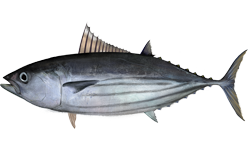 Skipjack TunaKatsuwonus pelamis
Compare
Questions and answers
What is the scientific name of the Atlantic Bonito?
The scientific name of the Atlantic Bonito is Sarda sarda. Written with its author, the full name is Sarda sarda (Bloch, 1793).
Which family does the Atlantic Bonito belong to?
Sarda sarda belongs to the family Scombridae, in the order Scombriformes and the class Teleostei.
Where is the Atlantic Bonito found?
Checklists and occurrence records place Sarda sarda in 43 countries, including United States, Spain, Croatia, France, Portugal and Nigeria.
What is the conservation status of the Atlantic Bonito?
The IUCN Red List category recorded for Sarda sarda is Least Concern (LC).
What other names does the Atlantic Bonito have?
Sarda sarda is also known in English as Belted Bonito, Boston Mackerel, Pelamid, Skipjack, Bloater and Bone Jack.
Sources
Passages the profile rests on
- The Atlantic bonito has a completely scaled body, with larger scales typically occurring around the pectoral fins and along the lateral line. Source passage: “Its body is completely scaled, with those scales in the pectoral fin area and the lateral line usually larger in size.” — English Wikipedia
- The Atlantic bonito has a compressed body and lacks teeth on the roof of its mouth. Source passage: “Bonitos (fishes in the genus Sarda) differ from tuna by their compressed bodies, their lack of teeth on the roof of the mouth, and certain differences in colouration.” — English Wikipedia
- The Atlantic bonito has dorsal fins positioned very close together or separated by only a narrow gap. Source passage: “Atlantic bonito belong to a group which have the dorsal fins very near, or separated by a narrow interspace.” — English Wikipedia
- The Atlantic bonito has dark oblique stripes on its back. Source passage: “The Atlantic bonito can be distinguished from its relative by its dark oblique stripes on the back” — English Wikipedia
- The Atlantic bonito can reach 75 centimetres in length. Source passage: “Atlantic bonito grow up to 75 centimetres (30 in)” — English Wikipedia
- Atlantic bonito weighing 5–6 kilograms are reported at a length of 75 centimetres. Source passage: “and weigh 5–6 kilograms (11–13 lb) at this size.” — English Wikipedia
- The recorded world-record Atlantic bonito weighed 8.3 kilograms. Source passage: “The world record, 18 pounds 4 ounces (8.3 kg), was caught in the Azores.” — English Wikipedia
- The Atlantic bonito occurs in shallow waters of the Atlantic Ocean, Mediterranean Sea, and Black Sea. Source passage: “It is common in shallow waters of the Atlantic Ocean, the Mediterranean Sea, and the Black Sea” — English Wikipedia
- The Atlantic bonito is commonly found offshore near New York City. Source passage: “is common offshore in the vicinity of New York City” — English Wikipedia
- The Atlantic bonito feeds on mackerel, menhaden, alewives, silversides, and sand lances. Source passage: “Atlantic bonito eat mackerel, menhaden, alewives, silversides, sand lances” — English Wikipedia
- The Atlantic bonito also consumes squid. Source passage: “and other fishes, as well as squid.” — English Wikipedia
- The Atlantic bonito is a ram ventilator and must swallow its prey whole. Source passage: “The Atlantic bonito is a ram ventilator, meaning it cannot bite. They must eat their pray whole.” — mass.gov
- The Atlantic bonito is a strong swimmer. Source passage: “It is a strong swimmer.” — English Wikipedia
- The Atlantic bonito normally travels in fairly large schools. Source passage: “Normally, it travels in fairly large schools” — English Wikipedia
- The Atlantic bonito is known to jump out of the water. Source passage: “where it is known as "skipjack" because of its habit of jumping from the water.” — English Wikipedia
- The Atlantic bonito spawning season is June. Source passage: “The spawning season is June” — English Wikipedia
- Atlantic bonito measuring 12–15 centimetres have been caught off Long Island in September. Source passage: “specimens 12–15 centimetres (4.7–5.9 in) long are taken in September off Long Island.” — English Wikipedia
- The Atlantic bonito is commercially fished and targeted as a game fish. Source passage: “where it is an important commercial and game fish.” — English Wikipedia
- Atlantic bonito are sometimes used as bait. Source passage: “it is sometimes used as bait.” — English Wikipedia
- Atlantic bonito is consumed as a food fish in the Mediterranean. Source passage: “Bonito is a popular food fish in the Mediterranean” — English Wikipedia
- Atlantic bonito can be canned for consumption. Source passage: “Bonito is also canned” — English Wikipedia
- Atlantic bonito is prepared as escabeche in Algeria and Spain. Source passage: “In Algeria and Spain, it is often prepared as escabeche” — English Wikipedia
Data
- Catalogue of Life, 2026-10-16 XR cc by
- Global Biodiversity Information Facility CC BY 4.0
- Wikidata CC0
- GeoNames CC BY 4.0
- Wikimedia Commons per image; credit shown with each image
- Within the Catalogue of Life, this name comes from World Register of Marine Species cc by
This species in other databases
- Catalogue of Life 79MK9
- Wikidata Q910363
- iNaturalist 56940
- WoRMS urn:lsid:marinespecies.org:taxname:127021
- ITIS 172409
Page built on 26 November 2026. See how the catalog is made and all sources and licences.
Cite this page
ScientificNames.org. (2026). Sarda sarda (Atlantic Bonito). Retrieved November 26, 2026, from https://scientificnames.org/species/sarda-sarda
“Sarda sarda (Atlantic Bonito).” ScientificNames.org, 2026, scientificnames.org/species/sarda-sarda. Accessed 26 Nov. 2026.
ScientificNames.org. “Sarda sarda (Atlantic Bonito).” Accessed November 26, 2026. https://scientificnames.org/species/sarda-sarda.
@misc{scientificnames_sarda_sarda_atlantic_bonito,
  author = {{ScientificNames.org}},
  title = {Sarda sarda (Atlantic Bonito)},
  year = {2026},
  url = {https://scientificnames.org/species/sarda-sarda},
  note = {Accessed 2026-11-26}
}