Species · Birds
White-tailed Stonechat Saxicola leucurus
The scientific name of the White-tailed Stonechat is Saxicola leucurus. It is a species of bird in the family Muscicapidae (old world flycatcher), order Passeriformes. The name dates from 1847.
- Scientific name
- Saxicola leucurus (Blyth, 1847)
- Common name
- White-tailed Stonechat
- Genus
- Saxicola
- Family
- Muscicapidae (Old World Flycatcher)
- Order
- Passeriformes
- Class
- Aves
- Red List category
- LC Least Concern
- Recorded in
- 6 countries
- Name status
- accepted in the Catalogue of Life

Overview
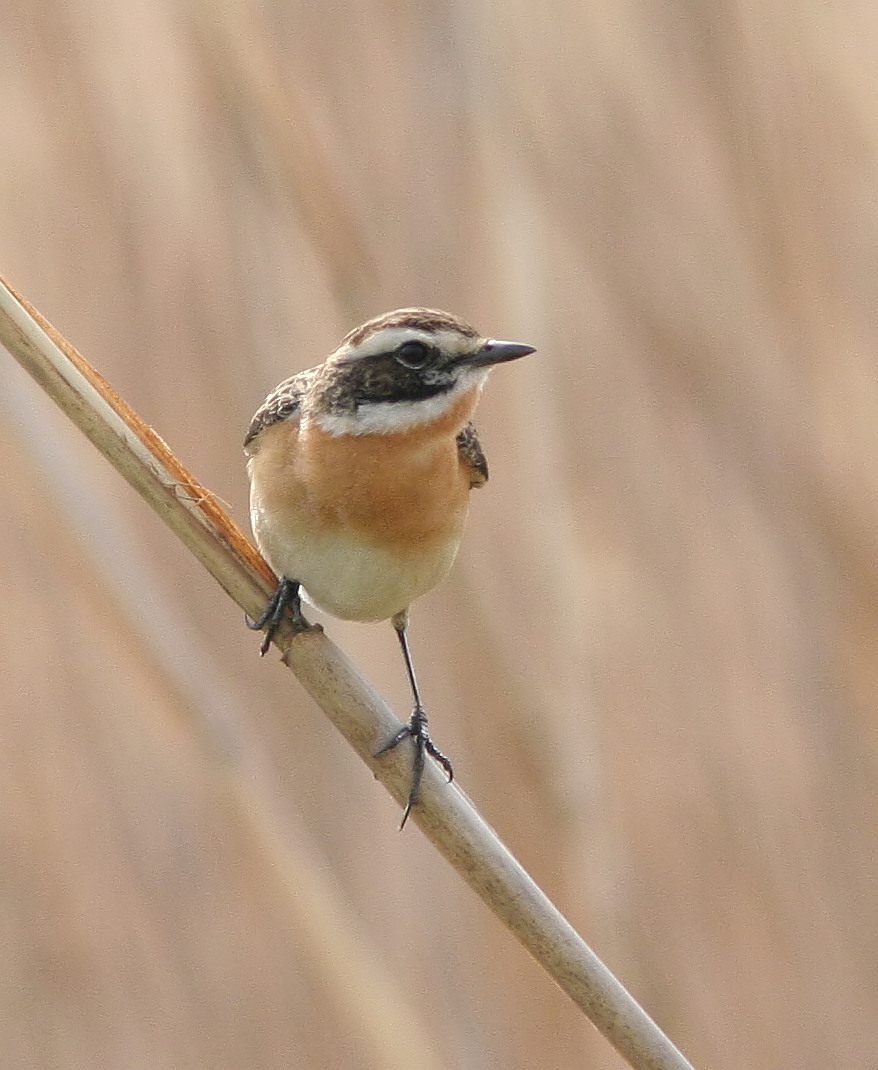
Saxicola leucurus occurs in the Indus River valley, southern Himalayan foothills, Terai–Duar savanna and grasslands, Bangladesh, South Assam Hills, Manipur, and Myanmar. The male has a black head, white collar, bright rufous chest patch, and white markings on its dark wings, back, and rump.
Written 27 November 2026 from the sources listed below. Each statement was checked against the passage it cites; statements that could not be supported were removed.
Appearance
The male has a black head, a white collar, and a bright rufous chest patch. Its back and wings are dark, with white markings on the wing coverts and rump.[1][2]
The outer tail feathers have white inner webs that become visible when the tail is spread. The tail feathers are white with black edges and tips.[3][4]
The female resembles the female European stonechat but has paler plumage and a duller rump, tail, and wings.[5]
Birds from the South Assam Hills are darker and have larger bills than other described populations. Birds from Pakistan have a more reddish chest patch.[6][7]
Habitat
The species inhabits low-lying wetlands containing reeds and tall grasses. It prefers grasslands and marshy areas containing tall grass, reeds, and tamarisk.[8][9]
It also uses farmland habitats in the Mardan and Bajaur districts of Pakistan.[10]
Behaviour
The species frequently flicks its tail to expose its white feathers. It catches prey by dropping to the ground or making short sallies from a perch.[11][12]
Individuals are generally observed in loose pairs and only rarely alone. The species undertakes local movements associated with water availability and possibly breeding.[13][14]
Reproduction and life cycle
The principal breeding season occurs from March through May. The species constructs cup-shaped nests in natural ground depressions among vegetation such as lotuses or tamarisk.[15][16]
A Pakistani breeding study monitored 53 nests, of which 44 were active. Nests in natural depressions had significantly larger clutch sizes and numbers of fledglings than nests at other sites.[17][18]
Nests with external diameters greater than 6 cm were associated with smaller clutches. Nests in Bajaur were generally smaller in outer and inner diameter and positioned lower than nests in Mardan.[19][20]
Overall breeding success did not differ significantly between the two studied Pakistani regions.[21]
Conservation
The species is classified as near-threatened. Its populations are declining because of habitat degradation, agricultural encroachment, and climate change.[22][23]
More than 90% of the species' Nepalese population occurs within protected areas. Unprotected habitat occupied by the species in Nepal has been substantially damaged, and the species is considered nationally threatened in Nepal.[24][25][26]
The species is considered rare and a vagrant in the India and Pakistan region.[27]
Similar species
The White-tailed Stonechat closely resembles the European stonechat in plumage. The female White-tailed Stonechat closely resembles the female European stonechat.[28][29]
The White-tailed Stonechat occurs alongside the Asian stonechat without interbreeding between the forms being indicated by plumage intergradation. The species is considered monotypic despite slight geographical variations in plumage.[30][31]
Classification of the White-tailed Stonechat
| Kingdom | Animalia |
|---|---|
| Phylum | Chordata |
| Subphylum | Vertebrata |
| Infraphylum | Gnathostomata |
| Parvphylum | Osteichthyes |
| Megaclass | Tetrapoda |
| Class | Aves (Bird) |
| Order | Passeriformes (Passerine) |
| Family | Muscicapidae (Old World Flycatcher) |
| Genus | Saxicola (Stonechats and Bush Chats) |
| Species | Saxicola leucurus (Blyth, 1847) |
Where the White-tailed Stonechat is found
Checklists and occurrence records place Saxicola leucurus in 6 countries. GBIF holds 3,703 georeferenced records of it.
Countries
Regions and cities with the most records
- Uttar Pradesh, India 478
- Bharatpur, Nepal 438
- New Delhi, India 390
- Dayal Pur, India 389
- Khajoori Khas, India 389
- Mandoli, India 389
- Mir Pur Turk, India 389
- Ziauddin Pur, India 389
- Delhi, India 388
- Dalūpura, India 385
- Chilla Soroda Bāngar, India 384
- Delhi Cantonment, India 384
- Gharonda Neemka Bangar, India 384
- Gharroli, India 382
- Kondli, India 382
- Sādatpur Gujran, India 371
- Assam, India 327
- Noida, India 304
- Kusum Pur, India 303
- Sultan Pur, India 300
- Malakpur Kohi Rangpur, India 299
- Saiyad-ul-ajaib, India 299
- Tighri, India 299
- Ali, India 298
- Chhatarpur, India 298
- Deoli, India 298
- Molārband, India 298
- Neb Sarai, India 298
- Pul Pehlad, India 298
- Taj Pul, India 298
- Mīthepur, India 296
- Jaitpur, India 295
- Dera Māndi, India 294
- Ghāziābād, India 294
- Tilpat, India 294
- Bhati, India 293
2 more countries have a few records outside this range
These countries hold a few records of Saxicola leucurus but lie outside the range the checklists give for it. Such records are often zoo or garden specimens, museum material or vagrants, so the species is not counted as occurring there.
A number beside a place is its count of GBIF occurrence records. A place without a number comes from a checklist alone. Records show where a species has been observed or collected, which can include escapes and vagrants.
Common names
English
- White-tailed Stonechat
Names in 30 other languages
- Azerbaijani
- Ağquyruq çəkçəki
- Bengali
- ধলালেজ শিলাফিদ্দা
- Bulgarian
- Белоопашато ливадарче
- Catalan
- bitxac cuablanc
- Chinese
- 白尾石䳭, 白尾石鵖
- Croatian
- močvarni batić
- Czech
- bramborníček běloocasý
- Danish
- Hvidhalet Bynkefugl
- Dutch
- Witstaartroodborsttapuit
- Esperanto
- Blankavosta saksikolo, blankvosta saksikolo
- Estonian
- suhkruroo-täks
- Finnish
- tamariskitasku
- French
- Tarier à queue blanche, Traquet à queue blanche
- German
- Weißschwanz-Schwarzkehlchen, Weißschwanzschmätzer, Weißschwanzschwarzkehlchen
- Hungarian
- fehérfarkú csuk
- Italian
- Saltimpalo codabianca, Sassicola codabianca
- Japanese
- オジロノビタキ
- Lithuanian
- baltauodegė kiauliukė
- Norwegian
- hvitstjertsvartstrupe
- Norwegian Bokmål
- hvithalesvartstrupe
- Persian
- چک دمسفید
- Polish
- kląskawka białosterna
- Portuguese
- cartaxo-de-cauda-branca, cartaxo-de-rabo-branco
- Russian
- Белохвостый чекан
- Serbian
- Belorepa travarka
- Slovak
- pŕhľaviar bielochvostý
- Spanish
- Tarabilla coliblanca, Tarabilla de Cola
- Swedish
- vitstjärtad buskskvätta
- Turkish
- Ak Kuyruklu Taşkuşu
- Ukrainian
- Трав'янка білохвоста, трав’янка білохвоста
Synonyms
4 other scientific names have been used for this species and are now treated as synonyms of Saxicola leucurus.
- Pratincola leucura Blyth, E, 1847
- Saxicola leucura (Blyth, 1847)
- Saxicola leucura Collar & Andrew (1988)
- Saxicola leucura Sibley & Monroe (1990, 1993)
Related species
-
 European StonechatSaxicola rubicola
-
 WhinchatSaxicola rubetra
-
 Siberian StonechatSaxicola maurus
-
 Pied Bush ChatSaxicola caprata
-
 African StonechatSaxicola torquatus
-
 Grey Bush ChatSaxicola ferreus
-
 Réunion StonechatSaxicola tectes
-
 Canary Islands StonechatSaxicola dacotiae
Compare
Questions and answers
What is the scientific name of the White-tailed Stonechat?
The scientific name of the White-tailed Stonechat is Saxicola leucurus. Written with its author, the full name is Saxicola leucurus (Blyth, 1847).
Which family does the White-tailed Stonechat belong to?
Saxicola leucurus belongs to the family Muscicapidae, in the order Passeriformes and the class Aves.
Where is the White-tailed Stonechat found?
Checklists and occurrence records place Saxicola leucurus in 6 countries: India, Nepal, Bangladesh, Myanmar, Pakistan and China.
What is the conservation status of the White-tailed Stonechat?
The IUCN Red List category recorded for Saxicola leucurus is Least Concern (LC).
How rare is a stonechat?
The White-tailed Stonechat is classified as near-threatened and is considered rare and a vagrant in the India and Pakistan region.[22][27]
Where do stonechat birds live?
The White-tailed Stonechat occurs in the Indus River valley, southern Himalayan foothills, Terai–Duar savanna and grasslands, Bangladesh, South Assam Hills, Manipur, and Myanmar. It inhabits low-lying wetlands, grasslands, and marshy areas containing tall grasses, reeds, and tamarisk.[32][8][9]
Sources
Passages the profile rests on
- The male has a black head, a white collar, and a bright rufous chest patch. Source passage: “The male has black head, white collar and bright rufous chest patch.” — English Wikipedia
- The male has dark back and wings with white markings on the wing coverts and rump. Source passage: “The back and wings are dark, with white on wing coverts and rump.” — English Wikipedia
- The male has white inner webs on the outer tail feathers, which become visible when the tail is spread. Source passage: “The key differentiating feature from male common stonechat is the white inner webs of outer tail feathers which is visible when the bird spreads the tail in flight or while landing.” — English Wikipedia
- The white-tailed stonechat has white tail feathers with black edges and tips. Source passage: “Flicks its tail often to reveal white feathers with black edges and tips.” — ebird.org
- The female resembles the female European stonechat but has paler plumage and duller rump, tail, and wings. Source passage: “The female is very similar to female european stonechat, but is overall paler with duller rump, tail and wings.” — English Wikipedia
- Birds from the South Assam Hills are darker and have larger bills than other described populations. Source passage: “birds from South Assam Hills (where the birds are darker and large billed)” — English Wikipedia
- Birds from Pakistan have a more reddish chest patch. Source passage: “Pakistan (where chest patch is more reddish).” — English Wikipedia
- The species inhabits low-lying wetlands containing reeds and tall grasses. Source passage: “An active little bird that inhabits reeds and tall grasses in low-lying wetlands.” — ebird.org
- The species prefers grasslands and marshy areas containing tall grass, reeds, and tamarisk. Source passage: “They prefer grasslands and marshy areas with tall grass, reeds and tamarisk.” — English Wikipedia
- The species uses farmland habitats in the Mardan and Bajaur districts of Pakistan. Source passage: “The breeding biology and nest site use of the white-tailed stonechat were studied in the primary farmland habitats of District Mardan and the farmland of mountaneous District Bajaur in Pakistan.” — pmc.ncbi.nlm.nih.gov
- The species frequently flicks its tail to expose its white feathers. Source passage: “Flicks its tail often to reveal white feathers with black edges and tips.” — ebird.org
- The species catches prey by dropping to the ground or making short sallies from a perch. Source passage: “Typical of stonechats, they catch their prey by dropping to ground or making short sallies from their perch.” — English Wikipedia
- Individuals are generally observed in loose pairs and only rarely alone. Source passage: “They are generally found in loose pairs, rarely in singles.” — English Wikipedia
- The species undertakes local movements associated with water availability and possibly breeding. Source passage: “They also undertake local movements, based on water availability and possibly for breeding.” — English Wikipedia
- The principal breeding season occurs from March through May. Source passage: “Key breeding season is Mar-May” — English Wikipedia
- The species constructs cup-shaped nests in natural ground depressions among vegetation such as lotuses or tamarisk. Source passage: “when it makes a cup shaped nest in natural depressions on the ground among plants like lotuses or tamarisk.” — English Wikipedia
- A Pakistani breeding study monitored 53 nests, of which 44 were active. Source passage: “A total of 53 (44 active) nests were monitored for clutch size, hatching and fledging success, and nest architecture.” — pmc.ncbi.nlm.nih.gov
- Nests in natural depressions had significantly larger clutch sizes and numbers of fledglings than nests at other sites. Source passage: “Clutch size and number of fledglings were significantly greater in nests that were in natural depression sites than those in other sites.” — pmc.ncbi.nlm.nih.gov
- Nests with external diameters greater than 6 cm were associated with smaller clutches. Source passage: “with smaller clutches found for nests with an external diameter greater than 6 cm.” — pmc.ncbi.nlm.nih.gov
- Nests in Bajaur were generally smaller in outer and inner diameter and positioned lower than nests in Mardan. Source passage: “nests in Bajaur generally being smaller in outer and inner diameter and placed lower to the ground compared to those in Mardan” — pmc.ncbi.nlm.nih.gov
- Overall breeding success did not differ significantly between the two studied Pakistani regions. Source passage: “overall breeding success was not significantly different.” — pmc.ncbi.nlm.nih.gov
- The species is classified as near-threatened. Source passage: “is a near-threatened, habitat-sensitive grassland passerine” — pmc.ncbi.nlm.nih.gov
- The species' populations are declining because of habitat degradation, agricultural encroachment, and climate change. Source passage: “where its populations are declining due to habitat degradation, agricultural encroachment, and climate change.” — pmc.ncbi.nlm.nih.gov
- More than 90% of the species' Nepalese population occurs within protected areas. Source passage: “In Nepal, more than 90% of its population occurs in protected areas” — pmc.ncbi.nlm.nih.gov
- Unprotected habitat occupied by the species in Nepal has been substantially damaged. Source passage: “the unprotected parts of its habitat have been substantially damaged” — pmc.ncbi.nlm.nih.gov
- The species is considered nationally threatened in Nepal. Source passage: “it is therefore considered threatened nationally.” — pmc.ncbi.nlm.nih.gov
- The species is considered rare and a vagrant in the India and Pakistan region. Source passage: “Although it is considered rare and a vagrant in the India and Pakistan region” — pmc.ncbi.nlm.nih.gov
- The white-tailed stonechat closely resembles the European stonechat in plumage. Source passage: “Very similar in plumage to european stonechat (Saxicola rubicola).” — English Wikipedia
- The female white-tailed stonechat closely resembles the female European stonechat. Source passage: “The female is very similar to female european stonechat” — English Wikipedia
- The white-tailed stonechat occurs alongside the Asian stonechat without interbreeding between the forms being indicated by plumage intergradation. Source passage: “Though sympatric with Asian stonechat in its range, they do not intergrade.” — English Wikipedia
- The species is considered monotypic despite slight geographical variations in plumage. Source passage: “Considered monotypic though there are slight variations in plumage” — English Wikipedia
- The species occurs in the Indus River valley, southern Himalayan foothills, Terai–Duar savanna and grasslands, Bangladesh, South Assam Hills, Manipur, and Myanmar. Source passage: “in the Indus River valley, southern Himalayan foothills, the Terai–Duar savanna and grasslands, Bangladesh, South Assam Hills, Manipur and Myanmar.” — English Wikipedia
Data
- Catalogue of Life, 2026-10-16 XR cc by
- Global Biodiversity Information Facility CC BY 4.0
- Wikidata CC0
- GeoNames CC BY 4.0
- Wikimedia Commons per image; credit shown with each image
- Within the Catalogue of Life, this name comes from The Integrated Taxonomic Information System cc0
This species in other databases
Page built on 28 November 2026. See how the catalog is made and all sources and licences.
Cite this page
ScientificNames.org. (2026). Saxicola leucurus (White-tailed Stonechat). Retrieved November 28, 2026, from https://scientificnames.org/species/saxicola-leucurus
“Saxicola leucurus (White-tailed Stonechat).” ScientificNames.org, 2026, scientificnames.org/species/saxicola-leucurus. Accessed 28 Nov. 2026.
ScientificNames.org. “Saxicola leucurus (White-tailed Stonechat).” Accessed November 28, 2026. https://scientificnames.org/species/saxicola-leucurus.
@misc{scientificnames_saxicola_leucurus_white_tailed_stonechat,
  author = {{ScientificNames.org}},
  title = {Saxicola leucurus (White-tailed Stonechat)},
  year = {2026},
  url = {https://scientificnames.org/species/saxicola-leucurus},
  note = {Accessed 2026-11-28}
}