Species · Amphibians
Maracaibo Basin Treefrog Scarthyla vigilans
The scientific name of the Maracaibo Basin Treefrog is Scarthyla vigilans. It is a species of amphibian in the family Hylidae (hylids), order Anura. The name dates from 1971.
- Scientific name
- Scarthyla vigilans (Solano, 1971)
- Common name
- Maracaibo Basin Treefrog
- Genus
- Scarthyla
- Family
- Hylidae (Hylids)
- Order
- Anura
- Class
- Amphibia
- Red List category
- LC Least Concern
- Recorded in
- 2 countries
- Name status
- accepted in the Catalogue of Life

Overview
The Maracaibo Basin Treefrog occurs in the Caribbean lowlands, Magdalena Valley, and eastern llanos of northern Colombia, and in the Maracaibo Basin, Falcón, Coastal Range, high Llanos, and Orinoco Delta of northern Venezuela. Its male advertisement call resembles a cricket chirp and has very low intensity.
Written 27 November 2026 from the sources listed below. Each statement was checked against the passage it cites; statements that could not be supported were removed.
Appearance
The Maracaibo Basin Treefrog has an elongate, slender body. Its head is as wide as the body and longer than it is wide, with a long, pointed snout and moderately large, protruding eyes.[1][2][3][4]
The tympanum is distinct but partly concealed by the supratympanic fold. The fingers and toes are slender and have small, round discs; the fingers lack webbing, whereas the toes are webbed.[5][6][7]
At night, the species is lime green with indistinct stripes and transparent ventral parts. Its coloration is more contrasting during the day.[8][9]
Males possess a single subgular vocal sac. Adults reach a maximum snout–vent length of 21 mm.[10][11]
The tadpoles have short, globular bodies and moderately long tails. They reach a maximum total length of 32 mm.[12][13]
Behaviour
The male advertisement call resembles a cricket chirp and can be mistaken for one. It has very low intensity.[14][15]
The quiet advertisement call can be masked by calls from other frogs. The species is described as very common but inconspicuous.[16][17]
Habitat
The Maracaibo Basin Treefrog inhabits open lowland environments, including flooded grasslands and degraded areas with low vegetation. It inhabits shallow standing water and has been recorded from dry and moist savannas.[18][19][20][21][22]
The species has a recorded maximum elevation of approximately 600 m above sea level. Most records come from elevations below this maximum.[23][24]
Reproduction and life cycle
Breeding occurs in standing water and swamps.[25]
Conservation
The species is adaptable and has no known threats. It occurs in some protected areas.[26][27]
Similar species
Adults of the Maracaibo Basin Treefrog closely resemble Scarthyla goinorum. The male advertisement call and tadpoles distinguish the two species.[28][29]
Molecular data confirm the close relationship of the Maracaibo Basin Treefrog with Scarthyla goinorum and its placement in the genus Scarthyla. The generic classification of the species has been controversial.[30][31]
Classification of the Maracaibo Basin Treefrog
| Kingdom | Animalia |
|---|---|
| Phylum | Chordata |
| Subphylum | Vertebrata |
| Infraphylum | Gnathostomata |
| Parvphylum | Osteichthyes |
| Megaclass | Tetrapoda |
| Class | Amphibia (Amphibians) |
| Order | Anura (Frogs) |
| Family | Hylidae (Hylids) |
| Genus | Scarthyla (Madre de Dios Tree Frogs) |
| Species | Scarthyla vigilans (Solano, 1971) |
Where the Maracaibo Basin Treefrog is found
Checklists and occurrence records place Scarthyla vigilans in 2 countries. GBIF holds 3,607 georeferenced records of it.
Countries
Regions and cities with the most records
- Antioquia, Colombia 2,214
- Apartadó, Colombia 2,108
- Turbo, Colombia 1,593
- Carepa, Colombia 686
- Santander Department, Colombia 434
- Puerto Wilches, Colombia 336
- Cesar Department, Colombia 230
- La Jagua de Ibirico, Colombia 152
- Córdoba, Colombia 127
- Becerril, Colombia 111
- Magdalena Department, Colombia 108
- Bolívar, Colombia 79
- Arauca Department, Colombia 68
- Caldas Department, Colombia 59
- Sucre Department, Colombia 54
- Barrancabermeja, Colombia 51
- La Dorada, Colombia 51
- Puerto Salgar, Colombia 51
- La Guajira Department, Colombia 44
- Boyacá, Colombia 40
- María la Baja, Colombia 40
- San Pablo, Colombia 40
- Ayapel, Colombia 39
- Montería, Colombia 39
- Yondó, Colombia 39
- Puerto Boyacá, Colombia 38
- El Banco, Colombia 37
- Albania, Colombia 36
- Honda, Colombia 34
- Nechí, Colombia 30
- San Marcos, Colombia 30
- Hatonuevo, Colombia 28
- Fundación, Colombia 22
- San Jacinto, Colombia 20
- San Juan Nepomuceno, Colombia 20
- Puerto Triunfo, Colombia 18
1 more country has a few records outside this range
These countries hold a few records of Scarthyla vigilans but lie outside the range the checklists give for it. Such records are often zoo or garden specimens, museum material or vagrants, so the species is not counted as occurring there.
A number beside a place is its count of GBIF occurrence records. A place without a number comes from a checklist alone. Records show where a species has been observed or collected, which can include escapes and vagrants.
Common names
English
- Maracaibo Basin Treefrog
Names in 3 other languages
- Czech
- rosnička maracaibská
- Russian
- Венесуэльская квакша
- Spanish
- Ranita Vigilante
Synonyms
3 other scientific names have been used for this species and are now treated as synonyms of Scarthyla vigilans.
- Hyla squalirostris Cochran and Goin, 1970
- Hyla vigilans Solano, 1971
- Pseudis vigilans Lynch & Suárez-Mayorga, 2011
Related species
- Slender Tree FrogScarthyla goinorum
-
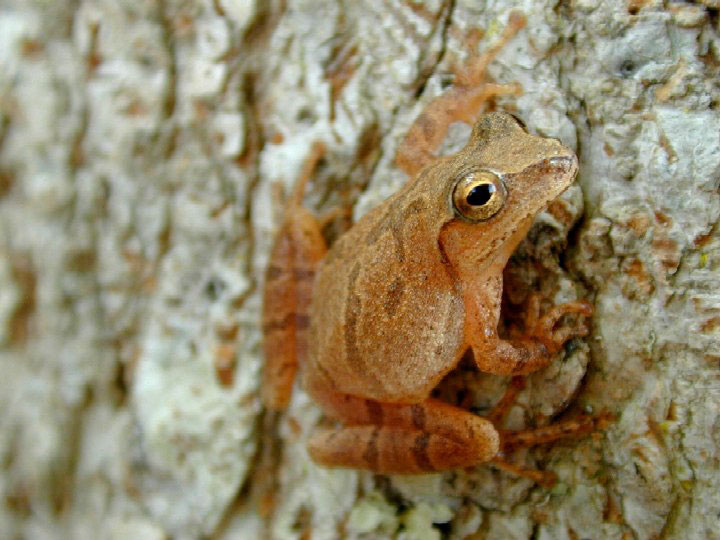 Spring PeeperPseudacris crucifer
-
 Cuban Tree FrogOsteopilus septentrionalis
-
 Pacific Tree FrogPseudacris regilla
-
 Rabbs' Fringe-limbed TreefrogEcnomiohyla rabborum
- European Tree FrogHyla arborea
-
 Mission Golden-eyed Tree FrogTrachycephalus resinifictrix
-
 Paradoxical FrogPseudis paradoxa
Compare
Questions and answers
What is the scientific name of the Maracaibo Basin Treefrog?
The scientific name of the Maracaibo Basin Treefrog is Scarthyla vigilans. Written with its author, the full name is Scarthyla vigilans (Solano, 1971).
Which family does the Maracaibo Basin Treefrog belong to?
Scarthyla vigilans belongs to the family Hylidae, in the order Anura and the class Amphibia.
Where is the Maracaibo Basin Treefrog found?
Checklists and occurrence records place Scarthyla vigilans in 2 countries: Colombia and Venezuela.
What is the conservation status of the Maracaibo Basin Treefrog?
The IUCN Red List category recorded for Scarthyla vigilans is Least Concern (LC).
Sources
Passages the profile rests on
- The species has an elongate, slender body. Source passage: “The body is elongate and slender.” — English Wikipedia
- The head is as wide as the body and longer than it is wide. Source passage: “The head is as wide as the body and longer than it is wide.” — English Wikipedia
- The species has a long, pointed snout. Source passage: “The snout is long and acuminate.” — English Wikipedia
- The eyes are moderately large and protruding. Source passage: “The eyes are moderately large and protuberant.” — English Wikipedia
- The tympanum is distinct but partly concealed by the supratympanic fold. Source passage: “The tympanum is distinct although partly obscured by the diffuse supratympanic fold.” — English Wikipedia
- The fingers and toes are slender and have small, round discs. Source passage: “The fingers and toes are slender and bear small round discs.” — English Wikipedia
- The fingers lack webbing, whereas the toes are webbed. Source passage: “The fingers lack webbing while the toes are webbed.” — English Wikipedia
- At night, the species is lime green with indistinct stripes and transparent ventral parts. Source passage: “Night-time coloration is lime green with indistinct stripes; the ventral parts are transparent.” — English Wikipedia
- The species has more contrasting coloration during the day than at night. Source passage: “During the day, the coloration is more contrasting.” — English Wikipedia
- Males possess a single subgular vocal sac. Source passage: “Males have a single subgular vocal sac.” — English Wikipedia
- Adults reach a maximum snout–vent length of 21 mm. Source passage: “with a maximum size of 21 mm (0.8 in) in snout–vent length.” — English Wikipedia
- The tadpoles reach a maximum total length of 32 mm. Source passage: “The maximum total length is 32 mm (1.3 in).” — English Wikipedia
- The tadpoles have short, globular bodies and moderately long tails. Source passage: “The tadpoles have short, globular body and moderately long tail.” — English Wikipedia
- The male advertisement call resembles a cricket chirp and can be mistaken for one. Source passage: “The male advertisement call resembles a cricket chirp (and can be mistaken as such)” — English Wikipedia
- The male advertisement call has very low intensity. Source passage: “and has very low intensity.” — English Wikipedia
- The species is described as very common but inconspicuous. Source passage: “It is a very common but nocturnal, small, and inconspicuous species.” — English Wikipedia
- The species' quiet advertisement call can be masked by calls from other frogs. Source passage: “The call is relatively low and easily masked by other calling frogs.” — English Wikipedia
- The species inhabits open lowland environments. Source passage: “Scarthyla vigilans occurs in open environments of lowlands” — English Wikipedia
- The species occurs in flooded grasslands. Source passage: “including flooded grasslands” — English Wikipedia
- The species occurs in degraded areas with low vegetation. Source passage: “degraded areas with low vegetation” — English Wikipedia
- The species inhabits shallow standing water. Source passage: “and shallow standing water.” — English Wikipedia
- The species has been recorded from dry and moist savannas. Source passage: “Its natural habitats are dry savanna, moist savanna” — inaturalist.org
- The species has a recorded maximum elevation of approximately 600 m above sea level. Source passage: “Its maximum altitude is about 600 m (2,000 ft) above sea level” — English Wikipedia
- Most records of the species come from elevations below its recorded maximum of approximately 600 m. Source passage: “although most records are from lower elevations.” — English Wikipedia
- Breeding occurs in standing water and swamps. Source passage: “Breeding takes place in standing water and swamps.” — English Wikipedia
- The species is adaptable and has no known threats. Source passage: “It is adaptable and not facing any known threats.” — English Wikipedia
- The species occurs in some protected areas. Source passage: “It is present in some protected areas.” — English Wikipedia
- Adults of this species closely resemble Scarthyla goinorum. Source passage: “Indeed, adults are very similar to Scarthyla goinorum” — English Wikipedia
- The male advertisement call and tadpoles distinguish this species from Scarthyla goinorum. Source passage: “however, the male advertisement call and tadpoles are clearly distinct.” — English Wikipedia
- Molecular data confirm the close relationship of this species with Scarthyla goinorum and its placement in the genus Scarthyla. Source passage: “molecular data have now confirmed its close relationship with Scarthyla goinorum and placement in that genus.” — English Wikipedia
- The generic classification of this species has been controversial. Source passage: “Although generic allocation of this species has been controversial” — English Wikipedia
Data
- Catalogue of Life, 2026-10-16 XR cc by
- Global Biodiversity Information Facility CC BY 4.0
- Wikidata CC0
- GeoNames CC BY 4.0
- Wikimedia Commons per image; credit shown with each image
- Within the Catalogue of Life, this name comes from The Integrated Taxonomic Information System cc0
References
- Barrio-Amorós, C. L., Pascual, A. D. D., Mueses-Cisneros, J. J., & Chacón, E. I. A. (2006). Hyla vigilans Solano, 1971, a second species for the genus Scarthyla, redescription and distribution in Venezuela and Colombia. Zootaxa, 1349, 1–18. https://doi.org/10.5281/zenodo.174503 Link where the name was published
This species in other databases
Page built on 29 November 2026. See how the catalog is made and all sources and licences.
Cite this page
ScientificNames.org. (2026). Scarthyla vigilans (Maracaibo Basin Treefrog). Retrieved November 29, 2026, from https://scientificnames.org/species/scarthyla-vigilans
“Scarthyla vigilans (Maracaibo Basin Treefrog).” ScientificNames.org, 2026, scientificnames.org/species/scarthyla-vigilans. Accessed 29 Nov. 2026.
ScientificNames.org. “Scarthyla vigilans (Maracaibo Basin Treefrog).” Accessed November 29, 2026. https://scientificnames.org/species/scarthyla-vigilans.
@misc{scientificnames_scarthyla_vigilans_maracaibo_basin_treefrog,
  author = {{ScientificNames.org}},
  title = {Scarthyla vigilans (Maracaibo Basin Treefrog)},
  year = {2026},
  url = {https://scientificnames.org/species/scarthyla-vigilans},
  note = {Accessed 2026-11-29}
}