Species · Fishes
Blue-barred Parrotfish Scarus ghobban
The scientific name of the Blue-barred Parrotfish is Scarus ghobban. It is a species of fish in the family Labridae (wrasse), order Perciformes. The name dates from 1775.
- Scientific name
- Scarus ghobban Forsskål, 1775
- Common name
- Blue-barred Parrotfish
- Genus
- Scarus
- Family
- Labridae (Wrasse)
- Order
- Perciformes
- Class
- Teleostei
- Red List category
- LC Least Concern
- Environment
- brackish, marine
- Recorded in
- 63 countries
- Name status
- accepted in the Catalogue of Life

Overview
Scarus ghobban occurs widely throughout the Indo-Pacific, from East Africa to Indonesia, and also occurs in the Eastern Pacific, including the Galápagos Islands. It has a blue-green to green body coloration and fused teeth forming a beak of two broad joined plates on each jaw.
Written 26 November 2026 from the sources listed below. Each statement was checked against the passage it cites; statements that could not be supported were removed.
Appearance
The body is moderately deep and compressed, with blue-green to green coloration. The underside may be pinkish or yellowish, and blue markings may occur around the pectoral fin.[1][2][3][4]
The teeth are fused into a beak consisting of two broad joined plates on each jaw. Their outer surfaces are smooth and uncovered by lips, and the upper jaw has one or two canines on its rear side.[5][6][7]
The pectoral fin has 15 rays, of which 13–14 are branched. The vertical fins are orange-yellow and may have a pink central stripe on the dorsal and anal fins.[8][9][10]
The cheek has three rows of large, smooth scales. The upper two rows usually contain six scales each, while the lower row usually contains two; six scales occur along the center of the nape before the dorsal fin.[11][12][13]
The lateral line is divided into two sections. The tail fin is slightly concave in small individuals and strongly concave in terminal males.[14][15]
Initial-phase individuals are generally yellowish to yellowish green and have five irregular blue to whitish bars on their sides. Terminal-phase males have blue-green backs with salmon-pink scale edges and predominantly salmon-pink lower sides with green scale margins.[16][17][18]
Terminal-phase males have a pair of blue bands on the chin. Juveniles are pale with a yellowish hue and may have either three dark body stripes or five narrow blue-white spotted bars.[19][20]
The species commonly reaches approximately 46 cm in length.[21]
Habitat
The species occurs in areas with sandy bottoms and seagrass and inhabits marginal reefs and deeper waters. It is usually observed on shallow reefs and nearby sand-rubble areas.[22][23][24]
Behaviour
The species tends to gather in small schools. It can rotate its mandible bone at high velocity, enabling it to act as a scraper and facilitate the hydrological transport of fine sediments.[25][26][27]
Reproduction and life cycle
Females reproduce by releasing eggs into the water current. The eggs hatch approximately 25 hours after fertilization.[28][29]
Young fish mature quickly after hatching and do not need to remain near their parents for long. The species grows quickly and can live for up to 13 years.[30][31][32][33]
Conservation
The species is captured in large numbers by fishermen for consumption and sale and experiences substantial bycatch from other fisheries. It is not particularly targeted by fisheries and was described as apparently not threatened at the time of the source.[34][35][36]
Continued coral reef degradation is identified as a likely threat to the species.[37]
Classification of the Blue-barred Parrotfish
| Kingdom | Animalia |
|---|---|
| Phylum | Chordata |
| Subphylum | Vertebrata |
| Infraphylum | Gnathostomata |
| Parvphylum | Osteichthyes |
| Gigaclass | Actinopterygii |
| Superclass | Actinopteri |
| Class | Teleostei (Teleost) |
| Order | Perciformes |
| Family | Labridae (Wrasse) |
| Subfamily | Scarinae |
| Tribe | Scarini |
| Genus | Scarus (Parrotfishes) |
| Species | Scarus ghobban Forsskål, 1775 |
Where the Blue-barred Parrotfish is found
Checklists and occurrence records place Scarus ghobban in 63 countries. GBIF holds 16,314 georeferenced records of it.
Countries
- American Samoa 8
- Australia 5,276
- Bahrain 4
- British Indian Ocean Territory 13
- Cambodia 4
- China 82
- Christmas Island 4
- Colombia 1,260
- Cook Islands 27
- Costa Rica 85
- Ecuador 2,577
- Egypt 70
- Eritrea 3
- Fiji 153
- French Polynesia 259
- Guam 26
- Hong Kong 26
- India 58
- Indonesia 226
- Iran 10
- Israel 37
- Japan 296
- Kenya 57
- Kiribati 91
- Lebanon 12
- Madagascar 58
- Malaysia 72
- Maldives 38
- Marshall Islands 20
- Mauritius 29
- Mayotte 25
- Mexico 445
- Micronesia 70
- Mozambique 2,476
- New Caledonia 556
- Norfolk Island 19
- Northern Mariana Islands 35
- Oman 12
- Palau 53
- Panama 352
- Papua New Guinea 13
- Philippines 107
- Reunion 39
- Samoa 26
- Saudi Arabia 17
- Seychelles 62
- Singapore 13
- Solomon Islands 66
- South Africa 46
- Sri Lanka 23
- Syria 4
- Taiwan 110
- Tanzania 34
- Thailand 240
- Tonga 308
- Turkey 25
- Tuvalu 19
- United Arab Emirates 15
- United States Minor Outlying Islands 100
- Vanuatu 35
- Vietnam 16
- Wallis and Futuna 65
- Yemen 7
Regions and cities with the most records
- Vilankulo, Mozambique 675
- Galápagos, Ecuador 341
- Nouméa, New Caledonia 248
- Inhambane, Mozambique 240
- Maxixe, Mozambique 233
- Mont-Dore, New Caledonia 157
- Dumbéa, New Caledonia 148
- Queensland, Australia 100
- Nuku‘alofa, Tonga 89
- Western Australia, Australia 88
- New South Wales, Australia 83
- Sydney, Australia 70
- Mata-Utu, Wallis and Futuna 62
- Veraguas Province, Panama 50
- Crucecita, Mexico 40
- Surat Thani, Thailand 38
- Baja California Sur, Mexico 35
- La Paz, Mexico 31
- Vavau, Tonga 31
- Townsville, Australia 28
- Cabo San Lucas, Mexico 26
- Colonia del Sol, Mexico 26
- Choi Wan, Hong Kong 24
- Choi Wan Estate (I & II), Hong Kong 24
- Hang Hau, Hong Kong 24
- LOHAS Park, Hong Kong 24
- Labasa, Fiji 24
- Lam Tin, Hong Kong 24
- Piton Saint-Leu, Reunion 24
- Sai Kung, Hong Kong 24
- Saint-Leu, Reunion 24
- Sau Mau Ping, Hong Kong 24
- Tseung Kwan O, Hong Kong 24
- Aldrich Bay, Hong Kong 23
- Choi Hung Estate, Hong Kong 23
- Heng Fa Chuen, Hong Kong 23
3 more countries have a few records outside this range
These countries hold a few records of Scarus ghobban but lie outside the range the checklists give for it. Such records are often zoo or garden specimens, museum material or vagrants, so the species is not counted as occurring there.
A number beside a place is its count of GBIF occurrence records. A place without a number comes from a checklist alone. Records show where a species has been observed or collected, which can include escapes and vagrants.
Common names
English
- Blue-barred Parrotfish
- Blue Trim Parrotfish
- Blue-barred Orange Parrot-fish
- Blue-barred Orange Parrotfish
- Cream Parrotfish
- Flame-breasted Parrot-fish
- Globe-headed Parrotfish
- Green Blotched Parrotfish
- Yellow Scale Parrotfish
- Bluechin Parrotfish
- Flame Parrotfish
Names in 24 other languages
- Arabic
- Gen, Humara, سمكة الببغاء البرتقالية زرقاء الخطوط
- Catalan
- Peix lloro de Forsskål
- Cebuano
- Aliyakyak, Bungalog, Buyos
- Chinese
- 紅蠔魚(雌), 紅衫, 藍紋鸚哥魚, 藍點鸚哥魚, 青点鹦嘴鱼, 青衫(雄), 青點鸚嘴魚, 鸚哥
- Czech
- ploskozubec modropruhý
- Danish
- Blåbåndet papegøjefisk
- Dutch
- Blauwbandpapegaaivis
- Finnish
- turkoosipapukaijakala
- French
- Kakatoi Blanc, Perroquet, Perroquet Barbe Bleue, Perroquet Crème, Perroquet Souris, Perroquet à Bord Bleu, Perroquet à Ecailles Jaunes, Perroquet à bandes bleues
- German
- Blauband-Papageifisch
- Hebrew
- תוכינון, תוכינון האוכפים
- Italian
- Pesce pappagallo fasce azzurre
- Japanese
- Hibudai, ヒブダイ
- Malay
- Kalat, Ketarap, Perencong
- Portuguese
- Nyabugui Senene, Papagaio, Papagaio de Escamas Amarelas, Peixe-papagaio-de-manchas-azuis, Thukwani
- Russian
- Скар-попугай
- Spanish
- Loro, Loro Barba Azul, Loro de Escamas Amarillas, Loro perico, loro barbazul
- Swahili
- Pono
- Tagalog
- Luro, Lutiin
- Thai
- ปลานกแก้วสีเพลิง
- Turkish
- Papağan Balığı
- bik
- Bunog na angol
- sgd
- Batagon
- tbk
- Malunaw
Synonyms
33 other scientific names have been used for this species and are now treated as synonyms of Scarus ghobban.
- Callyodon apridentatus Smith, 1956
- Callyodon dussumieri (Valenciennes, 1840)
- Callyodon fuscocuneus Fowler, 1935
- Callyodon ghobban (Forsskål, 1775)
- Callyodon guttatus (Bloch & Schneider, 1801)
- Callyodon pyrrostethus (Richardson, 1846)
- Callyodon speigleri Smith, 1956
- Hemistoma reticulata (Swainson, 1839)
- Julis cantori Bleeker, 1861
- Pseudoscarus californiensis Pellegrin, 1901
- Pseudoscarus cantori Bleeker, 1861
- Pseudoscarus flavipinnis De Vis, 1885
- Pseudoscarus garretti Günther, 1909
- Pseudoscarus natalensis Gilchrist & Thompson, 1909
- Pseudoscarus nudirostris Alleyne & MacLeay, 1877
- Pseudoscarus papuensis MacLeay, 1883
- Scarus apridentatus Smith
- Scarus azureus Meek & Hildebrand, 1928
- Scarus dussumieri Valenciennes, 1840
- Scarus fehlmanni Schultz, 1969
- Scarus ghoban Forsskål, 1775
- Scarus guttatus Bloch & Schneider, 1801
- Scarus haridoides Bleeker, 1855
- Scarus lacerta Valenciennes, 1840
- Scarus maculosus Lacepède, 1802
- Scarus magrathii Bennett, 1841
- Scarus noyesi Heller & Snodgrass, 1903
- Scarus pepo Bennett, 1830
- Scarus pyrrostethus Richardson, 1846
- Scarus pyrrostethus australianus Paradice, 1927
- Scarus reticulata Swainson, 1839
- Scarus scabriusculus Valenciennes, 1840
- Scarus toshi Whitley, 1933
Related species
-
 Blue ParrotfishScarus coeruleus
- Black ParrotfishScarus niger
-
 Rainbow ParrotfishScarus guacamaia
-
 Queen ParrotfishScarus vetula
-
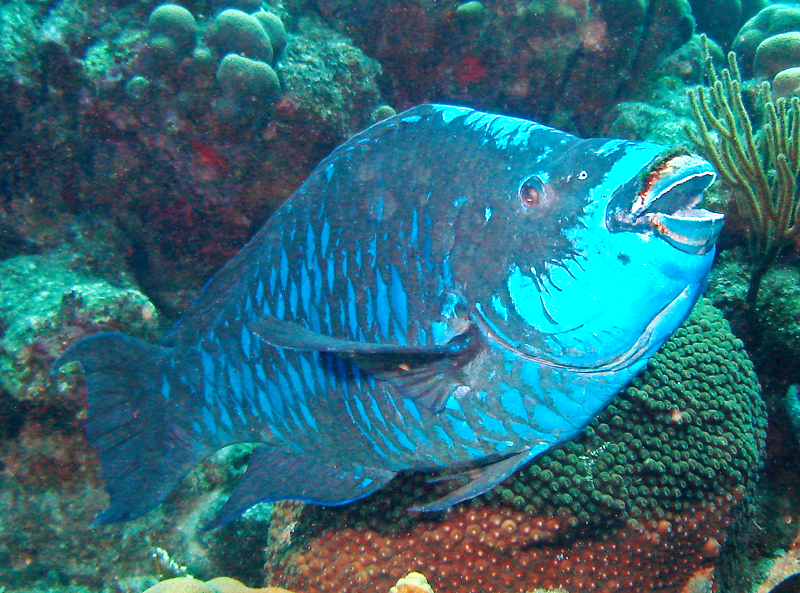 Midnight ParrotfishScarus coelestinus
-
 Princess ParrotfishScarus taeniopterus
-
 Common ParrotfishScarus psittacus
-
 Rusty ParrotfishScarus ferrugineus
Compare
Questions and answers
What is the scientific name of the Blue-barred Parrotfish?
The scientific name of the Blue-barred Parrotfish is Scarus ghobban. Written with its author, the full name is Scarus ghobban Forsskål, 1775.
Which family does the Blue-barred Parrotfish belong to?
Scarus ghobban belongs to the family Labridae, in the order Perciformes and the class Teleostei.
Where is the Blue-barred Parrotfish found?
Checklists and occurrence records place Scarus ghobban in 63 countries, including Australia, Ecuador, Mozambique, Colombia, New Caledonia and Mexico.
What is the conservation status of the Blue-barred Parrotfish?
The IUCN Red List category recorded for Scarus ghobban is Least Concern (LC).
What other names does the Blue-barred Parrotfish have?
Scarus ghobban is also known in English as Blue Trim Parrotfish, Blue-barred Orange Parrot-fish, Blue-barred Orange Parrotfish, Cream Parrotfish, Flame-breasted Parrot-fish and Globe-headed Parrotfish.
What is the habitat of a parrotfish?
The blue-barred parrotfish occurs in areas with sandy bottoms and seagrass, marginal reefs, deeper waters, shallow reefs, and nearby sand-rubble areas.[22][23][24]
Is a blue parrot fish good to eat?
The species is captured by fishermen for consumption and sale.[34]
Sources
Passages the profile rests on
- The species has a blue-green to green body coloration. Source passage: “This species is blue-green to green in colour” — English Wikipedia
- The underside of the body may be pinkish or yellowish. Source passage: “The underside of the body may be pinkish or yellowish.” — English Wikipedia
- Blue markings may occur around the pectoral fin. Source passage: “There may be blue markings around the area of the pectoral fin.” — English Wikipedia
- The body is moderately deep and compressed. Source passage: “Body moderately deep, compressed;” — biogeodb.stri.si.edu
- The teeth are fused into a beak consisting of two broad joined plates on each jaw. Source passage: “teeth fused into a beak with two broad joined plates on each jaw” — biogeodb.stri.si.edu
- The outer surfaces of the jaw plates are smooth and uncovered by lips. Source passage: “outer surface of plates smooth, not covered by lips;” — biogeodb.stri.si.edu
- The upper jaw has one or two canines on its rear side. Source passage: “1-2 canines on rear side of top jaw;” — biogeodb.stri.si.edu
- The species may have a pink central stripe on its dorsal and anal fins. Source passage: “It may have a central stripe on the dorsal and anal fins that is pink in color.” — English Wikipedia
- The pectoral fin has 15 rays, of which 13–14 are branched. Source passage: “pectoral rays 15, 13-14 branched;” — biogeodb.stri.si.edu
- The vertical fins are orange-yellow. Source passage: “vertical fins orange-yellow.” — biogeodb.stri.si.edu
- The cheek has three rows of large, smooth scales. Source passage: “scales large, smooth, 3 rows on cheek,” — biogeodb.stri.si.edu
- The upper two cheek scale rows usually contain six scales each, while the lower row usually contains two. Source passage: “upper 2 rows with 5-7 (usually 6) scales, lower row 2-3 (usually 2) scales;” — biogeodb.stri.si.edu
- Six scales occur along the center of the nape before the dorsal fin. Source passage: “6 scales on center of nape before dorsal fin;” — biogeodb.stri.si.edu
- The tail fin is slightly concave in small individuals and strongly concave in terminal males. Source passage: “tail fin slightly concave in small fish, strongly concave in terminal males;” — biogeodb.stri.si.edu
- The lateral line is divided into two sections. Source passage: “lateral line in 2 sections.” — biogeodb.stri.si.edu
- Initial-phase individuals are generally yellowish to yellowish green and have five irregular blue to whitish bars on their sides. Source passage: “IP: overall yellowish to yellowish green with five irregular scale blue to whitish bars on side;” — biogeodb.stri.si.edu
- Terminal-phase males have blue-green backs with salmon-pink scale edges. Source passage: “TP: males blue greenish on back with salmon-pink scale edges,” — biogeodb.stri.si.edu
- Terminal-phase males have predominantly salmon-pink lower sides with green scale margins. Source passage: “lower side largely salmon pink with green scale margins;” — biogeodb.stri.si.edu
- Terminal-phase males have a pair of blue bands on the chin. Source passage: “a pair of blue bands on chin;” — biogeodb.stri.si.edu
- Juveniles are pale with a yellowish hue and may have either three dark body stripes or five narrow blue-white spotted bars. Source passage: “juveniles pale with yellowish hue, either striped (3 dark stripes along body) or barred (5 narrow blue-white spotted bars);” — biogeodb.stri.si.edu
- The species commonly reaches approximately 46 cm in length. Source passage: “commonly grows to approximately 46 cm.” — English Wikipedia
- The species occurs in areas with sandy bottoms and seagrass. Source passage: “Scarus ghobban occurs in places with sandy bottoms and in areas with seagrass.” — English Wikipedia
- The species inhabits marginal reefs and deeper waters. Source passage: “It is also known to live in marginal reefs and in deeper waters.” — English Wikipedia
- The species is usually observed on shallow reefs and nearby sand-rubble areas. Source passage: “Habitat: usually seen on shallow reefs and adjacent sand-rubble areas.” — biogeodb.stri.si.edu
- The species tends to gather in small schools. Source passage: “It tends to congregate in small schools.” — English Wikipedia
- The species can rotate its mandible bone at high velocity. Source passage: “Scarus ghobban can rotate their mandible bone at a high velocity;” — English Wikipedia
- Rapid mandible rotation enables the species to act as a scraper and facilitate the hydrological transport of fine sediments. Source passage: “this allows them to function as a scraper and facilitate hydrological transport of fine sediments.” — English Wikipedia
- Females reproduce by releasing eggs into the water current. Source passage: “The way Scarus ghobban reproduces is by the female laying eggs into the current of the water.” — English Wikipedia
- The eggs hatch approximately 25 hours after fertilization. Source passage: “After about 25 hours after the egg has been fertilized, it will hatch.” — English Wikipedia
- Young fish mature quickly after hatching. Source passage: “After birth, the parrotfish will mature quickly” — English Wikipedia
- Young fish do not need to remain near their parents for long. Source passage: “will not have to be near its parents for much time.” — English Wikipedia
- The species can live for up to 13 years. Source passage: “can live up to 13 years.” — English Wikipedia
- The species grows quickly. Source passage: “Scarus ghobban grows quickly” — English Wikipedia
- The species is captured in large numbers by fishermen for consumption and sale. Source passage: “the species is captured in large numbers by fishermen for consumption and sale,” — English Wikipedia
- The species experiences substantial bycatch from other fisheries. Source passage: “there is also a high amount of bycatch from other fisheries,” — English Wikipedia
- The species is not particularly targeted by fisheries and was described as apparently not threatened at the time of the source. Source passage: “it is not particularly targeted and appears not to be threatened at this point.” — English Wikipedia
- Continued coral reef degradation is identified as a likely threat to the species. Source passage: “is likely to suffer from the continued degradation of those reefs.” — English Wikipedia
Data
- Catalogue of Life, 2026-10-16 XR cc by
- Global Biodiversity Information Facility CC BY 4.0
- Wikidata CC0
- GeoNames CC BY 4.0
- Wikimedia Commons per image; credit shown with each image
- Within the Catalogue of Life, this name comes from World Register of Marine Species cc by
References
- Forskål P. (1775). Descriptiones Animalium, Avium, Amphibiorum, Piscium, Insectorum, Vermium; quae in Itinere Orientali Observavit Petrus Forskål. Post Mortem Auctoris editit Carsten Niebuhr. Adjuncta est materia Medica Kahirina. Mölleri, Hafniae, 19 + xxxiv + 164 pp. Post Mortem Auctoris Edidit Carsten Niebuhr. Hauniae., Moller, Copenhagen, xxxiv + 140 pp. https://doi.org/10.5962/bhl.title.2154 Link where the name was published
This species in other databases
- Catalogue of Life 79VXT
- Wikidata Q2076448
- iNaturalist 84175
- WoRMS urn:lsid:marinespecies.org:taxname:219127
- ITIS 170846
Page built on 28 November 2026. See how the catalog is made and all sources and licences.
Cite this page
ScientificNames.org. (2026). Scarus ghobban (Blue-barred Parrotfish). Retrieved November 28, 2026, from https://scientificnames.org/species/scarus-ghobban
“Scarus ghobban (Blue-barred Parrotfish).” ScientificNames.org, 2026, scientificnames.org/species/scarus-ghobban. Accessed 28 Nov. 2026.
ScientificNames.org. “Scarus ghobban (Blue-barred Parrotfish).” Accessed November 28, 2026. https://scientificnames.org/species/scarus-ghobban.
@misc{scientificnames_scarus_ghobban_blue_barred_parrotfish,
  author = {{ScientificNames.org}},
  title = {Scarus ghobban (Blue-barred Parrotfish)},
  year = {2026},
  url = {https://scientificnames.org/species/scarus-ghobban},
  note = {Accessed 2026-11-28}
}