Species · Fishes
Queen Parrotfish Scarus vetula
The scientific name of the Queen Parrotfish is Scarus vetula. It is a species of fish in the family Labridae (wrasse), order Perciformes. The name dates from 1801.
- Scientific name
- Scarus vetula Bloch & Schneider, 1801
- Common name
- Queen Parrotfish
- Genus
- Scarus
- Family
- Labridae (Wrasse)
- Order
- Perciformes
- Class
- Teleostei
- Red List category
- LC Least Concern
- Environment
- marine
- Recorded in
- 34 countries
- Name status
- accepted in the Catalogue of Life

Overview
The Queen Parrotfish is a fish with a heavy, spindle-shaped body and a beak-like mouth. It occurs in the tropical western Atlantic Ocean, the Caribbean Sea, and the southern Gulf of Mexico. It is a protogynous hermaphrodite in which the initial phase is female and the terminal phase is male.
Written 26 November 2026 from the sources listed below. Each statement was checked against the passage it cites; statements that could not be supported were removed.
Appearance
Adult individuals have heavy, spindle-shaped bodies and beak-like mouths. Initial-phase females are reddish-brown or grayish-brown, with a paler head and a white stripe along the lower side of each flank.[1][2]
Terminal-phase males are pale bluish-green, with blue spots near the mouth, yellowish streaks between the mouth and eye, and pale blue pectoral-fin bars. The species has four rows of cheek scales and a red band near the edge of its caudal fin.[3][4]
Its teeth form beak-like plates, with the lower plate concealed by the upper plate when the mouth is closed. It has a long, single dorsal fin and a truncated caudal fin.[5][6]
Young individuals have two white stripes and a white belly.[7]
Habitat
The Queen Parrotfish inhabits rocky and coral reefs at depths of approximately 25 m or less. It occurs in tropical coral reefs of the Caribbean and is restricted to relatively shallow water.[8][9]
Its recorded distribution includes the tropical western Atlantic Ocean, the Caribbean Sea, and the southern Gulf of Mexico. Its range extends from the West Indies to Florida.[10][11]
Diet
The Queen Parrotfish primarily scrapes turf algae from surfaces and consumes coral from coral reefs. It preferentially scrapes turf algae growing on flat surfaces and coral reefs.[12][13]
Its diet also includes sponges and other encrusting organisms. It crushes consumed coral and algae into fine material in its pharyngeal mill and excretes indigestible sand.[14][15][16]
Behaviour
The species is active during daylight and rests in seabed crevices at night. Individuals sleep in crevices and surround themselves with a protective mucus envelope.[17][18][19]
Individuals commonly occur in groups of four or five containing one terminal-phase male and several initial-phase females. They also commonly form small schools containing three or four females and one supermale.[20][21]
Individuals propel themselves using their pectoral fins rather than swimming strongly. At night, they secrete a mucus layer around themselves that may help conceal them from predators.[22][23]
Reproduction and life cycle
The Queen Parrotfish is a protogynous hermaphrodite in which the initial phase is female and the terminal phase is male. Females change sex to become males at an average length of approximately 25 cm.[24][25]
Breeding occurs throughout the year, with most reproductive activity taking place in the mornings. The breeding system involves one male mating with multiple females.[26][27]
During courtship, the male circles a female before both release their gametes into the water. Spawning involves the simultaneous release of eggs and sperm into the sea, followed by external fertilization.[28][29][30]
After fertilization, the eggs hatch and the developing larvae become part of the plankton. The life cycle includes egg and larval stages as well as primary and terminal color phases.[31][32]
Conservation
The Queen Parrotfish is classified as Least Concern by the International Union for Conservation of Nature. Overfishing and habitat degradation are identified as major threats to parrotfish conservation.[33][34]
Uses
The species contributes substantially to sand production through its digestion of coral. It is considered a major attraction on reefs.[35][36]
Similar species
The Queen Parrotfish scrapes carbonate material from corals, causing less erosion than the excavating stoplight parrotfish.[37]
Classification of the Queen Parrotfish
| Kingdom | Animalia |
|---|---|
| Phylum | Chordata |
| Subphylum | Vertebrata |
| Infraphylum | Gnathostomata |
| Parvphylum | Osteichthyes |
| Gigaclass | Actinopterygii |
| Superclass | Actinopteri |
| Class | Teleostei (Teleost) |
| Order | Perciformes |
| Family | Labridae (Wrasse) |
| Subfamily | Scarinae |
| Tribe | Scarini |
| Genus | Scarus (Parrotfishes) |
| Species | Scarus vetula Bloch & Schneider, 1801 |
Where the Queen Parrotfish is found
Checklists and occurrence records place Scarus vetula in 34 countries. GBIF holds 8,315 georeferenced records of it.
Countries
- Anguilla 6
- Antigua and Barbuda 10
- Aruba 40
- Bahamas 167
- Barbados 38
- Belize 84
- Bermuda 152
- Bonaire, Saint Eustatius and Saba 540
- British Virgin Islands 31
- Cayman Islands 61
- Colombia 798
- Cuba 20
- Curacao 143
- Dominica 8
- Dominican Republic 10
- Grenada 9
- Guadeloupe 162
- Honduras 76
- Jamaica 7
- Martinique 59
- Mexico 289
- Panama 15
- Puerto Rico 336
- Saint Barthelemy 59
- Saint Kitts and Nevis 4
- Saint Lucia 54
- Saint Martin 14
- Saint Vincent and the Grenadines 11
- Sint Maarten 5
- Trinidad and Tobago 77
- Turks and Caicos Islands 67
- U.S. Virgin Islands 786
- United States 4,159
- Venezuela 18
Regions and cities with the most records
- Key West, United States 1,092
- Kralendijk, Bonaire, Saint Eustatius and Saba 519
- Saint Croix, U.S. Virgin Islands 344
- Charlotte Amalie, U.S. Virgin Islands 329
- Santa Marta, Colombia 294
- Bonaire, Bonaire, Saint Eustatius and Saba 218
- Hamilton, Bermuda 126
- San Andrés, Colombia 106
- Basse-Terre, Guadeloupe 71
- Cozumel, Mexico 70
- Road Town, British Virgin Islands 60
- Gustavia, Saint Barthelemy 59
- Willemstad, Curacao 58
- Aguadilla, Puerto Rico 57
- Bandariba, Curacao 57
- Scarborough, Trinidad and Tobago 55
- Castries, Saint Lucia 52
- Killarney, Bahamas 52
- Providenciales, Turks and Caicos Islands 51
- Nassau, Bahamas 50
- Ducos, Martinique 46
- George Town, Cayman Islands 43
- West Bay, Cayman Islands 43
- Santa Cruz, Aruba 40
- Coconut Grove, United States 37
- Miami, United States 37
- Miami Beach, United States 37
- Sainte-Rose, Guadeloupe 37
- Mayagüez, Puerto Rico 36
- Noord, Aruba 36
- Oranjestad, Aruba 36
- Tanki Leendert, Aruba 36
- Bridgetown, Barbados 34
- Le Lamentin, Martinique 33
- Florida, United States 32
- Soufrière, Saint Lucia 32
1 more country has a few records outside this range
These countries hold a few records of Scarus vetula but lie outside the range the checklists give for it. Such records are often zoo or garden specimens, museum material or vagrants, so the species is not counted as occurring there.
A number beside a place is its count of GBIF occurrence records. A place without a number comes from a checklist alone. Records show where a species has been observed or collected, which can include escapes and vagrants.
Common names
English
- Queen Parrotfish
- Blownose
- Blue Chub
- Blue Parrotfish
- Blueman
- Joblin Crow Parrot
- Moontail
- Okra Peji
- Scarld
- Slimy Head
- Green Parrotfish
Names in 12 other languages
- Catalan
- Peix lloro reina
- Czech
- ploskozubec královský
- Danish
- Kone papegøjefisk
- French
- Perroquet périco
- German
- Königinpapageifisch
- Italian
- Pesce pappagallo regina
- Mandarin Chinese
- 皇后鸚嘴魚, 皇后鹦嘴鱼
- Papiamento
- Goetoe, Gutu berde, Gutu berdè
- Polish
- Skarus wetula
- Portuguese
- Peixe-papagaio-rainha
- Russian
- Королевский скар
- Spanish
- Jabón, Loro Cotorra, Loro Perico, Pez loro real, Pez loro reina, loro reina
Synonyms
7 other scientific names have been used for this species and are now treated as synonyms of Scarus vetula.
- Pseudoscarus gnathodus Poey, 1867
- Scarus acutus Poey, 1860
- Scarus cuzamilae Bean, 1891
- Scarus gnathodus (Poey, 1867)
- Scarus nigrescens Meek & Hildebrand, 1928
- Scarus roseiventer Fowler, 1944
- Scarus superbus Poey, 1860
Related species
-
 Blue ParrotfishScarus coeruleus
- Black ParrotfishScarus niger
-
 Rainbow ParrotfishScarus guacamaia
-
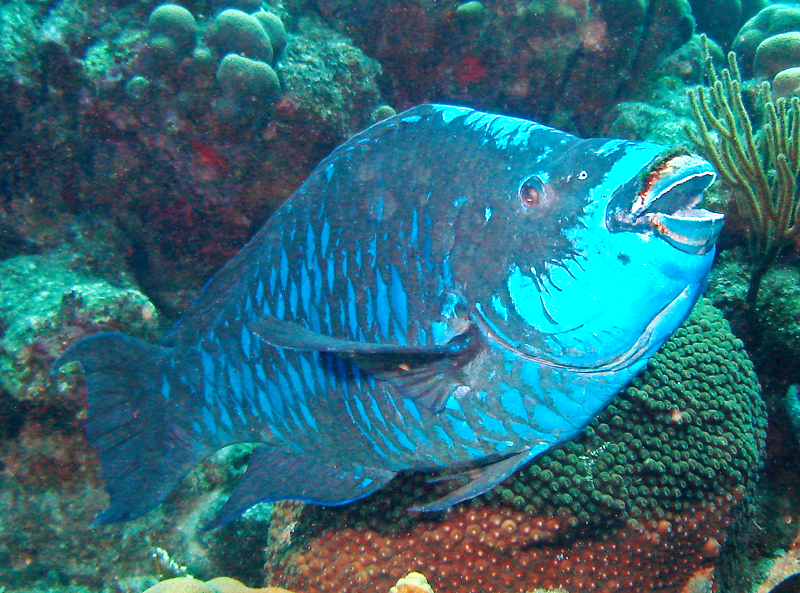 Midnight ParrotfishScarus coelestinus
-
 Blue-barred ParrotfishScarus ghobban
-
 Princess ParrotfishScarus taeniopterus
-
 Common ParrotfishScarus psittacus
-
 Rusty ParrotfishScarus ferrugineus
Compare
Questions and answers
What is the scientific name of the Queen Parrotfish?
The scientific name of the Queen Parrotfish is Scarus vetula. Written with its author, the full name is Scarus vetula Bloch & Schneider, 1801.
Which family does the Queen Parrotfish belong to?
Scarus vetula belongs to the family Labridae, in the order Perciformes and the class Teleostei.
Where is the Queen Parrotfish found?
Checklists and occurrence records place Scarus vetula in 34 countries, including United States, Colombia, U.S. Virgin Islands, Bonaire, Saint Eustatius and Saba , Puerto Rico and Mexico.
What is the conservation status of the Queen Parrotfish?
The IUCN Red List category recorded for Scarus vetula is Least Concern (LC).
What other names does the Queen Parrotfish have?
Scarus vetula is also known in English as Blownose, Blue Chub, Blue Parrotfish, Blueman, Joblin Crow Parrot and Moontail.
What is the diet of a parrotfish?
The Queen Parrotfish primarily consumes turf algae scraped from surfaces and coral from coral reefs. Its diet also includes sponges and other encrusting organisms.[12][14][13][16]
Sources
Passages the profile rests on
- Adult individuals have heavy, spindle-shaped bodies and beak-like mouths. Source passage: “Adult queen parrotfishes are heavy-bodied fish with fusiform (spindle-shaped) bodies and beak-like mouths” — English Wikipedia
- Initial-phase females are reddish-brown or grayish-brown with a paler head and a white stripe along the lower side of each flank. Source passage: “All initial phase individuals are female, being reddish-brown or grayish-brown with a paler head and a white lateral stripe low on each flank” — English Wikipedia
- Terminal-phase males are pale bluish-green and have blue spots near the mouth, yellowish streaks between the mouth and eye, and pale blue pectoral-fin bars. Source passage: “becoming pale bluish-green, with blue spots near the mouth, yellowish streaks between the mouth and eye, and pale blue bars on the pectoral fins.” — English Wikipedia
- The species has four rows of cheek scales and a red band near the edge of its caudal fin. Source passage: “Scarus vetula have four rows of scales on their cheeks. They have no longitudinal band on their head or body, but a red band near the edge of the caudal fin is present” — animaldiversity.org
- Its teeth form beak-like plates, with the lower plate concealed by the upper plate when the mouth is closed. Source passage: “S. vetula have teeth that form beak-like plates, similar to parrots. The lower plate is hidden by the upper plate when their mouth is closed.” — animaldiversity.org
- The species has a long, single dorsal fin and a truncated caudal fin. Source passage: “S. vetula can be identified by a long, single dorsal fin and a truncated caudal fin” — animaldiversity.org
- Young individuals have two white stripes and a white belly. Source passage: “S. vetula young have two white stripes and a white belly” — animaldiversity.org
- The species inhabits both rocky and coral reefs at depths of approximately 25 m or less. Source passage: “It is found on both rocky and coral reefs at depths down to about 25 m (80 ft).” — English Wikipedia
- The species occurs in tropical coral reefs of the Caribbean and is restricted to relatively shallow water. Source passage: “Scarus vetula are found in the tropical coral reefs of the Caribbean and are, therefore, restricted to relatively shallow water” — animaldiversity.org
- The species occurs in the tropical western Atlantic Ocean, the Caribbean Sea, and the southern Gulf of Mexico. Source passage: “The queen parrotfish is native to the tropical West Atlantic Ocean, the Caribbean Sea and the southern Gulf of Mexico.” — English Wikipedia
- Its recorded range extends from the West Indies to Florida. Source passage: “Scarus vetula range from the West Indies to Florida.” — animaldiversity.org
- The species primarily scrapes turf algae from surfaces and consumes coral from coral reefs. Source passage: “The queen parrotfish feeds primarily on the algal turf it can scrape off surfaces, and coral from coral reefs” — English Wikipedia
- The species preferentially scrapes turf algae growing on flat surfaces and coral reefs. Source passage: “They scrape algae, preferably turf algae, that is on flat surfaces and coral from coral reefs with their unique beak” — animaldiversity.org
- Its diet also includes sponges and other encrusting organisms. Source passage: “but may also eat sponges and other encrusting organisms as it feeds.” — English Wikipedia
- The species crushes consumed coral and algae into fine material in its pharyngeal mill and excretes indigestible sand. Source passage: “S. vetula crushes the coral and algae mixture finely in the pharyngeal mill, and the indigestible sand is excreted” — animaldiversity.org
- Sponges are also part of the species' diet. Source passage: “It has also been found that S. vetula feeds on sponges” — animaldiversity.org
- The species is active during daylight and rests in seabed crevices at night. Source passage: “It is a diurnal fish, and rests on the seabed or hides in a crevice at night” — English Wikipedia
- Individuals are active only during the day. Source passage: “S. vetula are only active during the day.” — animaldiversity.org
- Individuals sleep in crevices at night and surround themselves with a protective mucus envelope. Source passage: “During the night they find a crevice to sleep in and then they secrete a mucous envelope around themselves for protection” — animaldiversity.org
- Individuals commonly occur in groups of four or five containing one terminal-phase male and several initial-phase females. Source passage: “They are often found in small groups of four or five, consisting of one final-phase male and several initial-phase females.” — English Wikipedia
- The species commonly forms small schools containing three or four females and one supermale. Source passage: “Scarus vetula are mostly found in small schools of 3 - 4 females and a supermale.” — animaldiversity.org
- At night, individuals secrete a mucus layer around themselves that may help conceal them from predators. Source passage: “immersed in a layer of mucus that it exudes and which may help to disguise it from predators.” — English Wikipedia
- Individuals propel themselves using their pectoral fins rather than swimming strongly. Source passage: “They are not strong swimmers so they scull themselves along with their pectoral fins” — animaldiversity.org
- The species is a protogynous hermaphrodite in which the initial phase is female and the terminal phase is male. Source passage: “They are protogynous hermaphrodites, where the initial phase is female and the terminal phase is male.” — English Wikipedia
- Females change sex to become males at an average length of approximately 25 cm. Source passage: “At an average length of 25 cm (10 in), females change sex to become males.” — English Wikipedia
- Breeding occurs throughout the year, with most reproductive activity taking place in the mornings. Source passage: “Breeding occurs throughout the year, with most activity in the mornings.” — animaldiversity.org
- The breeding system involves one male mating with multiple females. Source passage: “Their breeding system is characterized as harem polygyny: one male mates with multiple females.” — animaldiversity.org
- During courtship, the male circles a female before both release their gametes into the water. Source passage: “The supermale in the group is in a terminal phase, where he is brightly colored. The supermale spawns with an individual female by first swimming in circles around the females and then as they increase their speed and tighten their circles the female joins the supermale.” — animaldiversity.org
- Spawning involves the simultaneous release of eggs and sperm into the sea. Source passage: “the male constantly circles a female until they join and both simultaneously release spawn into the sea.” — English Wikipedia
- The species undergoes external fertilization. Source passage: “Scarus vetula reproduce sexually with external fertilization.” — animaldiversity.org
- After fertilization, the eggs hatch and the developing larvae become part of the plankton. Source passage: “After fertilization, the eggs hatch and the developing larvae form part of the plankton.” — English Wikipedia
- The life cycle includes egg and larval stages as well as primary and terminal color phases. Source passage: “S. vetula have both an egg and a larval stage and a primary and a terminal phase where they change colors” — animaldiversity.org
- The species is classified as Least Concern by the International Union for Conservation of Nature. Source passage: “the International Union for Conservation of Nature has rated its conservation status as "least concern".” — English Wikipedia
- Overfishing and habitat degradation are identified as major threats to parrotfish conservation. Source passage: “In general, the major challenges that parrotfish conservation faces is overfishing and habitat degradation.” — English Wikipedia
- The species contributes substantially to sand production through its digestion of coral. Source passage: “Scarus vetula are a large contributor to the production of sand through their digestion of corals.” — animaldiversity.org
- The species is considered a major attraction on reefs. Source passage: “They are also believed to be a major reef attraction” — animaldiversity.org
- The species scrapes carbonate material from corals, causing less erosion than the excavating stoplight parrotfish. Source passage: “Scarus vetula is a "scraper", causing erosion of carbonate materials from corals but to a lesser extent than S. viride.” — English Wikipedia
Data
- Catalogue of Life, 2026-10-16 XR cc by
- Global Biodiversity Information Facility CC BY 4.0
- Wikidata CC0
- GeoNames CC BY 4.0
- Wikimedia Commons per image; credit shown with each image
- Within the Catalogue of Life, this name comes from World Register of Marine Species cc by
References
- Bloch, M. E., & Schneider, J. G. (1801). M.E. Blochii, Systema Ichthyologiae iconibus cx illustratum. Post obitum auctoris opus inchoatum absolvit, correxit, interpolavit Jo. Gottlob Schneider, Saxo. Berolini. Sumtibus Auctoris Impressum et Bibliopolio Sanderiano Commissum, Pp i–lx + 1–584, Pls. 1–110. https://doi.org/10.5962/bhl.title.5750 Link where the name was published
This species in other databases
- Catalogue of Life 4V3PF
- Wikidata Q2701369
- iNaturalist 112169
- WoRMS urn:lsid:marinespecies.org:taxname:276064
- ITIS 170816
Page built on 28 November 2026. See how the catalog is made and all sources and licences.
Cite this page
ScientificNames.org. (2026). Scarus vetula (Queen Parrotfish). Retrieved November 28, 2026, from https://scientificnames.org/species/scarus-vetula
“Scarus vetula (Queen Parrotfish).” ScientificNames.org, 2026, scientificnames.org/species/scarus-vetula. Accessed 28 Nov. 2026.
ScientificNames.org. “Scarus vetula (Queen Parrotfish).” Accessed November 28, 2026. https://scientificnames.org/species/scarus-vetula.
@misc{scientificnames_scarus_vetula_queen_parrotfish,
  author = {{ScientificNames.org}},
  title = {Scarus vetula (Queen Parrotfish)},
  year = {2026},
  url = {https://scientificnames.org/species/scarus-vetula},
  note = {Accessed 2026-11-28}
}