Species · Birds
White-throated Tapaculo Scelorchilus albicollis
The scientific name of the White-throated Tapaculo is Scelorchilus albicollis. It is a species of bird in the family Rhinocryptidae (tapaculo), order Passeriformes. The name dates from 1830.
- Scientific name
- Scelorchilus albicollis (Kittlitz, 1830)
- Common name
- White-throated Tapaculo
- Genus
- Scelorchilus
- Family
- Rhinocryptidae (Tapaculo)
- Order
- Passeriformes
- Class
- Aves
- Red List category
- LC Least Concern
- Recorded in
- 1 country
- Name status
- accepted in the Catalogue of Life

Overview
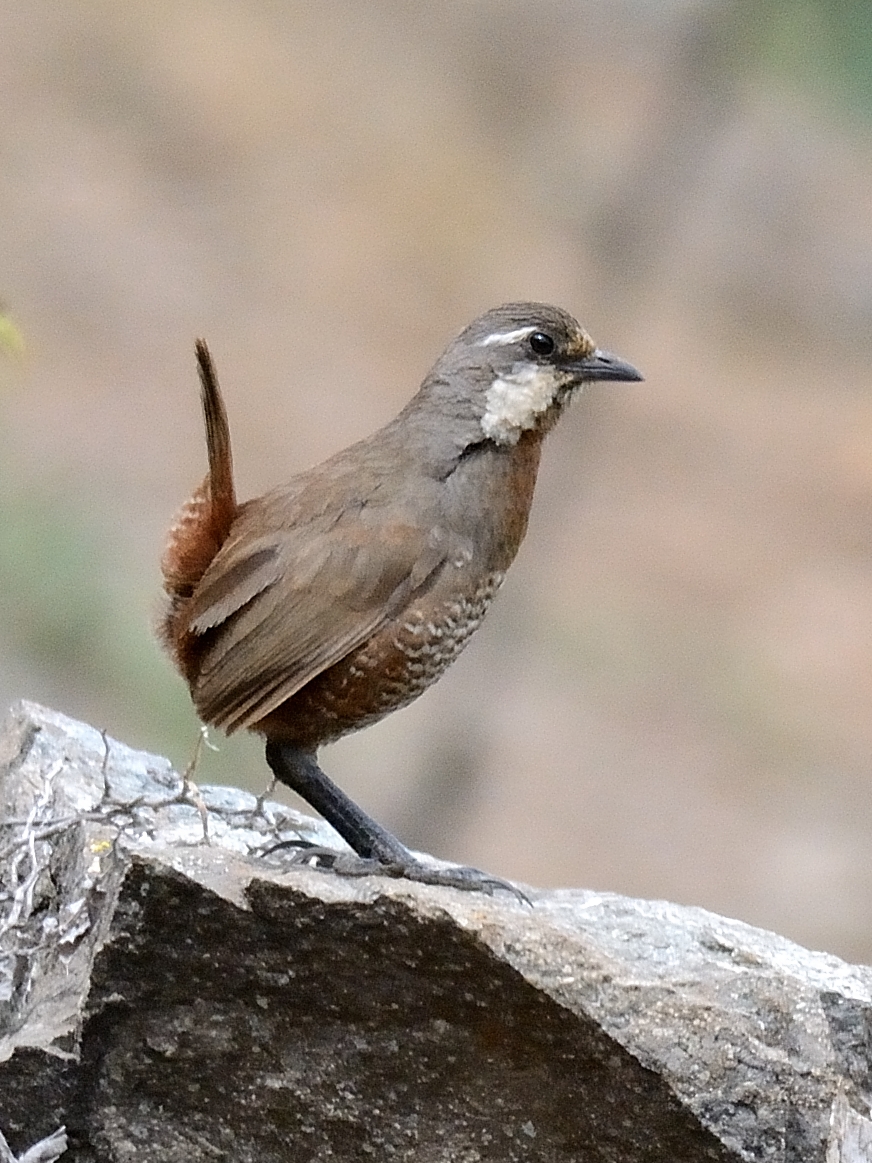
Scelorchilus albicollis is endemic to Chile, where it occurs in central Chile and inhabits shrublands, woodlands and scrub. It has a whitish throat and chest bib, bold white supercilia, and dark brown bars across most of its underparts.
Written 27 November 2026 from the sources listed below. Each statement was checked against the passage it cites; statements that could not be supported were removed.
Conservation
The IUCN classifies the White-throated Tapaculo as Least Concern. Its fairly large geographical range includes protected areas.[1][2]
The species is considered fairly common, and its population is believed to be stable. Its population size has not been quantified.[3][4]
Similar species
The White-throated Tapaculo is smaller and slimmer than the Moustached Turca. It has a longer and brighter rusty tail.[5][6]
Appearance
Adult nominate White-throated Tapaculos have cinnamon foreheads, bold white supercilia, and gray-brown upperparts. Their rumps are lightly barred, and their whitish underparts become pale cinnamon on the belly.[7][8]
Most of the nominate subspecies' underparts have dark brown bars. The species also has a whitish throat and chest bib.[9][10]
The subspecies S. a. atacamae is paler than the nominate subspecies, with noticeably grayer upperparts. Juveniles resemble adults but have barring across their entire bodies.[11][12]
The White-throated Tapaculo is approximately 19 cm long.[13]
Habitat
The species inhabits xeric shrublands in the northern part of its Chilean range. In the southern part of its range, it inhabits woodlands and scrub in Mediterranean climates.[14][15]
Diet
Arthropods constitute almost the entire diet of the White-throated Tapaculo.[16]
Behaviour
The species obtains most of its food by foraging on the ground in dense cover. It usually stays on the ground in its dense shrubland habitat.[17][18]
The White-throated Tapaculo is thought to be sedentary. It sings from the ground or from a low perch.[19][20]
Its typical song consists of a series of barking notes that decrease in pitch. Its call is a harsh grunt compared to the sound made by a pig.[21][22]
Reproduction and life cycle
The species builds cup-shaped nests from soft grass at the end of tunnels that can reach 2 metres in length. It lays its eggs in September and October.[23][24]
Both parents incubate the eggs and feed the nestlings.[25]
Classification of the White-throated Tapaculo
| Kingdom | Animalia |
|---|---|
| Phylum | Chordata |
| Subphylum | Vertebrata |
| Infraphylum | Gnathostomata |
| Parvphylum | Osteichthyes |
| Megaclass | Tetrapoda |
| Class | Aves (Bird) |
| Order | Passeriformes (Passerine) |
| Family | Rhinocryptidae (Tapaculo) |
| Genus | Scelorchilus (Chucao and White-throated Tapaculos) |
| Species | Scelorchilus albicollis (Kittlitz, 1830) |
Where the White-throated Tapaculo is found
Checklists and occurrence records place Scelorchilus albicollis in 1 country across South America. GBIF holds 7,967 georeferenced records of it.
Countries
Regions and cities with the most records
- Coquimbo Region, Chile 3,205
- Valparaiso, Chile 2,178
- Santiago Metropolitan, Chile 1,797
- Limache, Chile 1,091
- Quillota, Chile 965
- Peñalolén, Chile 666
- El Quisco, Chile 665
- Santiago, Chile 627
- La Cruz, Chile 562
- Llaillay, Chile 446
- Atacama, Chile 410
- Cartagena, Chile 405
- Renca, Chile 387
- La Calera, Chile 366
- San Antonio, Chile 360
- Puente Alto, Chile 352
- La Pintana, Chile 331
- La Serena, Chile 270
- Coquimbo, Chile 242
- Lampa, Chile 196
- Illapel, Chile 179
- Lo Prado, Chile 148
- Antofagasta, Chile 140
- Curacaví, Chile 123
- Villa Alemana, Chile 123
- Maipú, Chile 122
- San Esteban, Chile 118
- Padre Hurtado, Chile 109
- Peñaflor, Chile 107
- Quilpué, Chile 103
- San Bernardo, Chile 101
- Los Andes, Chile 91
- Putaendo, Chile 88
- Quilicura, Chile 86
- Casablanca, Chile 80
- San Felipe, Chile 80
Range as the checklists state it
South America
A number beside a place is its count of GBIF occurrence records. A place without a number comes from a checklist alone. Records show where a species has been observed or collected, which can include escapes and vagrants.
Common names
English
- White-throated Tapaculo
Names in 25 other languages
- Catalan
- tapacul gros golablanc
- Chinese
- 白喉窜鸟, 白喉竄鳥
- Croatian
- bjelogrla strmorepka
- Czech
- štidlák bělohrdlý
- Danish
- Hvidstrubet Tapaculo
- Dutch
- Witkeeltapaculo
- Esperanto
- blankagorĝa tapakulo
- Finnish
- isomyyrätapakulo
- French
- Tourco à gorge blanche
- German
- Weißkehl-Tapaculo, Weißkehltapaculo
- Hungarian
- fehérbegyű tapakúló
- Italian
- Tapaculo golabianca
- Japanese
- アカバネオタテドリ
- Lithuanian
- baltagurklis strazdinis topakulas
- Norwegian
- hvitstrupetapakulo
- Polish
- krytonos białogardły
- Portuguese
- tapaculo-de-garganta-branca
- Russian
- Белогорлый дроздовый топаколо, Белогорлый тюрко
- Serbian
- Belogrli tapakulo
- Slovak
- turko bielohrdlý
- Spanish
- Tapaculo, Tapaculo Gorgiblanco, Tapaculo gorjiblanco, Tococo
- Swedish
- vitstrupig tapakul
- Turkish
- Ak Boğazlı Tapakola
- Ukrainian
- тапакуло білогорлий
- Welsh
- tapacwlo gyddfwyn
Synonyms
One other scientific name has been used for this species and is now treated as a synonym of Scelorchilus albicollis.
- Pteroptochos albicollis Kittlitz, 1830
Subspecies and varieties
- Scelorchilus albicollis albicollis subspecies
- Scelorchilus albicollis atacamae subspecies
Related species
-
 Chucao TapaculoScelorchilus rubecula
-
 Black-throated Huet-huetPteroptochos tarnii
-
 Moustached TurcaPteroptochos megapodius
-
 Magellanic TapaculoScytalopus magellanicus
-
 Slaty BristlefrontMerulaxis ater
-
 Ocellated TapaculoAcropternis orthonyx
-
 Crested GallitoRhinocrypta lanceolata
-
 Blackish TapaculoScytalopus latrans
Compare
Questions and answers
What is the scientific name of the White-throated Tapaculo?
The scientific name of the White-throated Tapaculo is Scelorchilus albicollis. Written with its author, the full name is Scelorchilus albicollis (Kittlitz, 1830).
Which family does the White-throated Tapaculo belong to?
Scelorchilus albicollis belongs to the family Rhinocryptidae, in the order Passeriformes and the class Aves.
Where is the White-throated Tapaculo found?
Checklists and occurrence records place Scelorchilus albicollis in 1 country: Chile.
What is the conservation status of the White-throated Tapaculo?
The IUCN Red List category recorded for Scelorchilus albicollis is Least Concern (LC).
Sources
Passages the profile rests on
- The IUCN classifies the White-throated Tapaculo as Least Concern. Source passage: “The IUCN has assessed the white-throated tapaculo as of Least Concern.” — English Wikipedia
- The species has a fairly large geographical range that includes protected areas. Source passage: “It has a fairly large range that includes some protected areas.” — English Wikipedia
- The population size of the species has not been quantified. Source passage: “The population has not been quantified” — English Wikipedia
- The species is considered fairly common and its population is believed to be stable. Source passage: “the species is "fairly common" and their number is believed to be stable.” — English Wikipedia
- The White-throated Tapaculo is smaller and slimmer than the Moustached Turca. Source passage: “Smaller and slimmer than Moustached Turca” — ebird.org
- The White-throated Tapaculo has a longer and brighter rusty tail than the Moustached Turca. Source passage: “with a longer and brighter rusty tail” — ebird.org
- Adult nominate White-throated Tapaculos have cinnamon foreheads, bold white supercilia, and gray-brown upperparts. Source passage: “The adult of the nominate subspecies of white-throated tapaculo has a cinnamon forehead, a bold white supercilium, and gray-brown upper parts.” — English Wikipedia
- The nominate subspecies has lightly barred rumps and whitish underparts that become pale cinnamon on the belly. Source passage: “The rump is lightly barred. The underparts are whitish darkening to pale cinnamon on the belly.” — English Wikipedia
- Most of the nominate subspecies' underparts have dark brown bars. Source passage: “Most of the underparts have dark brown bars.” — English Wikipedia
- The species has a whitish throat and chest bib. Source passage: “a whitish throat and chest bib” — ebird.org
- The subspecies S. a. atacamae is paler than the nominate subspecies, with noticeably grayer upperparts. Source passage: “The subspecies S. a. atacamae is similarly colored but paler; in particular the upper parts are much more gray than brown.” — English Wikipedia
- Juvenile White-throated Tapaculos resemble adults but have barring across their entire bodies. Source passage: “The juveniles are similar to the adults but barred all over.” — English Wikipedia
- The White-throated Tapaculo is approximately 19 cm long. Source passage: “The white-throated tapaculo is approximately 19 cm (7.5 in) long.” — English Wikipedia
- The species inhabits xeric shrublands in the northern part of its Chilean range. Source passage: “The more northern part of its range is characterized by xeric shrublands” — English Wikipedia
- The species inhabits woodlands and scrub in Mediterranean climates in the southern part of its range. Source passage: “the more southerly part by woodlands and scrub in a Mediterranean climate.” — English Wikipedia
- Arthropods constitute almost the entire diet of the White-throated Tapaculo. Source passage: “The white-throated tapaculo's diet is almost exclusively arthropods.” — English Wikipedia
- The species obtains most of its food by foraging on the ground in dense cover. Source passage: “It forages mostly on the ground in dense cover.” — English Wikipedia
- The species usually stays on the ground in its dense shrubland habitat. Source passage: “where it is usually found on the ground” — datazone.birdlife.org
- The species is thought to be sedentary. Source passage: “It is thought to be sedentary.” — English Wikipedia
- The species sings from the ground or from a low perch. Source passage: “The white-throated tapaculo sings from the ground or a low perch.” — English Wikipedia
- Its typical song consists of a series of barking notes that decrease in pitch. Source passage: “The typical song is a series of "barking" notes falling in pitch” — English Wikipedia
- Its call is a harsh grunt compared to the sound made by a pig. Source passage: “The call is a harsh grunt that has been compared to a pig's” — English Wikipedia
- The species builds cup-shaped nests from soft grass at the end of tunnels that can reach 2 metres in length. Source passage: “The white-throated tapaculo's nest is a cup made of soft grass built at the end of a tunnel up to 2 m (6.6 ft) long.” — English Wikipedia
- White-throated Tapaculos lay their eggs in September and October. Source passage: “Eggs are laid in September and October.” — English Wikipedia
- Both parents incubate the eggs and feed the nestlings. Source passage: “Both the male and the female incubate the eggs and feed the nestlings.” — English Wikipedia
Data
- Catalogue of Life, 2026-10-16 XR cc by
- Global Biodiversity Information Facility CC BY 4.0
- Wikidata CC0
- GeoNames CC BY 4.0
- Wikimedia Commons per image; credit shown with each image
- Within the Catalogue of Life, this name comes from The Integrated Taxonomic Information System cc0
References
- Gill, Frank, & and Minturn Wright. (2006). Birds of the World: Recommended English Names.
This species in other databases
Page built on 29 November 2026. See how the catalog is made and all sources and licences.
Cite this page
ScientificNames.org. (2026). Scelorchilus albicollis (White-throated Tapaculo). Retrieved November 29, 2026, from https://scientificnames.org/species/scelorchilus-albicollis
“Scelorchilus albicollis (White-throated Tapaculo).” ScientificNames.org, 2026, scientificnames.org/species/scelorchilus-albicollis. Accessed 29 Nov. 2026.
ScientificNames.org. “Scelorchilus albicollis (White-throated Tapaculo).” Accessed November 29, 2026. https://scientificnames.org/species/scelorchilus-albicollis.
@misc{scientificnames_scelorchilus_albicollis_white_throated_tapaculo,
  author = {{ScientificNames.org}},
  title = {Scelorchilus albicollis (White-throated Tapaculo)},
  year = {2026},
  url = {https://scientificnames.org/species/scelorchilus-albicollis},
  note = {Accessed 2026-11-29}
}