Species · Insects
Sebaris palpalis
Sebaris palpalis has no English name on record in the checklists used here. It is a species of insect in the family Scarabaeidae (dung beetles), order Coleoptera. The name dates from 1840.
- Scientific name
- Sebaris palpalis Laporte, 1840
- Genus
- Sebaris
- Family
- Scarabaeidae (Dung Beetles)
- Order
- Coleoptera
- Class
- Insecta
- Name status
- accepted in the Catalogue of Life
Overview
The species occurs in South Africa, specifically the Western Cape. Adults are light chestnut-red and are distinguished by long, dense fulvous hairs and a hollowed clypeus with strongly reflexed margins.
Written 28 November 2026 from the sources listed below. Each statement was checked against the passage it cites; statements that could not be supported were removed.
Appearance
Adult beetles measure approximately 15–19.5 mm in length and have a light chestnut-red coloration.[1][2]
The head, pronotum, scutellum, and underside are covered with very long, dense, sub-erect fulvous hairs. These hairs conceal the surface sculpture of much of the integument.[3][4]
The clypeus is hollowed, densely punctate, moderately pubescent, and has strongly reflexed margins. Its outer portion extends obliquely outward, and its outer angles form somewhat blunt teeth.[5][6][7][8]
The anterior clypeal margin has a triangular median incision that forms two broad, sub-triangular teeth. The outer anterior angles are less sharply developed in females than in males.[9][10]
The frontal region of the head is concealed by long hairs and is closely punctulate.[11]
The scutellum has sparse punctation and a smooth apex.[12]
The elytra widen slightly laterally beyond the humeral region and are somewhat convex. They are glabrous, have deep, relatively coarse punctation, and each bears four costules on its side.[13][14][15]
The outer fringe of each elytron consists of moderately long fulvous hairs. The pygidium has sparse punctation.[16][17]
Classification of Sebaris palpalis
| Kingdom | Animalia |
|---|---|
| Phylum | Arthropoda |
| Subphylum | Hexapoda |
| Class | Insecta (Insect) |
| Order | Coleoptera (Beetle) |
| Suborder | Polyphaga |
| Series | Staphyliniformia |
| Superfamily | Scarabaeoidea |
| Family | Scarabaeidae (Dung Beetles) |
| Subfamily | Melolonthinae |
| Tribe | Tanyproctini |
| Subtribe | Tanyproctina |
| Genus | Sebaris |
| Species | Sebaris palpalis Laporte, 1840 |
Where Sebaris palpalis is found
Range as the checklists state it
Afrotropical(Republic South Africa:Western Cape)
A number beside a place is its count of GBIF occurrence records. A place without a number comes from a checklist alone. Records show where a species has been observed or collected, which can include escapes and vagrants.
Related species
- Sebaris lanuginosa
-
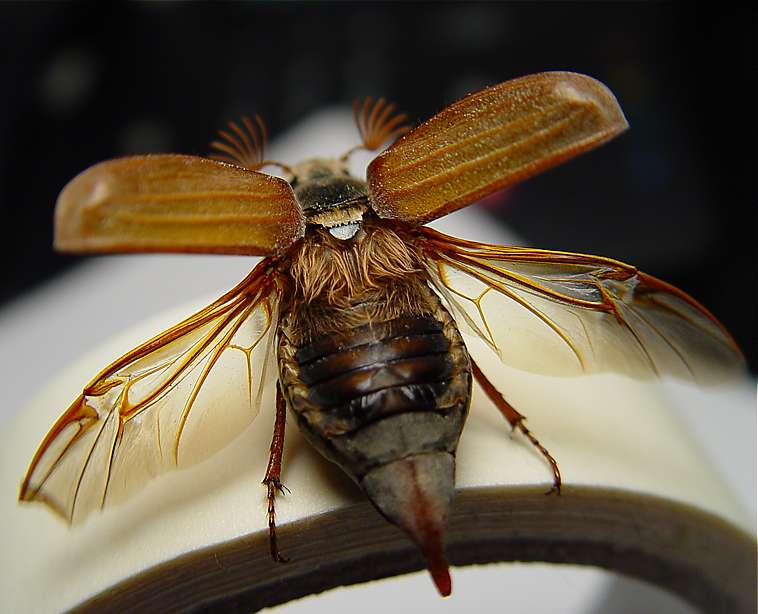 CockchaferMelolontha melolontha
-
 Hercules BeetleDynastes (Dynastes) hercules
-
 Japanese BeetlePopillia japonica
-
 Japanese Rhinoceros BeetleTrypoxylus dichotomus
-
 Sacred ScarabScarabaeus sacer
-
 Figeater BeetleCotinis (Cotinis) mutabilis
-
 Atlas BeetleChalcosoma atlas
Compare
Questions and answers
Where does Sebaris palpalis occur?
It occurs in South Africa, specifically the Western Cape.[18]
How large are adult Sebaris palpalis beetles?
Adults measure approximately 15–19.5 mm in length.[1]
What colour are the adults?
Adults have a light chestnut-red coloration.[2]
How does the clypeus differ between males and females?
The outer anterior angles of the clypeus are less sharply developed in females than in males.[10]
Sources
Passages the profile rests on
- Adult Sebaris palpalis beetles measure approximately 15–19.5 mm in length. Source passage: “Adults reach a length of about 15–19.5 mm (0.59–0.77 in).” — English Wikipedia
- Adults have a light chestnut-red coloration. Source passage: “They are light chestnut-red,” — English Wikipedia
- The head, pronotum, scutellum, and underside are covered with very long, dense, sub-erect fulvous hairs. Source passage: “the head, pronotum, scutellum, and underside clothed with very long and very dense sub-erect fulvous hairs” — English Wikipedia
- The dense hairs covering much of the beetle conceal the surface sculpture of its integument. Source passage: “hiding the sculpture of the teguments.” — English Wikipedia
- The clypeus is hollowed and has strongly reflexed margins. Source passage: “The clypeus is hollowed and with the margins very much reflexed,” — English Wikipedia
- The outer portion of the clypeus extends obliquely outward. Source passage: “the outer part is produced obliquely outwardly,” — English Wikipedia
- The outer angles of the anterior clypeal region form somewhat blunt teeth. Source passage: “the outer angles of the anterior part are produced into a somewhat blunted tooth,” — English Wikipedia
- The hollowed clypeus is densely punctate and moderately pubescent. Source passage: “the hollowed clypeus is closely punctate and moderately pubescent,” — English Wikipedia
- The anterior clypeal margin has a triangular incision in its median region, forming two broad, sub-triangular teeth. Source passage: “where it is triangularly incised, with the angles of the incision forming two broad sub-triangular teeth,” — English Wikipedia
- The outer anterior angles of the clypeus are less sharply developed in females than in males. Source passage: “the outer angles of the anterior part are not quite as sharp in the female as in the male,” — English Wikipedia
- The frontal region of the head is concealed by long hairs and is closely punctulate. Source passage: “the frontal part of the head is entirely hidden by the long hairs, but it is closely punctulate like the pronotum.” — English Wikipedia
- The scutellum has sparse punctation and a smooth apex. Source passage: “The scutellum is sparingly punctate and smooth at the apex” — English Wikipedia
- The elytra widen slightly laterally beyond the humeral region and are somewhat convex. Source passage: “the elytra are a little ampliated laterally past the humeral part, somewhat convex,” — English Wikipedia
- The elytra are glabrous and have deep, relatively coarse punctation. Source passage: “glabrous, deeply and somewhat coarsely punctate,” — English Wikipedia
- Each elytron bears four costules on its side. Source passage: “having on each side four costules,” — English Wikipedia
- The elytra have an outer fringe of moderately long fulvous hairs. Source passage: “they have an outer fringe of moderately long fulvous hairs.” — English Wikipedia
- The pygidium has sparse punctation. Source passage: “The pygidium is sparingly punctured.” — English Wikipedia
- Sebaris palpalis occurs in South Africa, specifically the Western Cape. Source passage: “It is found in South Africa (Western Cape).” — English Wikipedia
Data
- Catalogue of Life, 2026-10-16 XR cc by
- Wikidata CC0
- Within the Catalogue of Life, this name comes from World Scarabaeidae Database cc by
References
- Laporte, F.L., Comte de Castelnau. (1840). Histoire Naturelle des Insectes Coléoptères. Avec une introduction renfermant l’Anatomie et la Physiologie des Animaux Articulés, par M.Brullé. P.Duménil, Paris 2:1-564. https://doi.org/10.5962/bhl.title.35290 Link where the name was published
This species in other databases
Page built on 29 November 2026. See how the catalog is made and all sources and licences.
Cite this page
ScientificNames.org. (2026). Sebaris palpalis. Retrieved November 29, 2026, from https://scientificnames.org/species/sebaris-palpalis
“Sebaris palpalis.” ScientificNames.org, 2026, scientificnames.org/species/sebaris-palpalis. Accessed 29 Nov. 2026.
ScientificNames.org. “Sebaris palpalis.” Accessed November 29, 2026. https://scientificnames.org/species/sebaris-palpalis.
@misc{scientificnames_sebaris_palpalis,
  author = {{ScientificNames.org}},
  title = {Sebaris palpalis},
  year = {2026},
  url = {https://scientificnames.org/species/sebaris-palpalis},
  note = {Accessed 2026-11-29}
}