Species · Ferns and allies
Deflexed Spikemoss Selaginella deflexa
The scientific name of the Deflexed Spikemoss is Selaginella deflexa. It is a species of fern or lycophyte in the family Selaginellaceae (spikemoss family), order Selaginellales.
- Scientific name
- Selaginella deflexa Brack.
- Common name
- Deflexed Spikemoss
- Genus
- Selaginella
- Family
- Selaginellaceae (Spikemoss Family)
- Order
- Selaginellales
- Class
- Lycopodiopsida
- Recorded in
- 1 country
- Name status
- accepted in the Catalogue of Life

Overview
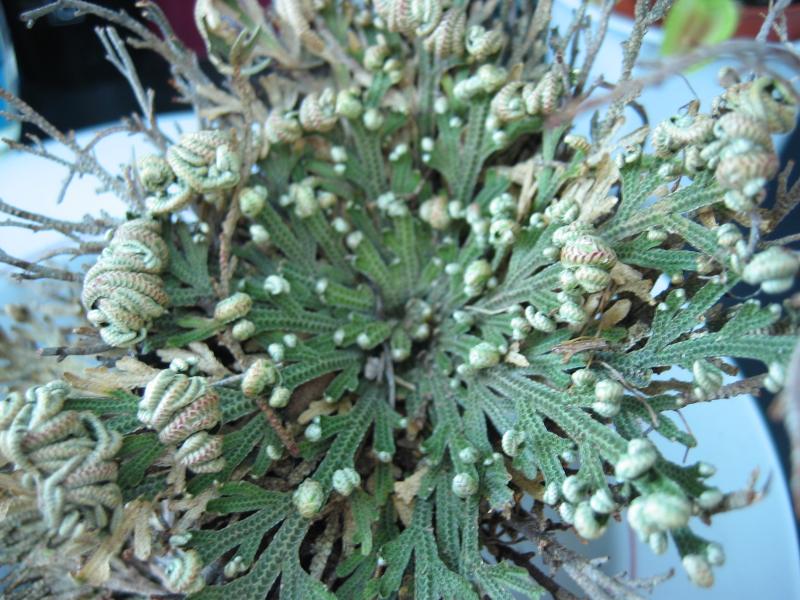
Selaginella deflexa is endemic to the Hawaiian Islands and occurs on all Hawaiian Islands except Lānaʻi. It has downward-bending needle-like leaves and spiky, helical reproductive structures called strobili.
Written 27 November 2026 from the sources listed below. Each statement was checked against the passage it cites; statements that could not be supported were removed.
Appearance
Deflexed Spikemoss has needle-like leaves with lanceolate or ovate-lanceolate shapes that bend downwards. The plant is typically yellowish-green and grows to approximately 10–25 cm in height.[1][2][3]
Its reproductive structures form spiky, helical strobili containing embedded sporophylls. Its roots attach to a swollen region of an elongated hypocotyl base.[4][5]
The subgenus containing Deflexed Spikemoss lacks the rhizophores typically found along the stems of other Selaginella species. The species name refers to its reflexed leaves, which point outwards.[6][7]
Habitat
Deflexed Spikemoss typically inhabits wetland bogs surrounded by moss. It occurs at elevations between 1,050 and 1,500 metres above sea level.[8][9]
The species occurs on all Hawaiian Islands except Lānaʻi and is rarely found on Oʻahu.[10][11]
Reproduction and life cycle
Deflexed Spikemoss reproduces through spores and is heterosporous. Each plant produces both megasporangia and microsporangia, which occur within helical strobili at the plant's branching points.[12][13][14]
Each megasporangium has three lobes and a globular appearance. It contains four tetrahedrally arranged megaspores.[15][16]
The megaspores have irregularly arranged spines measuring 70–90 micrometres in height. These spines join together to form larger composite spines.[17][18]
The microsporangia are smooth and contain hundreds of microspores each.[19]
Similar species
Selaginella selaginoides is the only other member of the same subgenus and is closely related to Deflexed Spikemoss. Both species are included in the Euselaginella group.[20][21]
Classification of the Deflexed Spikemoss
| Kingdom | Plantae |
|---|---|
| Subkingdom | Pteridobiotina |
| Phylum | Tracheophyta |
| Class | Lycopodiopsida |
| Order | Selaginellales |
| Family | Selaginellaceae (Spikemoss Family) |
| Genus | Selaginella (Spikemoss) |
| Species | Selaginella deflexa Brack. |
Where the Deflexed Spikemoss is found
Checklists and occurrence records place Selaginella deflexa in 1 country across North America. GBIF holds 210 georeferenced records of it.
Countries
Regions and cities with the most records
Range as the checklists state it
Hawaii (Kauai, Oahu, Molokai, Maui, Hawaii Isl.)
A number beside a place is its count of GBIF occurrence records. A place without a number comes from a checklist alone. Records show where a species has been observed or collected, which can include escapes and vagrants.
Common names
English
- Deflexed Spikemoss
Synonyms
2 other scientific names have been used for this species and are now treated as synonyms of Selaginella deflexa.
- Lycopodioides deflexa (Brack.) Kuntze
- Selaginoides deflexa (Brack.) Li Bing Zhang & X.M.Zhou
Related species
-
 Rose-of-JerichoSelaginella lepidophylla
-
 African ClubmossSelaginella kraussiana
-
 Peacock FernSelaginella uncinata
-
 Willdenow's SpikemossSelaginella willdenowii
-
 Little-club-mossSelaginella tamariscina
-
 Lesser ClubmossSelaginella selaginoides
-
 Gemmiferous SpikemossSelaginella moellendorffii
-
 Mediterranean ClubmossSelaginella denticulata
Compare
Questions and answers
What is the scientific name of the Deflexed Spikemoss?
The scientific name of the Deflexed Spikemoss is Selaginella deflexa. Written with its author, the full name is Selaginella deflexa Brack..
Which family does the Deflexed Spikemoss belong to?
Selaginella deflexa belongs to the family Selaginellaceae, in the order Selaginellales and the class Lycopodiopsida.
Where is the Deflexed Spikemoss found?
Checklists and occurrence records place Selaginella deflexa in 1 country: United States.
Sources
Passages the profile rests on
- The plant has needle-like leaves with lanceolate or ovate-lanceolate shapes that bend downwards. Source passage: “It has needle-like leaves that bend downwards and exhibit a lanceolate or ovate-lanceolate shape.” — English Wikipedia
- The plant is typically yellowish-green in color. Source passage: “The plant tends to have a yellowish-green color” — English Wikipedia
- The plant grows to approximately 10–25 cm in height. Source passage: “grows to 10–25 cm (4–10 in) in height.” — English Wikipedia
- Its reproductive structures form spiky, helical strobili containing embedded sporophylls. Source passage: “Selaginella deflexa additionally have spiky, helical strobili in which the sporangia-bearing sporophylls are embedded.” — English Wikipedia
- Its roots attach to a swollen region of an elongated hypocotyl base. Source passage: “its roots can be found attached to a swollen region of a long hypocotyl base.” — English Wikipedia
- The subgenus containing this species lacks the rhizophores typically found along the stems of other Selaginella species. Source passage: “This subgenus is unique in that it lacks the rhizophores typically seen along the stems of other Selaginella species.” — English Wikipedia
- The species name refers to its reflexed leaves, which point outwards. Source passage: “This plant gets its name from its reflexed leaves which point outwards.” — English Wikipedia
- The species typically inhabits wetland bogs surrounded by moss. Source passage: “It typically grows within wetland bogs surrounded by moss” — English Wikipedia
- The species occurs at elevations between 1,050 and 1,500 metres above sea level. Source passage: “located between 1,050–1,500 m (3,440–4,920 ft) above sea level.” — English Wikipedia
- The species occurs on all Hawaiian Islands except Lānaʻi. Source passage: “Excluding Lānaʻi, S. deflexa is found across all of the Hawaiian Islands” — English Wikipedia
- The species is rarely found on Oʻahu. Source passage: “its appearance on Oʻahu is rare.” — English Wikipedia
- The species reproduces through spores. Source passage: “Selaginella deflexa reproduces via spores.” — English Wikipedia
- The species is heterosporous and produces both megasporangia and microsporangia on each plant. Source passage: “Selaginella deflexa is heterosporous and contains both megasporangia and microsporangia on each plant body.” — English Wikipedia
- The sporangia occur within helical strobili at the plant's branching points. Source passage: “The sporangia are arranged within the helical strobili along the branching points of the plant.” — English Wikipedia
- Each megasporangium has three lobes and a globular appearance. Source passage: “The megasporangium has three lobes and can easily be identified along the reproductive stalks of the plant due to its globular appearance.” — English Wikipedia
- Each megasporangium contains four tetrahedrally arranged megaspores. Source passage: “Within each megasporangium there are four megaspores arranged tetrahedrally.” — English Wikipedia
- The megaspores have irregularly arranged spines measuring 70–90 micrometres in height. Source passage: “Selaginella deflexa megaspores are covered by irregularly arranged spines between 70-90 micrometers high” — English Wikipedia
- The megaspore spines join together to form larger composite spines. Source passage: “that join to form larger, composite spines.” — English Wikipedia
- The microsporangia are smooth and contain hundreds of microspores each. Source passage: “The microsporangia of S. deflexa plants are smooth and contain hundreds of microspores per structure.” — English Wikipedia
- Selaginella selaginoides is the only other member of the same subgenus and is closely related to Selaginella deflexa. Source passage: “It is closely related to Selaginella selaginoides which is the only other member in its subgenus.” — English Wikipedia
- Selaginella deflexa is included in the Euselaginella group alongside Selaginella selaginoides. Source passage: “Euselaginella, which contained the type species Selaginella selaginoides and Selaginella deflexa.” — blogs.reading.ac.uk
Data
- Catalogue of Life, 2026-10-16 XR cc by
- Global Biodiversity Information Facility CC BY 4.0
- Wikidata CC0
- GeoNames CC BY 4.0
- Wikimedia Commons per image; credit shown with each image
- Within the Catalogue of Life, this name comes from Checklist of Ferns and Lycophytes of the World cc by
References
- Brack. (1854). U.S. Expl. Exped. 16 (Filic.): 332, no. 3, t. 45, f. 3 (1854). where the name was published
This species in other databases
Page built on 29 November 2026. See how the catalog is made and all sources and licences.
Cite this page
ScientificNames.org. (2026). Selaginella deflexa (Deflexed Spikemoss). Retrieved November 29, 2026, from https://scientificnames.org/species/selaginella-deflexa
“Selaginella deflexa (Deflexed Spikemoss).” ScientificNames.org, 2026, scientificnames.org/species/selaginella-deflexa. Accessed 29 Nov. 2026.
ScientificNames.org. “Selaginella deflexa (Deflexed Spikemoss).” Accessed November 29, 2026. https://scientificnames.org/species/selaginella-deflexa.
@misc{scientificnames_selaginella_deflexa_deflexed_spikemoss,
  author = {{ScientificNames.org}},
  title = {Selaginella deflexa (Deflexed Spikemoss)},
  year = {2026},
  url = {https://scientificnames.org/species/selaginella-deflexa},
  note = {Accessed 2026-11-29}
}