Species · Flowering plants
Namib Sesamebush Sesamothamnus leistneri
The scientific name of the Namib Sesamebush is Sesamothamnus leistneri. It is a species of flowering plant in the family Pedaliaceae (pedalium family or sesame family), order Lamiales.
- Scientific name
- Sesamothamnus leistneri P.Craven ex Swanepoel & A.E.van Wyk
- Common name
- Namib Sesamebush
- Genus
- Sesamothamnus
- Family
- Pedaliaceae (Pedalium Family Or Sesame Family)
- Order
- Lamiales
- Class
- Magnoliopsida
- Recorded in
- 2 countries
- Name status
- accepted in the Catalogue of Life
Classification of the Namib Sesamebush
| Kingdom | Plantae |
|---|---|
| Subkingdom | Pteridobiotina |
| Phylum | Tracheophyta |
| Class | Magnoliopsida |
| Order | Lamiales |
| Family | Pedaliaceae (Pedalium Family Or Sesame Family) |
| Tribe | Sesamothamneae |
| Genus | Sesamothamnus |
| Species | Sesamothamnus leistneri P.Craven ex Swanepoel & A.E.van Wyk |
Origin of the name. Etymology: - The specific epithet honours Otto Albrecht Leistner, who, together with Bernard de Winter, first collected Sesamothamnus leistneri in 1957 during an epic collecting trip to the Kaokoveld (Leistner 2022). In our choice of name, we have chosen to use the epithet as a noun in the genitive case (" leistneri ") rather than an adjective (" leistnerianus "). Either of these options have been used to designate the taxon in the past. We consider the genitive case to be more appropriate, as it indicates that this species is Leistner's particular discovery, not anybody else's. Notes: - Sesamothamnus leistneri differs from the three other southern African members of the genus in habit, leaf, indumentum, and flower characters. It is morphologically more similar to the two northeast African species (hence our choice of S. rivae to compare it with in the Diagnosis) with which it shares an indumentum of mucilage hairs with quadrangular heads; the other three southern African species have mucilaginous hairs with distinctly stellate heads (Ihlenfeld 2010: 159, figs 13 & 14). It has also been suggested that S. leistneri may well be the most primitive member of the genus (Ihlenfeldt 1994). The suggested closer affinity of Sesamothamnus leistneri with the disjunct northeast African S. rivea, rather than the three other southern African members of the genus, is not unexpected. There are well-known floristic (and faunal) links, often involving discontinuities in distribution, between arid areas in southern Africa and arid areas in East Africa, the Horn of Africa, and Arabia. These disjunct patterns indicate that at least the semi-arid habitats have been connected by an arid corridor, the periodic existence of which was presumably related to patterns of climate change, with arid episodes accompanied by, among other causes, periods of glaciation. Abundant botanical and zoological evidence support the existence of such a periodical arid corridor (e. g. Van Wyk & Smith 2001 and references therein, Thiv et al. 2011, Bellstedt et al. 2012, Linder 2014). Apart from the differences in habit and morphological characters, the distribution of the three southern African taxa differs, with Sesamothamnus leistneri being confined to the mountainous areas immediately to the north and south of the Kunene River in the Kaokoveld Centre of Endemism in Angola and Namibia, and S. benguellensis to the northern part of the Kaokoveld Centre in Angola from the Benguella, Namibe, and Cunene Province southwards crossing the Kunene River into Namibia as far as the Rooidrom area (just south of the Marienfluss Valley). Sesamothamnus guerichii is confined to the southern part of the Namibian Kaokoveld from the Rooidrom area southwards to Omatjette near Omaruru in the Erongo Region. Only a single locality is known where S. leistneri and S. guerichii grow together (Ihlenfeldt 2010). Some of the more prominent morphological features to differentiate amongst all the currently recognised species of Sesamothamnus are supplied in Table 1. TABLE 1. Prominent morphological differences amongst Sesamothamnus leistneri, S. benguellensis, S. busseanus, S. guerichii, S. lugardii and S. rivae. Character S. leistneri S. benguellensis S. busseanus S. guerichii S. lugardii S. rivae Habit Single- or multi- stemmed tree, up to 8 m tall Compact low shrub to 2 m tall, rarely a shrub up to 3.5 m tall Shrub or small multi- stemmed tree, 2 - 5 m tall Shrub, 3 - 5 m tall Shrub, 3 - 5 m tall Shrub or small multistemmed tree, 2 - 6 m tall Succulence of main stems High High Low Medium to high Medium Low Leaf lamina Narrowly ovate, narrowly obovate or elliptic, 40 - 70 × 15 - 40 mm, green, often shiny Obovate to oblanceolate to broadly elliptic, 40 - 60 × 20 - 30 mm, green, dull Obovate, 20 - 50 × 10 - 25 mm, pale green to yellowish green, dull Obovate to oblanceolate, 20 - 30 × 5 - 8 mm, grey- green, dull Oblong to obovate, 10 - 25 × 4 - 6 mm, grey, dull Obovate (occasionally ovate), 20 - 80 × 30 - 60 mm, grey, dull Mucilage hairs Sparse; heads ca. quadrangular Dense on abaxial side of leaf lamina; heads stellate Sparse; heads ca. quadrangular Dense on abaxial side of leaf lamina; heads stellate Dense on abaxial side of leaf lamina; heads stellate Sparse; heads ca. quadrangular Flowering period During rainy season; plant with well- developed leaves Prolonged and irregular; individual plant usually without leaves Before onset of rainy season; plant still leafless Before onset of rainy season; plant still leafless Before onset of rainy season; plant still leafless Before onset of rainy season; plant still leafless Flower basic colour of corolla limb (before fading) White or cream- coloured, tube may be purplish outside White or cream- coloured, tube may be purplish outside White or cream-coloured, tube may be purplish outside Yellow White or cream-coloured, tube may be purplish outside White, cream-coloured or whitish brown Corolla tube (shape & size) Straight or only slightly curved, 95 - 150 mm long, 4 - 6 mm diam. Slightly curved, 50 - 80 mm long, 4 - 5 mm diam. Straight, 25 - 40 mm long, 3 - 5 mm diam. at base, widening to 7 - 11 mm diam. at throat Curved, sometimes S- shaped, 50 - 65 mm long, ca. 4 mm diam. Slightly curved, 80 - 100 mm long, 4 - 6 mm diam. Straight, 50 - 70 mm long, 2.5 mm diam. at base widening to 6 mm diam. at throat Corolla spur Absent, posterior side of corolla tube base slightly gibbous Present, 20 - 40 mm long Present, 40 - 60 mm long Absent but corolla tube base prominently gibbous Present, 8 - 15 mm long Present, 30 - 60 mm long Filaments Free part ca. 1.5 mm long Free part ca. 2.5 mm long Free part ca. 1.5 mm long Free part 32 - 45 mm long Free part 4 - 5 mm long Free part 6 - 8 mm long Position of anthers In mouth of tube In mouth of tube In mouth of tube Exserted from tube to just before mouth In mouth of tube In mouth of tube Distribution Far southwestern Angola, southwards over the Kunene Rivere into northwestern Namibia to near Sesfontein Southwestern Angola: coastal plain southwards crossing the Kunene River into northwestern Namibia as far south as the Rooidrom area Northeastern Africa in Ethiopia, Somalia, Kenia, and Tanzania Northwestern Namibia: from the Rooidrom area southwards to Omatjette Southern Zimbabwe, eastern Botswana and northern South Africa Northeastern Africa in Ethiopia, Somalia, Kenia, and Tanzania FIGURE 5. Sesamothamnus leistneri, fruit morphology. A. Two almost mature fruit and a dehisced one. B. Old dehisced fruit persist for some time on trees. Photographs by W. Swanepoel (A) and A. E. van Wyk (B). FIGURE 6. Known distribution of Sesamothamnus leistneri. Solid circles indicate localities supported by herbarium specimens in PRE and WIND; open circles with small central dots depict sight records only. The floral traits of S. leistneri suggest that it is specialised for pollination by long-tongued hawkmoths (flowers display the sphingophilous syndrome), as is the case in all the other members of the genus (Ihlenfeldt 2004). Flowers open in the later afternoon and in the evening, are sweetly scented, and contain abundant nectar. They last only a single night before the corollas are shed. Further study is needed to investigate the significance of variation in the degree to which the style protrudes from the corolla tube in flowers. This variation may well result from differences in the timing of maturation between the male and female floral parts. According to Ihlenfeldt (2004), protogyny has been observed in Sesamothamnus, and it is possible that this type of dichogamy is present in S. leistneri. Additional collections (paratypes): - ANGOLA, Namibe Province: - 1612: Serra Tchamalindi, eastern part of range, (- DD), Swanepoel, Van Jaarsveld & Gomes 622 (LUBA!). NAMIBIA, Kunene Region: - 1712: Kaokoveld, Otjomborombonga, main kloof to the south, (- BB), 14 July 1976, Leistner, Oliver, Steenkamp & Vorster 162 (PRE!); Otjihipa Mountains, (- BD), 21 December 1999, Bruyns 8042 (WIND!); Mountain slopes with large weathered boulders at Ombepera, (- DB), 11 April 1957, De Winter & Leistner 5504 (PRE!, WIND!); Otjihende, where Otjihende Dam road forks ± half mile from Otjihende, (- DB), 24 February 1973, Owen-Smith & Malan 291 A (WIND!); 8 km oos van Otjitanda (- DB), 23 June 1977, Viljoen 432 (WIND!); 7 km towards Van Zyl's Pass from Otjitanda, 1300 m, (- DB), 24 February 1999, Bruyns 8056 (WIND!); Opuwo District, Etengua along road to Otjitanda, 1413 m, (- DB), 31 January 2009, Rugheimer, Klaassen, Lutombi, Haufiku, Hasheela & Aiyambo 2633 (WIND!); Marble ridge, 2 km north of Onyava [Onyuva], (- DC), 1156 m, 10 January 2004, Swanepoel SWA 3 / 110 (WIND!); Kunene, (- DC), 28 November 2004, Curtis BC 2191 (WIND!). - 1713: Hill south of camp. Ombuku River, (- AD), 12 March 2003, Curtis BC 1976 (WIND!); Ehomba Village, 1176 m, (- BD), 16 January 2004, Swanepoel 3 / 114 (WIND!). - 1813: Ohohorwa (Poort ± 40 km south of Kaoko-Otavi), (- DA), 17 February 1973, Owen-Smith & Malan 291 (WIND!); Robbies Pass, (- DA), 1420 m, 31 March 2002, Curtis, Aronson & Le Floch CUR 1659 (WIND!); Robbies Pass, 1360 m, (- DA), 6 January 2004, Swanepoel SWA 3 / 85 (WIND!); Ohumbameya, 1400 m, (- DA), 6 January 2004, Swanepoel SWA 3 / 87 (WIND!).
Where the Namib Sesamebush is found
Checklists and occurrence records place Sesamothamnus leistneri in 2 countries across Africa. GBIF holds 5 georeferenced records of it.
Countries
Regions and cities with the most records
Range as the checklists state it
Angola; Namibia
A number beside a place is its count of GBIF occurrence records. A place without a number comes from a checklist alone. Records show where a species has been observed or collected, which can include escapes and vagrants.
Common names
English
- Namib Sesamebush
Related species
-
 Sesame-bushSesamothamnus lugardii
-
 Kaoko SesamebushSesamothamnus benguellensis
-
 Thickstem SesameSesamothamnus guerichii
- Sesamothamnus rivae
- Sesamothamnus busseanus
-
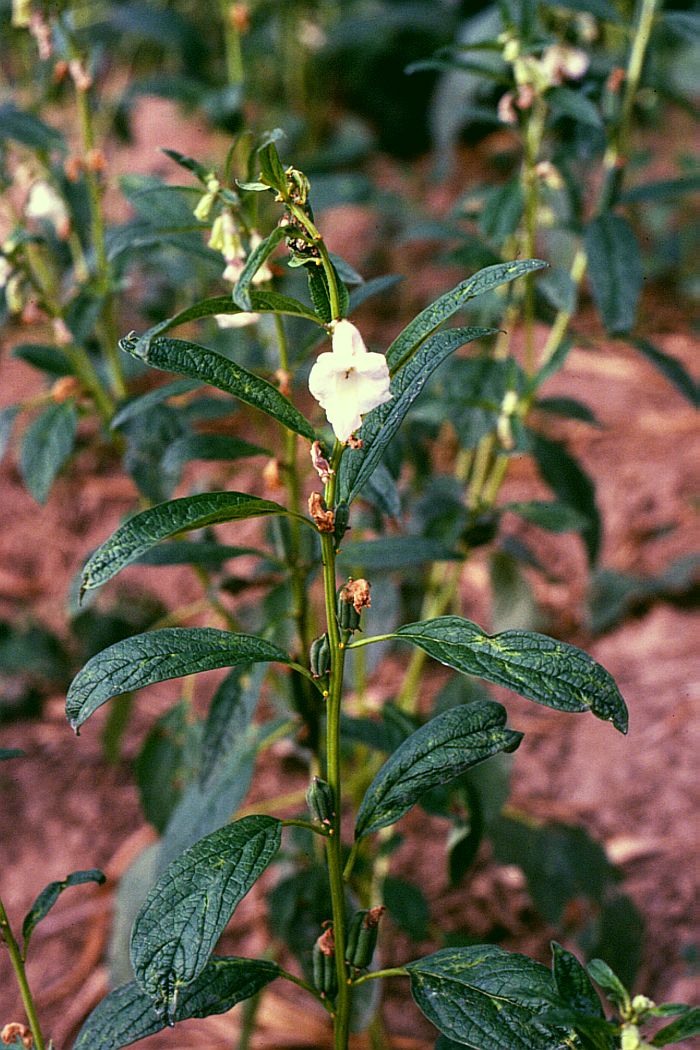 SesameSesamum indicum
-
 Wingseed SesameSesamum alatum
-
 Mousetrap TreeUncarina grandidieri
Compare
Questions and answers
What is the scientific name of the Namib Sesamebush?
The scientific name of the Namib Sesamebush is Sesamothamnus leistneri. Written with its author, the full name is Sesamothamnus leistneri P.Craven ex Swanepoel & A.E.van Wyk.
Which family does the Namib Sesamebush belong to?
Sesamothamnus leistneri belongs to the family Pedaliaceae, in the order Lamiales and the class Magnoliopsida.
Where is the Namib Sesamebush found?
Checklists and occurrence records place Sesamothamnus leistneri in 2 countries: Namibia and Angola.
Sources
Data
- Catalogue of Life, 2026-10-16 XR cc by
- Global Biodiversity Information Facility CC BY 4.0
- GeoNames CC BY 4.0
- Within the Catalogue of Life, this name comes from Synonymic Checklists of the Vascular Plants of the World cc by
References
- Craven ex Swanepoel, P., & van Wyk, A. E. (2023). Phytotaxa 626(3): 149 (2023). where the name was published
This species in other databases
Page built on 26 November 2026. See how the catalog is made and all sources and licences.
Cite this page
ScientificNames.org. (2026). Sesamothamnus leistneri (Namib Sesamebush). Retrieved November 26, 2026, from https://scientificnames.org/species/sesamothamnus-leistneri
“Sesamothamnus leistneri (Namib Sesamebush).” ScientificNames.org, 2026, scientificnames.org/species/sesamothamnus-leistneri. Accessed 26 Nov. 2026.
ScientificNames.org. “Sesamothamnus leistneri (Namib Sesamebush).” Accessed November 26, 2026. https://scientificnames.org/species/sesamothamnus-leistneri.
@misc{scientificnames_sesamothamnus_leistneri_namib_sesamebush,
  author = {{ScientificNames.org}},
  title = {Sesamothamnus leistneri (Namib Sesamebush)},
  year = {2026},
  url = {https://scientificnames.org/species/sesamothamnus-leistneri},
  note = {Accessed 2026-11-26}
}