Species · Amphibians
Silverstoneia gutturalis
Silverstoneia gutturalis has no English name on record in the checklists used here. It is a species of amphibian in the family Dendrobatidae (poison dart frog), order Anura. The name dates from 2013.
- Scientific name
- Silverstoneia gutturalis Grant & Myers, 2013
- Genus
- Silverstoneia
- Family
- Dendrobatidae (Poison Dart Frog)
- Order
- Anura
- Class
- Amphibia
- Red List category
- DD Data Deficient
- Name status
- accepted in the Catalogue of Life
Overview
Silverstoneia gutturalis Grant & Myers, 2013 is an amphibian in the family Dendrobatidae, order Anura, and class Amphibia. It occurs in Chocó within the Río Atrato watershed in Colombia. It is suspected to be diurnal, and all known specimens were collected in 1968 and 1970.
Written 27 November 2026 from the sources listed below. Each statement was checked against the passage it cites; statements that could not be supported were removed.
Habitat
Silverstoneia gutturalis inhabits shady lowland forests at elevations between 30 and 450 meters above sea level.[1]
Behaviour
The species is suspected to be diurnal because it has only been recorded during daylight hours.[2]
Reproduction and life cycle
Females are inferred to deposit their eggs on leaf litter. Adult frogs are inferred to transport hatchling tadpoles to water.[3][4]
Conservation
The IUCN classifies Silverstoneia gutturalis as data deficient. Its current population status and the threats affecting it are unknown to scientists.[5][6]
Its habitat is exposed to subsistence logging and gold mining. These activities contribute to water pollution affecting local amphibians.[7][8]
Whether the species is collected for the international pet trade is unknown.[9]
Classification of Silverstoneia gutturalis
| Kingdom | Animalia |
|---|---|
| Phylum | Chordata |
| Subphylum | Vertebrata |
| Infraphylum | Gnathostomata |
| Parvphylum | Osteichthyes |
| Megaclass | Tetrapoda |
| Class | Amphibia (Amphibians) |
| Order | Anura (Frogs) |
| Superfamily | Dendrobatoidea |
| Family | Dendrobatidae (Poison Dart Frog) |
| Subfamily | Colostethinae |
| Genus | Silverstoneia (Rocket Frogs) |
| Species | Silverstoneia gutturalis Grant & Myers, 2013 |
Related species
-
 Rainforest Rocket FrogSilverstoneia flotator
- Boquete Rocket FrogSilverstoneia nubicola
- Silverstoneia minutissima
- Silverstoneia punctiventris
- Urrao Rocket FrogSilverstoneia erasmios
- Silverstoneia dalyi
- Silverstoneia minima
-
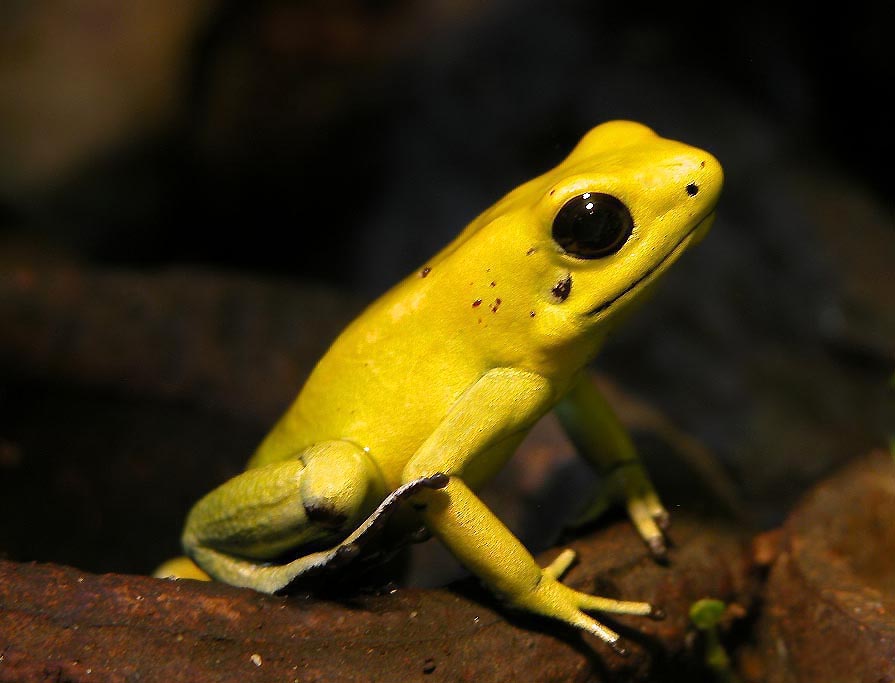 Golden Poison FrogPhyllobates terribilis
Compare
Questions and answers
Where does Silverstoneia gutturalis occur?
It occurs in Chocó within the Río Atrato watershed in Colombia.[10]
What habitat does Silverstoneia gutturalis inhabit?
It inhabits shady lowland forests at elevations between 30 and 450 meters above sea level.[1]
Is Silverstoneia gutturalis diurnal?
It is suspected to be diurnal because it has only been recorded during daylight hours.[2]
How does Silverstoneia gutturalis reproduce?
Females are inferred to deposit their eggs on leaf litter, and adult frogs are inferred to transport hatchling tadpoles to water.[3][4]
What is the conservation status of Silverstoneia gutturalis?
The IUCN classifies the species as data deficient. Its current population status and threats affecting it are unknown to scientists.[5][6]
What activities affect its habitat?
Its habitat is exposed to subsistence logging and gold mining, which contribute to water pollution affecting local amphibians.[7][8]
When were specimens of Silverstoneia gutturalis collected?
All known specimens were collected in 1968 and 1970.[11]
Is Silverstoneia gutturalis collected for the international pet trade?
Whether the species is collected for the international pet trade is unknown.[9]
Sources
Passages the profile rests on
- The species inhabits shady lowland forests at elevations between 30 and 450 meters above sea level. Source passage: “This frog lives in shady lowland forests between 30 and 450 meters above sea level.” — English Wikipedia
- The species is suspected to be diurnal because it has only been recorded during daylight hours. Source passage: “This frog has only been found during the day, so scientists suspect it is diurnal.” — English Wikipedia
- Females are inferred to deposit their eggs on leaf litter. Source passage: “Scientists infer that the female frog lays eggs on the leaf litter” — English Wikipedia
- Adult frogs are inferred to transport hatchling tadpoles to water. Source passage: “after the eggs hatch, the adult frogs carry the tadpoles to water, as other frogs in Silverstoneia do.” — English Wikipedia
- The IUCN classifies Silverstoneia gutturalis as data deficient. Source passage: “The IUCN classifies this frog as data deficient.” — English Wikipedia
- The current population status and threats affecting the species are unknown to scientists. Source passage: “Scientists are unsure of the current state of its population or what threats it faces.” — English Wikipedia
- The species' habitat is exposed to subsistence logging and gold mining. Source passage: “the area where it lives is subject to subsistence logging and gold mining” — English Wikipedia
- Gold mining and logging in the species' habitat contribute to water pollution affecting local amphibians. Source passage: “which puts pollution in the water on which local amphibians rely.” — English Wikipedia
- Whether Silverstoneia gutturalis is collected for the international pet trade is unknown. Source passage: “Scientists do not know if people catch this frog for the international pet trade” — English Wikipedia
- Silverstoneia gutturalis occurs in Colombia, specifically in Chocó within the Río Atrato watershed. Source passage: “It lives in Colombia, in Chocó, in the Río Atrato watershed.” — English Wikipedia
- All known specimens of the species were collected in 1968 and 1970. Source passage: “All specimens were collected in 1968 and 1970.” — English Wikipedia
Data
- Catalogue of Life, 2026-10-16 XR cc by
- Wikidata CC0
- Within the Catalogue of Life, this name comes from The Integrated Taxonomic Information System cc0
References
- Review of the Frog Genus Silverstoneia, with, Descriptions of Five New Species from the Colombian Choco (Dendrobatidae: Colostethinae). (2013). American Museum Novitates, 3784, 1–58. https://doi.org/10.1206/3784.2 Link where the name was published
This species in other databases
Page built on 28 November 2026. See how the catalog is made and all sources and licences.
Cite this page
ScientificNames.org. (2026). Silverstoneia gutturalis. Retrieved November 28, 2026, from https://scientificnames.org/species/silverstoneia-gutturalis
“Silverstoneia gutturalis.” ScientificNames.org, 2026, scientificnames.org/species/silverstoneia-gutturalis. Accessed 28 Nov. 2026.
ScientificNames.org. “Silverstoneia gutturalis.” Accessed November 28, 2026. https://scientificnames.org/species/silverstoneia-gutturalis.
@misc{scientificnames_silverstoneia_gutturalis,
  author = {{ScientificNames.org}},
  title = {Silverstoneia gutturalis},
  year = {2026},
  url = {https://scientificnames.org/species/silverstoneia-gutturalis},
  note = {Accessed 2026-11-28}
}