Species · Amphibians
Silverstoneia punctiventris
Silverstoneia punctiventris has no English name on record in the checklists used here. It is a species of amphibian in the family Dendrobatidae (poison dart frog), order Anura. The name dates from 2013.
- Scientific name
- Silverstoneia punctiventris Grant & Myers, 2013
- Genus
- Silverstoneia
- Family
- Dendrobatidae (Poison Dart Frog)
- Order
- Anura
- Class
- Amphibia
- Red List category
- EN Endangered
- Recorded in
- 1 country
- Name status
- accepted in the Catalogue of Life
Overview
The species is endemic to the Chocó region of Colombia. It has a dark brown dorsum, white lateral stripes, dark throat spots, and a gold-colored iris.
Written 27 November 2026 from the sources listed below. Each statement was checked against the passage it cites; statements that could not be supported were removed.
Habitat
The species inhabits lowland rainforests near clear streams with rocky bottoms. It occurs near Parque Nacional Natural Utría.[1][2]
It has been observed at elevations of 80–200 meters above sea level on Serranía del Baudó.[3]
Appearance
Adult males measure 16.8–17.6 mm in snout-vent length, while adult females measure 17.7–20.3 mm.[4][5]
The frog has a dark brown dorsum with a white stripe along each side of its body. The area between the ribs and hips is dark brown or black, and bronze striping occurs near its lips.[6][7][8]
Its throat and ventrum are white, with dark brown or black spots on the throat. Its iris is gold-colored.[9][10][11]
The hind legs have yellow coloration, and their bottoms are green.[12][13]
Behaviour
The species is terrestrial and diurnal. Males defend egg-laying sites through territorial calling and call to females while perched.[14][15][16]
Reproduction and life cycle
Adult frogs are inferred to carry tadpoles to water after hatching.[17]
Conservation
The IUCN classifies Silverstoneia punctiventris as endangered.[18]
The species may be threatened by deforestation associated with logging, mining, and illegal crops. It may also be collected for sale in the international pet trade.[19][20]
Researchers infer that the species may occur within Parque Nacional Natural Utría.[21]
Classification of Silverstoneia punctiventris
| Kingdom | Animalia |
|---|---|
| Phylum | Chordata |
| Subphylum | Vertebrata |
| Infraphylum | Gnathostomata |
| Parvphylum | Osteichthyes |
| Megaclass | Tetrapoda |
| Class | Amphibia (Amphibians) |
| Order | Anura (Frogs) |
| Superfamily | Dendrobatoidea |
| Family | Dendrobatidae (Poison Dart Frog) |
| Subfamily | Colostethinae |
| Genus | Silverstoneia (Rocket Frogs) |
| Species | Silverstoneia punctiventris Grant & Myers, 2013 |
Where Silverstoneia punctiventris is found
Checklists and occurrence records place Silverstoneia punctiventris in 1 country. GBIF holds 18 georeferenced records of it.
Countries
Regions and cities with the most records
A number beside a place is its count of GBIF occurrence records. A place without a number comes from a checklist alone. Records show where a species has been observed or collected, which can include escapes and vagrants.
Related species
-
 Rainforest Rocket FrogSilverstoneia flotator
- Boquete Rocket FrogSilverstoneia nubicola
- Silverstoneia minutissima
- Urrao Rocket FrogSilverstoneia erasmios
- Silverstoneia dalyi
- Silverstoneia minima
- Silverstoneia gutturalis
-
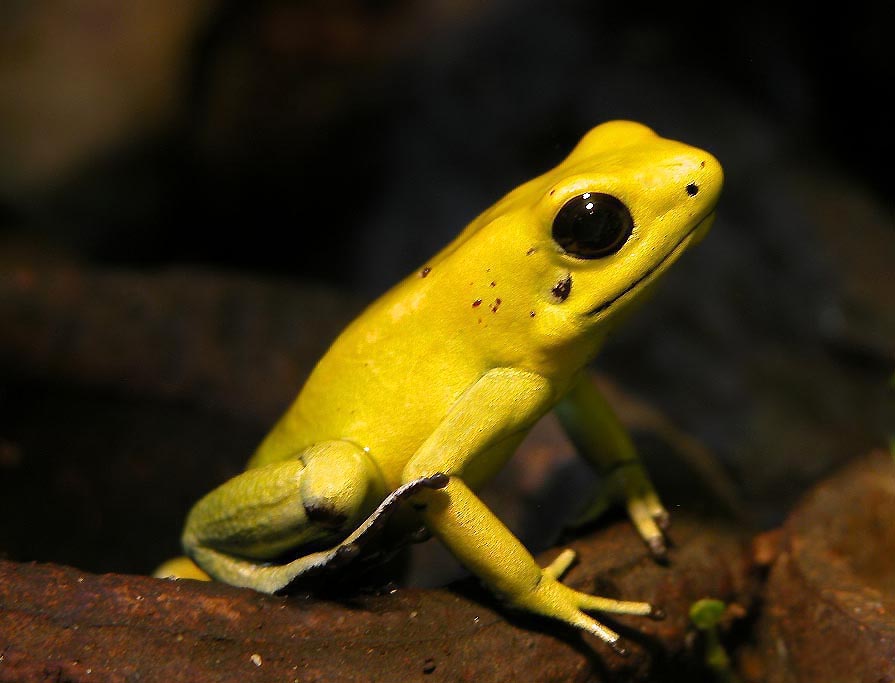 Golden Poison FrogPhyllobates terribilis
Compare
Questions and answers
What does the name punctiventris mean?
The specific name punctiventris refers to the spots on the lower side of the frog's throat.[22]
Sources
Passages the profile rests on
- The species inhabits lowland rainforests near clear streams with rocky bottoms. Source passage: “This terrestrial, diurnal frog lives in lowland rainforests near clear, rocky-bottomed streams” — English Wikipedia
- The species occurs near Parque Nacional Natural Utría. Source passage: “This frog lives near one protected park, Parque Nacional Natural Utría” — English Wikipedia
- The species has been observed at elevations of 80–200 meters above sea level on Serranía del Baudó. Source passage: “It has been observed between 80 and 200 meters above sea level on Serranía del Baudó.” — English Wikipedia
- Adult males measure 16.8–17.6 mm in snout-vent length. Source passage: “The adult male frog measures 16.8 to 17.6 mm (0.66 to 0.69 in) in snout-vent length” — English Wikipedia
- Adult females measure 17.7–20.3 mm in snout-vent length. Source passage: “the adult female frog 17.7 to 20.3 mm (0.70 to 0.80 in).” — English Wikipedia
- The frog has a dark brown dorsum with a white stripe along each side of its body. Source passage: “The skin of the dorsum is dark brown in color with a white stripe on each side of the body” — English Wikipedia
- The area between the ribs and hips is dark brown or black. Source passage: “a dark brown or black color between the ribs and the hips.” — English Wikipedia
- The frog has bronze striping near its lips. Source passage: “There is some bronze striping near the lips.” — English Wikipedia
- The frog has dark brown or black spots on its throat. Source passage: “The skin of the frog's throat has dark brown or black spots” — English Wikipedia
- The frog's ventrum and throat are white. Source passage: “The ventrum and throat are white.” — English Wikipedia
- The frog has a gold-colored iris. Source passage: “The iris of the eye is gold in color.” — English Wikipedia
- The frog has yellow coloration on its hind legs. Source passage: “There is some yellow color on the hind legs” — English Wikipedia
- The bottoms of the frog's hind legs are green. Source passage: “some green color on the bottoms of the hind legs.” — English Wikipedia
- The species is terrestrial and diurnal. Source passage: “This terrestrial, diurnal frog lives in lowland rainforests” — English Wikipedia
- Males defend egg-laying sites through territorial calling. Source passage: “Male frogs are territorial, defending egg-laying sites with their calls.” — English Wikipedia
- Males call to females while perched. Source passage: “They also call to the females from perches.” — English Wikipedia
- Adult frogs are inferred to carry tadpoles to water after hatching. Source passage: “after the eggs hatch, the adult frogs carry the tadpoles to water” — English Wikipedia
- The IUCN classifies Silverstoneia punctiventris as endangered. Source passage: “The IUCN classifies this frog as endangered because of its small range.” — English Wikipedia
- The species may be threatened by deforestation associated with logging, mining, and illegal crops. Source passage: “Deforestation associated with logging, mining, and illegal crops may affect the population.” — English Wikipedia
- The species may be collected for sale in the international pet trade. Source passage: “Scientists also believe that, now that the conflict between the government of Colombia and the guerillas has become less severe, people may capture adult frogs to sell in the international pet trade.” — English Wikipedia
- Researchers infer that the species may occur within Parque Nacional Natural Utría. Source passage: “scientists infer that it may live within its boundaries.” — English Wikipedia
- The specific name punctiventris refers to the spots on the lower side of the frog's throat. Source passage: “Scientists named this frog puncti for "dot" and ventris for "lower side" because of the spots on the lower side of its throat.” — English Wikipedia
- The frog possesses alkaloids and other volatile organic compounds. Source passage: “This frog has alkaloids and other volatile organic compounds.” — English Wikipedia
- Its chemical compounds may poison predators or make the frog taste and smell unpleasant. Source passage: “Scientists believe these chemicals may poison predators or at least make it taste and smell bad.” — English Wikipedia
- Its chemical compounds may function as olfactory camouflage. Source passage: “They also believe the chemicals might serve as olfactory camouflage.” — English Wikipedia
Data
- Catalogue of Life, 2026-10-16 XR cc by
- Global Biodiversity Information Facility CC BY 4.0
- Wikidata CC0
- GeoNames CC BY 4.0
- Within the Catalogue of Life, this name comes from The Integrated Taxonomic Information System cc0
References
- Review of the Frog Genus Silverstoneia, with, Descriptions of Five New Species from the Colombian Choco (Dendrobatidae: Colostethinae). (2013). American Museum Novitates, 3784, 1–58. https://doi.org/10.1206/3784.2 Link where the name was published
This species in other databases
Page built on 27 November 2026. See how the catalog is made and all sources and licences.
Cite this page
ScientificNames.org. (2026). Silverstoneia punctiventris. Retrieved November 27, 2026, from https://scientificnames.org/species/silverstoneia-punctiventris
“Silverstoneia punctiventris.” ScientificNames.org, 2026, scientificnames.org/species/silverstoneia-punctiventris. Accessed 27 Nov. 2026.
ScientificNames.org. “Silverstoneia punctiventris.” Accessed November 27, 2026. https://scientificnames.org/species/silverstoneia-punctiventris.
@misc{scientificnames_silverstoneia_punctiventris,
  author = {{ScientificNames.org}},
  title = {Silverstoneia punctiventris},
  year = {2026},
  url = {https://scientificnames.org/species/silverstoneia-punctiventris},
  note = {Accessed 2026-11-27}
}