Species · Birds
Stub-tailed Antbird Sipia berlepschi
The scientific name of the Stub-tailed Antbird is Sipia berlepschi. It is a species of bird in the family Thamnophilidae (antbird), order Passeriformes. The name dates from 1898.
- Scientific name
- Sipia berlepschi (E. J. O. Hartert, 1898)
- Common name
- Stub-tailed Antbird
- Genus
- Sipia
- Family
- Thamnophilidae (Antbird)
- Order
- Passeriformes
- Class
- Aves
- Red List category
- LC Least Concern
- Recorded in
- 2 countries
- Name status
- accepted in the Catalogue of Life

Overview
Sipia berlepschi occurs in Colombia and Ecuador, from central Chocó Department in western Colombia southward to Esmeraldas Province in northwestern Ecuador. It is characterized by a chunky build, a short tail, and deep red irises in both sexes.
Written 27 November 2026 from the sources listed below. Each statement was checked against the passage it cites; statements that could not be supported were removed.
Appearance
The Stub-tailed Antbird measures between 13.5 and 14.5 cm in length. It has a chunky build and a short tail.[1][2]
Adult males are almost entirely black, with a white patch between their scapulars. Adult females are predominantly black, with white dots on their wing-covert tips and white spots on their throat, breast, and upper belly.[3][4]
The white markings on the female's belly sometimes form a scaly pattern. Both sexes have deep red irises.[5][6]
Habitat
The Stub-tailed Antbird inhabits the understory of evergreen forests in wet lowlands and foothills. It favors forest edges, overgrown forest openings, and adjacent mature secondary forests.[7][8]
It primarily occurs from near sea level to 400 m elevation, with local occurrences reaching 650 m.[9]
Diet
The Stub-tailed Antbird feeds primarily on insects and probably also consumes other arthropods.[10]
Behaviour
Individuals, pairs, and family groups forage in dense vegetation at ground level and up to approximately 2 m above the ground. Their foraging includes searching tangled understory vegetation near fallen logs.[11][12]
The species rarely joins mixed-species feeding flocks. It sometimes follows army ant swarms to capture prey escaping from the ants.[13][14]
The Stub-tailed Antbird is believed to remain in its range throughout the year.[15]
Its song consists of descending notes that initially fall and subsequently rise in pitch. Its calls include a sharp chit sound and a ch-dit sound.[16][17]
Reproduction and life cycle
The breeding biology of the Stub-tailed Antbird is unknown.[18]
Conservation
The IUCN classifies the Stub-tailed Antbird as Least Concern. Its population size is unknown and its population is believed to be stable.[19][20]
No immediate threats to the species have been identified. It is considered uncommon in Colombia and ranges from uncommon to locally fairly common in Ecuador.[21][22][23]
Existing Chocó reserves are concentrated in montane areas, leaving lowlands and lower foothills relatively unprotected. Additional reserves are needed in the lowland and lower foothill elevations of the Chocó region.[24][25]
Classification of the Stub-tailed Antbird
| Kingdom | Animalia |
|---|---|
| Phylum | Chordata |
| Subphylum | Vertebrata |
| Infraphylum | Gnathostomata |
| Parvphylum | Osteichthyes |
| Megaclass | Tetrapoda |
| Class | Aves (Bird) |
| Order | Passeriformes (Passerine) |
| Family | Thamnophilidae (Antbird) |
| Genus | Sipia (Sipia Antbirds) |
| Species | Sipia berlepschi (E. J. O. Hartert, 1898) |
Where the Stub-tailed Antbird is found
Checklists and occurrence records place Sipia berlepschi in 2 countries across South America. GBIF holds 1,681 georeferenced records of it.
Countries
Regions and cities with the most records
- Valle del Cauca Department, Colombia 970
- Buenaventura, Colombia 794
- Esmeraldas, Ecuador 354
- Buenaventura, Colombia 158
- Chocó, Colombia 121
- Pichincha, Ecuador 72
- Nariño, Colombia 64
- Cauca Department, Colombia 54
- Timbiquí, Colombia 37
- Quibdó, Colombia 8
- San Lorenzo de Esmeraldas, Ecuador 6
- Tadó, Colombia 4
Range as the checklists state it
South America
A number beside a place is its count of GBIF occurrence records. A place without a number comes from a checklist alone. Records show where a species has been observed or collected, which can include escapes and vagrants.
Common names
English
- Stub-tailed Antbird
Names in 23 other languages
- Catalan
- formiguera cuacurta
- Chinese
- 短尾蚁鸟, 短尾蟻鳥
- Croatian
- sitnopjegava mravarica
- Czech
- mravenčík krátkochvostý
- Danish
- Korthalet Myrefugl
- Dutch
- Kortstaartmiervogel
- Esperanto
- kurtvosta formikulo
- Finnish
- töpömuura
- French
- Alapi à queue courte, Batara à queue courte
- German
- Kurzschwanz-Ameisenvogel
- Italian
- Formichiere codamozza
- Japanese
- タンビアリドリ
- Lithuanian
- trumpauodegė devynbalsė skruzdinukė
- Norwegian
- chocomaurfugl
- Polish
- czerwonook czarny
- Portuguese
- formigueiro-de-cauda-curta, formigueiro-preto-do-pacífico
- Russian
- Короткохвостая муравьеловка, Чёрная сипия
- Serbian
- Kusorepa mravarka
- Slovak
- mravcovka škvrnochrbtá
- Spanish
- Hormiguero colimocho
- Swedish
- stubbstjärtad myrfågel
- Turkish
- Kısa Kuyruklu Karıncakuşu
- Ukrainian
- покривник узлісний
Synonyms
5 other scientific names have been used for this species and are now treated as synonyms of Sipia berlepschi.
- Pyriglena berlepschi E. J. O. Hartert, 1898
- Sipia berlepschi Stotz et al. (1996)
- Sipia berlepschi berlepschi BirdLife International (2004)
- Thamnophilus cachabiensis Hartert, EJO, 1898
- Myrmeciza berlepschi (E. J. O. Hartert, 1898) ambiguous synonym
Related species
-
 Dull-mantled AntbirdSipia laemosticta
-
 Magdalena AntbirdSipia palliata
-
 Esmeraldas AntbirdSipia nigricauda
-
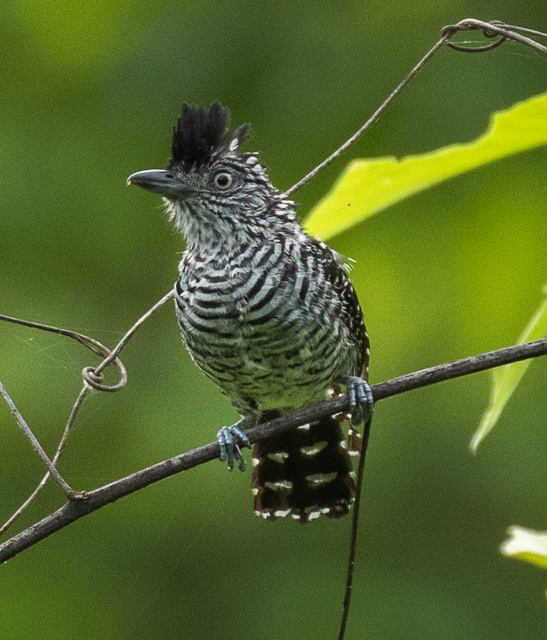 Barred AntshrikeThamnophilus doliatus
-
 Great AntshrikeTaraba major
-
 Black-crowned AntshrikeThamnophilus atrinucha
-
 Ocellated AntbirdPhaenostictus mcleannani
-
 Bicolored AntbirdGymnopithys bicolor
Compare
Questions and answers
What is the scientific name of the Stub-tailed Antbird?
The scientific name of the Stub-tailed Antbird is Sipia berlepschi. Written with its author, the full name is Sipia berlepschi (E. J. O. Hartert, 1898).
Which family does the Stub-tailed Antbird belong to?
Sipia berlepschi belongs to the family Thamnophilidae, in the order Passeriformes and the class Aves.
Where is the Stub-tailed Antbird found?
Checklists and occurrence records place Sipia berlepschi in 2 countries: Colombia and Ecuador.
What is the conservation status of the Stub-tailed Antbird?
The IUCN Red List category recorded for Sipia berlepschi is Least Concern (LC).
Where does the Stub-tailed Antbird occur?
It occurs in Colombia and Ecuador, from central Chocó Department in western Colombia southward to Esmeraldas Province in northwestern Ecuador. It occurs within the Chocó Endemic Bird Area.[26][27][28][29]
How was the Stub-tailed Antbird originally classified?
Ernst Hartert described the species in 1898 under the scientific name Pyriglena berlepschi. It was transferred to the genus Sipia in 1924 and was previously classified under the genus Myrmeciza as Myrmeciza berlepschi.[30][31][32]
What is the origin of the species name?
The species was named in honor of German ornithologist Hans von Berlepsch.[33]
Is the Stub-tailed Antbird monotypic?
Yes. The Stub-tailed Antbird is monotypic.[34]
Sources
Passages the profile rests on
- The stub-tailed antbird measures between 13.5 and 14.5 cm in length. Source passage: “The stub-tailed antbird is 13.5 to 14.5 cm (5.3 to 5.7 in) long.” — English Wikipedia
- The species is characterized by a chunky build and a short tail. Source passage: “Fairly small, chunky, and short-tailed antbird.” — ebird.org
- Adult males are almost entirely black and have a white patch between their scapulars. Source passage: “Adult males are almost entirely black, with a white patch between their scapulars.” — English Wikipedia
- Adult females are predominantly black with white dots on their wing-covert tips and white spots on their throat, breast, and upper belly. Source passage: “Adult females are also mostly black, with white dots on the tips of their wing coverts and white spots on their throat, breast, and upper belly.” — English Wikipedia
- The white markings on the female's belly sometimes form a scaly pattern. Source passage: “Those on the belly sometimes have a scaly pattern.” — English Wikipedia
- Both sexes have deep red irises. Source passage: “Both sexes have a deep red iris.” — English Wikipedia
- The species inhabits the understory of evergreen forests in wet lowlands and foothills. Source passage: “There it inhabits the understorey of evergreen forest in the wet lowlands and foothills.” — English Wikipedia
- The stub-tailed antbird favors forest edges, overgrown forest openings, and adjacent mature secondary forests. Source passage: “It favors the forest edge, overgrown openings within the forest, and adjacent mature secondary forest.” — English Wikipedia
- The species primarily occurs from near sea level to 400 m elevation, with local occurrences reaching 650 m. Source passage: “In elevation it mostly ranges from near sea level to 400 m (1,300 ft), though locally it reaches 650 m (2,100 ft).” — English Wikipedia
- The species feeds primarily on insects and probably also consumes other arthropods. Source passage: “The stub-tailed antbird feeds primarily on insects and probably includes other arthropods in its diet.” — English Wikipedia
- Individuals, pairs, and family groups forage in dense vegetation at ground level and up to approximately 2 m above the ground. Source passage: “Individuals, pairs, and family groups forage in dense vegetation on the ground and up to about 2 m (7 ft) above it.” — English Wikipedia
- Its foraging behavior includes searching tangled understory vegetation near fallen logs. Source passage: “distinctive foraging behaviour in tangled understory near fallen logs” — English Wikipedia
- The species rarely joins mixed-species feeding flocks. Source passage: “It seldom joins mixed-species feeding flocks” — English Wikipedia
- The stub-tailed antbird sometimes follows army ant swarms to capture prey escaping from the ants. Source passage: “but sometimes attends army ant swarms to capture prey that flees from the ants.” — English Wikipedia
- The species is believed to remain in its range throughout the year. Source passage: “The stub-tailed antbird is believed to be a year-round resident throughout its range.” — English Wikipedia
- The species' song consists of descending notes that initially fall and subsequently rise in pitch. Source passage: “a series of downslurred notes that first drop and then rise in pitch” — English Wikipedia
- Its calls include a sharp chit sound and a ch-dit sound. Source passage: “Its calls include "a sharp 'chit' and a 'ch-dit' "” — English Wikipedia
- The breeding biology of the stub-tailed antbird is unknown. Source passage: “Nothing is known about the stub-tailed antbird's breeding biology.” — English Wikipedia
- The IUCN classifies the stub-tailed antbird as Least Concern. Source passage: “The IUCN has assessed the stub-tailed antbird as being of Least Concern.” — English Wikipedia
- The species' population size is unknown and its population is believed to be stable. Source passage: “Its population size is not known and is believed to be stable.” — English Wikipedia
- No immediate threats to the species have been identified. Source passage: “No immediate threats have been identified.” — English Wikipedia
- The species is considered uncommon in Colombia. Source passage: “It is considered uncommon in Colombia” — English Wikipedia
- In Ecuador, the species ranges from uncommon to locally fairly common. Source passage: “uncommon to locally fairly common in Ecuador.” — English Wikipedia
- Existing Chocó reserves are concentrated in montane areas, leaving lowlands and lower foothills relatively unprotected. Source passage: “Most existing Chocó reserves are centred on montane areas, leaving the biologically diverse lowlands and lower foothills relatively unprotected.” — English Wikipedia
- Additional reserves are needed in the lowland and lower foothill elevations of the Chocó region. Source passage: “Establishment of more reserves in this elevational zone is needed.” — English Wikipedia
- The stub-tailed antbird occurs in Colombia and Ecuador. Source passage: “It is found in Colombia and Ecuador.” — English Wikipedia
- Its range extends from central Chocó Department in western Colombia southward to Esmeraldas Province in northwestern Ecuador. Source passage: “The stub-tailed antbird is found from central Chocó Department in western Colombia, south into northwestern Ecuador's Esmeraldas Province.” — English Wikipedia
- The stub-tailed antbird occurs within the Chocó Endemic Bird Area. Source passage: “It is a bird of the Chocó Endemic Bird Area.” — English Wikipedia
- The stub-tailed antbird is recorded from both Colombia and Ecuador. Source passage: “It is found in Colombia and Ecuador.” — inaturalist.org
- Ernst Hartert described the species in 1898 under the scientific name Pyriglena berlepschi. Source passage: “It was described by the German ornithologist Ernst Hartert in 1898 and given the binomial name Pyriglena berlepschi.” — English Wikipedia
- The species was transferred to the genus Sipia in 1924. Source passage: “In 1924 it was moved to genus Sipia” — English Wikipedia
- The species was previously classified under the genus Myrmeciza in the combination Myrmeciza berlepschi. Source passage: “Sipia berlepschi (del Hoyo and Collar 2016) was previously listed as Myrmeciza berlepschi.” — datazone.birdlife.org
- The species was named in honor of German ornithologist Hans von Berlepsch. Source passage: “The species was named to honor the German ornithologist Hans von Berlepsch.” — English Wikipedia
- The stub-tailed antbird is monotypic. Source passage: “The stub-tailed antbird is monotypic.” — English Wikipedia
Data
- Catalogue of Life, 2026-10-16 XR cc by
- Global Biodiversity Information Facility CC BY 4.0
- Wikidata CC0
- GeoNames CC BY 4.0
- Wikimedia Commons per image; credit shown with each image
- Within the Catalogue of Life, this name comes from The Integrated Taxonomic Information System cc0
This species in other databases
Page built on 27 November 2026. See how the catalog is made and all sources and licences.
Cite this page
ScientificNames.org. (2026). Sipia berlepschi (Stub-tailed Antbird). Retrieved November 27, 2026, from https://scientificnames.org/species/sipia-berlepschi
“Sipia berlepschi (Stub-tailed Antbird).” ScientificNames.org, 2026, scientificnames.org/species/sipia-berlepschi. Accessed 27 Nov. 2026.
ScientificNames.org. “Sipia berlepschi (Stub-tailed Antbird).” Accessed November 27, 2026. https://scientificnames.org/species/sipia-berlepschi.
@misc{scientificnames_sipia_berlepschi_stub_tailed_antbird,
  author = {{ScientificNames.org}},
  title = {Sipia berlepschi (Stub-tailed Antbird)},
  year = {2026},
  url = {https://scientificnames.org/species/sipia-berlepschi},
  note = {Accessed 2026-11-27}
}