Species · Birds
Dull-mantled Antbird Sipia laemosticta
The scientific name of the Dull-mantled Antbird is Sipia laemosticta. It is a species of bird in the family Thamnophilidae (antbird), order Passeriformes. The name dates from 1865.
- Scientific name
- Sipia laemosticta (Salvin, 1865)
- Common name
- Dull-mantled Antbird
- Genus
- Sipia
- Family
- Thamnophilidae (Antbird)
- Order
- Passeriformes
- Class
- Aves
- Red List category
- LC Least Concern
- Recorded in
- 2 countries
- Name status
- accepted in the Catalogue of Life

Overview
The Dull-mantled Antbird is a bird measuring 12.5–15.0 cm in length and weighing approximately 25 g. It occurs in Colombia, Costa Rica, and Panama, inhabiting wet foothill evergreen forests and lowland habitats. Adult males are distinguished by blackish-gray to slate-black heads, necks, and upper mantles, black throats and chins, and red irises.
Written 27 November 2026 from the sources listed below. Each statement was checked against the passage it cites; statements that could not be supported were removed.
Appearance
Adult males have blackish-gray to slate-black heads, necks, and upper mantles. Their remaining upperparts are dark reddish-brown, chestnut, or olive, and they usually have a concealed white patch between their scapulars.[1][2][3]
Adult females have gray areas that are less blackish than those of males and a smaller interscapular patch. Their black throats have numerous white spots or bars.[4][5][6]
Both sexes have red irises and gray legs and feet. Young males have brown coloration on their heads and faint buff mottling on their throats.[7][8]
Similar species
The Esmeraldas antbird (Sipia nigricauda) appears to be its closest relative. The Magdalena antbird was formerly considered conspecific with the Dull-mantled Antbird.[9][10]
Habitat
The Dull-mantled Antbird primarily inhabits the forest floor and understory of wet foothill evergreen forests. It also occurs in lowland habitats.[11][12]
It favors densely vegetated ravines and slopes beside streams. It also inhabits regenerating vegetation in landslide scars and tree-fall openings.[13][14]
In Costa Rica, it occurs along the Caribbean slope from the Cordillera de Guanacaste southward, at elevations of 300–900 m. In Panama, it occurs on both Caribbean and Pacific slopes, from near sea level to 1,000 m.[15][16][17][18]
Its Panamanian distribution includes Bocas del Toro and Veraguas provinces and extends from Guna Yala south to Colombia. At least one sighting has been documented in extreme northwestern Colombia.[19][20]
Diet
The Dull-mantled Antbird feeds on insects and other arthropods, including spiders.[21]
Behaviour
The Dull-mantled Antbird remains resident throughout its range throughout the year. Individuals, pairs, and family groups forage mainly on the ground in dense vegetation and also forage in vegetation up to approximately 1 m above the ground.[22][23][24]
It captures prey by gleaning vegetation, picking prey from leaf litter, and making short jumps or flutter flights. It seldom participates in mixed-species feeding flocks.[25][26]
It occasionally attends army ant swarms to catch prey escaping from the ants.[27]
Reproduction and life cycle
The breeding season has not been fully defined, but breeding in Costa Rica includes at least April and May. The only documented nests were found in Costa Rica.[28][29]
The nests are cup-shaped structures woven from several kinds of relatively coarse plant fibers. Some have moss on their exterior and are lined with finer fibers.[30][31]
Nests have been found within 1 m of the ground in small shrubs or saplings near watercourses. Two documented nests each contained two eggs.[32][33]
Documented egg colors include white with cinnamon markings and pinkish with cinnamon and lavender markings.[34]
Conservation
The IUCN assesses the Dull-mantled Antbird as Least Concern. The most recent IUCN Red List assessment was conducted in 2025.[35][36]
Its population size is unknown and is believed to be decreasing. No immediate threats have been identified.[37][38]
The species is considered fairly common in Costa Rica and eastern Panama, although its distribution is patchy.[39]
Classification of the Dull-mantled Antbird
| Kingdom | Animalia |
|---|---|
| Phylum | Chordata |
| Subphylum | Vertebrata |
| Infraphylum | Gnathostomata |
| Parvphylum | Osteichthyes |
| Megaclass | Tetrapoda |
| Class | Aves (Bird) |
| Order | Passeriformes (Passerine) |
| Family | Thamnophilidae (Antbird) |
| Genus | Sipia (Sipia Antbirds) |
| Species | Sipia laemosticta (Salvin, 1865) |
Where the Dull-mantled Antbird is found
Checklists and occurrence records place Sipia laemosticta in 2 countries across North America. GBIF holds 10,040 georeferenced records of it.
Countries
Regions and cities with the most records
- Alajuela Province, Costa Rica 5,647
- Turrialba, Costa Rica 2,134
- Cartago Province, Costa Rica 2,131
- Limón Province, Costa Rica 577
- Guápiles, Costa Rica 551
- Panamá Oeste Province, Panama 537
- Paraíso, Costa Rica 466
- Quesada, Costa Rica 310
- Darién, Panama 220
- Coclé, Panama 192
- Guanacaste Province, Costa Rica 121
- Heredia Province, Costa Rica 89
- San José, Costa Rica 68
- Chilibre, Panama 54
- Alcalde Díaz, Panama 52
- Panamá, Panama 46
- Colón, Panama 40
- Siquirres, Costa Rica 40
- Veraguas Province, Panama 25
- Cartago, Costa Rica 18
- Arraiján, Panama 11
- Ancón, Panama 10
- Chiriquí Province, Panama 10
- Curundú, Panama 10
- Panama City, Panama 10
- Bocas del Toro Province, Panama 6
- Liberia, Costa Rica 5
- San Miguelito, Panama 5
- Embera, Panama 4
- Cativá, Panama 3
1 more country has a few records outside this range
These countries hold a few records of Sipia laemosticta but lie outside the range the checklists give for it. Such records are often zoo or garden specimens, museum material or vagrants, so the species is not counted as occurring there.
Range as the checklists state it
Middle America
A number beside a place is its count of GBIF occurrence records. A place without a number comes from a checklist alone. Records show where a species has been observed or collected, which can include escapes and vagrants.
Common names
English
- Dull-mantled Antbird
Names in 23 other languages
- Catalan
- Formiguer fluvial septentrional, formiguera d'ales brunes
- Chinese
- 暗背蚁鸟, 暗背蟻鳥
- Croatian
- sivoprsa mravarica
- Czech
- mravenčík hnědokřídlý
- Danish
- Mørkrygget Myrefugl
- Dutch
- Grijskruinmiervogel
- Esperanto
- brunflugila formikulo
- Finnish
- rotkomuura
- French
- Alapi tabac, Batara tabac
- German
- Grauscheitel-Ameisenvogel
- Italian
- Formichiere mantoscialbo, Mangiaformiche mantoscialbo
- Japanese
- メスボシアリドリ
- Lithuanian
- kostarikinė devynbalsė skruzdinukė
- Norwegian
- rødøyemaurfugl
- Norwegian Bokmål
- rufsebrystmaurfugl
- Polish
- czerwonook śniady
- Portuguese
- formigueiro-de-peito-preto, guarda-ribeira-ocidental
- Russian
- Табачная славковая муравьянка, Темноспинная муравьеловка
- Slovak
- mravcovka hnedochrbtá
- Spanish
- Homiguero guardarribera occidental, Hormiguero Alimaculado, Hormiguero guardarribera
- Swedish
- mörkryggig myrfågel
- Turkish
- Boz Kanatlı Karıncakuşu
- Ukrainian
- покривник бурий
Synonyms
3 other scientific names have been used for this species and are now treated as synonyms of Sipia laemosticta.
- Myrmeciza laemosticta Salvin, 1865
- Myrmeciza laemosticta laemosticta Salvin, O, 1865
- Myrmeciza stictoptera Lawrence, GN, 1865
Related species
-
 Stub-tailed AntbirdSipia berlepschi
-
 Magdalena AntbirdSipia palliata
-
 Esmeraldas AntbirdSipia nigricauda
-
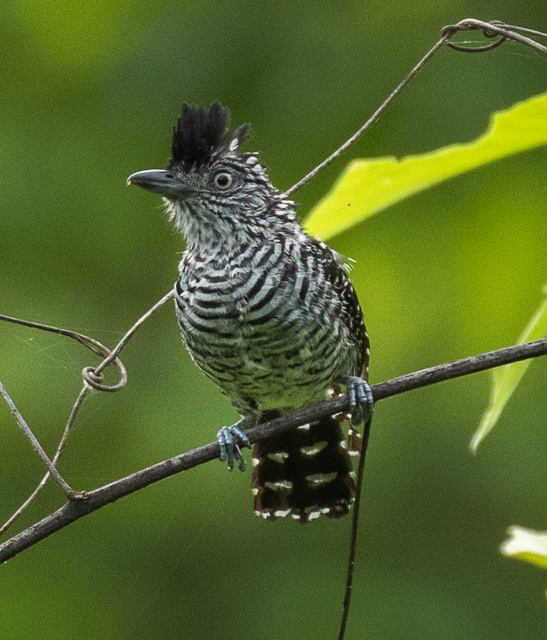 Barred AntshrikeThamnophilus doliatus
-
 Great AntshrikeTaraba major
-
 Black-crowned AntshrikeThamnophilus atrinucha
-
 Ocellated AntbirdPhaenostictus mcleannani
-
 Bicolored AntbirdGymnopithys bicolor
Compare
Questions and answers
What is the scientific name of the Dull-mantled Antbird?
The scientific name of the Dull-mantled Antbird is Sipia laemosticta. Written with its author, the full name is Sipia laemosticta (Salvin, 1865).
Which family does the Dull-mantled Antbird belong to?
Sipia laemosticta belongs to the family Thamnophilidae, in the order Passeriformes and the class Aves.
Where is the Dull-mantled Antbird found?
Checklists and occurrence records place Sipia laemosticta in 2 countries: Costa Rica and Panama.
What is the conservation status of the Dull-mantled Antbird?
The IUCN Red List category recorded for Sipia laemosticta is Least Concern (LC).
Sources
Passages the profile rests on
- Adult males have a blackish-gray to slate-black head, neck, and upper mantle. Source passage: “Adult males have a blackish gray to slate-black head, neck, and upper mantle.” — English Wikipedia
- Adult males have dark reddish-brown, chestnut, or olive remaining upperparts. Source passage: “The rest of their upperparts are dark reddish brown, chestnut, or olive” — English Wikipedia
- Adult males usually have a concealed white patch between their scapulars. Source passage: “with a usually hidden white patch between their scapulars.” — English Wikipedia
- Adult females have gray areas that are less blackish than those of males. Source passage: “Adult females are similar to males with gray areas that are somewhat less blackish than the male's.” — English Wikipedia
- Adult females have a smaller interscapular patch than males. Source passage: “Their interscapular patch is much smaller than the male's.” — English Wikipedia
- Adult females have black throats with numerous white spots or bars. Source passage: “Their throat is black with many white spots or bars.” — English Wikipedia
- Both sexes have red irises and gray legs and feet. Source passage: “Both sexes have a red iris and gray legs and feet.” — English Wikipedia
- Young males have brown coloration on their heads and faint buff mottling on their throats. Source passage: “Young males have a brown wash on their head, faint buff mottling on their throat” — English Wikipedia
- The Esmeraldas antbird (Sipia nigricauda) appears to be its closest relative. Source passage: “The dull-mantled antbird's closest relative appears to be the Esmeraldas antbird (S. nigricauda).” — English Wikipedia
- The Magdalena antbird was formerly considered conspecific with the dull-mantled antbird. Source passage: “What is now the Magdalena antbird (S. palliata) was previously considered conspecific with the dull-mantled antbird” — English Wikipedia
- The species primarily inhabits the forest floor and understory of wet foothill evergreen forests. Source passage: “The species primarily inhabits the floor and understorey of wet foothills evergreen forest” — English Wikipedia
- The species also occurs in lowland habitats. Source passage: “and also occurs in lowlands.” — English Wikipedia
- The species favors densely vegetated ravines and slopes beside streams. Source passage: “It favors ravines and slopes along streams with dense vegetation” — English Wikipedia
- The species also inhabits regenerating vegetation in landslide scars and tree-fall openings. Source passage: “and also regenerating vegetation in landslide scars and tree-fall openings.” — English Wikipedia
- In Costa Rica, the species occurs along the Caribbean slope from the Cordillera de Guanacaste southward. Source passage: “It is found in Costa Rica on the Caribbean slope from the Cordillera de Guanacaste south” — English Wikipedia
- In Costa Rica, the species occurs at elevations of 300–900 m. Source passage: “at elevations between 300 and 900 m (1,000 and 3,000 ft).” — English Wikipedia
- In Panama, the species occurs on both Caribbean and Pacific slopes. Source passage: “In Panama it occurs on both the Caribbean and Pacific slopes” — English Wikipedia
- In Panama, the species ranges from near sea level to 1,000 m elevation. Source passage: “In Panama it ranges from near sea level to 1,000 m (3,300 ft).” — English Wikipedia
- Its Panamanian distribution includes Bocas del Toro and Veraguas provinces and extends from Guna Yala south to Colombia. Source passage: “in Bocas del Toro and Veraguas provinces and from Guna Yala south to Colombia.” — English Wikipedia
- At least one sighting has been documented in extreme northwestern Colombia. Source passage: “At least one sighting has been documented in extreme northwestern Colombia.” — English Wikipedia
- The species feeds on insects and other arthropods, including spiders. Source passage: “The dull-mantled antbird feeds on insects and other arthropods like spiders.” — English Wikipedia
- The species remains resident throughout its range throughout the year. Source passage: “The dull-mantled antbird is a year-round resident throughout its range.” — English Wikipedia
- Individuals, pairs, and family groups forage mainly on the ground in dense vegetation. Source passage: “Individuals, pairs, and family groups forage in dense vegetation mostly on the ground” — English Wikipedia
- The species also forages in vegetation up to approximately 1 m above the ground. Source passage: “and also up to about 1 m (3 ft) above it.” — English Wikipedia
- The species captures prey by gleaning vegetation, picking prey from leaf litter, and making short jumps or flutter flights. Source passage: “It captures prey by gleaning vegetation while perched, by picking from leaf litter, or with a jump or a short flutter flight to overhanging vegetation.” — English Wikipedia
- The species seldom participates in mixed-species feeding flocks. Source passage: “It seldom joins mixed-species feeding flocks” — English Wikipedia
- The species occasionally attends army ant swarms to catch prey escaping from the ants. Source passage: “but occasionally attends army ant swarms to capture prey that flees from the ants.” — English Wikipedia
- The breeding season has not been fully defined, but breeding in Costa Rica includes at least April and May. Source passage: “The dull-mantled antbird's breeding season has not been defined but in Costa Rica includes at least April and May.” — English Wikipedia
- The only documented nests were found in Costa Rica. Source passage: “The only known nests were found in Costa Rica.” — English Wikipedia
- The nests are cup-shaped structures woven from several kinds of relatively coarse plant fibers. Source passage: “They were cups woven of several kinds of somewhat coarse plant fibers” — English Wikipedia
- Some nests have moss on their exterior and are lined with finer fibers. Source passage: “sometimes with moss on the outside, and lined with finer fibers.” — English Wikipedia
- Nests have been found within 1 m of the ground in small shrubs or saplings near watercourses. Source passage: “They were within 1 m (3 ft) of the ground in small shrubs or saplings near watercourses.” — English Wikipedia
- Two documented nests each contained two eggs. Source passage: “Two of the nests each held two eggs;” — English Wikipedia
- Documented egg colors include white with cinnamon markings and pinkish with cinnamon and lavender markings. Source passage: “in one they were white with cinnamon markings and in the other were pinkish with cinnamon and lavender markings.” — English Wikipedia
- The IUCN assesses the species as Least Concern. Source passage: “The IUCN has assessed the dull-mantled antbird as being of Least Concern.” — English Wikipedia
- The IUCN Red List assessment for the species was most recently conducted in 2025. Source passage: “Sipia laemosticta has most recently been assessed for The IUCN Red List of Threatened Species in 2025.” — iucnredlist.org
- The species' population size is unknown and is believed to be decreasing. Source passage: “Its population size is not known and is believed to be decreasing.” — English Wikipedia
- No immediate threats have been identified for the species. Source passage: “No immediate threats have been identified.” — English Wikipedia
- The species is considered fairly common in Costa Rica and eastern Panama, although its distribution is patchy. Source passage: “It is considered fairly common in Costa Rica and in eastern Panama though patchily distributed across its range.” — English Wikipedia
Data
- Catalogue of Life, 2026-10-16 XR cc by
- Global Biodiversity Information Facility CC BY 4.0
- Wikidata CC0
- GeoNames CC BY 4.0
- Wikimedia Commons per image; credit shown with each image
- Within the Catalogue of Life, this name comes from The Integrated Taxonomic Information System cc0
This species in other databases
Page built on 29 November 2026. See how the catalog is made and all sources and licences.
Cite this page
ScientificNames.org. (2026). Sipia laemosticta (Dull-mantled Antbird). Retrieved November 29, 2026, from https://scientificnames.org/species/sipia-laemosticta
“Sipia laemosticta (Dull-mantled Antbird).” ScientificNames.org, 2026, scientificnames.org/species/sipia-laemosticta. Accessed 29 Nov. 2026.
ScientificNames.org. “Sipia laemosticta (Dull-mantled Antbird).” Accessed November 29, 2026. https://scientificnames.org/species/sipia-laemosticta.
@misc{scientificnames_sipia_laemosticta_dull_mantled_antbird,
  author = {{ScientificNames.org}},
  title = {Sipia laemosticta (Dull-mantled Antbird)},
  year = {2026},
  url = {https://scientificnames.org/species/sipia-laemosticta},
  note = {Accessed 2026-11-29}
}