Species · Insects
Spathoschiza debilis
Spathoschiza debilis has no English name on record in the checklists used here. It is a species of insect in the family Scarabaeidae (dung beetles), order Coleoptera. The name dates from 1902.
- Scientific name
- Spathoschiza debilis Arrow, 1902
- Genus
- Spathoschiza
- Family
- Scarabaeidae (Dung Beetles)
- Order
- Coleoptera
- Class
- Insecta
- Recorded in
- 1 country
- Name status
- accepted in the Catalogue of Life
Overview
Spathoschiza debilis occurs in Zimbabwe. It is characterized by pale testaceous coloration, a reddish head, a flavescent antennal club, and cylindrical elytra with deep, evenly spaced punctures.
Written 28 November 2026 from the sources listed below. Each statement was checked against the passage it cites; statements that could not be supported were removed.
Appearance
Adult individuals reach approximately 9 mm in length. They have a pale testaceous coloration, a somewhat reddish head, and a flavescent antennal club.[1][2]
The adults have sparse, short, flavescent hairs that are somewhat longer on the underside. The pronotum has fine crenulations and sharply defined posterior angles.[3][4]
The pronotum is densely and relatively deeply punctured, with each puncture bearing a short, setulose hair. The elytra are cylindrical and only slightly wider at their bases than the base of the pronotum.[5][6]
The elytra bear deep, evenly spaced, setigerous punctures separated by intervals approximately equal to their own diameter. The pygidium is deeply and relatively densely punctured and fringed with long hairs.[7][8]
The entire underside is deeply and relatively densely punctured.[9]
Classification of Spathoschiza debilis
| Kingdom | Animalia |
|---|---|
| Phylum | Arthropoda |
| Subphylum | Hexapoda |
| Class | Insecta (Insect) |
| Order | Coleoptera (Beetle) |
| Suborder | Polyphaga |
| Series | Staphyliniformia |
| Superfamily | Scarabaeoidea |
| Family | Scarabaeidae (Dung Beetles) |
| Subfamily | Melolonthinae |
| Tribe | Melolonthini |
| Genus | Spathoschiza |
| Species | Spathoschiza debilis Arrow, 1902 |
Where Spathoschiza debilis is found
Checklists and occurrence records place Spathoschiza debilis in 1 country across Africa. GBIF holds 2 georeferenced records of it.
Countries
Range as the checklists state it
Afrotropical(Zimbabwe)
A number beside a place is its count of GBIF occurrence records. A place without a number comes from a checklist alone. Records show where a species has been observed or collected, which can include escapes and vagrants.
Related species
-
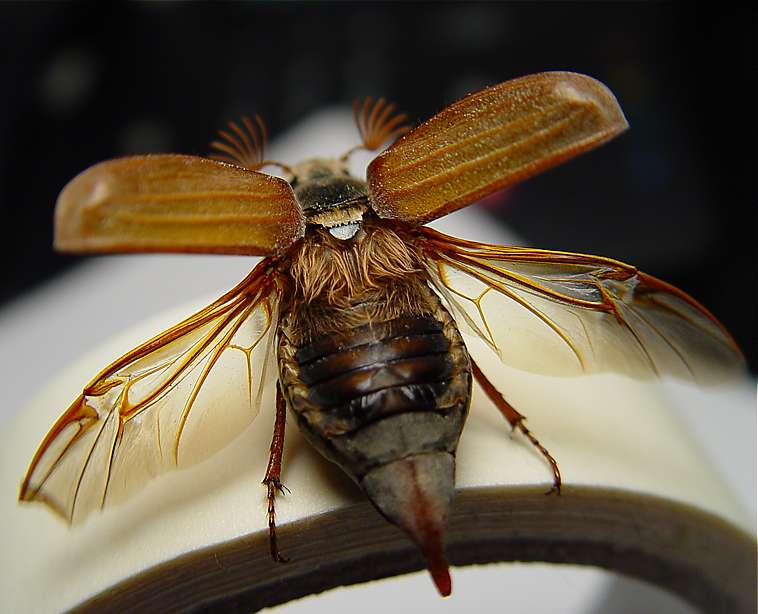 CockchaferMelolontha melolontha
-
 Hercules BeetleDynastes (Dynastes) hercules
-
 Japanese BeetlePopillia japonica
-
 Japanese Rhinoceros BeetleTrypoxylus dichotomus
-
 Sacred ScarabScarabaeus sacer
-
 Figeater BeetleCotinis (Cotinis) mutabilis
-
 Atlas BeetleChalcosoma atlas
-
 Coconut Rhinoceros BeetleOryctes (Rykanes) rhinoceros
Compare
Questions and answers
Where does Spathoschiza debilis occur?
It occurs in Zimbabwe.[10]
How large are adult Spathoschiza debilis?
Adult individuals reach approximately 9 mm in length.[1]
What coloration do the adults have?
They have a pale testaceous coloration, a somewhat reddish head, and a flavescent antennal club.[2]
What are the characteristics of the pronotum?
The pronotum has fine crenulations, sharply defined posterior angles, and dense, relatively deep punctures, each bearing a short, setulose hair.[4][5]
What are the characteristics of the elytra?
The elytra are cylindrical and only slightly wider at their bases than the base of the pronotum. They bear deep, evenly spaced, setigerous punctures separated by intervals approximately equal to their own diameter.[6][7]
What are the characteristics of the pygidium?
The pygidium is deeply and relatively densely punctured and fringed with long hairs.[8]
Sources
Passages the profile rests on
- Adult individuals reach approximately 9 mm in length. Source passage: “Adults reach a length of about 9 mm (0.35 in).” — English Wikipedia
- Adults have a pale testaceous coloration, a somewhat reddish head, and a flavescent antennal club. Source passage: “They are pale testaceous, with the head somewhat reddish and the antennal club flavescent.” — English Wikipedia
- The adults have sparse, short hairs that are flavescent and somewhat longer on the underside. Source passage: “They are briefly but not densely pilose, with the hairs flavescent and somewhat longer on the under side.” — English Wikipedia
- The pronotum has fine crenulations and sharply defined posterior angles. Source passage: “The pronotum is finely crenulate and the posterior angles are sharp.” — English Wikipedia
- The pronotum is densely and relatively deeply punctured, with each puncture bearing a short, setulose hair. Source passage: “It is closely and somewhat deeply punctate, all the punctures bearing a short, setulose hair.” — English Wikipedia
- The elytra are cylindrical and only slightly wider at their bases than the base of the pronotum. Source passage: “The elytra are cylindrical, very little wider at the base than the base of the pronotum” — English Wikipedia
- The elytra bear deep, evenly spaced, setigerous punctures separated by intervals approximately equal to their own diameter. Source passage: “covered with deep, equi-distant, setigerous punctures, separated by an interval about equal in width to their own diameter.” — English Wikipedia
- The pygidium is deeply and relatively densely punctured and fringed with long hairs. Source passage: “The pygidium is deeply and somewhat closely punctate and fringed with long hairs.” — English Wikipedia
- The entire underside is deeply and relatively densely punctured. Source passage: “The underside is deeply and somewhat closely punctured all over.” — English Wikipedia
- Spathoschiza debilis occurs in Zimbabwe. Source passage: “which is found in Zimbabwe.” — English Wikipedia
Data
- Catalogue of Life, 2026-10-16 XR cc by
- Global Biodiversity Information Facility CC BY 4.0
- Wikidata CC0
- GeoNames CC BY 4.0
- Within the Catalogue of Life, this name comes from World Scarabaeidae Database cc by
References
- Arrow, G. J. (1902). On Rutelid and Melolonthid Beetles from Mashonaland and East Africa. The Annals and Magazine of Natural History, Including Zoology, Botany and Geology, London 7(9):89-101. https://doi.org/10.1080/00222930208678551 Link where the name was published
This species in other databases
Page built on 29 November 2026. See how the catalog is made and all sources and licences.
Cite this page
ScientificNames.org. (2026). Spathoschiza debilis. Retrieved November 29, 2026, from https://scientificnames.org/species/spathoschiza-debilis
“Spathoschiza debilis.” ScientificNames.org, 2026, scientificnames.org/species/spathoschiza-debilis. Accessed 29 Nov. 2026.
ScientificNames.org. “Spathoschiza debilis.” Accessed November 29, 2026. https://scientificnames.org/species/spathoschiza-debilis.
@misc{scientificnames_spathoschiza_debilis,
  author = {{ScientificNames.org}},
  title = {Spathoschiza debilis},
  year = {2026},
  url = {https://scientificnames.org/species/spathoschiza-debilis},
  note = {Accessed 2026-11-29}
}