Species · Flowering plants
Field Woundwort Stachys arvensis
The scientific name of the Field Woundwort is Stachys arvensis. It is a species of flowering plant in the family Lamiaceae (mint family), order Lamiales.
- Scientific name
- Stachys arvensis (L.) L.
- Common name
- Field Woundwort
- Genus
- Stachys
- Family
- Lamiaceae (Mint Family)
- Order
- Lamiales
- Class
- Magnoliopsida
- Recorded in
- 70 countries
- Name status
- accepted in the Catalogue of Life

Overview
Stachys arvensis is native to Europe, Western Asia, and North Africa and occurs as an introduced plant on other continents.
Written 26 November 2026 from the sources listed below. Each statement was checked against the passage it cites; statements that could not be supported were removed.
Appearance
Field woundwort grows with either a sprawling or an erect habit. Its pale green, branched, square stems have sparse glandular hairs and can reach 45 cm in length.[1][2][3]
The plant has short, white, fibrous roots concentrated at its base, sometimes extending along horizontal stems near the base. Its leaves are arranged in opposite, decussate pairs and have no stipules.[4][5]
The leaf petioles can reach 4 cm in length, and the simple, oval blades can reach 4 cm. Each side of a blade has between seven and twelve rounded teeth; the upper surface is dull, medium green, while the underside is paler.[6][7][8][9][10]
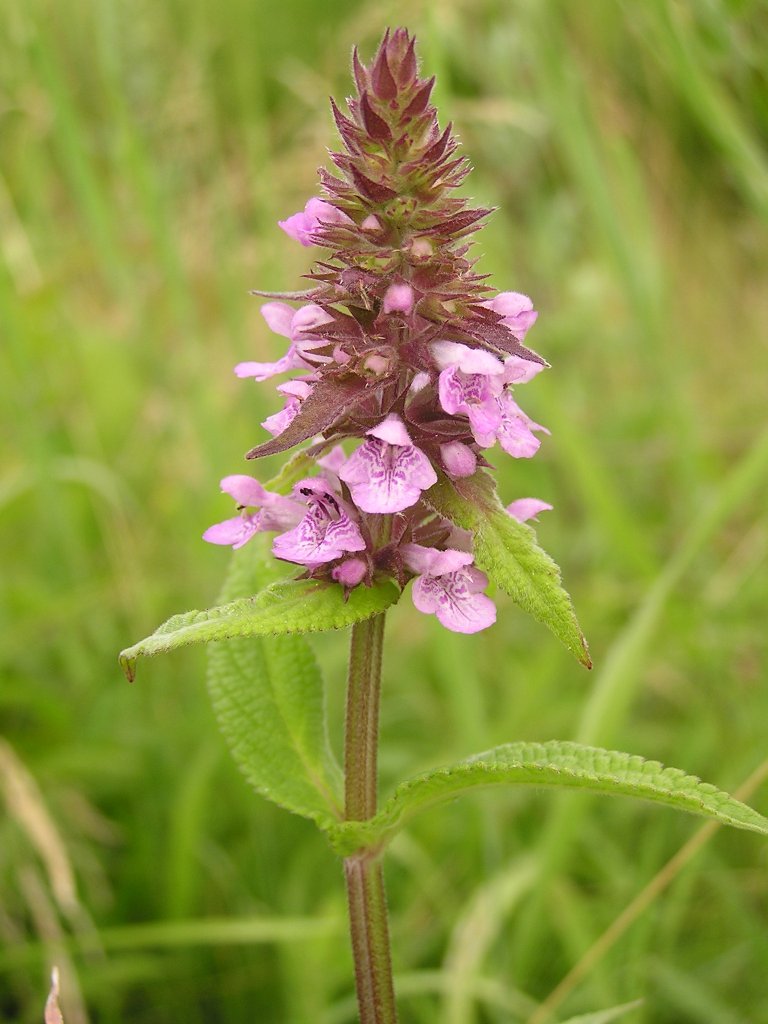
The inflorescence forms a terminal spike containing up to eight false whorls. The lower whorls are widely spaced, while the upper whorls are more crowded near the plant tip.[11][12]
Pairs of leaf-like bracts subtend the flower whorls, with stalked bracts near the inflorescence base and sessile bracts towards the top. Each flower cluster has a tiny bracteole at its base, and the flower pedicels can reach 1.5 mm in length.[13][14][15]
The flowers are zygomorphic and have a five-lobed calyx tube measuring between 5 and 7 mm in length. Their two-lipped corolla measures between 6 and 8 mm, with an entire upper lip and a three-lobed lower lip whose central lobe is substantially larger than the other lobes.[16][17][18][19][20]
The flowers can be white, pink, or purple.[21]
Habitat
Field woundwort occurs in many habitat types, including disturbed areas. It often grows in moist locations.[22][23]
The species is native to Europe, Western Asia, and North Africa. Outside its native range, it occurs as an introduced plant on other continents and is widespread as a weed.[24][25]
Behaviour
Field woundwort is easily uprooted.[26]
Reproduction and life cycle
Field woundwort is an annual herb.[27]
Uses
The herb has been used for wound healing since Roman times.[28]
Similar species
Hedge woundwort and marsh woundwort are identified as close relatives of field woundwort. Both are also used to treat wounds.[29][30]
Classification of the Field Woundwort
| Kingdom | Plantae |
|---|---|
| Subkingdom | Pteridobiotina |
| Phylum | Tracheophyta |
| Class | Magnoliopsida |
| Order | Lamiales |
| Family | Lamiaceae (Mint Family) |
| Subfamily | Lamioideae |
| Tribe | Stachydeae |
| Genus | Stachys (Woundwort) |
| Species | Stachys arvensis (L.) L. |
Where the Field Woundwort is found
Checklists and occurrence records place Stachys arvensis in 70 countries across Africa, Asia, Europe, North America, Oceania and South America. GBIF holds 62,520 georeferenced records of it.
Countries where it is native or its origin is not stated
- Afghanistan
- Albania
- Algeria 46
- Austria 4
- Belgium 3,169
- Cabo Verde 11
- China 49
- Croatia 8
- Czechia 12
- Denmark 928
- Finland 12
- France 10,920
- Georgia 3
- Germany 3,057
- Gibraltar 2
- Greece 40
- Guernsey 14
- Hong Kong 3
- India 1
- Ireland 80
- Isle of Man 153
- Israel 222
- Italy 334
- Japan 75
- Jersey 6
- Kosovo
- Lebanon 1
- Luxembourg 226
- Montenegro 1
- Morocco 177
- North Macedonia
- Norway 58
- Poland 50
- Portugal 4,139
- Reunion 31
- Serbia
- Slovakia
- Slovenia
- Spain 4,238
- Sweden 2,858
- Switzerland 249
- Syria 1
- Taiwan 156
- The Netherlands 3,950
- Tunisia 13
- Turkey 24
- United Kingdom 22,498
Countries where it has been introduced
- Argentina 121
- Australia 2,589
- Bolivia 10
- Brazil 614
- Canada 37
- Chile 11
- Colombia 45
- Dominica
- Ecuador 12
- Guadeloupe
- Martinique 5
- Mauritius
- New Caledonia 29
- New Zealand 589
- Paraguay 4
- Peru 35
- Puerto Rico 1
- Saint Helena 26
- South Africa 133
- Sri Lanka 4
- United States 326
- Uruguay 96
- Venezuela 14
Regions and cities with the most records
- England, United Kingdom 17,136
- Wales, United Kingdom 1,750
- New South Wales, Australia 1,694
- Truro, United Kingdom 1,583
- Skåne, Sweden 1,518
- Centre-Val de Loire, France 1,516
- Falmouth, United Kingdom 1,413
- Azores, Portugal 1,368
- Newquay, United Kingdom 1,338
- Scotland, United Kingdom 1,317
- Redruth, United Kingdom 1,310
- Provence-Alpes-Côte d'Azur, France 1,294
- St Austell, United Kingdom 1,215
- Tienen, Belgium 1,138
- Bodmin, United Kingdom 1,117
- Camborne, United Kingdom 1,031
- Kessel-Lo, Belgium 992
- Blauwput, Belgium 984
- Heverlee, Belgium 965
- Leuven, Belgium 963
- Herent, Belgium 875
- Auvergne-Rhône-Alpes, France 867
- Gelderland, The Netherlands 860
- Rotselaar, Belgium 858
- Nijmegen, The Netherlands 783
- Saltash, United Kingdom 782
- Limburg, The Netherlands 776
- Bourgogne-Franche-Comté, France 754
- Sint-Truiden, Belgium 740
- Beuningen, The Netherlands 733
- Wijchen, The Netherlands 705
- Occitanie, France 693
- Elst, The Netherlands 683
- Aarschot, Belgium 672
- Groesbeek, The Netherlands 663
- Île-de-France, France 651
7 more countries have a few records outside this range
These countries hold a few records of Stachys arvensis but lie outside the range the checklists give for it. Such records are often zoo or garden specimens, museum material or vagrants, so the species is not counted as occurring there.
Range as the checklists state it
England (England, Wales, Isle of Man, Scotland, Outer Hebrides, Orkney Isl., Isles of Scilly); Ireland (Ireland, Northern Ireland); Denmark; Sweden; Netherlands; Belgium; Luxembourg; Germany (Brandenburg, +Berlin, Baden-Württemberg, Bayern, Hessen, Hamburg, Mecklenburg-Vorpommern, Niedersachsen, Nordrhein-Westfalen, Rheinland-Pfalz, Schleswig-Holstein, Saarland, Sachsen, Sachsen-Anhalt, Thüringen); Switzerland; Austria; Poland; Slovakia; Portugal; Spain; Gibraltar; Baleares; France; Channel Isl. (Alderney, Guernsey, Jersey, Sark); Corsica; Sardinia; Italy; Sicily; Pantelleria; Slovenia; Croatia; Montenegro; Serbia; Kosovo; North Macedonia; Albania; Greece (rare lowlands near coast, Kiklades, Kerkyra, Ionian Isl.); Crete; European Russia; Morocco; Algeria; Tunisia; Azores (Santa Maria Isl., Sao Miguel Isl., Terceira, Graciosa, Sao Jorge, Pico, Faial, Flores Isl., Corvo Isl.); Madeira (Madeira Isl., Ilhas Desertas, Porto Santo Isl.); Canary Isl. (Lanzarote, Fuerteventura, Gran Canaria, Tenerife, La Gomera, Hierro, La Palma); Cape Verde Isl. (Santo Antao Isl., Fogo Isl., Ilha Brava); São Tomé [I]; South Africa [I] (E-Cape Prov. [I]); Ascension Isl. [I]; St. Helena [I]; Mauritius [I]; La Réunion [I]; East Aegaean Isl. (Lesvos, Psara, Ikaria, Samos, Karpathos, Rhodos); Turkey (NW-Anatolia: Bithynia, SSW-Anatolia, SW-Anatolia); Afghanistan (Kandahar); Lebanon (coastal W-Lebanon); Syria (coastal W-Syria); Israel (coastal W-Israel); China (Fujian, Guangdong, Guangxi); Taiwan; India [c]; Sri Lanka [I]; Australia [I] (Western Australia [I], South Australia [I], Queensland [I], New South Wales [I], Victoria [I], Tasmania [I]); Lord Howe Isl. [I]; Norfolk Isl. [I]; New Zealand [I]; New Caledonia [I]; Easter Isl. [I]; Hawaii [I] (Kauai [I], Oahu [I], Molokai [I], Lanai [I], Maui [I], Hawaii Isl. [I]); Canada [I] (British Columbia [I], Nova Scotia [I]); USA [I] (California [I], District of Columbia [I], Louisiana [I], Massachusetts [I], Maine [I], New Jersey [I], New York [I], Oregon [I], Pennsylvania [I], Texas [I], Virginia [I]); Puerto Rico [I]; Guadeloupe [I]; Dominica [I]; Martinique [I]; Colombia [I]; Venezuela [I]; Ecuador [I]; Peru [I]; Bolivia [I]; Brazil [I]; Paraguay [I]; Uruguay [I]; Argentina [I]; Chile [I] (Valparaíso [I], Los Lagos [I]); Juan Fdz. Isl.
A number beside a place is its count of GBIF occurrence records. A place without a number comes from a checklist alone. Records show where a species has been observed or collected, which can include escapes and vagrants.
Common names
English
- Field Woundwort
- Corn Wound-wort
- Corn Woundwort
- Field Hedge-nettle
- Field Nettle Betony
- Field Stachys
- Hedge-nettle
- Staggerweed
- Wild Mint
Names in 21 other languages
- Catalan
- Espiguera de camp
- Chinese
- 田野水蘇
- Czech
- čistec rolní
- Danish
- Ager-galtetand
- Dutch
- Akkerandoorn
- Finnish
- rikkapähkämö
- French
- épiaire des champs
- German
- Acker-Ziest
- Hebrew
- אשבל השדה
- Italian
- Stregona minore
- Japanese
- ヤブイヌゴマ, ヤブチョロギ
- Norwegian Bokmål
- småsvinerot
- Polish
- Czyściec polny
- Portuguese
- Orelha-de-urso, Urtiga-mansa, hortelã-das-roças
- Russian
- Чистец полевой
- Slovak
- čistec roľný
- Spanish
- hierba del gato, matapollos
- Swedish
- åkersyska
- Welsh
- Archoll yr Ŷd, Briwlys y Tir Âr, Briwlys yr Ardd, Briwlys yr Âr, Briwlys yr Ŷd
- hsb
- Rólna přeslička
- que
- Supikiwa
Synonyms
18 other scientific names have been used for this species and are now treated as synonyms of Stachys arvensis.
- Cardiaca arvensis (L.) Lam.
- Glechoma arvensis L.
- Glechoma belgica L.
- Glechoma marrubiastrum Vill.
- Leonurus arvensis (L.) Durande
- Stachys arvensis f. albiflora H.Lindb.
- Stachys arvensis f. stricta (G.Mey.) Gams
- Stachys arvensis var. albiflora Bolzon
- Stachys arvensis var. bermudiana Millsp.
- Stachys arvensis var. lamiiformis Domin
- Stachys arvensis var. typica Domin
- Stachys brasiliensis Benth.
- Trixago arvensis (L.) Hoffmanns. & Link
- Trixago arvensis (L.) Moritzi
- Trixago colorata C.Presl
- Trixago cordifolia Moench
- Trixago punctata Gilib.
- Trixella arvensis (L.) Fourr.
Related species
-
 Lamb's EarStachys byzantina
-
 Chinese-artichokeStachys affinis
-
 Hedge WoundwortStachys sylvatica
-
 Marsh WoundwortStachys palustris
-
 Florida BetonyStachys floridana
-
 Perennial Yellow-WoundwortStachys recta
-
 Annual Yellow WoundwortStachys annua
-
 Coastal Hedge-nettleStachys chamissonis
Compare
Questions and answers
What is the scientific name of the Field Woundwort?
The scientific name of the Field Woundwort is Stachys arvensis. Written with its author, the full name is Stachys arvensis (L.) L..
Which family does the Field Woundwort belong to?
Stachys arvensis belongs to the family Lamiaceae, in the order Lamiales and the class Magnoliopsida.
Where is the Field Woundwort found?
Checklists and occurrence records place Stachys arvensis in 70 countries, including United Kingdom, France, Spain, Portugal, The Netherlands and Belgium.
What other names does the Field Woundwort have?
Stachys arvensis is also known in English as Corn Wound-wort, Corn Woundwort, Field Hedge-nettle, Field Nettle Betony, Field Stachys and Hedge-nettle.
What is staggerweed?
Staggerweed is a common name for field woundwort. The name refers to its poisonous effects on livestock, which can cause them to stagger.[31]
Sources
Passages the profile rests on
- Stachys arvensis has pale green, branched, square stems covered with sparse glandular hairs. Source passage: “The stems are pale green and covered with patent, sparsely glandular hairs up to 2 mm long.” — English Wikipedia
- The branched stems can reach 45 cm in length. Source passage: “branched, square stems up to 45 cm long” — English Wikipedia
- The plant grows with either a sprawling or an erect habit. Source passage: “growing with a sprawling or erect habit.” — English Wikipedia
- The plant has short, white, fibrous roots concentrated at its base and sometimes extending along horizontal stems near the base. Source passage: “a mass of short, white, fibrous roots at the base of the plant and sometimes along any horizontal stems close to the base.” — English Wikipedia
- Its leaves are arranged in opposite, decussate pairs and have no stipules. Source passage: “The leaves are arranged in opposite, decussate pairs, with no stipules” — English Wikipedia
- The leaf petioles can reach 4 cm in length. Source passage: “petioles of up to 4 cm long” — English Wikipedia
- The leaves have simple, oval blades with truncate bases. Source passage: “the blade is simple and oval, up to 4 cm long, with a truncate base” — English Wikipedia
- The leaf blades can reach 4 cm in length. Source passage: “the blade is simple and oval, up to 4 cm long” — English Wikipedia
- Each side of a leaf blade has between seven and twelve rounded teeth. Source passage: “between 7 and 12 rounded teeth per side.” — English Wikipedia
- The upper leaf surfaces are dull, medium green, while the undersides are paler. Source passage: “They are dull, medium green on the upper surface and paler beneath” — English Wikipedia
- The inflorescence forms a terminal spike containing up to eight false whorls. Source passage: “The inflorescence consists of a terminal spike with up to 8 false whorls” — English Wikipedia
- The lower flower whorls are widely spaced, whereas the upper whorls are more crowded near the plant tip. Source passage: “The lower whorls are widely spaced, but the upper ones are more crowded towards the tip of the plant.” — English Wikipedia
- The flower pedicels can reach 1.5 mm in length. Source passage: “each with a short pedicel of up to 1.5 mm.” — English Wikipedia
- Pairs of leaf-like bracts subtend the flower whorls, with stalked bracts near the inflorescence base and sessile bracts towards the top. Source passage: “The whorls are subtended by a pair of leaf-like bracts which are stalked at the base of the inflorescence, becoming sessile towards the top of the plant.” — English Wikipedia
- Each flower cluster has a tiny bracteole at its base. Source passage: “There is also one tiny bracteole at the base of each cluster of flowers.” — English Wikipedia
- The flowers are zygomorphic and have a five-lobed calyx tube. Source passage: “The flowers are zygomorphic with a 5 lobed calyx tube” — English Wikipedia
- The calyx tube measures between 5 and 7 mm in length. Source passage: “a 5 lobed calyx tube 5 to 7 mm long” — English Wikipedia
- The flowers have a two-lipped corolla with an entire upper lip and a three-lobed lower lip. Source passage: “and two lipped corolla 6 to 8 mm. The upper lip is entire and the lower lip is three lobed” — English Wikipedia
- The corolla measures between 6 and 8 mm in length. Source passage: “two lipped corolla 6 to 8 mm.” — English Wikipedia
- The central lobe of the lower corolla lip is substantially larger than its other lobes. Source passage: “with the central lobe much larger.” — English Wikipedia
- The flowers can be white, pink, or purple. Source passage: “It can be white, pink or purple.” — English Wikipedia
- Stachys arvensis occurs in many habitat types, including disturbed areas. Source passage: “It grows in many types of habitat, including disturbed areas” — English Wikipedia
- The species often grows in moist locations. Source passage: “and often in moist spots.” — English Wikipedia
- The species is native to Europe, Western Asia, and North Africa. Source passage: “It is native to Europe, Western Asia, and North Africa.” — English Wikipedia
- Outside its native range, the species occurs as an introduced plant on other continents and is widespread as a weed. Source passage: “It is known on other continents as an introduced species and widespread weed.” — English Wikipedia
- The plant is easily uprooted. Source passage: “Plants are easily uprooted” — English Wikipedia
- The plant is an annual herb. Source passage: “Field woundwort is an annual herb” — English Wikipedia
- The herb has been used for wound healing since Roman times. Source passage: “this herb has been used since Roman times in healing wounds” — English Wikipedia
- Hedge woundwort and marsh woundwort are identified as close relatives of Stachys arvensis. Source passage: “Its close relatives hedge woundwort and marsh woundwort” — English Wikipedia
- Hedge woundwort and marsh woundwort are also used to treat wounds. Source passage: “hedge woundwort and marsh woundwort are also used to treat wounds.” — English Wikipedia
- The common name staggerweed refers to the plant's poisonous effects on livestock, which can cause them to stagger. Source passage: “The common name staggerweed is because the plant is poisonous to livestock and causes livestock to stagger around.” — English Wikipedia
Data
- Catalogue of Life, 2026-10-16 XR cc by
- Global Biodiversity Information Facility CC BY 4.0
- Wikidata CC0
- GeoNames CC BY 4.0
- Wikimedia Commons per image; credit shown with each image
- Within the Catalogue of Life, this name comes from Synonymic Checklists of the Vascular Plants of the World cc by
References
- L. (1763). Sp. Pl. [Linnaeus], ed. 2: 814 (1763). where the name was published
This species in other databases
- Catalogue of Life 4ZFC6
- Wikidata Q162811
- iNaturalist 169309
- World Flora Online wfo-0000313721
- GRIN 316845
Page built on 29 November 2026. See how the catalog is made and all sources and licences.
Cite this page
ScientificNames.org. (2026). Stachys arvensis (Field Woundwort). Retrieved November 29, 2026, from https://scientificnames.org/species/stachys-arvensis
“Stachys arvensis (Field Woundwort).” ScientificNames.org, 2026, scientificnames.org/species/stachys-arvensis. Accessed 29 Nov. 2026.
ScientificNames.org. “Stachys arvensis (Field Woundwort).” Accessed November 29, 2026. https://scientificnames.org/species/stachys-arvensis.
@misc{scientificnames_stachys_arvensis_field_woundwort,
  author = {{ScientificNames.org}},
  title = {Stachys arvensis (Field Woundwort)},
  year = {2026},
  url = {https://scientificnames.org/species/stachys-arvensis},
  note = {Accessed 2026-11-29}
}