Species · Flowering plants
Marsh Woundwort Stachys palustris
The scientific name of the Marsh Woundwort is Stachys palustris. It is a species of flowering plant in the family Lamiaceae (mint family), order Lamiales.
- Scientific name
- Stachys palustris L.
- Common name
- Marsh Woundwort
- Genus
- Stachys
- Family
- Lamiaceae (Mint Family)
- Order
- Lamiales
- Class
- Magnoliopsida
- Red List category
- LC Least Concern
- Recorded in
- 61 countries
- Name status
- accepted in the Catalogue of Life
Overview
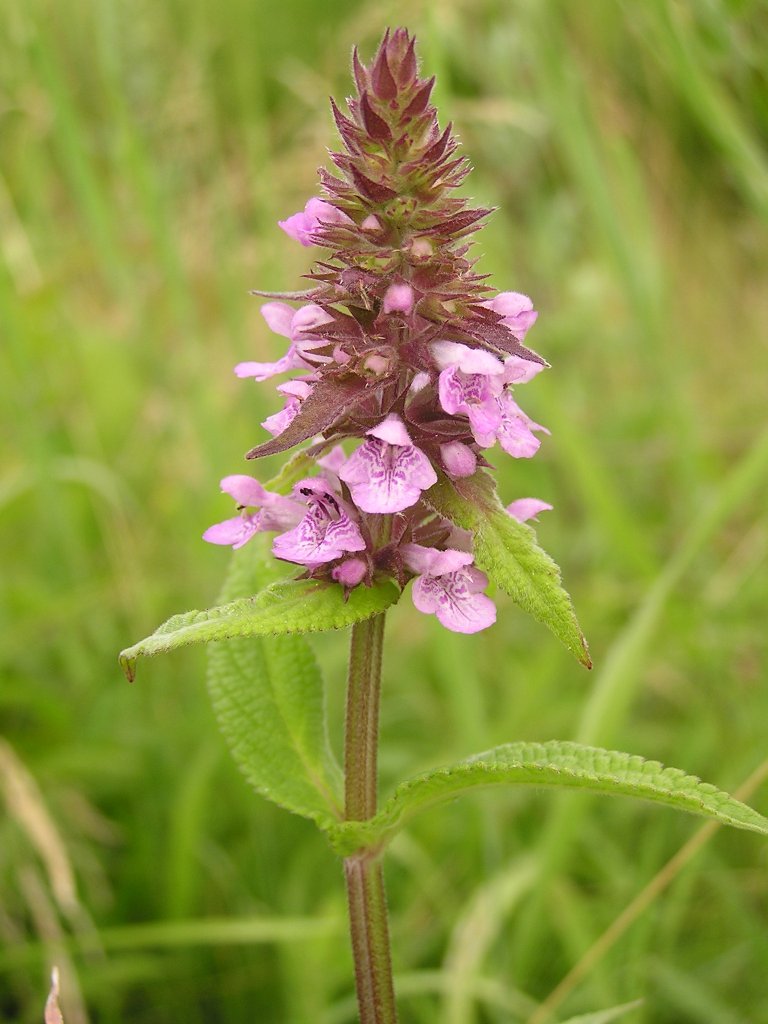
Stachys palustris typically grows near lake shores, in marshes containing alder trees, and along the banks of ditches and streams. It has purplish-red flowers arranged in terminal spikes and grows from horizontal tuberous runners.
Written 26 November 2026 from the sources listed below. Each statement was checked against the passage it cites; statements that could not be supported were removed.
Appearance
Its purplish-red flowers grow in terminal spikes with gaps in their lower portions. They are arranged in whorls and consist of five fused petals, with a two-lipped corolla having a gently hooded upper lip and a flat, three-lobed lower lip.[1][2][3]
Each flower has four stamens, consisting of two long and two short stamens. Its calyx has five sharply pointed lobes.[4][5]
Its fruit is a dry, four-chambered schizocarp. The plant can grow to 80 centimeters tall.[6][7]
Habitat
Marsh woundwort typically grows near lake shores and occurs in marshes containing alder trees. It also grows along the banks of ditches and streams.[8][9][10]
The species is native to Europe and Asia and has been introduced to North America.[11][12]
Diet
Marsh woundwort is described as an edible plant.[13]
Behaviour
The flowers are mostly visited by bumblebees. They have little fragrance but are highly attractive to bumblebees.[14][15]
Nectar indicators guide visiting insects toward the center of the flowers. The positioning of the anthers and pistils facilitates pollen transfer by visiting insects.[16][17]
Reproduction and life cycle
Marsh woundwort grows from horizontal tuberous runners. It also spreads vegetatively through hollow tuberous roots that produce shoots away from the original plant.[18][19]
Its seeds disperse effectively through the movement of floating dry fruit capsules.[20]
Conservation
Marsh woundwort can be a persistent weed in arable land because its tubers make it difficult to eradicate.[21]
Uses
Marsh woundwort is used to promote wound healing.[22]
Classification of the Marsh Woundwort
| Kingdom | Plantae |
|---|---|
| Subkingdom | Pteridobiotina |
| Phylum | Tracheophyta |
| Class | Magnoliopsida |
| Order | Lamiales |
| Family | Lamiaceae (Mint Family) |
| Subfamily | Lamioideae |
| Tribe | Stachydeae |
| Genus | Stachys (Woundwort) |
| Species | Stachys palustris L. |
Where the Marsh Woundwort is found
Checklists and occurrence records place Stachys palustris in 61 countries across Asia, Europe, North America and Oceania. GBIF holds 368,973 georeferenced records of it.
Countries where it is native or its origin is not stated
- Aland Islands 101
- Albania 6
- Armenia
- Austria 1,970
- Belarus 432
- Belgium 15,028
- Bosnia and Herzegovina 21
- Bulgaria 15
- China 69
- Croatia 94
- Czechia 2,785
- Denmark 21,676
- Estonia 1,548
- Finland 6,565
- France 42,975
- Georgia 11
- Germany 32,969
- Greece 29
- Guernsey 8
- Hungary 258
- India 3
- Iran
- Ireland 2,248
- Isle of Man 1,174
- Italy 665
- Jersey 2
- Kazakhstan 160
- Kosovo 2
- Kyrgyzstan
- Latvia 197
- Liechtenstein 35
- Lithuania 360
- Luxembourg 821
- Malta
- Moldova 10
- Mongolia 6
- Montenegro 11
- North Macedonia
- Norway 4,540
- Poland 9,558
- Portugal 67
- Romania 89
- Russia 16,542
- San Marino
- Serbia 31
- Slovakia 2,471
- Slovenia 136
- South Korea 3
- Spain 372
- Sweden 18,631
- Switzerland 5,200
- Tajikistan
- The Netherlands 78,145
- Turkey 20
- Ukraine 1,440
- United Kingdom 95,827
- Uzbekistan
Countries where it has been introduced
Regions and cities with the most records
- England, United Kingdom 61,454
- Scotland, United Kingdom 20,557
- Bavaria, Germany 16,150
- Gelderland, The Netherlands 10,852
- Waddinxveen, The Netherlands 10,293
- Benthuizen, The Netherlands 10,171
- Boskoop, The Netherlands 10,012
- Zoetermeer, The Netherlands 9,480
- Bergschenhoek, The Netherlands 9,384
- Berkel en Rodenrijs, The Netherlands 9,201
- Alphen aan den Rijn, The Netherlands 8,990
- Pijnacker, The Netherlands 8,630
- Bodegraven, The Netherlands 8,230
- Woerden, The Netherlands 8,146
- Capelle aan den IJssel, The Netherlands 8,120
- Gouda, The Netherlands 8,023
- Nootdorp, The Netherlands 7,970
- Krimpen aan den IJssel, The Netherlands 7,862
- Mijdrecht, The Netherlands 7,853
- Rotterdam, The Netherlands 7,750
- Leiderdorp, The Netherlands 7,638
- Voorschoten, The Netherlands 7,471
- Ypenburg, The Netherlands 7,332
- Voorburg, The Netherlands 7,192
- Grand Est, France 7,097
- Central Jutland, Denmark 7,075
- Maarssen, The Netherlands 7,061
- Delft, The Netherlands 7,059
- Uithoorn, The Netherlands 7,012
- Ridderkerk, The Netherlands 6,872
- De Meern, The Netherlands 6,856
- Leiden, The Netherlands 6,638
- Schiedam, The Netherlands 6,602
- Nieuw-Vennep, The Netherlands 6,564
- Amstelveen, The Netherlands 6,549
- Alblasserdam, The Netherlands 6,534
1 more country has a few records outside this range
These countries hold a few records of Stachys palustris but lie outside the range the checklists give for it. Such records are often zoo or garden specimens, museum material or vagrants, so the species is not counted as occurring there.
Range as the checklists state it
England (England, Wales, Isle of Man, Scotland, Outer Hebrides, Orkney Isl., Shetland Isl., Isles of Scilly); Ireland (Ireland, Northern Ireland); Denmark; Norway; Sweden; Finland; Netherlands; Belgium; Luxembourg; Germany (Brandenburg, Berlin, Baden-Württemberg, Bayern, Hessen, Hamburg, Mecklenburg-Vorpommern, Niedersachsen, Nordrhein-Westfalen, Rheinland-Pfalz, Schleswig-Holstein, Saarland, Sachsen, Sachsen-Anhalt, Thüringen); Switzerland; Liechtenstein; Austria; Poland; Czech Republic; Slovakia; Hungary; Portugal; Spain; France; Channel Isl. (Alderney, Guernsey, Jersey, Sark); Corsica; Italy; Malta; San Marino; Slovenia; Croatia; Bosnia & Hercegovina; Montenegro; Serbia; Kosovo; North Macedonia; Albania; Romania; Bulgaria; European Turkey; Greece (scattered N- & C-Greece, Kerkyra); Estonia; Latvia; Lithuania; Belarus; C-European Russia; E-European Russia; N-European Russia; W-European Russia; Ukraine; Crimea; Siberia (Altay, Krasnoyarsk, Tuva, W-Siberia); Russian Far East [I] (Amur [I], Khabarovsk [I], Primorye [I], Sakhalin [I]); Kazakhstan; Uzbekistan; Kyrgyzstan; Tajikistan; Northern Caucasus; Georgia [Caucasus]; Armenia; Turkey (N-Anatolia, NE-Anatolia); Iran (Iranian Aserbaijan); China (Xinjiang); Mongolia; NW-India (Jammu & Kashmir); Australia [I] (Tasmania [I]); New Zealand [I]; Alaska [I]; Canada [I] (Manitoba [I], New Brunswick [I], Newfoundland [I], Nova Scotia [I], Ontario [I], Prince Edward Isl. [I], Québec [I]); USA [I] (Connecticut [I], District of Columbia [I], Delaware [I], Illinois [I], Massachusetts [I], Maryland [I], Maine [I], Michigan [I], Minnesota [I], New Hampshire [I], New Jersey [I], New York [I], Ohio [I], Pennsylvania [I], Rhode Island [I], Vermont [I], Wisconsin [I])
A number beside a place is its count of GBIF occurrence records. A place without a number comes from a checklist alone. Records show where a species has been observed or collected, which can include escapes and vagrants.
Common names
English
- Marsh Woundwort
- Hedge-nettle
- Marsh Betony
- Marsh Hedge-nettle
- Woundwort
Names in 30 other languages
- Armenian
- Աբեղախոտ ճահճային
- Belarusian
- Чысцік балотны
- Bulgarian
- Блатен ранилист
- Chinese
- 沼生水苏, 沼生水蘇
- Croatian
- Močvarni čistac
- Czech
- čistec bahenní
- Danish
- Kær-galtetand
- Dutch
- Moerasandoorn
- Estonian
- soo-nõianõges
- Finnish
- peltopähkämö
- French
- Epiaire des Marais, crapaudine, épiaire des marais
- German
- Sumpf-Ziest
- Hungarian
- Mocsári tisztesfű
- Irish
- Duilleog na saor
- Italian
- Stregona palustre
- Japanese
- オトメイヌゴマ
- Latvian
- purva sārmene
- Lithuanian
- Pelkinė notra
- Norwegian Bokmål
- åkersvinerot
- Polish
- Czyściec błotny
- Portuguese
- betónica-palustre
- Russian
- Чистец болотный
- Slovak
- čistec močiarny
- Slovenian
- močvirnati čišljak
- Spanish
- betónica palustre, hortiga muerta de hojas estrechas, ortiga hedionda
- Swedish
- knölsyska
- Ukrainian
- Чистець болотяний
- Welsh
- Briwlys y Gors, Briwlys y Taeog, Briwlys yr Afon, Llys yr Archoll
- hsb
- Włóžna přeslička
- nav
- Tólchiintsoh
Synonyms
48 other scientific names have been used for this species and are now treated as synonyms of Stachys palustris.
- Stachys aquatica Bubani
- Stachys austriaca Heynh.
- Stachys maeotica Postrig.
- Stachys palustris f. acuminata (Briq.) Ravarut
- Stachys palustris f. angustifolia Serg.
- Stachys palustris f. canescens Briq. ex Litard.
- Stachys palustris f. cleoniquei B.Boivin
- Stachys palustris f. eglandulosa Ravarut
- Stachys palustris f. latifolia Serg.
- Stachys palustris f. petiolata (Peterm.) Gams
- Stachys palustris f. segetum (Hagen) C.W.Christ.
- Stachys palustris f. sessilis (Čelak.) Gams
- Stachys palustris f. submersa Glück
- Stachys palustris f. virescens Briq. ex Litard.
- Stachys palustris subsp. palustris
- Stachys palustris subvar. acuminata (Briq.) Gams
- Stachys palustris subvar. major (Wirtg.) Gams
- Stachys palustris subvar. oblongifolia (Briq.) Gams
- Stachys palustris var. acuminata Briq.
- Stachys palustris var. agrestis (F.Aresch.) Serg.
- Stachys palustris var. angustifolia Benth.
- Stachys palustris var. arenicola Farw.
- Stachys palustris var. bracteata Beck
- Stachys palustris var. ciliata Peterm.
- Stachys palustris var. cinerea T.Durand
- Stachys palustris var. hybrida Benth.
- Stachys palustris var. insularis Briq. ex Litard.
- Stachys palustris var. latifolia Peterm.
- Stachys palustris var. major Wirtg.
- Stachys palustris var. oblongifolia Briq.
- Stachys palustris var. palustris
- Stachys palustris var. petiolata T.Durand
- Stachys palustris var. petiolata Peterm.
- Stachys palustris var. petiolata Čelak.
- Stachys palustris var. pseudoambigua Erdner
- Stachys palustris var. pubescens Schur
- Stachys palustris var. segetalis Klett & Richt.
- Stachys palustris var. segetalis Brügger
- Stachys palustris var. segetum (Hagen) Nyman
- Stachys palustris var. segetum (Hagen) Rchb.
Showing 40 of 48.
Related species
-
 Lamb's EarStachys byzantina
-
 Chinese-artichokeStachys affinis
-
 Hedge WoundwortStachys sylvatica
-
 Field WoundwortStachys arvensis
-
 Florida BetonyStachys floridana
-
 Perennial Yellow-WoundwortStachys recta
-
 Annual Yellow WoundwortStachys annua
-
 Coastal Hedge-nettleStachys chamissonis
Compare
Questions and answers
What is the scientific name of the Marsh Woundwort?
The scientific name of the Marsh Woundwort is Stachys palustris. Written with its author, the full name is Stachys palustris L..
Which family does the Marsh Woundwort belong to?
Stachys palustris belongs to the family Lamiaceae, in the order Lamiales and the class Magnoliopsida.
Where is the Marsh Woundwort found?
Checklists and occurrence records place Stachys palustris in 61 countries, including United Kingdom, The Netherlands, France, Germany, Denmark and Sweden.
What is the conservation status of the Marsh Woundwort?
The IUCN Red List category recorded for Stachys palustris is Least Concern (LC).
What other names does the Marsh Woundwort have?
Stachys palustris is also known in English as Hedge-nettle, Marsh Betony, Marsh Hedge-nettle and Woundwort.
Sources
Passages the profile rests on
- Its flowers are purplish-red and grow in terminal spikes with gaps in their lower portions. Source passage: “The purplish-red flowers are in terminal spikes, with gaps in the lower part of the spike.” — English Wikipedia
- Its flowers are arranged in whorls and consist of five fused petals. Source passage: “They are arranged in whorls, each flower consisting of five fused petals” — English Wikipedia
- Its corolla has two lips, with a gently hooded upper lip and a flat, three-lobed lower lip. Source passage: “the corolla being two-lipped, the upper lip being gently hooded and the lower lip flat and three-lobed.” — English Wikipedia
- Its calyx has five sharply pointed lobes. Source passage: “The calyx has five sharply-pointed lobes.” — English Wikipedia
- Each flower has four stamens, consisting of two long and two short stamens. Source passage: “There are four stamens, two long and two short” — English Wikipedia
- Its fruit is a dry, four-chambered schizocarp. Source passage: “the fruit is a dry four-chambered schizocarp.” — English Wikipedia
- Stachys palustris can grow to 80 centimeters tall. Source passage: “growing to 80 centimeters tall.” — English Wikipedia
- The species typically grows near lake shores. Source passage: “near the shore of lakes” — English Wikipedia
- It occurs in marshes containing alder trees. Source passage: “in marshes with alder trees” — English Wikipedia
- It grows along the banks of ditches and streams. Source passage: “on the banks of ditches and streams” — English Wikipedia
- Stachys palustris is native to Europe and Asia. Source passage: “The marsh woundwort is native to Europe and Asia.” — English Wikipedia
- The species has been introduced to North America. Source passage: “but has been introduced to North America.” — English Wikipedia
- Stachys palustris is described as an edible plant. Source passage: “is an edible perennial grassland herb” — English Wikipedia
- Its flowers are mostly visited by bumblebees. Source passage: “The flowers are mostly visited by bumblebees.” — English Wikipedia
- The species has little fragrance but is highly attractive to bumblebees. Source passage: “Although the marsh woundwort has little fragrance, it is very attractive to bumblebees.” — English Wikipedia
- Nectar indicators guide visiting insects toward the center of its flowers. Source passage: “Nectar indicators guide the insect to probe into the centre of the flower” — English Wikipedia
- The positioning of its anthers and pistils facilitates pollen transfer by visiting insects. Source passage: “the anthers of the stamens and the pistils are correctly located for the insect to transfer pollen between flowers.” — English Wikipedia
- Stachys palustris grows from horizontal tuberous runners. Source passage: “growing from a horizontal tuberous runner.” — English Wikipedia
- The species also spreads vegetatively through hollow tuberous roots that produce shoots away from the original plant. Source passage: “It also spreads vegetatively by means of hollow tuberous root which can throw up shoots far from the original plant.” — English Wikipedia
- Its seeds disperse effectively through the movement of floating dry fruit capsules. Source passage: “The seeds of this plant disperse well, the dry fruit capsules float away” — English Wikipedia
- The species can be a persistent weed in arable land because its tubers make it difficult to eradicate. Source passage: “In arable land, it is a difficult weed to get rid of because of its persistent tubers.” — English Wikipedia
- Stachys palustris is used to promote wound healing. Source passage: “it is used to promote the healing of wounds.” — English Wikipedia
Data
- Catalogue of Life, 2026-10-16 XR cc by
- Global Biodiversity Information Facility CC BY 4.0
- Wikidata CC0
- GeoNames CC BY 4.0
- Wikimedia Commons per image; credit shown with each image
- Within the Catalogue of Life, this name comes from Synonymic Checklists of the Vascular Plants of the World cc by
References
- L. (1753). Sp. Pl. [Linnaeus] 2: 580 (1753). where the name was published
This species in other databases
- Catalogue of Life 6ZH4J
- Wikidata Q158392
- iNaturalist 57457
- World Flora Online wfo-0000314357
- GRIN 312174
Page built on 28 November 2026. See how the catalog is made and all sources and licences.
Cite this page
ScientificNames.org. (2026). Stachys palustris (Marsh Woundwort). Retrieved November 28, 2026, from https://scientificnames.org/species/stachys-palustris
“Stachys palustris (Marsh Woundwort).” ScientificNames.org, 2026, scientificnames.org/species/stachys-palustris. Accessed 28 Nov. 2026.
ScientificNames.org. “Stachys palustris (Marsh Woundwort).” Accessed November 28, 2026. https://scientificnames.org/species/stachys-palustris.
@misc{scientificnames_stachys_palustris_marsh_woundwort,
  author = {{ScientificNames.org}},
  title = {Stachys palustris (Marsh Woundwort)},
  year = {2026},
  url = {https://scientificnames.org/species/stachys-palustris},
  note = {Accessed 2026-11-28}
}