Species · Fishes
Stauroglanis gouldingi
Stauroglanis gouldingi has no English name on record in the checklists used here. It is a species of fish in the family Trichomycteridae (pencil catfish), order Siluriformes. The name dates from 1989.
- Scientific name
- Stauroglanis gouldingi de Pinna, 1989
- Genus
- Stauroglanis
- Family
- Trichomycteridae (Pencil Catfish)
- Order
- Siluriformes
- Class
- Teleostei
- Red List category
- LC Least Concern
- Environment
- freshwater
- Recorded in
- 1 country
- Name status
- accepted in the Catalogue of Life
Overview
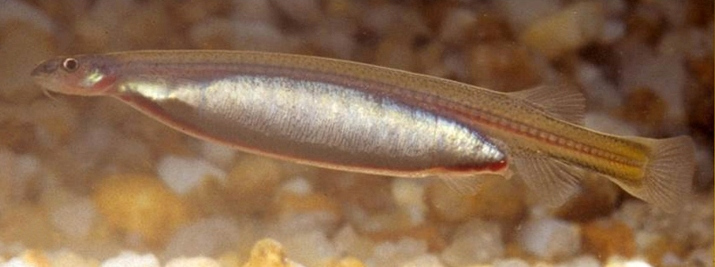
Stauroglanis gouldingi de Pinna, 1989 is a fish of the family Trichomycteridae, order Siluriformes and class Teleostei, and the sole species in the genus Stauroglanis. The species is known from the Daraá River in Brazil's Rio Negro basin. It is distinguished by its large conspicuous eyes, very short nasal barbels, elongated body and snout, and thin transparent integument.
Written 27 November 2026 from the sources listed below. Each statement was checked against the passage it cites; statements that could not be supported were removed.
Appearance
The species has large, conspicuous eyes and very short nasal barbels. Its snout region and body are elongated, and its mouth is subterminal and does not have a sucker-like form.[1][2][3][4][5]
Its integument is very thin and transparent, allowing its superficial muscles and some internal structures to be readily visible. The species exhibits skeletal paedomorphic characteristics.[6][7][8]
The species reaches approximately 2.7 centimetres in standard length.[9]
Habitat
During daylight, the species occupies patches of loose sand where water flow creates temporary sand ripples.[10]
Diet
The species is a predominantly visually oriented microcarnivore that feeds on immature aquatic insects.[11]
Behaviour
One feeding strategy involves moving along ripple grooves while scanning the bottom alternately across adjacent grooves. Feeding activity reaches its peaks in the late morning and afternoon.[12][13]
When disturbed, the species buries itself in the sand. At night, it remains completely buried in the sand.[14][15]
Reproduction and life cycle
The species exhibits indications of seasonal reproduction during wet months. No reproductive individuals have been found during dry months.[16][17]
Conservation
Expansion of unpaved roads can degrade the forest stream dynamics and temporary sandy microhabitat used by the species. Degradation of its stream microhabitat may cause local extirpation.[18][19]
Classification of Stauroglanis gouldingi
| Kingdom | Animalia |
|---|---|
| Phylum | Chordata |
| Subphylum | Vertebrata |
| Infraphylum | Gnathostomata |
| Parvphylum | Osteichthyes |
| Gigaclass | Actinopterygii |
| Superclass | Actinopteri |
| Class | Teleostei (Teleost) |
| Order | Siluriformes (Catfish) |
| Family | Trichomycteridae (Pencil Catfish) |
| Subfamily | Sarcoglanidinae |
| Genus | Stauroglanis |
| Species | Stauroglanis gouldingi de Pinna, 1989 |
Where Stauroglanis gouldingi is found
Checklists and occurrence records place Stauroglanis gouldingi in 1 country. GBIF holds 27 georeferenced records of it.
Countries
Regions and cities with the most records
A number beside a place is its count of GBIF occurrence records. A place without a number comes from a checklist alone. Records show where a species has been observed or collected, which can include escapes and vagrants.
Common names
Names in 2 other languages
- Czech
- kandiru Gouldingův
- Portuguese
- Candiru Fantasma
Related species
-
 CandiruVandellia cirrhosa
-
 GreasefishRhizosomichthys totae
-
 Trichomycterus rivulatus
-
 Trichogenes claviger
-
 EremophilusEremophilus mutisii
- Trichomycterus maracaiboensis
-
 Pareiodon microps
- Paracanthopoma parva
Compare
Sources
Passages the profile rests on
- The species has large, conspicuous eyes. Source passage: “the eyes are large and conspicuous” — English Wikipedia
- Its nasal barbels are present but very short. Source passage: “the nasal barbels are present but very short” — English Wikipedia
- The species has an elongated snout region. Source passage: “the snout region of the head is elongate” — English Wikipedia
- Its mouth is subterminal and does not have a sucker-like form. Source passage: “the mouth subterminal and not suckerlike.” — English Wikipedia
- The species has an elongated body. Source passage: “It has an elongate body.” — English Wikipedia
- Its integument is very thin and transparent. Source passage: “The integument is very thin and transparent” — English Wikipedia
- Its superficial muscles and some internal structures are readily visible through its integument. Source passage: “superficial muscles and some other internal structures are readily visible.” — English Wikipedia
- The species exhibits skeletal paedomorphic characteristics. Source passage: “S. gouldingi has certain skeletal paedomorphic characteristics.” — English Wikipedia
- The species reaches approximately 2.7 centimetres in standard length. Source passage: “This species grows to about 2.7 centimetres (1.1 in) SL.” — English Wikipedia
- During daylight, the species occupies patches of loose sand where water flow creates temporary sand ripples. Source passage: “During the day, S. gouldingi is found on patches of loose sand where the water flow forms ephemeral sand ripples.” — English Wikipedia
- The species is a predominantly visually oriented microcarnivore that feeds on immature aquatic insects. Source passage: “This species is a mostly visually oriented microcarnivore, foraging on immature aquatic insects.” — English Wikipedia
- One feeding strategy involves moving along ripple grooves while scanning the bottom alternately across adjacent grooves. Source passage: “One foraging tactic of the species is movement along the ripple grooves while scanning the bottom back and forth, alternating between adjacent grooves.” — English Wikipedia
- Feeding activity reaches its peaks in the late morning and afternoon. Source passage: “Feeding activity peaks at late morning and afternoon.” — English Wikipedia
- When disturbed, the species buries itself in the sand. Source passage: “When disturbed, S. gouldingi buries in the sand” — English Wikipedia
- At night, the species remains completely buried in the sand. Source passage: “at night it remains completely buried.” — English Wikipedia
- The species exhibits indications of seasonal reproduction during wet months. Source passage: “Seasonal reproduction has been indicated in the wet months” — English Wikipedia
- No reproductive individuals of the species have been found during dry months. Source passage: “no reproductive individuals have been found in the dry months.” — English Wikipedia
- Expansion of unpaved roads can degrade the forest stream dynamics and temporary sandy microhabitat used by the species. Source passage: “The expansion of unpaved roads and the removal of riparian vegetation degrade forest stream dynamics and the ephemeral microhabitat of S. gouldingi” — English Wikipedia
- Degradation of its stream microhabitat may cause local extirpation of the species. Source passage: “which may result in its local extirpation.” — English Wikipedia
Data
- Catalogue of Life, 2026-10-16 XR cc by
- Global Biodiversity Information Facility CC BY 4.0
- Wikidata CC0
- GeoNames CC BY 4.0
- Within the Catalogue of Life, this name comes from World Register of Marine Species cc by
References
- de Pinna, M. C. C. (1989). A new scarcoglanidine catfish, phylogeny of its subfamily, and an appraisal of the phyletic status of the Trichomycterinae (Teleostei, Trichomycteridae). American Museum Novitates, No. 2950: 1–39. where the name was published
This species in other databases
- Catalogue of Life 4ZM5D
- Wikidata Q3764345
- iNaturalist 621735
- WoRMS urn:lsid:marinespecies.org:taxname:1383962
- ITIS 682166
Page built on 29 November 2026. See how the catalog is made and all sources and licences.
Cite this page
ScientificNames.org. (2026). Stauroglanis gouldingi. Retrieved November 29, 2026, from https://scientificnames.org/species/stauroglanis-gouldingi
“Stauroglanis gouldingi.” ScientificNames.org, 2026, scientificnames.org/species/stauroglanis-gouldingi. Accessed 29 Nov. 2026.
ScientificNames.org. “Stauroglanis gouldingi.” Accessed November 29, 2026. https://scientificnames.org/species/stauroglanis-gouldingi.
@misc{scientificnames_stauroglanis_gouldingi,
  author = {{ScientificNames.org}},
  title = {Stauroglanis gouldingi},
  year = {2026},
  url = {https://scientificnames.org/species/stauroglanis-gouldingi},
  note = {Accessed 2026-11-29}
}