Species · Mammals
Andrews's Three-toed Jerboa Stylodipus andrewsi
The scientific name of the Andrews's Three-toed Jerboa is Stylodipus andrewsi. It is a species of mammal in the family Dipodidae (jerboa), order Rodentia. The name dates from 1925.
- Scientific name
- Stylodipus andrewsi G. M. Allen, 1925
- Common name
- Andrews's Three-toed Jerboa
- Genus
- Stylodipus
- Family
- Dipodidae (Jerboa)
- Order
- Rodentia
- Class
- Mammalia
- Red List category
- LC Least Concern
- Recorded in
- 2 countries
- Name status
- accepted in the Catalogue of Life
Overview
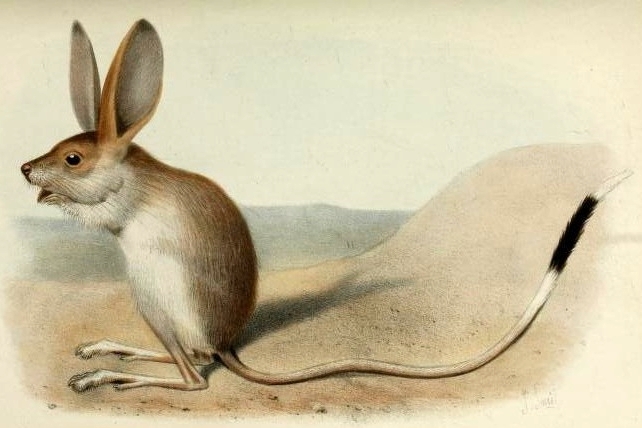
Stylodipus andrewsi inhabits semi-arid and arid steppes and grasslands, sand dunes with scrubby vegetation, and coniferous and mixed forests containing undergrowth. It has a longer central hind toe, a hairy sole, and a thickened tail with a flattened, bushy black terminal section.
Written 26 November 2026 from the sources listed below. Each statement was checked against the passage it cites; statements that could not be supported were removed.
Appearance
The species has a grey crown with white spots above the eye and behind the ear. The remainder of its coat is buffish grey, with a white band across the hips and white underparts.[1][2]
The central toe on the hind foot is longer than the other toes, and the sole is covered with hair. The tail is thickened and has a flattened, bushy black terminal section.[3][4]
Habitat
The species inhabits semi-arid and arid steppes and grasslands. It also occurs in sand dunes with scrubby vegetation.[5][6]
The species also occurs in coniferous and mixed forests containing undergrowth.[7]
Diet
The species feeds on green plant parts, roots, and seeds.[8]
Behaviour
Reproduction and life cycle
Females usually produce one litter per year. Each litter usually contains two to four young.[11][12]
Conservation
The species has a wide geographic range and a presumed large total population. It occurs in several protected areas, and no specific threats have been identified.[13][14][15]
Its population trend is unknown. The species is classified as Least Concern by the International Union for Conservation of Nature.[16][17]
Similar species
Andrews's Three-toed Jerboa can be distinguished from Stylodipus telum by possessing premolars in its upper jaw, which are vestigial in that species.[18]
Classification of the Andrews's Three-toed Jerboa
| Kingdom | Animalia |
|---|---|
| Phylum | Chordata |
| Subphylum | Vertebrata |
| Infraphylum | Gnathostomata |
| Parvphylum | Osteichthyes |
| Megaclass | Tetrapoda |
| Class | Mammalia (Mammal) |
| Subclass | Theria |
| Infraclass | Eutheria |
| Order | Rodentia (Rodent) |
| Suborder | Myomorpha (Mice) |
| Superfamily | Dipodoidea |
| Family | Dipodidae (Jerboa) |
| Subfamily | Dipodinae |
| Genus | Stylodipus (Three-toed Jerboas) |
| Species | Stylodipus andrewsi G. M. Allen, 1925 |
Where the Andrews's Three-toed Jerboa is found
Checklists and occurrence records place Stylodipus andrewsi in 2 countries across Asia. GBIF holds 101 georeferenced records of it.
Countries
Regions and cities with the most records
Range as the checklists state it
Europe & Northern Asia (excluding China)
Southern Asia
A number beside a place is its count of GBIF occurrence records. A place without a number comes from a checklist alone. Records show where a species has been observed or collected, which can include escapes and vagrants.
Common names
English
- Andrews's Three-toed Jerboa
- Andrew S Three-toed Jerboa
- Andrew's Three-toed Jerboa
- Mongolian Jerboa
Names in 6 other languages
- Chinese
- Mengguyuwei Tiaoshu
- Czech
- tarbík mongolský
- Finnish
- mongolianhäntäjerbo
- Japanese
- アンドリューミユビトビネズミ
- Mongolian
- Mongoljin Daakhai
- Polish
- chyżoskoczek mongolski
Synonyms
3 other scientific names have been used for this species and are now treated as synonyms of Stylodipus andrewsi.
- Scirtopoda andrewsi (Allen, 1925)
- Stylodipus andrews : G. M. Allen, 1925
- Stylodipus telum andrewsi (Allen, 1925) Allen, 1940
Related species
-
 Thick-tailed Three-toed JerboaStylodipus telum
- Mongolian Three-toed JerboaStylodipus sungorus
-
 Baluchistan Pygmy JerboaSalpingotulus michaelis
-
 Long-eared JerboaEuchoreutes naso
-
 Lesser Egyptian JerboaJaculus jaculus
-
 Meadow Jumping MouseZapus hudsonius
-
 Woodland Jumping MouseNapaeozapus insignis
-
 Greater Egyptian JerboaJaculus orientalis
Compare
Questions and answers
What is the scientific name of the Andrews's Three-toed Jerboa?
The scientific name of the Andrews's Three-toed Jerboa is Stylodipus andrewsi. Written with its author, the full name is Stylodipus andrewsi G. M. Allen, 1925.
Which family does the Andrews's Three-toed Jerboa belong to?
Stylodipus andrewsi belongs to the family Dipodidae, in the order Rodentia and the class Mammalia.
Where is the Andrews's Three-toed Jerboa found?
Checklists and occurrence records place Stylodipus andrewsi in 2 countries: Mongolia and China.
What is the conservation status of the Andrews's Three-toed Jerboa?
The IUCN Red List category recorded for Stylodipus andrewsi is Least Concern (LC).
What other names does the Andrews's Three-toed Jerboa have?
Stylodipus andrewsi is also known in English as Andrew S Three-toed Jerboa, Andrew's Three-toed Jerboa and Mongolian Jerboa.
What is a jerboas habitat?
Andrews's Three-toed Jerboa inhabits semi-arid and arid steppes and grasslands, sand dunes with scrubby vegetation, and coniferous and mixed forests containing undergrowth.[5][6][7]
What does the jerboa eat?
Andrews's Three-toed Jerboa feeds on green plant parts, roots, and seeds.[8]
Sources
Passages the profile rests on
- The species has a grey crown with white spots above the eye and behind the ear, while the remainder of its coat is buffish grey. Source passage: “The crown of the head is grey with white spots above the eye and another behind the ear. The rest of the coat is buffish grey.” — English Wikipedia
- The species has a white band across its hips and white underparts. Source passage: “A white band stretches across the hips and the underparts are white.” — English Wikipedia
- The central toe on the hind foot is longer than the other toes, and the sole is covered with hair. Source passage: “The central toe on the hind foot is the longest and the sole of the foot is haired.” — English Wikipedia
- The species has a thickened tail with a flattened, bushy black terminal section. Source passage: “The tail is thickened by the adipose tissue beneath the skin and has a flattened, terminal, black bushy section.” — English Wikipedia
- The species inhabits semi-arid and arid steppes and grasslands. Source passage: “It inhabits semi-arid and arid steppes and grassland” — English Wikipedia
- The species occurs in sand dunes with scrubby vegetation. Source passage: “as well as sand dunes with scrubby vegetation.” — English Wikipedia
- The species also occurs in coniferous and mixed forests containing undergrowth. Source passage: “It is also found in coniferous and mixed forests with undergrowth.” — English Wikipedia
- The species feeds on green plant parts, roots, and seeds. Source passage: “It feeds on green parts of plants, roots and seeds.” — English Wikipedia
- The species is active at night. Source passage: “Andrews's three-toed jerboa is nocturnal” — English Wikipedia
- The species lives solitarily. Source passage: “and is a solitary animal.” — English Wikipedia
- Females usually produce one litter per year. Source passage: “Females usually have a single litter” — English Wikipedia
- Each litter usually contains two to four young. Source passage: “consisting of two to four young in the year.” — English Wikipedia
- The species has a wide geographic range and a presumed large total population. Source passage: “has a wide range and presumed large total population” — English Wikipedia
- The species occurs in several protected areas. Source passage: “and occurs in a number of protected areas.” — English Wikipedia
- No specific threats to the species have been identified. Source passage: “No particular threats to this species have been identified” — English Wikipedia
- The population trend of the species is unknown. Source passage: “Its population trend is unknown.” — English Wikipedia
- The species is classified as Least Concern by the International Union for Conservation of Nature. Source passage: “The International Union for Conservation of Nature has assessed its conservation status as being of "least concern".” — English Wikipedia
- The species can be distinguished from Stylodipus telum by possessing premolars in its upper jaw, which are vestigial in that species. Source passage: “it has premolars in the upper jaw, these being vestigial in S. telum.” — English Wikipedia
Data
- Catalogue of Life, 2026-10-16 XR cc by
- Global Biodiversity Information Facility CC BY 4.0
- Wikidata CC0
- GeoNames CC BY 4.0
- Within the Catalogue of Life, this name comes from The Integrated Taxonomic Information System cc0
References
- Am. Mus. Novit. vol.161 p.4 where the name was published
- Ellerman, J. R., and T. C. S. Morrison-Scott. (1951). Checklist of Palaearctic and Indian Mammals 1758 to 1946.
- Wilson, Don E., and DeeAnn M. Reeder, eds. (1993). Mammal Species of the World: A Taxonomic and Geographic Reference, 2nd Ed., 3rd Printing.
- Wilson, Don E., and F. Russell Cole. (2000). Common Names of Mammals of the World.
- Holden, Mary Ellen, and Guy G. Musser / Wilson, Don E., and DeeAnn M. Reeder, eds. (2005). Family Dipodidae. Mammal Species of the World: A Taxonomic and Geographic Reference, 3rd Ed., Vol. 2.
This species in other databases
Page built on 28 November 2026. See how the catalog is made and all sources and licences.
Cite this page
ScientificNames.org. (2026). Stylodipus andrewsi (Andrews's Three-toed Jerboa). Retrieved November 28, 2026, from https://scientificnames.org/species/stylodipus-andrewsi
“Stylodipus andrewsi (Andrews's Three-toed Jerboa).” ScientificNames.org, 2026, scientificnames.org/species/stylodipus-andrewsi. Accessed 28 Nov. 2026.
ScientificNames.org. “Stylodipus andrewsi (Andrews's Three-toed Jerboa).” Accessed November 28, 2026. https://scientificnames.org/species/stylodipus-andrewsi.
@misc{scientificnames_stylodipus_andrewsi_andrewss_three_toed_jerboa,
  author = {{ScientificNames.org}},
  title = {Stylodipus andrewsi (Andrews's Three-toed Jerboa)},
  year = {2026},
  url = {https://scientificnames.org/species/stylodipus-andrewsi},
  note = {Accessed 2026-11-28}
}