Species · Mammals
Thick-tailed Three-toed Jerboa Stylodipus telum
The scientific name of the Thick-tailed Three-toed Jerboa is Stylodipus telum. It is a species of mammal in the family Dipodidae (jerboa), order Rodentia. The name dates from 1823.
- Scientific name
- Stylodipus telum (Lichtenstein, 1823)
- Common name
- Thick-tailed Three-toed Jerboa
- Genus
- Stylodipus
- Family
- Dipodidae (Jerboa)
- Order
- Rodentia
- Class
- Mammalia
- Red List category
- LC Least Concern
- Recorded in
- 5 countries
- Name status
- accepted in the Catalogue of Life

Overview
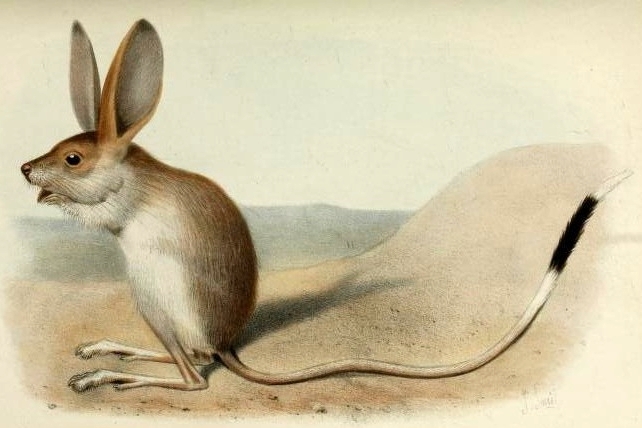
The Thick-tailed Three-toed Jerboa is a mammal in the family Dipodidae, order Rodentia, and class Mammalia. It occurs in China, Kazakhstan, Russia, Turkmenistan, Ukraine, and Uzbekistan. It has a pale greyish-yellow coat, a dark-coloured crown, and a white band across its hips.
Written 26 November 2026 from the sources listed below. Each statement was checked against the passage it cites; statements that could not be supported were removed.
Appearance
The Thick-tailed Three-toed Jerboa has a dark-coloured crown and a pale greyish-yellow coat with longer guard hairs bearing blackish tips. A white band extends across its hips, and its straw-coloured flanks are marked with dark flecks.[1][2][3][4]
Its head-and-body length is 104–133 mm. Its tail is approximately as long as its body, and it weighs between 70 and 90 grams.[5][6][7]
Habitat
The Thick-tailed Three-toed Jerboa inhabits steppe, desert, and mountain grassland environments. It occurs among saltbush and Artemisia growing in sandy or clayey soils.[8][9]
Diet
The Thick-tailed Three-toed Jerboa feeds on green plant parts, bulbs, and seeds.[10]
Behaviour
The Thick-tailed Three-toed Jerboa is nocturnal and solitary. It does not store food for winter.[11][12][13]
It inhabits a complex burrow system that can extend to 2.5 metres. Its main burrow systems have multiple entrances, each loosely blocked with a soil plug.[14][15]
The species also uses shallow burrows within its home range as refuges.[16]
Reproduction and life cycle
Females usually produce two litters annually, one in spring and another in autumn. Each litter usually contains two to four young.[17][18][19]
Conservation
The Thick-tailed Three-toed Jerboa has a wide geographical range and a presumed large total population. Its population is believed to be declining slowly.[20][21]
Conversion of steppe habitats to agricultural land is the main threat to the species. It is assessed as being of Least Concern by the International Union for Conservation of Nature.[22][23]
Classification of the Thick-tailed Three-toed Jerboa
| Kingdom | Animalia |
|---|---|
| Phylum | Chordata |
| Subphylum | Vertebrata |
| Infraphylum | Gnathostomata |
| Parvphylum | Osteichthyes |
| Megaclass | Tetrapoda |
| Class | Mammalia (Mammal) |
| Subclass | Theria |
| Infraclass | Eutheria |
| Order | Rodentia (Rodent) |
| Suborder | Myomorpha (Mice) |
| Superfamily | Dipodoidea |
| Family | Dipodidae (Jerboa) |
| Subfamily | Dipodinae |
| Genus | Stylodipus (Three-toed Jerboas) |
| Species | Stylodipus telum (Lichtenstein, 1823) |
Where the Thick-tailed Three-toed Jerboa is found
Checklists and occurrence records place Stylodipus telum in 5 countries across Asia. GBIF holds 638 georeferenced records of it.
Countries
Regions and cities with the most records
- Kherson, Ukraine 541
- Kherson, Ukraine 39
- Karaganda, Kazakhstan 13
- Oleshky, Ukraine 10
- Balqash, Kazakhstan 5
- Krasnoyarsk Krai, Russia 4
- Bahacheve, Ukraine 3
- Cherkasy, Ukraine 3
- Dagestan, Russia 3
- Zvenyhorodka, Ukraine 3
Range as the checklists state it
Europe & Northern Asia (excluding China)
Southern Asia
A number beside a place is its count of GBIF occurrence records. A place without a number comes from a checklist alone. Records show where a species has been observed or collected, which can include escapes and vagrants.
Common names
English
- Thick-tailed Three-toed Jerboa
Names in 11 other languages
- Czech
- tarbík emurančík
- Finnish
- paksuhäntäjerbo
- French
- Gerboise à grosse queue
- German
- Westliche Dickschwanzspringmaus, Zierliche Springmaus
- Greek
- Παχύουρο τριδάχτυλο Ζέρμποα
- Japanese
- オブトミユビトビネズミ
- Kazakh
- Тақылдағыш қосаяқ
- Norwegian Bokmål
- Tretået Sandspringmus
- Polish
- chyżoskoczek gruboogonowy
- Russian
- Обыкновенный емуранчик
- Ukrainian
- Ємуранчик звичайний
Synonyms
12 other scientific names have been used for this species and are now treated as synonyms of Stylodipus telum.
- Dipus proximus Fairmaire, 1853
- Dipus telum Lichenstein, 1823
- Dipus telum falzfeini Brauner, 1913
- Scirtopoda telum (Lichenstein, 1823) Vinogradov, 1930
- Scirtopoda telum amankaragai Selevin, 1934
- Scirtopoda telum birulae Martino, 1922 (in Vinogradov BS, 1937)
- Scirtopoda telum birulae Vinogradov, 1937
- Scirtopoda telum karelini Selevin, 1934
- Scirtopoda telum nastjukovi Shenbrot, 1991
- Scirtopoda telum turovi Hepner, 1934
- Stylodipus telum nastjukovi Shenbrot, 1991
- Dipus halticus Brandt, 1844 ambiguous synonym
Related species
- Andrews's Three-toed JerboaStylodipus andrewsi
- Mongolian Three-toed JerboaStylodipus sungorus
-
 Baluchistan Pygmy JerboaSalpingotulus michaelis
-
 Long-eared JerboaEuchoreutes naso
-
 Lesser Egyptian JerboaJaculus jaculus
-
 Meadow Jumping MouseZapus hudsonius
-
 Woodland Jumping MouseNapaeozapus insignis
-
 Greater Egyptian JerboaJaculus orientalis
Compare
Questions and answers
What is the scientific name of the Thick-tailed Three-toed Jerboa?
The scientific name of the Thick-tailed Three-toed Jerboa is Stylodipus telum. Written with its author, the full name is Stylodipus telum (Lichtenstein, 1823).
Which family does the Thick-tailed Three-toed Jerboa belong to?
Stylodipus telum belongs to the family Dipodidae, in the order Rodentia and the class Mammalia.
Where is the Thick-tailed Three-toed Jerboa found?
Checklists and occurrence records place Stylodipus telum in 5 countries: Ukraine, Kazakhstan, Russia, China and Mongolia.
What is the conservation status of the Thick-tailed Three-toed Jerboa?
The IUCN Red List category recorded for Stylodipus telum is Least Concern (LC).
What is the scientific name for jerboa?
The scientific name of the Thick-tailed Three-toed Jerboa is Stylodipus telum.[24]
What is a jerboas habitat?
The Thick-tailed Three-toed Jerboa inhabits steppe, desert, and mountain grassland environments. It is frequently found among saltbush and Artemisia growing in sandy or clayey soils.[8][9]
Is jerboa an herbivore?
The Thick-tailed Three-toed Jerboa feeds on green plant parts, bulbs, and seeds.[10]
Sources
Passages the profile rests on
- The crown of the species' head is dark-coloured. Source passage: “The crown of the head is dark-coloured” — English Wikipedia
- The species has a pale greyish-yellow coat with longer guard hairs bearing blackish tips. Source passage: “the rest of the coat is pale greyish-yellow with many longer guard hairs with blackish tips.” — English Wikipedia
- The species has a white band extending across its hips. Source passage: “A white band stretches across the hips” — English Wikipedia
- The species has straw-coloured flanks marked with dark flecks. Source passage: “the flanks are straw-coloured with dark flecks.” — English Wikipedia
- The species has a head-and-body length of 104–133 mm. Source passage: “grows to a length of 104 to 133 mm (4.1 to 5.2 in)” — English Wikipedia
- The species has a tail approximately as long as its body. Source passage: “with a tail as long again” — English Wikipedia
- The species weighs between 70 and 90 grams. Source passage: “a weight of 70 to 90 grams (2.5 to 3.2 oz).” — English Wikipedia
- The species inhabits steppe, desert, and mountain grassland environments. Source passage: “Its typical habitat is steppe, desert and mountain grassland” — English Wikipedia
- The species is frequently found among saltbush and Artemisia growing in sandy or clayey soils. Source passage: “where it is often found among saltbush and Artemisia in sandy or clayey soils.” — English Wikipedia
- The species feeds on green plant parts, bulbs, and seeds. Source passage: “It feeds on green parts of plants, bulbs and seeds” — English Wikipedia
- The species is nocturnal. Source passage: “The thick-tailed three-toed jerboa is nocturnal” — English Wikipedia
- The species is solitary. Source passage: “and is a solitary animal.” — English Wikipedia
- The species does not store food for winter. Source passage: “but does not store food for the winter.” — English Wikipedia
- The species inhabits a complex burrow system that can extend to 2.5 metres. Source passage: “It lives in a complex burrow system that may extend for two and a half metres” — English Wikipedia
- The species' main burrow systems have multiple entrances, each loosely blocked with a soil plug. Source passage: “with many entrances each loosely blocked with a plug of soil.” — English Wikipedia
- The species also uses shallow burrows within its home range as refuges. Source passage: “It also has shallow burrows within its home range which may be used by more than one individual and into which it can retreat.” — English Wikipedia
- Females of the species usually produce two litters annually. Source passage: “Females usually have two litters per year” — English Wikipedia
- Each litter usually contains two to four young. Source passage: “each consisting of two to four young” — English Wikipedia
- The species usually produces one litter in spring and another in autumn. Source passage: “one in spring and the other in autumn.” — English Wikipedia
- The species has a wide geographical range and a presumed large total population. Source passage: “The thick-tailed three-toed jerboa has a wide range and presumed large total population.” — English Wikipedia
- The species' population is believed to be declining slowly. Source passage: “Its population size is believed to be in slow decline” — English Wikipedia
- Conversion of steppe habitats to agricultural land is the main threat to the species. Source passage: “The main threat it faces is conversion of the steppe to agricultural use.” — English Wikipedia
- The species is assessed as being of Least Concern by the International Union for Conservation of Nature. Source passage: “the International Union for Conservation of Nature has assessed its conservation status as being of "least concern".” — English Wikipedia
- The scientific name recorded for the species is Stylodipus telum. Source passage: “Scientific Name. Stylodipus telum.” — fws.gov
Data
- Catalogue of Life, 2026-10-16 XR cc by
- Global Biodiversity Information Facility CC BY 4.0
- Wikidata CC0
- GeoNames CC BY 4.0
- Wikimedia Commons per image; credit shown with each image
- Within the Catalogue of Life, this name comes from The Integrated Taxonomic Information System cc0
References
- Naturhist. Anhang (or Eversmann's Reise Orenburg) p.120 where the name was published
- Wilson, Don E., and DeeAnn M. Reeder, eds. (1993). Mammal Species of the World: A Taxonomic and Geographic Reference, 2nd Ed., 3rd Printing.
- Wilson, Don E., and F. Russell Cole. (2000). Common Names of Mammals of the World.
- Holden, Mary Ellen, and Guy G. Musser / Wilson, Don E., and DeeAnn M. Reeder, eds. (2005). Family Dipodidae. Mammal Species of the World: A Taxonomic and Geographic Reference, 3rd Ed., Vol. 2.
- Shenbrot, G. I., V. E. Sokolov, V. G. Heptner, and Yu. M. Koval’skaya. (2008). Jerboas.
This species in other databases
Page built on 27 November 2026. See how the catalog is made and all sources and licences.
Cite this page
ScientificNames.org. (2026). Stylodipus telum (Thick-tailed Three-toed Jerboa). Retrieved November 27, 2026, from https://scientificnames.org/species/stylodipus-telum
“Stylodipus telum (Thick-tailed Three-toed Jerboa).” ScientificNames.org, 2026, scientificnames.org/species/stylodipus-telum. Accessed 27 Nov. 2026.
ScientificNames.org. “Stylodipus telum (Thick-tailed Three-toed Jerboa).” Accessed November 27, 2026. https://scientificnames.org/species/stylodipus-telum.
@misc{scientificnames_stylodipus_telum_thick_tailed_three_toed_jerboa,
  author = {{ScientificNames.org}},
  title = {Stylodipus telum (Thick-tailed Three-toed Jerboa)},
  year = {2026},
  url = {https://scientificnames.org/species/stylodipus-telum},
  note = {Accessed 2026-11-27}
}