Species · Birds
White-winged Swallow Tachycineta albiventer
The scientific name of the White-winged Swallow is Tachycineta albiventer. It is a species of bird in the family Hirundinidae (swallow), order Passeriformes. The name dates from 1783.
- Scientific name
- Tachycineta albiventer (Boddaert, 1783)
- Common name
- White-winged Swallow
- Genus
- Tachycineta
- Family
- Hirundinidae (Swallow)
- Order
- Passeriformes
- Class
- Aves
- Red List category
- LC Least Concern
- Recorded in
- 15 countries
- Name status
- accepted in the Catalogue of Life

Overview
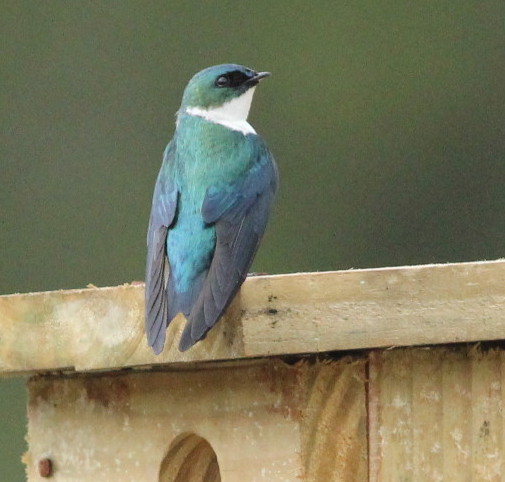
The species is native to Argentina, Bolivia, Brazil, Colombia, Ecuador, French Guiana, Guyana, Paraguay, Peru, Suriname, Trinidad and Tobago, and Venezuela. It is distinguished by its glossy blue-green back and conspicuous white patches on its wings.
Written 26 November 2026 from the sources listed below. Each statement was checked against the passage it cites; statements that could not be supported were removed.
Conservation
The White-winged Swallow is classified as Least Concern by the IUCN. This classification is based on its very large range, apparently stable population and large population size.[1][2]
The species was most recently assessed for the IUCN Red List in 2024.[3]
Similar species
The White-winged Swallow can be distinguished from the mangrove swallow by lacking a white line above the lores and having more white on its wings.[4]
Appearance
Adults have iridescent blue-green upperparts, white underparts and rump, and white edges on the secondary flight feathers. The wings are otherwise black, as is the tail.[5][6]
The species has dark brown eyes and a black bill and legs.[7]
Females have slightly less white on their wings than males.[8]
Juveniles have grayer underparts and generally duller plumage than adults. They also have less white on their wings.[9][10]
Adults measure approximately 14 centimetres in length and weigh between 14 and 17 grams.[11][12]
Habitat
The White-winged Swallow generally inhabits lowland areas in or near rivers and lakes. It occurs at elevations of approximately 500 metres.[13][14]
The species is native to Argentina, Bolivia, Brazil, Colombia, Ecuador, French Guiana, Guyana, Paraguay, Peru, Suriname, Trinidad and Tobago, and Venezuela. Occasional vagrants reach Panama, and the species is generally absent from the Pacific coast of South America, particularly its southern portion.[15][16][17]
The species is resident throughout most of its range, but populations in the southernmost part migrate. In Brazil and Argentina, it is present approximately from mid-September until mid-April.[18][19]
The wintering grounds of southern populations are thought most likely to include the Guianas, Venezuela and Colombia.[20]
Diet
The White-winged Swallow primarily eats flying insects.[21]
Behaviour
The White-winged Swallow is largely non-migratory.[22]
The species produces a harsh chirrup or a repeated rising buzz-like call. Its alarm call is short and harsh.[23][24]
The species generally feeds while flying at low altitude. It usually forages over water but also feeds over land.[25][26]
Between feeding attempts, individuals usually perch on branches near bodies of water.[27]
The species flies along direct flight paths using flapping flight.[28]
Reproduction and life cycle
The White-winged Swallow builds cup-shaped nests lined with feathers from other birds and some seeds. Nests are constructed in tree holes, between boulders or in man-made structures, generally a few metres above water.[29][30][31]
Breeding pairs establish separate nests.[32]
Clutches contain between three and six white eggs. The eggs measure 17–20 mm by 13–14.6 mm and each weighs approximately 1.9 grams.[33][34][35]
Classification of the White-winged Swallow
| Kingdom | Animalia |
|---|---|
| Phylum | Chordata |
| Subphylum | Vertebrata |
| Infraphylum | Gnathostomata |
| Parvphylum | Osteichthyes |
| Megaclass | Tetrapoda |
| Class | Aves (Bird) |
| Order | Passeriformes (Passerine) |
| Family | Hirundinidae (Swallow) |
| Genus | Tachycineta (Tree Swallows) |
| Species | Tachycineta albiventer (Boddaert, 1783) |
Where the White-winged Swallow is found
Checklists and occurrence records place Tachycineta albiventer in 15 countries across South America. GBIF holds 109,583 georeferenced records of it.
Countries
- Argentina 1,773
- Bolivia 1,761
- Brazil 39,805
- Colombia 17,923
- Ecuador 11,814
- French Guiana 1,648
- Grenada 58
- Guyana 2,533
- Martinique 4
- Panama 3
- Paraguay 206
- Peru 18,601
- Suriname 2,026
- Trinidad and Tobago 6,194
- Venezuela 5,234
Regions and cities with the most records
- Mato Grosso, Brazil 10,582
- Madre de Dios, Peru 10,394
- Sucumbíos, Ecuador 6,073
- Loreto, Peru 5,604
- Orellana Province, Ecuador 4,138
- Amazonas, Brazil 3,960
- São Paulo, Brazil 3,545
- Paradise, Trinidad and Tobago 3,254
- Tunapuna, Trinidad and Tobago 3,167
- Arima, Trinidad and Tobago 3,148
- Meta Department, Colombia 2,951
- Pará, Brazil 2,884
- Chaguanas, Trinidad and Tobago 2,596
- Bahia, Brazil 2,565
- Laventille, Trinidad and Tobago 2,416
- Tunapuna/Piarco, Trinidad and Tobago 2,254
- Port of Spain, Trinidad and Tobago 1,876
- Mato Grosso do Sul, Brazil 1,872
- Ceará, Brazil 1,652
- Casanare Department, Colombia 1,643
- Pernambuco, Brazil 1,533
- Minas Gerais, Brazil 1,507
- Puerto Iguazú, Argentina 1,485
- Misiones, Argentina 1,452
- Alagoas, Brazil 1,416
- Paraná, Brazil 1,370
- Antioquia, Colombia 1,362
- Putumayo Department, Colombia 1,224
- Cuzco Department, Peru 1,200
- Upper Takutu-Upper Essequibo, Guyana 1,161
- Puerto Maldonado, Peru 1,118
- Amazonas Department, Colombia 1,041
- Napo, Ecuador 1,032
- Tobago, Trinidad and Tobago 1,028
- Salvador, Brazil 1,001
- Sangre Grande, Trinidad and Tobago 966
Range as the checklists state it
South America
A number beside a place is its count of GBIF occurrence records. A place without a number comes from a checklist alone. Records show where a species has been observed or collected, which can include escapes and vagrants.
Common names
English
- White-winged Swallow
Names in 29 other languages
- Arabic
- سنونو ذو الأجنحة البيضاء
- Bulgarian
- Белокрила лястовица
- Catalan
- oreneta alablanca
- Chinese
- 白翅树燕, 白腹樹燕, 白腹樹燕〔白翅樹燕〕
- Croatian
- bjelokrili piljak
- Czech
- vlaštovka bělobřichá
- Danish
- Hvidbræmmet Svale, Peru Mangrovesvale
- Dutch
- Witbuikzwaluw
- Esperanto
- blankflugila hirundo
- Estonian
- kiritiib-pääsuke
- Finnish
- valkosiipipääsky
- French
- Hirondelle à ailes blanches
- German
- Cayenne-Schwalbe, Cayenneschwalbe
- Italian
- Rondine alibianche
- Japanese
- ハジロミドリツバメ
- Lithuanian
- baltasparnė amerikinė kregždė
- Norwegian
- hvitbremsvale
- Papiamento
- Souchi Barika Blanku, Swalchi Barica Blanco
- Persian
- پرستوی بالسفید
- Polish
- nadobniczka zielono-biała
- Portuguese
- andorinha-d'asa-branca, andorinha-do-rio
- Russian
- Белокрылая американская ласточка, Белокрылая ласточка
- Serbian
- Belokrila lasta
- Slovak
- lastovička bielobruchá
- Spanish
- Golondrina ala blanca, Golondrina aliblanca, Golondrina de alas blancas
- Swedish
- vitvingad svala
- Turkish
- Ak Kanatlı Kırlangıç
- Ukrainian
- білозорка білокрила
- Welsh
- gwennol adeinwen
Synonyms
2 other scientific names have been used for this species and are now treated as synonyms of Tachycineta albiventer.
- Hirundo albiventer Boddaert, 1783
- Iridoprocne albiventris Coues, E, 1878
Subspecies and varieties
- Tachycineta albiventer albiventer subspecies
- Tachycineta albiventer magdalenae subspecies
Related species
-
 Tree SwallowTachycineta bicolor
-
 Violet-green SwallowTachycineta thalassina
-
 Mangrove SwallowTachycineta albilinea
-
 Chilean SwallowTachycineta leucopyga
-
 White-rumped SwallowTachycineta leucorrhoa
-
 Golden SwallowTachycineta euchrysea
-
 Bahama SwallowTachycineta cyaneoviridis
- Tumbes SwallowTachycineta stolzmanni
Compare
Questions and answers
What is the scientific name of the White-winged Swallow?
The scientific name of the White-winged Swallow is Tachycineta albiventer. Written with its author, the full name is Tachycineta albiventer (Boddaert, 1783).
Which family does the White-winged Swallow belong to?
Tachycineta albiventer belongs to the family Hirundinidae, in the order Passeriformes and the class Aves.
Where is the White-winged Swallow found?
Checklists and occurrence records place Tachycineta albiventer in 15 countries, including Brazil, Peru, Colombia, Ecuador, Trinidad and Tobago and Venezuela.
What is the conservation status of the White-winged Swallow?
The IUCN Red List category recorded for Tachycineta albiventer is Least Concern (LC).
Sources
Passages the profile rests on
- The species is classified as Least Concern by the IUCN. Source passage: “The white-winged swallow is classified as Least Concern by the IUCN” — English Wikipedia
- The Least Concern classification is based on the species' very large range, apparently stable population, and large population size. Source passage: “based on its very large range, apparently stable population, and large population size.” — English Wikipedia
- The species was most recently assessed for the IUCN Red List in 2024. Source passage: “White-winged Swallow Tachycineta albiventer has most recently been assessed for The IUCN Red List of Threatened Species in 2024.” — iucnredlist.org
- The species can be distinguished from the mangrove swallow by lacking a white line above the lores and having more white on its wings. Source passage: “White-winged swallows can be distinguished from the similar mangrove swallow by the lack of a white line above its lores and a greater amount of white on its wings.” — English Wikipedia
- Adult individuals have iridescent blue-green upperparts, white underparts and rump, and white edges on the secondary flight feathers. Source passage: “It has iridescent blue-green upperparts, white underparts and rump, and white edgings to the secondary flight feathers.” — English Wikipedia
- The wings are otherwise black, as is the tail. Source passage: “The wings are otherwise black, along with the tail.” — English Wikipedia
- The species has dark brown eyes and a black bill and legs. Source passage: “It has dark brown eyes and a black bill and legs.” — English Wikipedia
- Females have slightly less white on their wings than males. Source passage: “the females have slightly less white on the wing.” — English Wikipedia
- Juveniles have grayer underparts and generally duller plumage than adults. Source passage: “Juveniles have grayer underparts and are duller in general when compared to the adults.” — English Wikipedia
- Juveniles have less white on their wings than adults. Source passage: “The juvenile also has less white on the wing.” — English Wikipedia
- Adult individuals measure approximately 14 centimetres in length. Source passage: “The adult white-winged swallow is 14 cm (5.5 in) long” — English Wikipedia
- Adult individuals weigh between 14 and 17 grams. Source passage: “weighs 14–17 g (0.49–0.60 oz).” — English Wikipedia
- The species generally inhabits lowland areas in or near rivers and lakes. Source passage: “The species is usually found in or near lowland areas along bodies of water such as rivers or lakes” — English Wikipedia
- The species occurs at elevations of approximately 500 metres. Source passage: “at elevations of about 500 m (1,600 ft).” — English Wikipedia
- The species is native to Argentina, Bolivia, Brazil, Colombia, Ecuador, French Guiana, Guyana, Paraguay, Peru, Suriname, Trinidad and Tobago, and Venezuela. Source passage: “The white-winged swallow is native to Argentina, Bolivia, Brazil, Colombia, Ecuador, French Guiana, Guyana, Paraguay, Peru, Suriname, Trinidad and Tobago, and Venezuela.” — English Wikipedia
- Occasional vagrants of this species reach Panama. Source passage: “Occasional vagrants reach Panama.” — English Wikipedia
- The species is generally absent from the Pacific coast of South America, particularly its southern portion. Source passage: “They are usually not found on the Pacific coast, especially in the southern portion of South America.” — English Wikipedia
- The species is resident throughout most of its range, but populations in the southernmost part migrate. Source passage: “It is resident in most of its range, although in the most southerly part it is migratory.” — English Wikipedia
- In Brazil and Argentina, the species is present approximately from mid-September until mid-April. Source passage: “In Brazil and Argentina, it is only present from approximately mid-September to mid-April.” — English Wikipedia
- The wintering grounds of the southern populations are thought most likely to include the Guianas, Venezuela, and Colombia. Source passage: “Where this population winters is not well known, but it is most likely in the Guianas, Venezuela, and Colombia.” — English Wikipedia
- The species primarily eats flying insects. Source passage: “catching flying insects.” — English Wikipedia
- The species is largely non-migratory. Source passage: “This swallow is largely non-migratory.” — English Wikipedia
- The species produces a harsh chirrup or a repeated rising buzz-like call. Source passage: “The call is a harsh chirrup or a repeated, rising, buzz-like zweeed.” — English Wikipedia
- Its alarm call is short and harsh. Source passage: “The alarm call is short and harsh.” — English Wikipedia
- The species generally feeds while flying at low altitude. Source passage: “The white-winged swallow feeds primarily in flight at a low altitude, catching flying insects.” — English Wikipedia
- The species usually forages over water but also feeds over land. Source passage: “It usually forages over water but may also feed over land.” — English Wikipedia
- Between feeding attempts, individuals usually perch on branches near bodies of water. Source passage: “In between foraging attempts, it usually perches on branches near bodies of water.” — English Wikipedia
- The species flies along direct flight paths using flapping flight. Source passage: “Flight paths are direct and they fly with a flapping flight.” — English Wikipedia
- The species builds cup-shaped nests lined with feathers from other birds and some seeds. Source passage: “The white-winged swallow builds a cup nest lined with other birds' feathers and some seed” — English Wikipedia
- The species nests in tree holes, between boulders, or in man-made structures. Source passage: “inside a tree hole, between boulders or in man-made structures.” — English Wikipedia
- Nests are generally constructed a few metres above water. Source passage: “Nests are usually built a few metres above water;” — English Wikipedia
- Breeding pairs establish separate nests. Source passage: “pairs nest separately.” — English Wikipedia
- Clutches contain between three and six white eggs. Source passage: “The clutch is three to six white eggs” — English Wikipedia
- The eggs measure 17–20 mm by 13–14.6 mm. Source passage: “measuring 17 mm–20 mm × 13 mm–14.6 mm” — English Wikipedia
- Each egg weighs approximately 1.9 grams. Source passage: “and weighing 1.9 g (0.067 oz).” — English Wikipedia
- The species has a glossy blue-green back and conspicuous white patches on its wings. Source passage: “Common swallow in tropical lowlands with a glossy blue-green back. Large white wing patches are easily visible in flight and on perched birds.” — ebird.org
Data
- Catalogue of Life, 2026-10-16 XR cc by
- Global Biodiversity Information Facility CC BY 4.0
- Wikidata CC0
- GeoNames CC BY 4.0
- Wikimedia Commons per image; credit shown with each image
- Within the Catalogue of Life, this name comes from The Integrated Taxonomic Information System cc0
References
- Gill, Frank, & and Minturn Wright. (2006). Birds of the World: Recommended English Names.
This species in other databases
Page built on 27 November 2026. See how the catalog is made and all sources and licences.
Cite this page
ScientificNames.org. (2026). Tachycineta albiventer (White-winged Swallow). Retrieved November 27, 2026, from https://scientificnames.org/species/tachycineta-albiventer
“Tachycineta albiventer (White-winged Swallow).” ScientificNames.org, 2026, scientificnames.org/species/tachycineta-albiventer. Accessed 27 Nov. 2026.
ScientificNames.org. “Tachycineta albiventer (White-winged Swallow).” Accessed November 27, 2026. https://scientificnames.org/species/tachycineta-albiventer.
@misc{scientificnames_tachycineta_albiventer_white_winged_swallow,
  author = {{ScientificNames.org}},
  title = {Tachycineta albiventer (White-winged Swallow)},
  year = {2026},
  url = {https://scientificnames.org/species/tachycineta-albiventer},
  note = {Accessed 2026-11-27}
}