Species · Birds
Tree Swallow Tachycineta bicolor
The scientific name of the Tree Swallow is Tachycineta bicolor. It is a species of bird in the family Hirundinidae (swallow), order Passeriformes. The name dates from 1808.
- Scientific name
- Tachycineta bicolor (Vieillot, 1808)
- Common name
- Tree Swallow
- Genus
- Tachycineta
- Family
- Hirundinidae (Swallow)
- Order
- Passeriformes
- Class
- Aves
- Red List category
- LC Least Concern
- Environment
- terrestrial
- Recorded in
- 21 countries
- Name status
- accepted in the Catalogue of Life

Overview
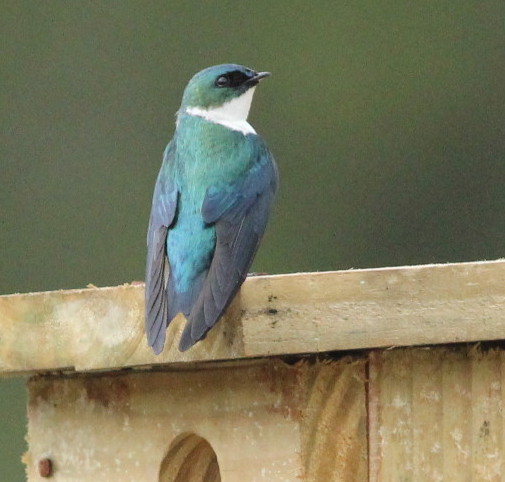
Adult males have glossy blue-green upperparts, blackish wings and tails, and white underparts.
Written 26 November 2026 from the sources listed below. Each statement was checked against the passage it cites; statements that could not be supported were removed.
Appearance
Adult males have glossy blue-green upperparts, blackish wings and tails, and white underparts. The white underparts do not extend to the eye.[1][2]
Females are generally duller in coloration than males and may have a brown forehead. Juveniles have brown upperparts and a gray-brown-washed breast.[3][4]
The species has a black bill, dark brown eyes, and pale brown legs and feet. Its body length is approximately 12–14 cm, its wingspan ranges from 30 to 35 cm, and its body mass is approximately 17–25.5 g.[5][6][7][8]
Habitat
The Tree Swallow's breeding habitat primarily consists of open and wooded areas, particularly those near water. It occupies wetlands, including marshes, wooded bogs, ponds, and fields.[9][10]
Diet
The Tree Swallow primarily feeds on insects captured in flight. Its diet also includes mollusks, spiders, and fruit.[11][12]
During periods of insect scarcity, it consumes bayberries and other plant matter. It can digest the wax found in bayberries.[13][14]
Both parents feed nestlings primarily insects.[15]
Behaviour
The Tree Swallow catches insects through acrobatic aerial flight near water bodies. It drinks by flying low over water and briefly touching the surface.[16][17]
It is generally aggressive during the breeding season. It generally returns to the same breeding site in subsequent years.[18][19]
Reproduction and life cycle
The Tree Swallow nests either in isolated pairs or loose groups. Its breeding season generally extends from early May through July.[20][21]
The species is generally socially monogamous, although up to 8% of breeding males are polygynous. Females typically lay four to seven pure white eggs.[22][23][24]
Incubation generally lasts approximately 14–15 days. Both sexes feed the nestlings, which generally fledge 18–22 days after hatching.[25][26][27]
In Alaska, the median egg-laying date is June 1.[28]
Conservation
The Tree Swallow is classified as Least Concern on the IUCN Red List. Its global population was estimated at 19 million birds in 2025.[29][30]
The species can accumulate aquatic contaminants such as mercury and PCBs. Artificial nest boxes help increase local populations.[31][32]
Classification of the Tree Swallow
| Kingdom | Animalia |
|---|---|
| Phylum | Chordata |
| Subphylum | Vertebrata |
| Infraphylum | Gnathostomata |
| Parvphylum | Osteichthyes |
| Megaclass | Tetrapoda |
| Class | Aves (Bird) |
| Order | Passeriformes (Passerine) |
| Family | Hirundinidae (Swallow) |
| Genus | Tachycineta (Tree Swallows) |
| Species | Tachycineta bicolor (Vieillot, 1808) |
Where the Tree Swallow is found
Checklists and occurrence records place Tachycineta bicolor in 21 countries across North America. GBIF holds 7,685,558 georeferenced records of it.
Countries
- Bahamas 410
- Belize 4,237
- Bermuda 582
- Canada 1,370,474
- Cayman Islands 463
- Costa Rica 909
- Cuba 2,220
- Dominican Republic 87
- El Salvador 17
- Guadeloupe 19
- Guatemala 843
- Haiti 19
- Honduras 593
- Jamaica 124
- Mexico 11,709
- Nicaragua 66
- Panama 58
- Puerto Rico 39
- Saint Pierre and Miquelon 310
- Turks and Caicos Islands 7
- United States 6,292,372
Regions and cities with the most records
- Ontario, Canada 506,397
- California, United States 501,902
- New York, United States 468,071
- Ohio, United States 409,045
- Quebec, Canada 377,823
- Pennsylvania, United States 372,839
- Massachusetts, United States 341,341
- Wisconsin, United States 299,421
- Michigan, United States 286,560
- Illinois, United States 285,280
- New Jersey, United States 282,807
- Florida, United States 241,610
- Oregon, United States 223,739
- Virginia, United States 202,016
- Washington, United States 189,323
- Maryland, United States 183,200
- Minnesota, United States 178,017
- British Columbia, Canada 177,808
- Colorado, United States 135,607
- Connecticut, United States 122,939
- Indiana, United States 120,835
- Alberta, Canada 109,874
- Texas, United States 104,860
- Maine, United States 99,062
- Montana, United States 89,787
- Tennessee, United States 86,430
- North Carolina, United States 83,300
- Vermont, United States 74,536
- Newton, United States 65,278
- Watertown, United States 65,251
- Waltham, United States 64,809
- Delaware, United States 64,529
- Belmont, United States 63,657
- Brighton, United States 63,643
- Arlington, United States 63,359
- New Hampshire, United States 61,234
8 more countries have a few records outside this range
These countries hold a few records of Tachycineta bicolor but lie outside the range the checklists give for it. Such records are often zoo or garden specimens, museum material or vagrants, so the species is not counted as occurring there.
Range as the checklists state it
Middle America
North America
Caribbean
A number beside a place is its count of GBIF occurrence records. A place without a number comes from a checklist alone. Records show where a species has been observed or collected, which can include escapes and vagrants.
Common names
English
- Tree Swallow
- American Tree Swallow
Names in 43 other languages
- Arabic
- سنونو الشجرة
- Basque
- Zuhaitz-enara
- Bulgarian
- Двуцветна дървесна лястовица
- Catalan
- oreneta bicolor
- Chinese
- 双色树燕, 双色樹燕, 雙色樹燕
- Croatian
- piljak dupljaš
- Czech
- vlaštovka stromová
- Danish
- Træsvale
- Dutch
- boomzwaluw
- Esperanto
- dukolora hirundo
- Estonian
- õõnepääsuke
- Finnish
- kelopääsky
- French
- Hirondelle bicolore
- German
- Sumpfschwalbe
- Greek
- Κοινό Δεντροχελίδονο
- Hebrew
- סנונית עצים
- Hungarian
- odúfecske
- Icelandic
- Trjásvala
- Irish
- Fáinleog chrainn
- Italian
- Rondine arboricola, Rondine arboricola bicolore
- Japanese
- ミドリツバメ
- Latvian
- koku bezdelīga
- Lithuanian
- Medkregždė, miškinė amerikinė kregždė, nedtūpė kregždė
- Malayalam
- ട്രീ സ്വാല്ലോ
- Northern Sami
- Soarvebeškkoš
- Norwegian
- tresvale
- Persian
- پرستوی درختی
- Polish
- nadobniczka drzewna
- Portuguese
- andorinha-das-árvores
- Russian
- Древесная американская ласточка, Древесная ласточка, американская древесная ласточка
- Serbian
- Dvobojna američka lasta
- Slovak
- lastovička dvojfarebná
- Slovenian
- drevesna lastovka
- Spanish
- Golondrina bicolor
- Swedish
- trädsvala
- Turkish
- ağaç kırlangıcı
- Ukrainian
- білозорка річкова
- Welsh
- gwennol coed America
- esu
- equgmelngaq
- hat
- Irondèl pye bwa
- nav
- Tsinyiʼ táshchozhii dootłʼizhígíí
- nya
- Mtengo ukumeza
- oji
- Shaawanipiisi (Shaashaawanipiisi)
Synonyms
5 other scientific names have been used for this species and are now treated as synonyms of Tachycineta bicolor.
- Hirundo bicolor Vieillot, 1808
- Iridoprocne bicolor (Vieillot, 1808)
- Iridoprocne bicolor Coues, E, 1878
- Iridoprogne bicolor Vieillot, LJP, 1808
- Hirundo viridis A. Wilson, 1812 ambiguous synonym
Related species
-
 Violet-green SwallowTachycineta thalassina
-
 Mangrove SwallowTachycineta albilinea
-
 Chilean SwallowTachycineta leucopyga
-
 White-rumped SwallowTachycineta leucorrhoa
-
 Golden SwallowTachycineta euchrysea
-
 Bahama SwallowTachycineta cyaneoviridis
-
 White-winged SwallowTachycineta albiventer
- Tumbes SwallowTachycineta stolzmanni
Compare
Questions and answers
What is the scientific name of the Tree Swallow?
The scientific name of the Tree Swallow is Tachycineta bicolor. Written with its author, the full name is Tachycineta bicolor (Vieillot, 1808).
Which family does the Tree Swallow belong to?
Tachycineta bicolor belongs to the family Hirundinidae, in the order Passeriformes and the class Aves.
Where is the Tree Swallow found?
Checklists and occurrence records place Tachycineta bicolor in 21 countries, including United States, Canada, Mexico, Belize, Cuba and Costa Rica.
What is the conservation status of the Tree Swallow?
The IUCN Red List category recorded for Tachycineta bicolor is Least Concern (LC).
What other names does the Tree Swallow have?
Tachycineta bicolor is also known in English as American Tree Swallow.
How rare is a Tree Swallow?
The Tree Swallow is classified as Least Concern on the IUCN Red List. Its global population was estimated at 19 million birds in 2025, although its North American population has declined by as much as 50% over the last 50 years.[29][33][30]
Do Tree Swallows come back to the same place every year?
The Tree Swallow generally returns to the same breeding site in subsequent years.[19]
What do Tree Swallows eat?
Tree Swallows primarily eat insects captured in flight. Their diet also includes mollusks, spiders, and fruit, as well as bayberries and other plant matter during periods of insect scarcity.[11][12][13]
What is a Swallows' favorite food?
The Tree Swallow primarily feeds on insects captured in flight.[11]
Sources
Passages the profile rests on
- Adult males have glossy blue-green upperparts, blackish wings and tails, and white underparts. Source passage: “The male has mostly glossy blue-green upperparts, the wings and tail being blackish. The underparts and the cheek patch are white” — English Wikipedia
- Its white underparts do not extend to the eye. Source passage: “The white does not extend to their eye as in Violet-green Swallows.” — adfg.alaska.gov
- Females are generally duller in coloration than males and may have a brown forehead. Source passage: “The female is duller in color than the male, and sometimes has a brown forehead.” — English Wikipedia
- Juveniles have brown upperparts and a gray-brown-washed breast. Source passage: “The juvenile tree swallow can be distinguished by its brown upperparts and gray-brown-washed breast.” — English Wikipedia
- The species has a black bill, dark brown eyes, and pale brown legs and feet. Source passage: “The bill is black, the eyes dark brown, and the legs and feet pale brown.” — English Wikipedia
- Its body length is approximately 12–14 cm. Source passage: “The tree swallow has a length between about 12 and 14 cm (4.7 and 5.5 in)” — English Wikipedia
- Its wingspan ranges from 30 to 35 cm. Source passage: “Wingspan ranges from 30 to 35 cm (12 to 14 in).” — English Wikipedia
- Its body mass is approximately 17–25.5 g. Source passage: “a weight of approximately 17 to 25.5 g (0.60 to 0.90 oz).” — English Wikipedia
- Its breeding habitat primarily consists of open and wooded areas, particularly those near water. Source passage: “The breeding habitat of this bird is primarily in open and wooded areas, especially those near water.” — English Wikipedia
- It occupies wetlands, including marshes, wooded bogs, ponds, and fields. Source passage: “These habitats—marshes, wooded bogs, ponds, and fields—provide the insects they eat” — adfg.alaska.gov
- It primarily feeds on insects captured in flight. Source passage: “An aerial insectivore, the tree swallow forages both alone and in groups, eating mostly insects” — English Wikipedia
- Its diet also includes mollusks, spiders, and fruit. Source passage: “in addition to mollusks, spiders, and fruit.” — English Wikipedia
- During periods of insect scarcity, it consumes bayberries and other plant matter. Source passage: “During the non-breeding season and other insect-scarce times, Tree Swallows eat bayberries (Myrica species) and other vegetable matter.” — adfg.alaska.gov
- It can digest the wax found in bayberries. Source passage: “Tree Swallows are one of the few species who can digest the wax in bayberries.” — adfg.alaska.gov
- Both parents feed nestlings primarily insects. Source passage: “The nestlings, like the adult, primarily eat insects, fed to it by both sexes.” — English Wikipedia
- It catches insects through acrobatic aerial flight near water bodies. Source passage: “Tree Swallows swoop near water bodies to catch insects in the air, turning abruptly and acrobatically.” — adfg.alaska.gov
- It drinks by flying low over water and briefly touching the surface. Source passage: “They drink by flying low over the water and contacting the surface briefly.” — adfg.alaska.gov
- It is generally aggressive during the breeding season. Source passage: “Although it is aggressive during the breeding season” — English Wikipedia
- It generally returns to the same breeding site in subsequent years. Source passage: “When a swallow returns to nest, it usually does not change breeding sites.” — English Wikipedia
- It nests either in isolated pairs or loose groups. Source passage: “The tree swallow nests either in isolated pairs or loose groups” — English Wikipedia
- Its breeding season generally extends from early May through July. Source passage: “Breeding can start as soon as early May, although this date is occurring earlier because of climate change, and it can end as late as July.” — English Wikipedia
- The species is generally socially monogamous, although up to 8% of breeding males are polygynous. Source passage: “This species is generally socially monogamous, but up to 8% of breeding males are polygynous.” — English Wikipedia
- Females typically lay four to seven eggs. Source passage: “The female incubates the clutch of two to eight (but usually four to seven) pure white eggs” — English Wikipedia
- The eggs are pure white. Source passage: “pure white eggs for around 14 to 15 days.” — English Wikipedia
- Incubation generally lasts approximately 14–15 days. Source passage: “pure white eggs for around 14 to 15 days.” — English Wikipedia
- Both sexes feed the nestlings. Source passage: “The nestlings, like the adult, primarily eat insects, fed to it by both sexes.” — English Wikipedia
- Nestlings generally fledge 18–22 days after hatching. Source passage: “They generally fledge about 18 to 22 days after hatching.” — English Wikipedia
- In Alaska, the median egg-laying date is June 1. Source passage: “Alaska-breeding birds’ median egg laying date is June 1st.” — adfg.alaska.gov
- The species is classified as Least Concern on the IUCN Red List. Source passage: “IUCN Red List of Threatened Species: Least Concern” — adfg.alaska.gov
- Its global population was estimated at 19 million birds in 2025. Source passage: “In 2025, their global population was estimated at 19 million birds” — adfg.alaska.gov
- The species can accumulate aquatic contaminants such as mercury and PCBs. Source passage: “Tree Swallows have been shown to bioaccumulate aquatic contaminants like mercury and PCBs” — adfg.alaska.gov
- Artificial nest boxes help increase local populations. Source passage: “The addition of nest boxes helps to increase local populations” — adfg.alaska.gov
- Its North American population has declined by as much as 50% over the last 50 years. Source passage: “their population in North America has declined as much as 50% in the last 50 years” — adfg.alaska.gov
Data
- Catalogue of Life, 2026-10-16 XR cc by
- Global Biodiversity Information Facility CC BY 4.0
- Wikidata CC0
- GeoNames CC BY 4.0
- Wikimedia Commons per image; credit shown with each image
- iNaturalist per image; credit shown with each image
- Within the Catalogue of Life, this name comes from The Integrated Taxonomic Information System cc0
References
- Hist. Nat. Ois. Am. Sept., 1(1807): 61, pl. 31. 1808 where the name was published
- Banks, R. C., R. W. McDiarmid, and A. L. Gardner. (1987). Checklist of Vertebrates of the United States, the U.S. Territories, and Canada. Resource Publication, No. 166.
- Gill, Frank, & and Minturn Wright. (2006). Birds of the World: Recommended English Names.
This species in other databases
- Catalogue of Life 54CBB
- Wikidata Q922192
- iNaturalist 11935
- WoRMS urn:lsid:marinespecies.org:taxname:422625
- Avibase treswa
Page built on 27 November 2026. See how the catalog is made and all sources and licences.
Cite this page
ScientificNames.org. (2026). Tachycineta bicolor (Tree Swallow). Retrieved November 27, 2026, from https://scientificnames.org/species/tachycineta-bicolor
“Tachycineta bicolor (Tree Swallow).” ScientificNames.org, 2026, scientificnames.org/species/tachycineta-bicolor. Accessed 27 Nov. 2026.
ScientificNames.org. “Tachycineta bicolor (Tree Swallow).” Accessed November 27, 2026. https://scientificnames.org/species/tachycineta-bicolor.
@misc{scientificnames_tachycineta_bicolor_tree_swallow,
  author = {{ScientificNames.org}},
  title = {Tachycineta bicolor (Tree Swallow)},
  year = {2026},
  url = {https://scientificnames.org/species/tachycineta-bicolor},
  note = {Accessed 2026-11-27}
}