Species · Birds
Sunda Zebra Finch Taeniopygia guttata
The scientific name of the Sunda Zebra Finch is Taeniopygia guttata. It is a species of bird in the family Estrildidae (munias), order Passeriformes. The name dates from 1817.
- Scientific name
- Taeniopygia guttata (Vieillot, 1817)
- Common name
- Sunda Zebra Finch
- Genus
- Taeniopygia
- Family
- Estrildidae (Munias)
- Order
- Passeriformes
- Class
- Aves
- Red List category
- LC Least Concern
- Recorded in
- 5 countries
- Name status
- accepted in the Catalogue of Life

Overview
The Sunda Zebra Finch occurs in the Lesser Sundas. It is distinguished by grey throats in adult males and zebra markings restricted to a barely visible patch on the sides of the lower neck.
Written 26 November 2026 from the sources listed below. Each statement was checked against the passage it cites; statements that could not be supported were removed.
Appearance
Adult males have grey throats, unlike the black-and-white barred throats of Australian zebra finches. The characteristic zebra markings are restricted to a barely visible patch on the sides of the lower neck.[1][2]
The Sunda Zebra Finch has slightly brownish coloration on the top of its head and underside.[3]
Habitat
The Sunda Zebra Finch occurs in the Lesser Sundas.[4]
Behaviour
During courtship, males adopt a more upright posture than Australian zebra finches and fluff their forehead feathers rather than their back-of-head feathers.[5][6]
In mixed captive flocks, Sunda and Australian zebra finches generally mate with members of their own species unless conspecific partners are unavailable.[7]
Only male zebra finches sing, and each individual has its own song. Young birds learn to sing by imitating adult birds and sometimes other juveniles.[8][9][10]
Reproduction and life cycle
Zebra finches learn their songs between 25 and 90 days of age.[11]
Uses
Taeniopygia guttata has been used as a model organism in studies of immune responses to parasites. Its transcriptome responses to infection have also been investigated in published studies.[12][13]
Similar species
The Australian zebra finch, Taeniopygia castanotis, is generally treated as a separate species rather than a subspecies of Taeniopygia guttata.[14]
Classification of the Sunda Zebra Finch
| Kingdom | Animalia |
|---|---|
| Phylum | Chordata |
| Subphylum | Vertebrata |
| Infraphylum | Gnathostomata |
| Parvphylum | Osteichthyes |
| Megaclass | Tetrapoda |
| Class | Aves (Bird) |
| Order | Passeriformes (Passerine) |
| Family | Estrildidae (Munias) |
| Genus | Taeniopygia (Zebra Finch) |
| Species | Taeniopygia guttata (Vieillot, 1817) |
Where the Sunda Zebra Finch is found
Checklists and occurrence records place Taeniopygia guttata in 5 countries. GBIF holds 220,388 georeferenced records of it.
Countries
Regions and cities with the most records
- New South Wales, Australia 46,582
- Western Australia, Australia 44,354
- Queensland, Australia 41,398
- Northern Territory, Australia 41,013
- South Australia, Australia 24,811
- Victoria, Australia 17,375
- Alice Springs, Australia 9,333
- Townsville, Australia 2,045
- Mount Isa, Australia 1,789
- Geelong, Australia 1,465
- Bacchus Marsh, Australia 963
- Toowoomba, Australia 905
- St Albans, Australia 893
- Broken Hill, Australia 732
- Karratha, Australia 711
- Mildura, Australia 702
- Griffith, Australia 594
- Tamworth, Australia 562
- Port Hedland, Australia 524
- Parramatta, Australia 462
- Bathurst, Australia 437
- Liverpool, Australia 430
- Melbourne, Australia 365
- Shepparton, Australia 336
- Sydney, Australia 311
- Hornsby, Australia 281
- Adelaide, Australia 271
- Muswellbrook, Australia 269
- Canberra, Australia 247
- Australian Capital Territory, Australia 245
- Adelaide Hills, Australia 224
- Balwyn North, Australia 215
- Echuca, Australia 207
- Wangaratta, Australia 206
- Labuan Bajo, Indonesia 201
- California, United States 197
36 more countries have a few records outside this range
These countries hold a few records of Taeniopygia guttata but lie outside the range the checklists give for it. Such records are often zoo or garden specimens, museum material or vagrants, so the species is not counted as occurring there.
- Argentina 9
- Austria 3
- Belgium 128
- Brazil 6
- Bulgaria 3
- Canada 44
- Chile 7
- China 6
- Colombia 7
- Czechia 118
- Denmark 17
- France 26
- Germany 53
- Hungary 3
- India 9
- Iran 4
- Israel 6
- Italy 22
- Japan 15
- Maldives 5
- Mexico 6
- Morocco 9
- Poland 9
- Portugal 46
- Puerto Rico 5
- Qatar 3
- Singapore 10
- Slovenia 6
- South Africa 14
- Spain 159
- Switzerland 6
- Taiwan 4
- Thailand 3
- The Netherlands 251
- United Arab Emirates 9
- United Kingdom 48
A number beside a place is its count of GBIF occurrence records. A place without a number comes from a checklist alone. Records show where a species has been observed or collected, which can include escapes and vagrants.
Common names
English
- Sunda Zebra Finch
- Spotted-sided Finch
- Timor Zebra Finch
- Zebra Finch
Names in 36 other languages
- Arabic
- الشُرشُور المُخطَّط, عصفور زيبرا, عصفور منقط الجانب, عصفور وحشي
- Bulgarian
- Зеброва амадина
- Catalan
- Diamant clapat, diamant zebrat
- Chinese
- 巽他斑胸草雀, 斑胸草雀
- Croatian
- sivogrla zebrica
- Czech
- zebřička pestrá
- Danish
- Timorzebrafinke, Zebrafinke
- Dutch
- Soendazebravink, Zebravink
- Esperanto
- Kastanoto, zebrostria estrildo
- Estonian
- sebra-amadiin
- Finnish
- seeprapeippo
- French
- Diamant mandarin, Mandarin de Timor
- German
- Sundaamadine, Timorzebraamadine, Zebraamadine, Zebrafink
- Hebrew
- זברה פינק
- Hungarian
- zebrapinty
- Icelandic
- Sebrafinka
- Indonesian
- Pipit zebra
- Italian
- Diamante mandarino, Diamante zebrato, Diamantino
- Japanese
- キンカチョウ
- Korean
- 금화조
- Lithuanian
- Zebrinė amadina, paprastoji zebrinė amadina
- Malay
- Burung Ciak Kuda Belang
- Norwegian
- sundaastrild
- Norwegian Bokmål
- Sebrafink, sebraastrild
- Persian
- فنچ راهراه
- Polish
- zeberka, zeberka timorska, zeberka zwyczajna
- Portuguese
- Mandarim, diamante-mandarim, mandarim-de-timor
- Russian
- Зебровая амадина
- Serbian
- Zebrasta zeba, Зебраста зеба
- Slovak
- Zebrička austrálska, zebrička červenozobá
- Spanish
- Diamante cebra de Timor, Diamante mandarín, Pinzón cebra
- Swedish
- sundazebrafink
- Turkish
- Zebra ispinozu
- Ukrainian
- Амадина зеброва, діамантник зебровий
- Vietnamese
- Chim di vằn
- Welsh
- Pila Gwellt Rhesog
Synonyms
6 other scientific names have been used for this species and are now treated as synonyms of Taeniopygia guttata.
- Fringilla guttata Vieillot, LJP, 1817
- Fringilla leucocephala Latham, J, 1801
- Peophila guttata Vieillot, LJP, 1817
- Poephila guttata Vieillot, LJP, 1817
- Poephila guttata guttata Vieillot, LJP, 1817
- Taenopygia guttata Vieillot, LJP, 1817
Subspecies and varieties
- Taeniopygia guttata castanotis (Australian Zebra Finch) subspecies
- Taeniopygia guttata guttata (Timor Zebra Finch) subspecies
Related species
-
 Double-barred FinchTaeniopygia bichenovii
-
 Scaly-breasted MuniaLonchura punctulata
-
 Red AvadavatAmandava amandava
-
 Common WaxbillEstrilda astrild
-
 Indian SilverbillEuodice malabarica
-
 Red-browed FinchNeochmia temporalis
-
 White-rumped MuniaLonchura striata
-
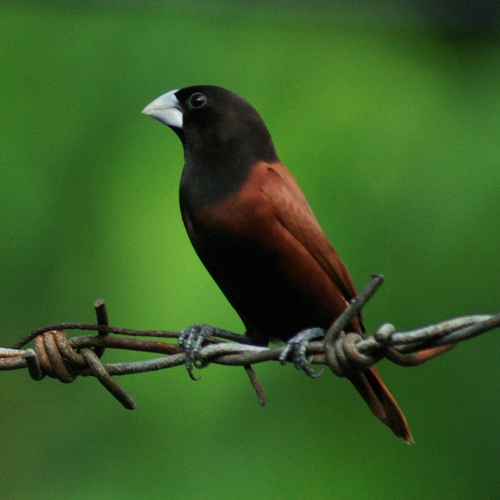 Chestnut MuniaLonchura atricapilla
Compare
Questions and answers
What is the scientific name of the Sunda Zebra Finch?
The scientific name of the Sunda Zebra Finch is Taeniopygia guttata. Written with its author, the full name is Taeniopygia guttata (Vieillot, 1817).
Which family does the Sunda Zebra Finch belong to?
Taeniopygia guttata belongs to the family Estrildidae, in the order Passeriformes and the class Aves.
Where is the Sunda Zebra Finch found?
Checklists and occurrence records place Taeniopygia guttata in 5 countries: Australia, Indonesia, United States, Timor Leste and New Zealand.
What is the conservation status of the Sunda Zebra Finch?
The IUCN Red List category recorded for Taeniopygia guttata is Least Concern (LC).
What other names does the Sunda Zebra Finch have?
Taeniopygia guttata is also known in English as Spotted-sided Finch, Timor Zebra Finch and Zebra Finch.
What is special about zebra finches?
Each zebra finch has an individual song. Young birds learn to sing by imitating adult birds and sometimes other juveniles.[9][10]
Where do zebra finches typically live?
The Sunda Zebra Finch occurs in the Lesser Sundas.[4]
Sources
Passages the profile rests on
- Adult males of the Sunda zebra finch have grey throats, unlike the black-and-white barred throats of Australian zebra finches. Source passage: “Purebred adult males, however, can immediately distinguished by the grey throat of T.guttata, while that region is barred black-and-white in T.castanotis.” — English Wikipedia
- The characteristic zebra markings of the Sunda zebra finch are restricted to a barely visible patch on the sides of its lower neck. Source passage: “These namesake "zebra" markings are limited to a barely visible patch on the sides of the lower neck in T.guttata.” — English Wikipedia
- The Sunda zebra finch has a slightly brownish coloration on the top of its head and underside. Source passage: “In direct comparison, the Sunda species has a slight brownish hue on the top of the head and the underside.” — English Wikipedia
- The Sunda zebra finch occurs in the Lesser Sundas. Source passage: “It is found in the Lesser Sundas.” — English Wikipedia
- During courtship, male Sunda zebra finches adopt a more upright posture than Australian zebra finches. Source passage: “during their courtship rituals, the Sunda species' males adopt a more upright pose than the Australian ones” — English Wikipedia
- During courtship, male Sunda zebra finches fluff their forehead feathers rather than the back-of-head feathers. Source passage: “while the latter fluff up the feathers at the back of the head, the Sunda males fluff the forehead feathers instead.” — English Wikipedia
- Sunda and Australian zebra finches in mixed captive flocks generally mate with members of their own species unless conspecific partners are unavailable. Source passage: “individuals of the two zebrafinch species will only mate with each other if no conspecific partners are available.” — English Wikipedia
- Only male zebra finches sing. Source passage: “Only male zebra finches sing.” — English Wikipedia
- Each zebra finch has an individual song. Source passage: “Each finch has an individual song.” — English Wikipedia
- Young zebra finches learn to sing by imitating adult birds and sometimes other juveniles. Source passage: “young zebra finches learn to sing by copying the songs of adults, and sometimes by copying the songs of other juveniles.” — English Wikipedia
- Zebra finches learn their songs between 25 and 90 days of age. Source passage: “Between the ages of 25 and 90 days old, young zebra finches learn to sing” — English Wikipedia
- Taeniopygia guttata has been used as a model organism in studies of immune responses to parasites. Source passage: “T. guttata sometimes serves as a model organism. Study of the immune response of T. guttata to parasites is informative for avians as a class.” — English Wikipedia
- The transcriptome responses of Taeniopygia guttata to infection have been investigated in published studies. Source passage: “Its transcriptome responses to infection have been studied by Watson et al., 2017 and Scalf et al., 2019.” — English Wikipedia
- The Australian zebra finch, Taeniopygia castanotis, is generally treated as a separate species rather than a subspecies of Taeniopygia guttata. Source passage: “since the 2020s it is generally considered a separate species Taeniopygia castanotis.” — English Wikipedia
Data
- Catalogue of Life, 2026-10-16 XR cc by
- Global Biodiversity Information Facility CC BY 4.0
- Wikidata CC0
- GeoNames CC BY 4.0
- Wikimedia Commons per image; credit shown with each image
- Within the Catalogue of Life, this name comes from The Integrated Taxonomic Information System cc0
References
- Gill, Frank, & and Minturn Wright. (2006). Birds of the World: Recommended English Names.
This species in other databases
Page built on 29 November 2026. See how the catalog is made and all sources and licences.
Cite this page
ScientificNames.org. (2026). Taeniopygia guttata (Sunda Zebra Finch). Retrieved November 29, 2026, from https://scientificnames.org/species/taeniopygia-guttata
“Taeniopygia guttata (Sunda Zebra Finch).” ScientificNames.org, 2026, scientificnames.org/species/taeniopygia-guttata. Accessed 29 Nov. 2026.
ScientificNames.org. “Taeniopygia guttata (Sunda Zebra Finch).” Accessed November 29, 2026. https://scientificnames.org/species/taeniopygia-guttata.
@misc{scientificnames_taeniopygia_guttata_sunda_zebra_finch,
  author = {{ScientificNames.org}},
  title = {Taeniopygia guttata (Sunda Zebra Finch)},
  year = {2026},
  url = {https://scientificnames.org/species/taeniopygia-guttata},
  note = {Accessed 2026-11-29}
}