Species · Birds
Sandy Gallito Teledromas fuscus
The scientific name of the Sandy Gallito is Teledromas fuscus. It is a species of bird in the family Rhinocryptidae (tapaculo), order Passeriformes. The name dates from 1873.
- Scientific name
- Teledromas fuscus (P. L. Sclater & Salvin, 1873)
- Common name
- Sandy Gallito
- Genus
- Teledromas
- Family
- Rhinocryptidae (Tapaculo)
- Order
- Passeriformes
- Class
- Aves
- Red List category
- LC Least Concern
- Recorded in
- 1 country
- Name status
- accepted in the Catalogue of Life

Overview
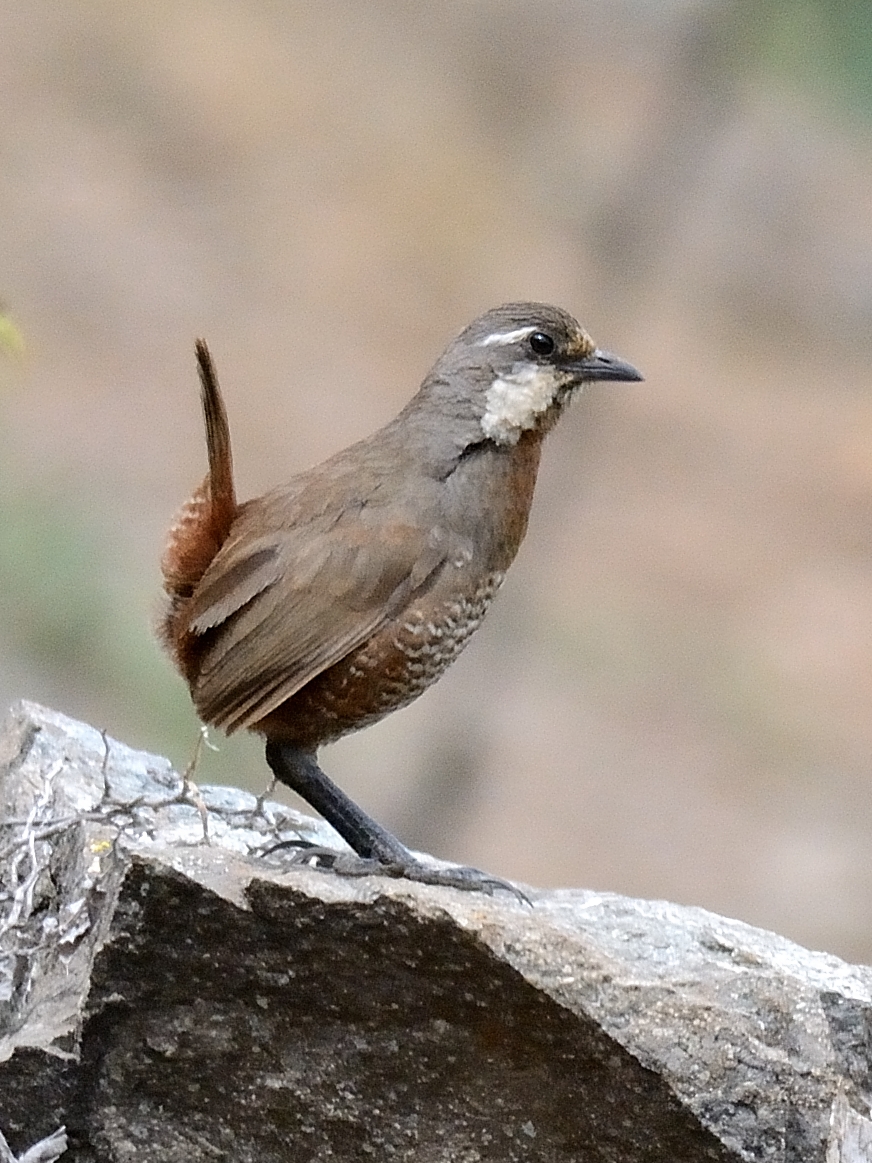
The Sandy Gallito is a suboscine passerine bird in the family Rhinocryptidae and the only species classified in the genus Teledromas. It is endemic to Argentina and lives on the eastern Andean slopes from southwestern Salta Province to Río Negro Province. It has light cinnamon upperparts and central tail feathers, blackish outer tail feathers, and a white throat and chest.
Written 27 November 2026 from the sources listed below. Each statement was checked against the passage it cites; statements that could not be supported were removed.
Appearance
The Sandy Gallito is a plain brown bird approximately the size of a thrush. It measures approximately 17 cm in length.[1][2]
Adults have light cinnamon crowns, backs, wings, and central tail feathers. Their outer tail feathers are blackish, their throats and chests are white, and their flanks and vent areas are light cinnamon.[3][4][5][6]
Juveniles are thought to have plumage similar to that of adults. The species has a shorter and thicker bill than canasteros, miners, and thornbirds.[7][8]
Two male specimens weighed 35.4 g and 41.8 g, respectively. A female specimen weighed 35.8 g.[9][10]
Habitat
The Sandy Gallito inhabits subtropical or tropical dry shrubland characterized by sparse vegetation growing on sand and gravel. It also occurs in dry washes and ravines.[11][12][13]
It is associated with the Monte desert region of western Argentina. It occurs at elevations up to 3,500 m across most of its range and up to 4,000 m in Salta Province.[14][15][16]
Diet
Arthropods are considered the Sandy Gallito's principal food.[17]
Behaviour
The Sandy Gallito obtains its food exclusively on the ground. While foraging, it attempts to remain concealed by running between bushes.[18][19]
Its typical song consists of repeated loud notes described as 'tchowk'. The song is repeated up to five times in Río Negro and up to ten times in other parts of its range.[20][21][22]
Reproduction and life cycle
The Sandy Gallito builds an open-cup nest made of grass, usually at the end of a tunnel measuring up to 50 cm in length.[23][24]
It lays eggs between November and February.[25]
Conservation
Its population size has not been determined, but the population is believed to be stable. The species is considered fairly common and occurs in several protected areas.[26][27][28][29]
Its habitat is unsuitable for agricultural development.[30]
Similar species
The crested gallito (Rhinocrypta lanceolata) is the Sandy Gallito's closest genetic relative.[31]
Classification of the Sandy Gallito
| Kingdom | Animalia |
|---|---|
| Phylum | Chordata |
| Subphylum | Vertebrata |
| Infraphylum | Gnathostomata |
| Parvphylum | Osteichthyes |
| Megaclass | Tetrapoda |
| Class | Aves (Bird) |
| Order | Passeriformes (Passerine) |
| Family | Rhinocryptidae (Tapaculo) |
| Genus | Teledromas |
| Species | Teledromas fuscus (P. L. Sclater & Salvin, 1873) |
Where the Sandy Gallito is found
Checklists and occurrence records place Teledromas fuscus in 1 country across South America. GBIF holds 1,926 georeferenced records of it.
Countries
Regions and cities with the most records
- Rio Negro, Argentina 367
- Salta, Argentina 327
- Mendoza, Argentina 263
- Neuquen, Argentina 253
- Tucuman, Argentina 251
- San Antonio Oeste, Argentina 156
- Santa María, Argentina 156
- La Rioja, Argentina 141
- Cafayate, Argentina 114
- Catamarca, Argentina 94
- La Pampa, Argentina 77
- Aimogasta, Argentina 48
- General Roca, Argentina 45
- San Luis, Argentina 38
- San Juan, Argentina 36
- Neuquén, Argentina 23
- Plottier, Argentina 22
- Cipolletti, Argentina 21
- Centenario, Argentina 18
- Cinco Saltos, Argentina 17
- Chubut, Argentina 16
- Allen, Argentina 15
- Catriel, Argentina 14
- Zapala, Argentina 14
- Cutral-Có, Argentina 13
- Caucete, Argentina 11
- Puerto Madryn, Argentina 11
- Pocito, Argentina 10
- Mendoza, Argentina 8
- Rodeo del Medio, Argentina 5
- Albardón, Argentina 4
- Chimbas, Argentina 4
- Malargüe, Argentina 4
- Rawson, Argentina 4
- San Juan, Argentina 4
- Santa Lucía, Argentina 4
Range as the checklists state it
South America
A number beside a place is its count of GBIF occurrence records. A place without a number comes from a checklist alone. Records show where a species has been observed or collected, which can include escapes and vagrants.
Common names
English
- Sandy Gallito
Names in 25 other languages
- Catalan
- tapacul sorrenc
- Chinese
- 沙色加利雀, 沙色窜鸟
- Croatian
- bjeloprsa strmorepka
- Czech
- štidlák béžový
- Danish
- Ørkentapaculo
- Dutch
- Bruine Galito, Bruine Gallito
- Esperanto
- sabla tapakulo
- Finnish
- hietatapakulo
- French
- Tourco sable
- German
- Bürzelstelzer, Fahlbrauner Tapaculo, Fahltapaculo
- Hungarian
- homokszínű gallító
- Italian
- Gallito sabbiato
- Japanese
- スナイロオタテドリ
- Lithuanian
- smėlinis galitas
- Norwegian
- løpetapakulo
- Polish
- krytonos piaskowy
- Portuguese
- tapaculo-arenoso, tapaculo-das-areias
- Russian
- Буланый галлито, Бурая галлито
- Serbian
- Sivkasti galito
- Slovak
- piesočník plavý
- Spanish
- Gallito arena
- Swedish
- sandtapakul
- Turkish
- Kum Rengi Tapakola
- Ukrainian
- галіто бурий
- Welsh
- galito'r tywod
Synonyms
One other scientific name has been used for this species and is now treated as a synonym of Teledromas fuscus.
- Rhinocrypta fusca P. L. Sclater & Salvin, 1873
Related species
-
 Chucao TapaculoScelorchilus rubecula
-
 Black-throated Huet-huetPteroptochos tarnii
-
 Moustached TurcaPteroptochos megapodius
-
 Magellanic TapaculoScytalopus magellanicus
-
 Slaty BristlefrontMerulaxis ater
-
 Ocellated TapaculoAcropternis orthonyx
-
 Crested GallitoRhinocrypta lanceolata
-
 Blackish TapaculoScytalopus latrans
Compare
Questions and answers
What is the scientific name of the Sandy Gallito?
The scientific name of the Sandy Gallito is Teledromas fuscus. Written with its author, the full name is Teledromas fuscus (P. L. Sclater & Salvin, 1873).
Which family does the Sandy Gallito belong to?
Teledromas fuscus belongs to the family Rhinocryptidae, in the order Passeriformes and the class Aves.
Where is the Sandy Gallito found?
Checklists and occurrence records place Teledromas fuscus in 1 country: Argentina.
What is the conservation status of the Sandy Gallito?
The IUCN Red List category recorded for Teledromas fuscus is Least Concern (LC).
Does the Sandy Gallito have any recognized subspecies?
No recognized subspecies are known.[32]
Is the Sandy Gallito a year-round resident?
Yes. It is a year-round resident of the eastern Andean slopes in Argentina.[33]
What genus does the Sandy Gallito belong to?
It belongs to the genus Teledromas, which contains only this species.[34]
Sources
Passages the profile rests on
- The sandy gallito is described as a plain brown bird approximately the size of a thrush. Source passage: “Plain brown thrush-sized bird” — ebird.org
- The sandy gallito measures approximately 17 cm in length. Source passage: “The sandy gallito is 17 cm (6.7 in) long.” — English Wikipedia
- Adult sandy gallitos have light cinnamon crowns, backs, wings, and central tail feathers. Source passage: “In the adult, the crown of the head, back, and wings are light cinnamon as are the central feathers of the tail.” — English Wikipedia
- The outer tail feathers of adult sandy gallitos are blackish. Source passage: “The rest of the tail is blackish.” — English Wikipedia
- Adult sandy gallitos have white throats and chests. Source passage: “The throat and chest are white,” — English Wikipedia
- The flanks and vent area of adult sandy gallitos are light cinnamon. Source passage: “blending to light cinnamon on the flanks and vent area.” — English Wikipedia
- Juvenile sandy gallitos are thought to have plumage similar to adults. Source passage: “The juvenile is thought to have similar plumage.” — English Wikipedia
- The sandy gallito has a shorter and thicker bill than canasteros, miners, and thornbirds. Source passage: “Note shorter, thicker bill than canasteros, miners and thornbirds.” — ebird.org
- Two male specimens weighed 35.4 g and 41.8 g, respectively. Source passage: “Two male specimens weighed 35.4 and 41.8 g (1.25 and 1.47 oz) respectively;” — English Wikipedia
- A female specimen weighed 35.8 g. Source passage: “one female weighted 35.8 g (1.26 oz).” — English Wikipedia
- The sandy gallito inhabits subtropical or tropical dry shrubland. Source passage: “Its habitat is subtropical or tropical dry shrubland” — English Wikipedia
- Its shrubland habitat is characterized by sparse vegetation growing on sand and gravel. Source passage: “characterized by sparse vegetation on sand and gravel,” — English Wikipedia
- The species also inhabits dry washes and ravines. Source passage: “dry washes, and ravines.” — English Wikipedia
- The sandy gallito is associated with the Monte desert region of western Argentina. Source passage: “of the Monte desert region of western Argentina.” — ebird.org
- The sandy gallito occurs at elevations up to 3,500 m across most of its range. Source passage: “For most of that range it is found up to 3,500 m (11,500 ft)” — English Wikipedia
- In Salta Province, the sandy gallito occurs at elevations up to 4,000 m. Source passage: “and in Salta up to 4,000 m (13,000 ft).” — English Wikipedia
- Arthropods are considered the sandy gallito's principal food. Source passage: “The sandy gallito's principal food is thought to be arthropods.” — English Wikipedia
- The sandy gallito obtains its food exclusively on the ground. Source passage: “It forages solely on the ground” — English Wikipedia
- While foraging, the sandy gallito attempts to remain concealed by running between bushes. Source passage: “while trying to stay hidden by running between bushes.” — English Wikipedia
- The sandy gallito's typical song consists of repeated loud notes described as 'tchowk'. Source passage: “The typical song of the sandy gallito is a phrase off "loud 'tchowk' notes"” — English Wikipedia
- The sandy gallito's song is repeated up to five times in Río Negro. Source passage: “repeated up to five times in Río Negro” — English Wikipedia
- The sandy gallito's song is repeated up to ten times in other parts of its range. Source passage: “and up to 10 times in other parts of the range.” — English Wikipedia
- The sandy gallito builds an open-cup nest made of grass. Source passage: “The sandy gallitos's nest is an open cup of grass,” — English Wikipedia
- The nest is usually constructed at the end of a tunnel measuring up to 50 cm in length. Source passage: “usually constructed at the end of a tunnel up to 50 cm (20 in) long.” — English Wikipedia
- The sandy gallito lays eggs between November and February. Source passage: “Eggs are laid between November and February.” — English Wikipedia
- The sandy gallito's population size has not been determined. Source passage: “Though its population has not been determined,” — English Wikipedia
- The sandy gallito's population is believed to be stable. Source passage: “it is believed to be stable” — English Wikipedia
- The sandy gallito is considered fairly common. Source passage: “and the species is thought to be fairly common.” — English Wikipedia
- The species occurs in several protected areas. Source passage: “It inhabits several protected areas” — English Wikipedia
- The sandy gallito's habitat is unsuitable for agricultural development. Source passage: “its habitat is not amenable to agricultural development.” — English Wikipedia
- The crested gallito (Rhinocrypta lanceolata) is the sandy gallito's closest genetic relative. Source passage: “It is genetically most closely related to the crested gallito (Rhinocrypta lanceolata).” — English Wikipedia
- The sandy gallito has no recognized subspecies. Source passage: “The sandy gallito is the only member of its genus and has no subspecies.” — English Wikipedia
- The sandy gallito is a year-round resident of the eastern Andean slopes in Argentina. Source passage: “The sandy gallito is a year round resident of the eastern slope of the Andes of Argentina” — English Wikipedia
- Teledromas fuscus is the only species classified in the genus Teledromas. Source passage: “It is the only species placed in the genus Teledromas.” — English Wikipedia
Data
- Catalogue of Life, 2026-10-16 XR cc by
- Global Biodiversity Information Facility CC BY 4.0
- Wikidata CC0
- GeoNames CC BY 4.0
- Wikimedia Commons per image; credit shown with each image
- Within the Catalogue of Life, this name comes from The Integrated Taxonomic Information System cc0
References
- Gill, Frank, & and Minturn Wright. (2006). Birds of the World: Recommended English Names.
This species in other databases
Page built on 28 November 2026. See how the catalog is made and all sources and licences.
Cite this page
ScientificNames.org. (2026). Teledromas fuscus (Sandy Gallito). Retrieved November 28, 2026, from https://scientificnames.org/species/teledromas-fuscus
“Teledromas fuscus (Sandy Gallito).” ScientificNames.org, 2026, scientificnames.org/species/teledromas-fuscus. Accessed 28 Nov. 2026.
ScientificNames.org. “Teledromas fuscus (Sandy Gallito).” Accessed November 28, 2026. https://scientificnames.org/species/teledromas-fuscus.
@misc{scientificnames_teledromas_fuscus_sandy_gallito,
  author = {{ScientificNames.org}},
  title = {Teledromas fuscus (Sandy Gallito)},
  year = {2026},
  url = {https://scientificnames.org/species/teledromas-fuscus},
  note = {Accessed 2026-11-28}
}