Species · Reptiles
Mexican Box Turtle Terrapene mexicana
The scientific name of the Mexican Box Turtle is Terrapene mexicana. It is a species of reptile in the family Emydidae (terrapins), order Testudines. The name dates from 1849.
- Scientific name
- Terrapene mexicana (Gray, 1849)
- Common name
- Mexican Box Turtle
- Genus
- Terrapene
- Family
- Emydidae (Terrapins)
- Order
- Testudines
- Class
- Reptilia
- Recorded in
- 2 countries
- Name status
- accepted in the Catalogue of Life

Overview
The Mexican Box Turtle is endemic to Mexico and occurs in Tamaulipas, Veracruz, and San Luis Potosí. It has a long, dome-shaped carapace with variable coloration and markings.
Written 26 November 2026 from the sources listed below. Each statement was checked against the passage it cites; statements that could not be supported were removed.
Appearance
The Mexican Box Turtle has a long, dome-shaped carapace with variable coloration and markings. Adult males have gray-blue coloration on the head and red or orange coloration on the front legs.[1][2]
The species can reach approximately 18–20 cm in length.[3]
Habitat
The Mexican Box Turtle inhabits tropical-climate areas within humid forests. It occurs near shallow rainwater puddles.[4][5]
Diet
Insects constitute a substantial part of the Mexican Box Turtle's diet.[6]
Behaviour
The Mexican Box Turtle uses bushes as hiding places.[7]
Classification of the Mexican Box Turtle
| Kingdom | Animalia |
|---|---|
| Phylum | Chordata |
| Subphylum | Vertebrata |
| Infraphylum | Gnathostomata |
| Parvphylum | Osteichthyes |
| Megaclass | Tetrapoda |
| Class | Reptilia (Reptile) |
| Order | Testudines (Turtle) |
| Suborder | Cryptodira |
| Superfamily | Testudinoidea |
| Family | Emydidae (Terrapins) |
| Genus | Terrapene (North American Box Turtle) |
| Species | Terrapene mexicana (Gray, 1849) |
Where the Mexican Box Turtle is found
Checklists and occurrence records place Terrapene mexicana in 2 countries across North America. GBIF holds 151 georeferenced records of it.
Countries
Regions and cities with the most records
- Tamaulipas, Mexico 53
- San Luis Potosí, Mexico 40
- Ciudad Valles, Mexico 19
- Veracruz, Mexico 11
- Altamira, Mexico 8
- Miramar, Mexico 7
- Tamuín, Mexico 6
- Ciudad Victoria, Mexico 5
- Tampico, Mexico 5
- Alto Lucero, Mexico 4
- Ciudad Madero, Mexico 4
- Túxpam de Rodríguez Cano, Mexico 4
- Ébano, Mexico 4
- Hidalgo, Mexico
Range as the checklists state it
Mexico (NE San Luis Potosi, SE Tamaulipas, N Veracruz, Hidalgo)
A number beside a place is its count of GBIF occurrence records. A place without a number comes from a checklist alone. Records show where a species has been observed or collected, which can include escapes and vagrants.
Common names
English
- Mexican Box Turtle
Names in 4 other languages
- Chinese
- 墨西哥箱龜
- Portuguese
- Tartaruga-de-caixa-mexicana
- Russian
- Мексиканская коробчатая черепаха
- Spanish
- Caja Mexicana, Tortuga mexicana de caja
Synonyms
3 other scientific names have been used for this species and are now treated as synonyms of Terrapene mexicana.
- Cistudo (Onychotria) mexicana Gray, 1849
- Terrapene carolina mexicana (Gray, 1849)
- Terrapene goldmani Stejneger, 1933
Related species
-
 Common Box TurtleTerrapene carolina
-
 Ornate Box TurtleTerrapene ornata
-
 Coahuilan Box TurtleTerrapene coahuila
-
 Spotted Box TurtleTerrapene nelsoni
- Three-toed Box TurtleTerrapene triunguis
-
 Yucatan Box TurtleTerrapene yucatana
-
 Painted TurtleChrysemys picta
-
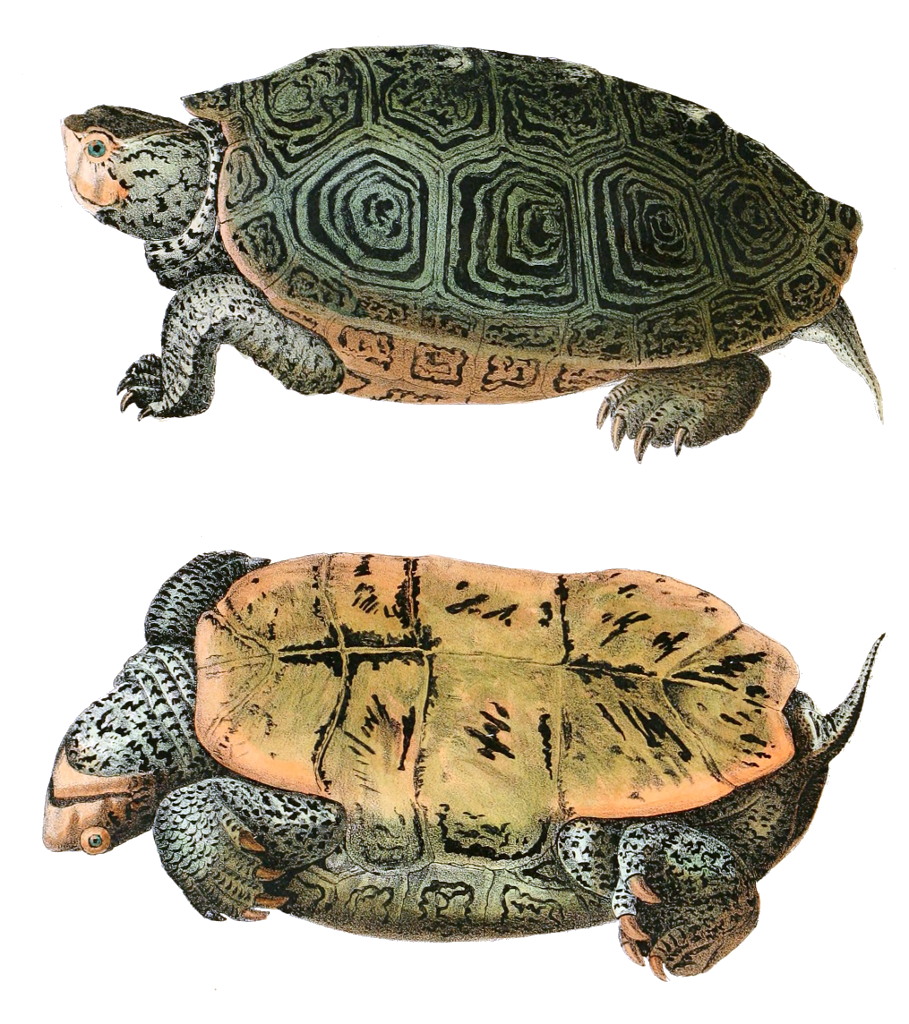 Diamondback TerrapinMalaclemys terrapin
Compare
Questions and answers
What is the scientific name of the Mexican Box Turtle?
The scientific name of the Mexican Box Turtle is Terrapene mexicana. Written with its author, the full name is Terrapene mexicana (Gray, 1849).
Which family does the Mexican Box Turtle belong to?
Terrapene mexicana belongs to the family Emydidae, in the order Testudines and the class Reptilia.
Where is the Mexican Box Turtle found?
Checklists and occurrence records place Terrapene mexicana in 2 countries: Mexico and United States.
What type of habitat do box turtles live in?
The Mexican Box Turtle inhabits tropical-climate areas within humid forests and occurs near shallow rainwater puddles.[4][5]
What is the diet of a box turtle?
Insects constitute a substantial part of the Mexican Box Turtle's diet.[6]
Sources
Passages the profile rests on
- The Mexican box turtle has a long, dome-shaped carapace with variable coloration and markings. Source passage: “The carapace is long and dome-shaped, with rather variable color and markings.” — English Wikipedia
- Adult males have gray-blue coloration on the head and red or orange coloration on the front legs. Source passage: “The adult males show gray-blue nuances on the head and red or orange nuances on the front legs.” — English Wikipedia
- The Mexican box turtle can reach approximately 18–20 cm in length. Source passage: “Terrapene mexicana can reach a length of about 18–20 cm (7.1–7.9 in).” — English Wikipedia
- The species inhabits tropical-climate areas within humid forests. Source passage: “It lives in areas with tropical climates within humid forests at shallow rainwater puddles.” — English Wikipedia
- The species occurs near shallow rainwater puddles. Source passage: “It lives in areas with tropical climates within humid forests at shallow rainwater puddles.” — English Wikipedia
- Insects constitute a substantial part of the Mexican box turtle's diet. Source passage: “Having a home by the water will attract insects, which are a big part of their diet.” — English Wikipedia
- The species uses bushes as hiding places. Source passage: “Usually these turtles have water nearby homes and a bush to hide.” — English Wikipedia
Data
- Catalogue of Life, 2026-10-16 XR cc by
- Global Biodiversity Information Facility CC BY 4.0
- Wikidata CC0
- GeoNames CC BY 4.0
- Wikimedia Commons per image; credit shown with each image
- Within the Catalogue of Life, this name comes from The Reptile Database cc by
References
- Milstead, W. M. (1969) Studies on the evolution of the box turtles (genus Terrapene). Bulletin of the Florida State Museum, Biological Sciences, 14 (1), 1 - 113. where the name was published
- Gray, J. E. (1849). Description of a new species of Box Tortoise from Mexico. Proc. Zool. Soc. London 1849: 16-17.
- Gray, J. E. (1864). Observations on the box tortoises, with the description of three new asiatic species. Ann. Mag. Nat. Hist. (3) 13: 105-111.
- Günther, A. C. L. G. (1885). Reptilia and Batrachia. Biologia Centrali-Américana. Taylor, & Francis, London, 326 Pp. [Published in Parts from 1885-1902; Reprint by the SSAR 1987].
- Boulenger, G. A. (1889). Catalogue of the chelonians, rhynchocephalians, and crocodiles in the British Museum (Natural History). British Museum, London, 311 Pp.
- Baur, G. (1893). Two new species of North American Testudinata. American Naturalist 27: 675–677.
- Boulenger, G. A. (1895). On the American Box-tortoises. Ann. Mag. Nat. Hist. (6)15: 330-331.
- Barbour, T., and L. J. Cole. (1906). Vertebrata from Yucatan. Reptilia, Amphibia and Pisces. Bull. Mus. Comp. Zool. Harvard 50: 146-159.
- Stejneger, L. (1933). Proc. Bio!. Soc. Washington, 46: 119.
- Smith, Hobart M. (1939). An annotated list of the Mexican amphibians and reptiles in the Carnegie Museum. Annals of the Carnegie Museum 27: 311-320.
- Smith, H. M., & Taylor, E. H. (1950). An annotated checklist and key to the reptiles of Mexico exclusive of the snakes. Bull. US Natl. Mus. 199: 1-253.
- Milstead, W.W., and D.W. Tinkle. (1967). Terrapene of western Mexico, with comments on the species groups in the genus. Copeia 1967 (1): 180-187.
- Milstead, W. W. (1969). Studies on the evolution of box turtles (genus Terrapene). Bulletin of the Florida State Museum, Biological Sciences 14 (1): 1-113.
- Wermuth, H., and R. Mertens. (1977). Liste der rezenten Amphibien und Reptilien. Testudines, Crocodylia, Rhynchocephalia. Das Tierreich. Berlin. 100: I-Xxvii, 1-174.
- Liner, E. A. (1994). Scientific and common names for the Amphibians and Reptiles of Mexico in English and Spanish. Herpetological Circular 23: 1-113.
- Stephens, P. R., & Wiens, J. J. (2003). Ecological diversification and phylogeny of emydid turtles. Biol. J. Linn. Soc. 79: 577-610.
- Fritz, U., & Havas, P. (2007). CHECKLIST OF CHELONIANS OF THE WORLD. Vertebrate Zoology 57(2): 149-368.
- Reynolds, Robert P.; Steve W. Gotte, and Carl H. Ernst. (2007). Catalog of Type Specimens of Recent Crocodilia and Testudines in the National Museum of Natural History, Smithsonian Institution. Smithsonian Contributions to Zoology 626: 1-49.
- TTWG; Rhodin, A.G.J.; van Dijk, P.P.; Iverson, J.B. & Shaffer, H.B. [turtle taxonomy working group]. (2010). Turtles of the World, 2010 Update: Annotated Checklist of Taxonomy, Synonymy, Distribution, and Conservation Status. Chelonian Research Monographs (ISSN 1088-7105) No. 5, Doi:10.3854/Crm.5.000.Checklist.V3.2010.
- Valverde, J. (2011). Die Schildkröten Mexikos. Reptilia (Münster) 16 (91): 16-23.
- Martin, Bradley T.; Neil P. Bernstein, Roger D. Birkhead, Jim F. Koukl, Steven M. Mussmann, John S. Placyk Jr. (2013). Sequence-based molecular phylogenetics and phylogeography of the American box turtles (Terrapene spp.) with support from DNA barcoding. Molecular Phylogenetics and Evolution 68 (1): 119–134.
- Legler, J. M., & Vogt, R. C. (2013). The Turtles of Mexico: Land and Freshwater Forms. University of California Press, 416 Pp.
- Seidel, Michael E. & Carl H. Ernst. (2017). A Systematic Review of the Turtle Family Emydidae. Vertebrate Zoology 67 (1): 1–122.
- Wylie, D. B., and C. I. Grünwald. (2017). First report of Terrapene mexicana (Testudines: Emydidae) from the state of Nuevo León, Mexico. Mesoamerican Herpetology 4 (2): 486–487.
- Johnson, J. D., L. D. Wilson, V. Mata-Silva, E. García-Padilla, and D. L. DeSantis. (2017). The endemic herpetofauna of Mexico: organisms of global significance in severe peril. Mesoamerican Herpetology 4 (3): 544–620.
This species in other databases
Page built on 29 November 2026. See how the catalog is made and all sources and licences.
Cite this page
ScientificNames.org. (2026). Terrapene mexicana (Mexican Box Turtle). Retrieved November 29, 2026, from https://scientificnames.org/species/terrapene-mexicana
“Terrapene mexicana (Mexican Box Turtle).” ScientificNames.org, 2026, scientificnames.org/species/terrapene-mexicana. Accessed 29 Nov. 2026.
ScientificNames.org. “Terrapene mexicana (Mexican Box Turtle).” Accessed November 29, 2026. https://scientificnames.org/species/terrapene-mexicana.
@misc{scientificnames_terrapene_mexicana_mexican_box_turtle,
  author = {{ScientificNames.org}},
  title = {Terrapene mexicana (Mexican Box Turtle)},
  year = {2026},
  url = {https://scientificnames.org/species/terrapene-mexicana},
  note = {Accessed 2026-11-29}
}