Species · Reptiles
Ornate Box Turtle Terrapene ornata
The scientific name of the Ornate Box Turtle is Terrapene ornata. It is a species of reptile in the family Emydidae (terrapins), order Testudines. The name dates from 1857.
- Scientific name
- Terrapene ornata (Agassiz, 1857)
- Common name
- Ornate Box Turtle
- Genus
- Terrapene
- Family
- Emydidae (Terrapins)
- Order
- Testudines
- Class
- Reptilia
- Red List category
- NT Near Threatened
- Environment
- freshwater, terrestrial
- Recorded in
- 2 countries
- Name status
- accepted in the Catalogue of Life

Overview
The species occurs in North America, primarily in the southwestern and central United States, with its range extending into northwestern Mexico. The Ornate Box Turtle has a relatively flattened, dark shell marked by elaborate yellow lines surrounding its shell scutes.
Written 26 November 2026 from the sources listed below. Each statement was checked against the passage it cites; statements that could not be supported were removed.
Appearance
The Ornate Box Turtle has a relatively flattened shell that is generally black or dark brown with yellow stripes. Its shell scutes are surrounded by elaborate, thick yellow lines.[1][2][3]
The species has dark brown or black coloration across most of its shell, tail, head, and limbs. Adult turtles have yellow spots on their heads.[4][5]
The species exhibits sexual dichromatism. Males characteristically have bright red eyes and green heads, while females typically have brown or black eyes and heads.[6][7][8]
The desert box turtle subspecies has more shell striping than the nominate ornate box turtle subspecies.[9]
Adult Ornate Box Turtles weigh between 198 and 538 grams on average. Their average carapace length is approximately 120 millimeters.[10][11]
Female Ornate Box Turtles have an average plastron length of 120 millimeters, compared with 116 millimeters in males. Adult plastron widths average between 60 and 80 millimeters, and females are generally slightly larger than males.[12][13][14][15]
Habitat
The Ornate Box Turtle primarily inhabits grasslands and is commonly found in burrows within sand dunes. It is occasionally found in ponds and wetlands.[16][17][18]
During hot summer days, turtles occupy underground burrows approximately 0.20 to 0.50 meters below the surface, with summer burrows averaging approximately 0.35 meters in depth. During winter hibernation, they occupy burrows between 0.50 and 1.8 meters below the surface.[19][20][21]
The species is more commonly associated with microhabitats having high ambient temperatures and low moisture and soil temperatures. Its home ranges generally contain substantial leaf coverage.[22][23]
Vegetation associated with its habitats includes Opuntia, Echinocereus, Yucca glauca, Larrea divericata, and Prosopis jusiflora. Both subspecies dig deep burrows in dry environments to escape heat and access higher humidity.[24][25]
Behaviour
The nominate subspecies often responds to predators by extending its legs and head to appear larger. The desert box turtle subspecies more commonly withdraws into its shell and uses its hinged plastron for protection.[26][27]
The species generally prefers temperatures between 25 and 30 degrees Celsius throughout the year.[28]
Reproduction and life cycle
Ornate Box Turtles mate during most of their active season, between April and October. Females may mate with multiple males and store sperm for an extended period.[29][30]
Females generally produce one or two clutches annually and usually reach sexual maturity at approximately eight years of age. Males generally reach sexual maturity at approximately five years of age.[31][32][33]
Females generally attain sexual maturity when their carapace length reaches at least 100 millimeters.[34]
Nesting usually occurs in July. Females usually construct nests in sandy soil approximately 10 centimeters beneath rocks or vegetation.[35][36]
Egg incubation normally lasts approximately 50 days, and its duration depends on temperature. Hatchlings are generally female when incubation temperatures reach at least 29 degrees Celsius and tend to be male when temperatures are below 28 degrees Celsius.[37][38][39][40]
Conservation
The Ornate Box Turtle is listed as endangered in Indiana.[41]
Similar species
Terrapene carolina is identified as the other recognized box turtle species in the United States.[42]
Uses
The Ornate Box Turtle became the official state reptile of Kansas in 1986.[43]
Classification of the Ornate Box Turtle
| Kingdom | Animalia |
|---|---|
| Phylum | Chordata |
| Subphylum | Vertebrata |
| Infraphylum | Gnathostomata |
| Parvphylum | Osteichthyes |
| Megaclass | Tetrapoda |
| Class | Reptilia (Reptile) |
| Order | Testudines (Turtle) |
| Suborder | Cryptodira |
| Superfamily | Testudinoidea |
| Family | Emydidae (Terrapins) |
| Genus | Terrapene (North American Box Turtle) |
| Species | Terrapene ornata (Agassiz, 1857) |
Where the Ornate Box Turtle is found
Checklists and occurrence records place Terrapene ornata in 2 countries across North America. GBIF holds 13,618 georeferenced records of it.
Countries
Regions and cities with the most records
- Kansas, United States 2,617
- Texas, United States 2,596
- Oklahoma, United States 1,857
- New Mexico, United States 1,227
- Arizona, United States 789
- Nebraska, United States 559
- Colorado, United States 478
- Missouri, United States 466
- Chihuahua, Mexico 261
- Olathe, United States 220
- Garden City, United States 193
- Gardner, United States 186
- Moore, United States 175
- Lawrence, United States 172
- Lenexa, United States 172
- Norman, United States 163
- Illinois, United States 135
- Edmond, United States 122
- Overland Park, United States 117
- Albuquerque, United States 102
- Shawnee, United States 97
- Prairie Village, United States 89
- Sierra Vista, United States 88
- Lubbock, United States 86
- South Valley, United States 85
- Leawood, United States 84
- Owasso, United States 78
- Del City, United States 74
- Wichita, United States 74
- Tulsa, United States 73
- Hays, United States 70
- Grandview, United States 69
- Rio Rancho, United States 66
- Bethany, United States 65
- Ciudad Juárez, Mexico 64
- El Paso, United States 64
Range as the checklists state it
USA (Wisconsin, Illinois, W Indiana, Iowa, S South Dakota, SE Wyoming, Nebraska, Kansas, Oklahoma, SW Louisiana, Missouri, Arkansas, Texas, New Mexico, SE Arizona), Mexico (Chiapas, Sonora, Chihuahua)
A number beside a place is its count of GBIF occurrence records. A place without a number comes from a checklist alone. Records show where a species has been observed or collected, which can include escapes and vagrants.
Common names
English
- Ornate Box Turtle
- Western Box Turtle
Names in 13 other languages
- Arabic
- سلحفاة صندوقية مزخرفة
- Chinese
- 錦箱龜
- Czech
- želva krabičná
- Danish
- Vestamerikansk Æskeskildpadde
- Dutch
- Sierdoosschildpad, Westelijke doosschildpad
- French
- Tortue-Boîte ornée (La), Tortue-boîte ornée commune
- German
- Schmuck-Dosenschildkröte, Schmuckdosenschildkröte
- Hungarian
- díszes dobozteknős
- Japanese
- ニシキハコガメ
- Portuguese
- Tartaruga-de-caixa-ornada
- Russian
- Украшенная коробчатая черепаха
- Spanish
- Caja Ornamentada, Tortuga adornada, Tortuga apestosa, Tortuga de adornos, Tortuga de caja adornada, tortuga de caja del desierto
- Thai
- เต่ากล่องตะวันตก
Synonyms
8 other scientific names have been used for this species and are now treated as synonyms of Terrapene ornata.
- Cistudo ornata Agassiz, 1857
- Terraoene ornata cimarronensis Cragin, 1894
- Terrapene longinsulae Hay, 1908
- Terrapene ornata cimarronensis Cragin, 1894
- Terrapene ornata luteola Smith & Ramsey, 1952
- Terrapene ornata ornata (Agassiz, 1857)
- Terrapene ornata var. cimarronensis Cragin, 1894
- Terrapene whitneyi Hay, 1916
Related species
-
 Common Box TurtleTerrapene carolina
-
 Coahuilan Box TurtleTerrapene coahuila
-
 Mexican Box TurtleTerrapene mexicana
-
 Spotted Box TurtleTerrapene nelsoni
- Three-toed Box TurtleTerrapene triunguis
-
 Yucatan Box TurtleTerrapene yucatana
-
 Painted TurtleChrysemys picta
-
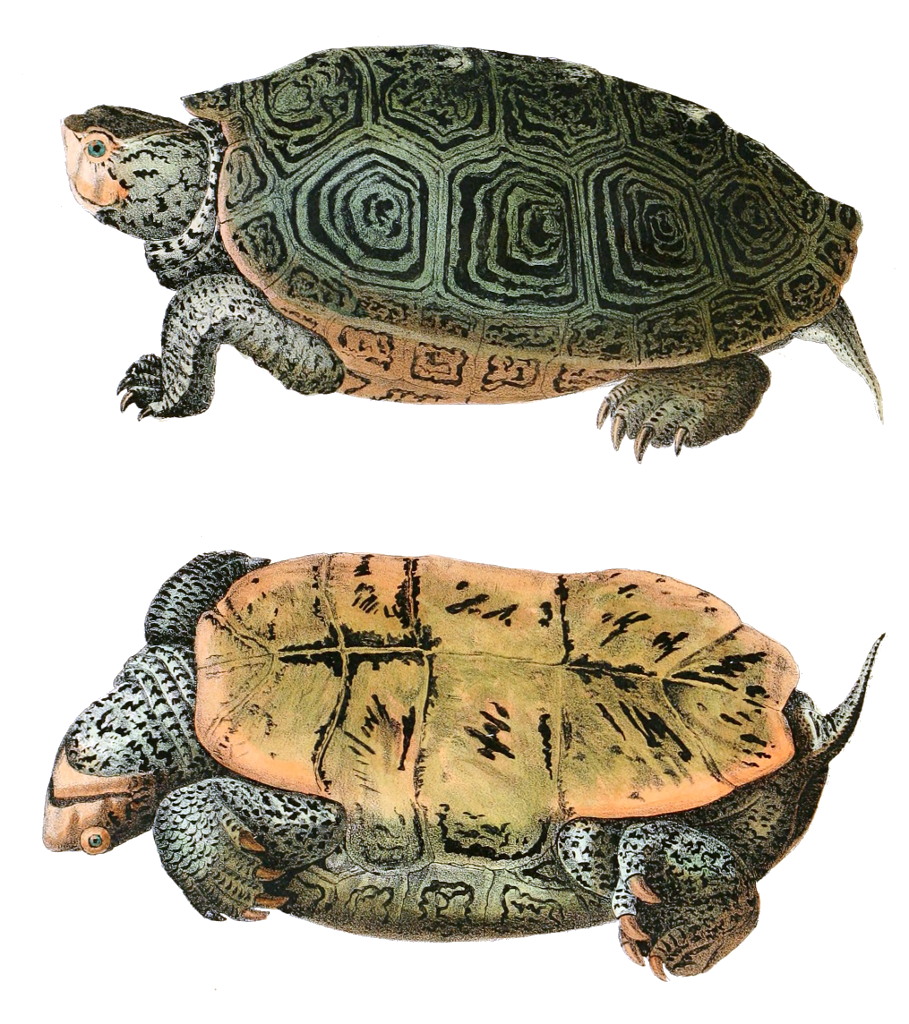 Diamondback TerrapinMalaclemys terrapin
Compare
Questions and answers
What is the scientific name of the Ornate Box Turtle?
The scientific name of the Ornate Box Turtle is Terrapene ornata. Written with its author, the full name is Terrapene ornata (Agassiz, 1857).
Which family does the Ornate Box Turtle belong to?
Terrapene ornata belongs to the family Emydidae, in the order Testudines and the class Reptilia.
Where is the Ornate Box Turtle found?
Checklists and occurrence records place Terrapene ornata in 2 countries: United States and Mexico.
What is the conservation status of the Ornate Box Turtle?
The IUCN Red List category recorded for Terrapene ornata is Near Threatened (NT).
What other names does the Ornate Box Turtle have?
Terrapene ornata is also known in English as Western Box Turtle.
Sources
Passages the profile rests on
- The ornate box turtle has a relatively flattened shell compared with other box turtle species. Source passage: “T. ornata has a shell that is less domed than other species of box turtle, appearing to be slightly flattened.” — English Wikipedia
- Its shell coloration is generally black or dark brown with yellow stripes. Source passage: “Their coloration is generally black or dark brown, with yellow striping.” — English Wikipedia
- Its shell scutes are surrounded by elaborate, thick yellow lines. Source passage: “they have concentric rings on their shells that are indicative of their age, as well as elaborate thick, yellow lines that surround their scutes.” — animaldiversity.org
- The species has dark brown or black coloration across most of its shell, tail, head, and limbs. Source passage: “The bulk of this species' shell, tail, head, and limbs are mostly dark brown or black in color.” — animaldiversity.org
- Adult ornate box turtles have yellow spots on their heads. Source passage: “All adults have yellow spots on their heads” — animaldiversity.org
- Male ornate box turtles characteristically have bright red eyes and green heads. Source passage: “Bright red eyes and green heads are characteristic of males” — animaldiversity.org
- Female ornate box turtles typically have brown or black eyes and heads. Source passage: “A female's eyes and head are typically brown or black.” — animaldiversity.org
- The species exhibits sexual dichromatism. Source passage: “Additionally, sexual dichromatism exists in this species.” — animaldiversity.org
- The desert box turtle subspecies has more shell striping than the nominate ornate box turtle subspecies. Source passage: “T. o. luteola tends to have more striping than T. o. ornata.” — English Wikipedia
- Adult ornate box turtles weigh between 198 and 538 grams on average. Source passage: “On average, adults weigh between 198 to 538 g.” — animaldiversity.org
- The average adult carapace length is approximately 120 millimeters. Source passage: “The carapace averages 120 mm in length for adults.” — animaldiversity.org
- Female ornate box turtles have an average plastron length of 120 millimeters. Source passage: “The plastron averages 120 mm long for females” — animaldiversity.org
- Male ornate box turtles have an average plastron length of 116 millimeters. Source passage: “116 mm long for males.” — animaldiversity.org
- Adult plastron widths average between 60 and 80 millimeters. Source passage: “plastron widths averaging between 60 to 80 mm.” — animaldiversity.org
- Female ornate box turtles are generally slightly larger than males. Source passage: “females tend to be slightly larger than males.” — animaldiversity.org
- The species primarily inhabits grasslands. Source passage: “The western box turtle primarily lives in grasslands” — animaldiversity.org
- Ornate box turtles are commonly found in burrows within sand dunes. Source passage: “This species is also commonly found within the burrows of sand dunes.” — animaldiversity.org
- Ornate box turtles are occasionally found in ponds and wetlands. Source passage: “Uncommonly, they are also found in ponds and wetlands.” — animaldiversity.org
- During hot summer days, ornate box turtles occupy underground burrows approximately 0.20 to 0.50 meters below the surface. Source passage: “On hot summer days they are often found in small underground burrows called forms, 0.20 to 0.50 m below the surface” — animaldiversity.org
- Summer burrows average approximately 0.35 meters in depth. Source passage: “averaging 0.35 m deep.” — animaldiversity.org
- During winter hibernation, ornate box turtles occupy burrows between 0.50 and 1.8 meters below the surface. Source passage: “During winter hibernation, they are found deeper, at 0.50 to 1.8 m below the surface” — animaldiversity.org
- The species is more commonly associated with microhabitats having high ambient temperatures and low moisture and soil temperatures. Source passage: “Generally, these box turtles are more common in micro-habitats with high ambient temperature, and lower moisture and soil temperatures.” — animaldiversity.org
- Their home ranges generally contain substantial leaf coverage. Source passage: “Their home ranges generally have a great deal of leaf coverage.” — animaldiversity.org
- Vegetation associated with their habitats includes Opuntia, Echinocereus, Yucca glauca, Larrea divericata, and Prosopis jusiflora. Source passage: “Common vegetation surrounding habitat locations include various cacti ( Opuntia, Echinocereus ), yucca ( Yucca glauca ), creosote bushes ( Larrea divericata ), mesquite ( Prosopis jusiflora )” — animaldiversity.org
- Both subspecies dig deep burrows in dry environments to escape heat and access higher humidity. Source passage: “Both sub-species, although they live in dry, arid environments, will dig deep burrows to escape the heat and allow access to higher humidity content.” — English Wikipedia
- The nominate subspecies often responds to predators by extending its legs and head to appear larger. Source passage: “T. o. ornata are generally more bold in their approach to predators, often stretching their legs and head out in an attempt to look big.” — English Wikipedia
- The desert box turtle subspecies more commonly withdraws into its shell and uses its hinged plastron for protection. Source passage: “T. o. luteola are more likely to close up into their shell and utilize their hinged plastron as protection.” — English Wikipedia
- The species generally prefers temperatures between 25 and 30 degrees Celsius throughout the year. Source passage: “T. ornata prefer temperature ranges from 25 to 30°C year round.” — animaldiversity.org
- Ornate box turtles mate during most of their active season, between April and October. Source passage: “This species mates during the majority of its active season, between the months of April and October.” — animaldiversity.org
- Females may mate with multiple males and store sperm for an extended period. Source passage: “through the practice of sperm storage, in which a female turtle may mate with several males and hold their sperm for an extended period of time” — animaldiversity.org
- Females generally produce one or two clutches annually. Source passage: “only one or two clutches are generally laid per year.” — animaldiversity.org
- Females generally reach sexual maturity at approximately eight years of age. Source passage: “The females are generally about 8 years old” — animaldiversity.org
- Males generally reach sexual maturity at approximately five years of age. Source passage: “Males reach sexual maturity at 5 years of age” — animaldiversity.org
- Females generally attain sexual maturity when their carapace length reaches at least 100 millimeters. Source passage: “The females are generally about 8 years old and have a carapace length of 100 mm or greater at sexual maturity.” — animaldiversity.org
- Nesting usually occurs in July. Source passage: “Nesting occurs mostly in July” — animaldiversity.org
- Females usually construct nests in sandy soil approximately 10 centimeters beneath rocks or vegetation. Source passage: “Nests are usually built in sandy soil, 10 cm underneath rocks or vegetation” — animaldiversity.org
- Egg incubation normally lasts approximately 50 days. Source passage: “They are normally incubated for about 50 days” — animaldiversity.org
- Egg incubation duration depends on temperature. Source passage: “Incubation time for eggs is temperature-dependent.” — animaldiversity.org
- Hatchlings are generally female when incubation temperatures reach at least 29 degrees Celsius. Source passage: “At temperatures at or above 29°C, hatchlings are generally females” — animaldiversity.org
- Hatchlings tend to be male when incubation temperatures are below 28 degrees Celsius. Source passage: “below 28°C, they tend to be male.” — animaldiversity.org
- The ornate box turtle is listed as endangered in Indiana. Source passage: “In Indiana, the ornate box turtle is listed as an endangered species.” — English Wikipedia
- Terrapene carolina is identified as the other recognized box turtle species in the United States. Source passage: “The second recognized species of box turtle is the eastern box turtle, Terrapene carolina.” — English Wikipedia
- The ornate box turtle became the official state reptile of Kansas in 1986. Source passage: “The species became the official state reptile of Kansas in 1986.” — English Wikipedia
Data
- Catalogue of Life, 2026-10-16 XR cc by
- Global Biodiversity Information Facility CC BY 4.0
- Wikidata CC0
- GeoNames CC BY 4.0
- Wikimedia Commons per image; credit shown with each image
- Within the Catalogue of Life, this name comes from The Reptile Database cc by
References
- Agassiz, & Louis. (1857). Contributions to the Natural History of the United States of America. vol. 1. Little, Brown & Co., Boston, Lii + 452 Pp.
- Boulenger, G. A. (1895). On the American Box-tortoises. Ann. Mag. Nat. Hist. (6)15: 330-331.
- Hay, W. P. (1916). Bull. Univ. Texas, 71: 8.
- Blanchard, Frank N. (1923). The amphibians and reptiles of Dickinson County, Iowa. Iowa Studies in Natural History 10 (2): 19-26.
- Force, Edith R. (1928). A Preliminary Checklist of Amphibians and Reptiles of Tulsa County. Proceedings of the Oklahoma Academy of Science 8:
- Evermann, B., & Clark, H. (1930). The Painted Box Turtle, Terrapene ornata (Agassiz), in Indiana. Copeia, 1930(2), 40-41.
- Smith, Hobart M.;Leonard, Arthur B. (1934). Distributional records of reptiles and amphibians in Oklahoma. American Midland Naturalist 15: 190-196.
- Burt, Charles E. (1935). Further records of the ecology and distribution of amphibians and reptiles in the middle west. American Midland Naturalist 16 (3): 311-336.
- Grant, C. (1935). The “Eastward Migration” of Terrapene ornata (Agassiz). Copeia, 1935(4), 186-188.
- Grant, & Chapman. (1937). Herpetological notes from Central Kansas. American Midland Naturalist 18 (3): 370-372.
- Cahn, A. R. (1937). The turtles of Illinois. Illinois Biol. Monogr. 16(1-2) 218 Pp.
- Smith,H.M. and Ramsey,L.W. (1952). A new turtle from Texas. Wasmann Journal of Biology 10 (1): 45-54.
- Clarke, R. F. (1956). A Case of Possible Overwintering of Terrapene o. ornata, in a Well. Herpetologica 12 (2): 131.
- Legler, John M. (1960). Natural history of the ornate box turtle, Terrapene ornata ornata Agassiz. Univ. Kansas Publ. Mus. Nat. Hist. 11 (10): 527-669.
- Rabb, George B. (1961). Natural history of the ornate box turtle, Terrapene ornata ornata Agassiz. Copeia 1961 (1): 123-124.
- Rabb, G. B. (1961). (Book review) Natural history of the Ornate box Turtle, Terrapene ornata ornata Agassiz by J.M. Legler. Copeia 1961 (1): 123-124.
- Rossman, Douglas A. (1965). The ornate box turtle, Terrapene ornata, in Louisiana. The Proceedings of the Louisiana Academy of Sciences 28 (December): 131-131.
- Milstead, W. W. (1969). Studies on the evolution of box turtles (genus Terrapene). Bulletin of the Florida State Museum, Biological Sciences 14 (1): 1-113.
- Nickerson, Max A.;Mays, Charles E. (1970). A preliminary herpetofaunal analysis of the Graham (Pinaleno) Mountain Region, Graham Co., Arizona with ecological comments. Transactions of the Kansas Academy of Science 72 (4): 492-505 [1969].
- Gatten, R. E. (1974). Effect of nutritional status on the preferred body temperature of the turtles, Pseudemys scripta and Terrapene ornata. Copeia 1974 (4): 912-917.
- Brown, Lauren E.; Funk, Richard S.; Moll, Don; Tucker, John K. (1975). Distributional notes on reptiles in Illinois. Herpetological Review 6 (3): 78-79.
- Ward J P. (1978). Terrapene ornata (Agassiz). Ornate box turtle. Catalogue of American Amphibians and Reptiles ( 217: 1-4.
- Metcalf, A.L. & E. Metcalf. (1978). An Experiment with Homing in Ornate Box Turtles (Terrapene ornata ornata Agassiz). Journal of Herpetology 12 (3): 411-412.
- Metcalf, E.L. & A.L. Metcalf. (1979). Mortality in Hibernating Ornate Box Turtles, Terrapene ornata. Herpetologica 35 (1): 93-96.
- Lynch, J. D. (1985). Annotated checklist of the amphibians and reptiles of Nebraska. Nebraska Acad. Of Sci., Lincoln, Trans. 13: 33-57.
This species in other databases
- Catalogue of Life 7C3M7
- Wikidata Q2302528
- iNaturalist 39807
- WoRMS urn:lsid:marinespecies.org:taxname:1287522
- ITIS 173778
Page built on 26 November 2026. See how the catalog is made and all sources and licences.
Cite this page
ScientificNames.org. (2026). Terrapene ornata (Ornate Box Turtle). Retrieved November 26, 2026, from https://scientificnames.org/species/terrapene-ornata
“Terrapene ornata (Ornate Box Turtle).” ScientificNames.org, 2026, scientificnames.org/species/terrapene-ornata. Accessed 26 Nov. 2026.
ScientificNames.org. “Terrapene ornata (Ornate Box Turtle).” Accessed November 26, 2026. https://scientificnames.org/species/terrapene-ornata.
@misc{scientificnames_terrapene_ornata_ornate_box_turtle,
  author = {{ScientificNames.org}},
  title = {Terrapene ornata (Ornate Box Turtle)},
  year = {2026},
  url = {https://scientificnames.org/species/terrapene-ornata},
  note = {Accessed 2026-11-26}
}