Species · Reptiles
Three-toed Box Turtle Terrapene triunguis
The scientific name of the Three-toed Box Turtle is Terrapene triunguis. It is a species of reptile in the family Emydidae (terrapins), order Testudines. The name dates from 1857.
- Scientific name
- Terrapene triunguis (Agassiz, 1857)
- Common name
- Three-toed Box Turtle
- Genus
- Terrapene
- Family
- Emydidae (Terrapins)
- Order
- Testudines
- Class
- Reptilia
- Recorded in
- 1 country
- Name status
- accepted in the Catalogue of Life
Overview
The Three-toed Box Turtle (Terrapene triunguis) is a reptile in the family Emydidae and the order Testudines. Its native range extends from eastern Texas to the northern edge of the Florida Panhandle, with Missouri and Kansas marking its northernmost range and Louisiana its southernmost range. It has a domed shell and is named for the three toes on its hind feet, although some individuals have four.
Written 28 November 2026 from the sources listed below. Each statement was checked against the passage it cites; statements that could not be supported were removed.
Similar species
The Three-toed Box Turtle is sometimes classified as a subspecies of the eastern box turtle under the name Terrapene carolina triunguis. It can be difficult to distinguish from the eastern box turtle in the eastern Mississippi Valley.[1][2]
Four-toed individuals have been proposed to be hybrids between eastern and three-toed box turtles. The species also interbreeds with other common box turtle subspecies where their ranges overlap.[3][4]
Appearance
The Three-toed Box Turtle has a domed shell measuring approximately 13–18 cm in length. The highest part of its carapace is positioned farther toward the rear than in other subspecies.[5][6][7]
The species is named for having three toes on its hind feet, although some individuals have four. Adult individuals commonly have dark blotches on otherwise olive-green or tan dorsal and limb surfaces.[8][9][10]
Some individuals have faint yellow dots or lines in the centers of their large shell scutes. Males often have yellow, red, or orange spots on their heads and throats.[11][12]
The plastron is frequently straw yellow and has fewer dark markings than those of other subspecies.[13]
Habitat
In Arkansas, individuals have been observed in grasslands during late spring. They have also been observed in forested areas during early spring, summer, and late fall.[14][15]
Diet
The Three-toed Box Turtle is omnivorous, and its diet varies according to food availability and season. It eats earthworms, insects, snails, and slugs.[16][17]
Its diet also includes strawberries, mushrooms, and green-leafed vegetation. It has been observed eating quail eggs and prefers live food over vegetation.[18][19][20]
Behaviour
The species migrates seasonally to maintain its preferred humidity level. During dry periods, individuals dig shallow burrows in leaf litter to conserve moisture.[21][22]
When water is available, the species soaks for longer periods than other box turtle subspecies. It commonly undergoes brumation during cold months to conserve energy.[23][24]
During winter brumation, individuals bury themselves in soil and reduce their bodily processes for up to five months.[25]
Conservation
The Three-toed Box Turtle is the official reptile of Missouri. Individuals are sometimes found outside their native range because of their popularity in the pet trade.[26][27]
Classification of the Three-toed Box Turtle
| Kingdom | Animalia |
|---|---|
| Phylum | Chordata |
| Subphylum | Vertebrata |
| Infraphylum | Gnathostomata |
| Parvphylum | Osteichthyes |
| Megaclass | Tetrapoda |
| Class | Reptilia (Reptile) |
| Order | Testudines (Turtle) |
| Suborder | Cryptodira |
| Superfamily | Testudinoidea |
| Family | Emydidae (Terrapins) |
| Genus | Terrapene (North American Box Turtle) |
| Species | Terrapene triunguis (Agassiz, 1857) |
Where the Three-toed Box Turtle is found
Checklists and occurrence records place Terrapene triunguis in 1 country across North America. GBIF holds 17,944 georeferenced records of it.
Countries
Regions and cities with the most records
- Missouri, United States 4,965
- Texas, United States 4,269
- Arkansas, United States 3,551
- Oklahoma, United States 2,411
- Fayetteville, United States 700
- Wildwood, United States 685
- Kansas, United States 672
- Springdale, United States 647
- Ballwin, United States 646
- Manchester, United States 619
- Louisiana, United States 606
- Mississippi, United States 555
- Kirkwood, United States 531
- Chesterfield, United States 517
- Creve Coeur, United States 456
- Webster Groves, United States 449
- Concord, United States 442
- Columbia, United States 412
- Affton, United States 410
- Arnold, United States 406
- Maumelle, United States 385
- Maryland Heights, United States 376
- Mehlville, United States 372
- Spring, United States 371
- Clayton, United States 366
- The Woodlands, United States 363
- Missouri City, United States 348
- Overland, United States 337
- University City, United States 337
- Stafford, United States 332
- Houston, United States 326
- Little Rock, United States 326
- Oakville, United States 305
- Lemay, United States 303
- North Little Rock, United States 302
- Tulsa, United States 292
Range as the checklists state it
USA (Alabama, Arkansas, Illinois, Kansas, Louisiana, Mississippi, Missouri, Oklahoma, Texas)
A number beside a place is its count of GBIF occurrence records. A place without a number comes from a checklist alone. Records show where a species has been observed or collected, which can include escapes and vagrants.
Common names
English
- Three-toed Box Turtle
Names in 6 other languages
- Chinese
- 三趾箱龜
- French
- Tortue-boîte à trois griffes
- German
- Dreizehen-Dosenschildkröte
- Portuguese
- Tartaruga-de-caixa-de-três-dedos
- Spanish
- Tortuga de caja de tres dedos
- mus
- Eto-ofv-lucv, Lucv-svokv, Lucv-tokocke
Synonyms
2 other scientific names have been used for this species and are now treated as synonyms of Terrapene triunguis.
- Cistudo triunguis Agassiz, 1857
- Terrapene carolina triunguis (Agassiz, 1857)
Related species
-
 Common Box TurtleTerrapene carolina
-
 Ornate Box TurtleTerrapene ornata
-
 Coahuilan Box TurtleTerrapene coahuila
-
 Mexican Box TurtleTerrapene mexicana
-
 Spotted Box TurtleTerrapene nelsoni
-
 Yucatan Box TurtleTerrapene yucatana
-
 Painted TurtleChrysemys picta
-
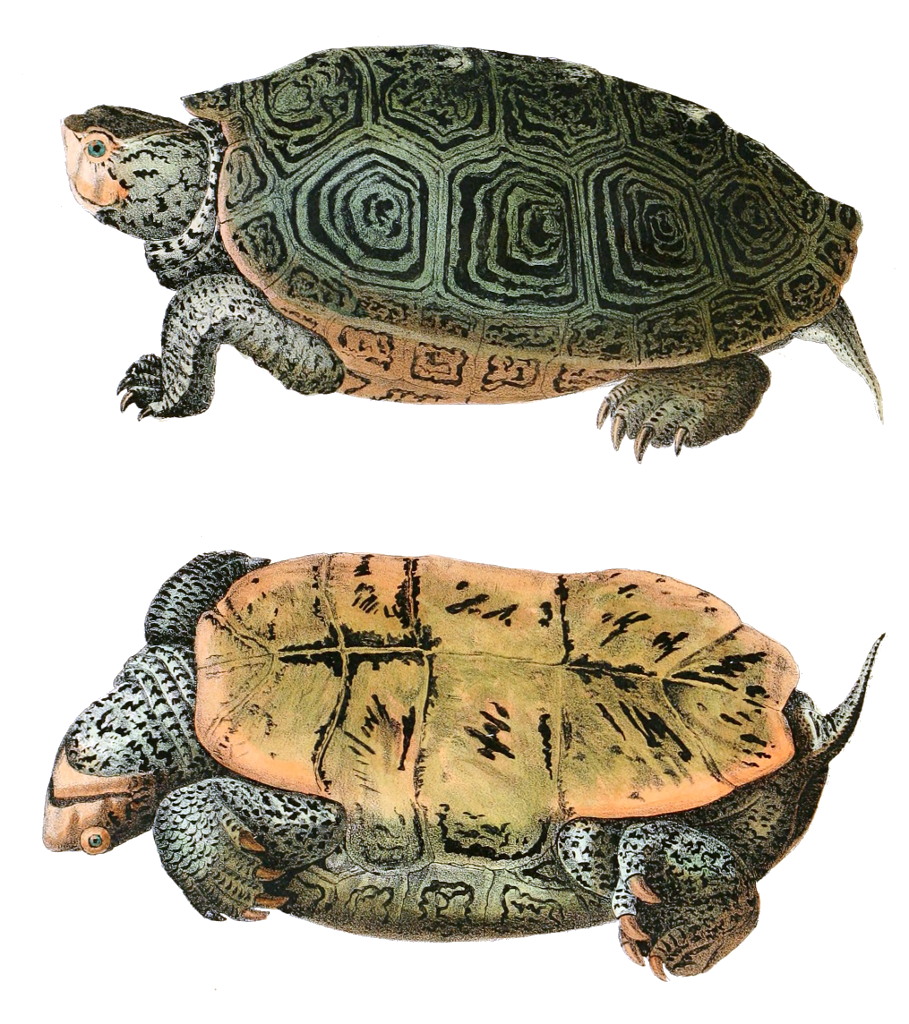 Diamondback TerrapinMalaclemys terrapin
Compare
Questions and answers
What is the scientific name of the Three-toed Box Turtle?
The scientific name of the Three-toed Box Turtle is Terrapene triunguis. Written with its author, the full name is Terrapene triunguis (Agassiz, 1857).
Which family does the Three-toed Box Turtle belong to?
Terrapene triunguis belongs to the family Emydidae, in the order Testudines and the class Reptilia.
Where is the Three-toed Box Turtle found?
Checklists and occurrence records place Terrapene triunguis in 1 country: United States.
What is the scientific name for the three-toed box turtle?
Its scientific name is Terrapene triunguis (Agassiz, 1857).[28]
What kind of food does a three-toed box turtle eat?
It is omnivorous and eats earthworms, insects, snails, slugs, strawberries, mushrooms, green-leafed vegetation, and quail eggs. It prefers live food over vegetation.[16][17][18][19][20]
What type of habitat do box turtles live in?
In Arkansas, Three-toed Box Turtles have been observed in grasslands during late spring and in forested areas during early spring, summer, and late fall.[14][15]
Is a three-toed box turtle rare?
The species is sometimes found outside its native range because of its popularity in the pet trade.[27]
Sources
Passages the profile rests on
- The species is sometimes classified as a subspecies of the eastern box turtle under the name Terrapene carolina triunguis. Source passage: “It is sometimes treated as a subspecies of the eastern box turtle as T. carolina triunguis.” — English Wikipedia
- The species can be difficult to distinguish from the eastern box turtle in the eastern Mississippi Valley. Source passage: “An example of this occurs in the eastern Mississippi valley, where this species is difficult to distinguish from the eastern box turtle.” — English Wikipedia
- Four-toed individuals have been proposed to be hybrids between eastern and three-toed box turtles. Source passage: “some speculate that the four-toed individuals are actually eastern box turtle × three-toed box turtle hybrids.” — English Wikipedia
- The species interbreeds with other common box turtle subspecies where their ranges overlap. Source passage: “Three-toed box turtles interbreed with other subspecies of common box turtles which overlap the borders of this area.” — English Wikipedia
- The species has a domed shell. Source passage: “Three-toed box turtles have a domed shell” — English Wikipedia
- The domed shell reaches approximately 13–18 cm in length. Source passage: “Three-toed box turtles have a domed shell which grows to 5–7 inches (13–18 cm) in length.” — English Wikipedia
- The highest part of the carapace is positioned farther toward the rear than in other subspecies. Source passage: “The highest part of its carapace or upper shell is more caudally positioned than in any of the other subspecies.” — English Wikipedia
- The species is named for having three toes on its hind feet. Source passage: “Three-toed box turtles are so named due to the number of toes on the back feet” — English Wikipedia
- Some individuals have four toes on their hind feet. Source passage: “some four-toed examples have been recorded as well.” — English Wikipedia
- Adult individuals commonly have dark blotches on otherwise olive-green or tan dorsal and limb surfaces. Source passage: “some dark blotches are common in adult turtles. These areas are more often a uniform olive green or tan color.” — English Wikipedia
- Some individuals have faint yellow dots or lines in the centers of their large shell scutes. Source passage: “Sometimes, faint yellow dots or lines are visible in the center of each large scute.” — English Wikipedia
- Males often have yellow, red, or orange spots on their heads and throats. Source passage: “In the males, the head and throat often display yellow, red, or orange spots.” — English Wikipedia
- The plastron is frequently straw yellow and has fewer dark markings than those of other subspecies. Source passage: “Frequently, the bottom shell or plastron is a straw yellow color, and has far fewer dark markings than the plastrons of the other subspecies.” — English Wikipedia
- In Arkansas, individuals have been observed in grasslands during late spring. Source passage: “In Arkansas, three-toed box turtles were observed in grasslands in late spring” — English Wikipedia
- In Arkansas, individuals have been observed in forested areas during early spring, summer, and late fall. Source passage: “while in early spring, summer, and late fall they were found in forested areas.” — English Wikipedia
- The species is omnivorous, with its diet varying according to food availability and season. Source passage: “Three-toed box turtles are omnivores, their diets varying with availability of food sources and the seasons.” — English Wikipedia
- The species eats earthworms, insects, snails, and slugs. Source passage: “They are known to eat earthworms, insects, snails, slugs, strawberries, mushrooms, and green-leafed vegetation.” — English Wikipedia
- The species consumes strawberries, mushrooms, and green-leafed vegetation. Source passage: “They are known to eat earthworms, insects, snails, slugs, strawberries, mushrooms, and green-leafed vegetation.” — English Wikipedia
- The species has been observed eating quail eggs. Source passage: “They have been observed eating the eggs of quail.” — English Wikipedia
- The species prefers live food over vegetation. Source passage: “All box turtles will prefer live foods to vegetation.” — English Wikipedia
- The species migrates seasonally to maintain its preferred humidity level. Source passage: “Three-toed box turtles are known to migrate seasonally in order to maintain their preferred humidity level.” — English Wikipedia
- During dry periods, individuals dig shallow burrows in leaf litter to conserve moisture. Source passage: “During dry times, they dig shallow burrows into leaf litter to conserve moisture.” — English Wikipedia
- When water is available, the species soaks for longer periods than other box turtle subspecies. Source passage: “When water is available, these turtles soak for longer periods of time than any of the other subspecies.” — English Wikipedia
- The species commonly undergoes brumation during cold months to conserve energy. Source passage: “Brumation is common in three-toed box turtles in order to preserve energy during cold months.” — English Wikipedia
- During winter brumation, individuals bury themselves in soil and reduce their bodily processes for up to five months. Source passage: “They will bury themselves in the dirt and slow down their body processes for up to five months during the winter.” — English Wikipedia
- The species is the official reptile of Missouri. Source passage: “is the official reptile of the state of Missouri.” — English Wikipedia
- Individuals are sometimes found outside their native range because of their popularity in the pet trade. Source passage: “Being popular in the pet trade, three-toed box turtles are sometimes found well outside of their home range.” — English Wikipedia
- The species belongs to the family Emydidae and the order Testudines. Source passage: “Family. Emydidae (basking, marsh, and box turtles) in the order Testudines (turtles).” — mdc.mo.gov
Data
- Catalogue of Life, 2026-10-16 XR cc by
- Global Biodiversity Information Facility CC BY 4.0
- Wikidata CC0
- GeoNames CC BY 4.0
- Within the Catalogue of Life, this name comes from The Reptile Database cc by
References
- Agassiz, L. (1857) Contributions to the Natural History of the United States of America. First Monograph. Vol. I. Part I. Essay on Classification. Part II. North American Testudinata. Little, Brown & Co., Boston, pp. 1 - 452. where the name was published
- Agassiz, & Louis. (1857). Contributions to the Natural History of the United States of America. vol. 1. Little, Brown & Co., Boston, Lii + 452 Pp.
- Boulenger, G. A. (1889). Catalogue of the chelonians, rhynchocephalians, and crocodiles in the British Museum (Natural History). British Museum, London, 311 Pp.
- Strecker, J. K. (1910). Description of a new solitary spadefoot toad (Scaphiopus hurterii) from Texas, with other herpetological notes. Proc. Biol. Soc. Washington 23: 115-122.
- Burt, Charles E. (1935). Further records of the ecology and distribution of amphibians and reptiles in the middle west. American Midland Naturalist 16 (3): 311-336.
- Wermuth, H., and R. Mertens. (1961). Schildkröten, Krokodile, Brückenechsen. Gustav Fischer Verlag, Jena. Xxvi + 422 Pp.
- Milstead, W. W. (1969). Studies on the evolution of box turtles (genus Terrapene). Bulletin of the Florida State Museum, Biological Sciences 14 (1): 1-113.
- Conant, R., & Collins, J. T. (1991). A Field Guide to Reptiles and Amphibians of Eastern/Central North America, 3rd ed. Houghton Mifflin (Boston/New York), Xx + 450 P.
- Bartlett, R. D., & Bartlett, P. (1999). A Field Guide to Texas Reptiles and Amphibians. Gulf Publishing Co., Houston, Texas, 331 Pp.
- TTWG; Rhodin, A.G.J.; van Dijk, P.P.; Iverson, J.B. & Shaffer, H.B. [turtle taxonomy working group]. (2010). Turtles of the World, 2010 Update: Annotated Checklist of Taxonomy, Synonymy, Distribution, and Conservation Status. Chelonian Research Monographs (ISSN 1088-7105) No. 5, Doi:10.3854/Crm.5.000.Checklist.V3.2010.
- Crother, B. I. (ed.). (2012). Standard Common and Current Scientific Names for North American Amphibians, Turtles, Reptiles, and Crocodilians, Seventh Edition. Herpetological Circular 39: 1-92.
- Martin, Bradley T.; Neil P. Bernstein, Roger D. Birkhead, Jim F. Koukl, Steven M. Mussmann, John S. Placyk Jr. (2013). Sequence-based molecular phylogenetics and phylogeography of the American box turtles (Terrapene spp.) with support from DNA barcoding. Molecular Phylogenetics and Evolution 68 (1): 119–134.
- Spinks, P. Q., Thomson, R. C., McCartney-Melstad, E., & Bradley Shaffer, H. (2016). Phylogeny and temporal diversification of the New World pond turtles (Emydidae). Molecular Phylogenetics and Evolution 103: 85-97.
- TTWG; Anders G.J. Rhodin, John B. iverson, Roger Bour, Uwe Fritz, Arthur GeoRges, H. BRadley Shaffer, and Peter Paul van Dijk. (2017). Turtles of the World: Annotated Checklist and Atlas of Taxonomy, Synonymy, Distribution, and Conservation Status (8th Ed.). In: Rhodin, A.G.J., Iverson, J.B., van Dijk, P.P., Saumure, R.A., Buhlmann, K.A., Pritchard, P.C.H., and Mittermeier, R.A. (Eds.). Conservation Biology of Freshwater Turtles and Tortoises: A Compilation Project of the IUCN/SSC Tortoise and Freshwater Turtle Specialist Group. Chelonian Research Monographs 7:1–292. Doi: 10.3854/Crm.7.Checklist.Atlas.V8.2017.
- Spinner, L. (2019). Eingedost! Lebensweise und Haltung nordamerikanischer Dosenschildkröten. Reptilia (Münster) 24 (137): 48-55.
- Thomson, R. C., Spinks, P. Q., & Shaffer, H. B. (2021). A global phylogeny of turtles reveals a burst of climate-associated diversification on continental margins. Proceedings of the National Academy of Sciences, 118 (7).
- TTWG; Rhodin, A.G.J., Iverson, J.B., Bour, R., Fritz, U., Georges, A., Shaffer, H.B., and van Dijk, P.P. (2021). Turtles of the World: Annotated Checklist and Atlas of Taxonomy, Synonymy, Distribution, and Conservation Status (9th Ed.). In: Rhodin, A.G.J., Iverson, J.B., van Dijk, P.P., Stanford, C.B., Goode, E.V., Buhlmann, K.A., and Mittermeier, R.A. (Eds.). Conservation Biology of Freshwater Turtles and Tortoises: A Compilation Project of the IUCN/SSC Tortoise and Freshwater Turtle Specialist Group. Chelonian Research Monographs 8:1–472. Doi:10.3854/Crm.8.Checklist.Atlas.V9.2021.
- TTWG [TURTLE TAXONOMY WORKING GROUP: RHODIN, A.G.J., IVERSON, J.B., FRITZ, U., GALLEGO-GARCÍA, N., GEORGES, A., SHAFFER, H.B., AND VAN DuK, P.P.]. (2025). Turtles of the World: Annotated Checklist and Atlas of Taxonomy, Synonymy, Distribution, and Conservation Status (10th Ed.). In: Rhodin, A.G.J., Iverson, J.B., van Dijk, P.P., Stanford, C.B., Goode, E.V., Buhlmann, K.A., and Mittermeier, R.A. (Eds.). Conservation Biology of Freshwater Turtles and Tortoises: A Compilation Project of the IUCN SSC Tortoise and Freshwater Turtle Specialist Group. Chelonian Research Monographs 10:1-575.
- Skerlec, S. M., Mardis, D. R., Joiner, J., Burkhead-Harris, S. E., & Luhring, T. M. (2026). Herpetofaunal Inventory of the Wichita State University Biological Field Station, Kansas, USA. Transactions of the Kansas Academy of Science, 129(1-2), 25-32.
This species in other databases
Page built on 28 November 2026. See how the catalog is made and all sources and licences.
Cite this page
ScientificNames.org. (2026). Terrapene triunguis (Three-toed Box Turtle). Retrieved November 28, 2026, from https://scientificnames.org/species/terrapene-triunguis
“Terrapene triunguis (Three-toed Box Turtle).” ScientificNames.org, 2026, scientificnames.org/species/terrapene-triunguis. Accessed 28 Nov. 2026.
ScientificNames.org. “Terrapene triunguis (Three-toed Box Turtle).” Accessed November 28, 2026. https://scientificnames.org/species/terrapene-triunguis.
@misc{scientificnames_terrapene_triunguis_three_toed_box_turtle,
  author = {{ScientificNames.org}},
  title = {Terrapene triunguis (Three-toed Box Turtle)},
  year = {2026},
  url = {https://scientificnames.org/species/terrapene-triunguis},
  note = {Accessed 2026-11-28}
}