Species · Flowering plants
Thalictrum clavatum
Thalictrum clavatum has no English name on record in the checklists used here. It is a species of flowering plant in the family Ranunculaceae (crowfoot family), order Ranunculales.
- Scientific name
- Thalictrum clavatum DC.
- Genus
- Thalictrum
- Family
- Ranunculaceae (Crowfoot Family)
- Order
- Ranunculales
- Class
- Magnoliopsida
- Recorded in
- 1 country
- Name status
- accepted in the Catalogue of Life

Overview
Thalictrum clavatum is native to the South and Central Appalachian regions of the United States, where it inhabits wooded seepages, streamsides, waterfall spray cliffs, and brookbanks.
Written 27 November 2026 from the sources listed below. Each statement was checked against the passage it cites; statements that could not be supported were removed.
Appearance
Thalictrum clavatum has erect, green, slender, smooth, hairless stems measuring approximately 15–60 cm in height. Its leaves are alternate and bi-ternately compound, with obovate leaflets measuring approximately 10–30 mm in width and having apically lobed tips.[1][2][3][4][5]
The undersides of its leaflets have a glaucous or waxy surface. Its roots are few, black, and slightly tuberous.[6][7]
The flowers contain numerous white filaments measuring 2.5–4.0 mm and anthers measuring 0.3–0.5 mm. Its fruit is a dry, one-seeded achene that remains closed when ripe; the achenes are flat, sickle-shaped, and veined along their sides.[8][9][10]
Its achene stalks measure approximately 1–3 mm in length.[11]
Habitat
The species inhabits wooded seepages, streamsides, waterfall spray cliffs, and brookbanks. It commonly grows in dense forests near cold-water sources and is occasionally found in rich cove forests.[12][13][14]
It tolerates shaded growing environments and is classified as a Facultative Wetland species, indicating that it is likely to occur in wetland environments.[15][16]
The species is native to the South and Central Appalachian regions of the United States. Its recorded distribution includes Virginia, West Virginia, North Carolina, South Carolina, Georgia, Kentucky, Tennessee, and Alabama.[17][18]
It occurs predominantly in Appalachian mountainous regions but has also been reported sparsely in Western Piedmont foothills. It has been recorded at elevations between 0 and 700 feet, most frequently at approximately 500 feet.[19][20]
Reproduction and life cycle
Its pollen-to-ovule ratio is approximately 4,000:1, and its pollen grains generally measure 28.5 μm in diameter. Its seeds have an average weight of 6.6 mg.[21][22][23]
The species produces between three and eight achene fruits per plant. Its white flowers bloom between May and July, and achene fruits develop after flowering.[24][25][26]
Water dispersal accounts for a small number of successful reproductive events.[27]
Conservation
Its global conservation rank is G4, indicating uncommon status and some concern about population decline. Its North Carolina Natural Heritage Program conservation rank is S4.[28][29]
The species has a Coefficient of Conservatism of 10, reflecting its association with undisturbed natural environments. It has low tolerance for habitat degradation.[30][31]
Uses
The species is displayed in the gardens of the Mount Cuba Center in Hockessin, Delaware.[32]
Similar species
Thalictrum filipes and Thalictrum nudicaule are listed as scientific synonyms of Thalictrum clavatum.[33]
Classification of Thalictrum clavatum
| Kingdom | Plantae |
|---|---|
| Subkingdom | Pteridobiotina |
| Phylum | Tracheophyta |
| Class | Magnoliopsida |
| Order | Ranunculales |
| Family | Ranunculaceae (Crowfoot Family) |
| Subfamily | Thalictroideae |
| Genus | Thalictrum (Meadow-rue) |
| Species | Thalictrum clavatum DC. |
Where Thalictrum clavatum is found
Checklists and occurrence records place Thalictrum clavatum in 1 country across North America. GBIF holds 1,165 georeferenced records of it.
Countries
Regions and cities with the most records
- North Carolina, United States 327
- Tennessee, United States 95
- Boone, United States 53
- Kentucky, United States 41
- Georgia, United States 37
- Asheville, United States 34
- South Carolina, United States 24
- Virginia, United States 22
- Cookeville, United States 6
- Alabama, United States 4
- Morganton, United States 4
- Johnson City, United States 3
- Sevierville, United States 3
- West Virginia, United States 2
3 more countries have a few records outside this range
These countries hold a few records of Thalictrum clavatum but lie outside the range the checklists give for it. Such records are often zoo or garden specimens, museum material or vagrants, so the species is not counted as occurring there.
Range as the checklists state it
USA (Alabama, Georgia, Kentucky, North Carolina, South Carolina, Tennessee, Virginia, West Virginia)
A number beside a place is its count of GBIF occurrence records. A place without a number comes from a checklist alone. Records show where a species has been observed or collected, which can include escapes and vagrants.
Common names
Synonyms
4 other scientific names have been used for this species and are now treated as synonyms of Thalictrum clavatum.
- Physocarpum clavatum (DC.) Bercht. & J.Presl
- Sumnera clavata (DC.) Nieuwl.
- Thalictrum filipes Torr. & A.Gray
- Thalictrum nudicaule Schwein. ex Torr. & A.Gray
Related species
-
 Columbine Meadow-rueThalictrum aquilegiifolium
-
 Chinese Meadow-RueThalictrum delavayi
-
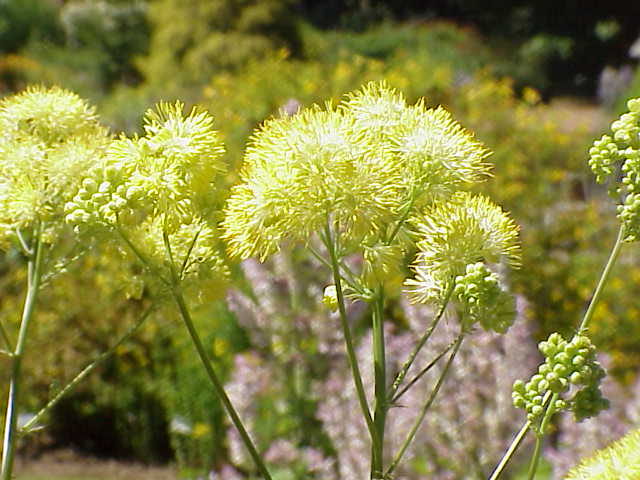 Common Meadow-RueThalictrum flavum
- Rue AnemoneThalictrum thalictroides
-
 Lesser Meadow-RueThalictrum minus
-
 Early Meadow-rueThalictrum dioicum
-
 Alpine Meadow-rueThalictrum alpinum
-
 Tall Meadow-rueThalictrum pubescens
Compare
Questions and answers
Does thalictrum like sun or shade?
Thalictrum clavatum tolerates shaded growing environments.[15]
Is thalictrum native to North America?
Thalictrum clavatum is native to the South and Central Appalachian regions of the United States.[17]
Sources
Passages the profile rests on
- The species has alternate, bi-ternately compound leaves. Source passage: “Both the proximal and distal leaves of the plant are bi-ternately compound. The leaves of the plant are arranged in an alternate configuration.” — English Wikipedia
- Its leaflets are obovate with apically lobed tips. Source passage: “The leaflets of the plant are obovate in shape with an apically lobed tip.” — English Wikipedia
- Its erect stems are green, slender, smooth, and hairless. Source passage: “The stem is glabrous, or devoid of hairs.” — English Wikipedia
- Its erect stems measure approximately 15–60 cm in height. Source passage: “The green-hued erect stem stands roughly 15 to 60 cm in height.” — English Wikipedia
- Its leaflets measure approximately 10–30 mm in width. Source passage: “Each leaflet is roughly 10 – 30 mm in width.” — English Wikipedia
- The undersides of its leaflets have a glaucous or waxy surface. Source passage: “The undersurface of the leaflets is glaucous, or waxy.” — English Wikipedia
- Its roots are few, black, and slightly tuberous. Source passage: “The roots of Thalictrum clavatum are few, black in coloration, and slightly tuberous.” — English Wikipedia
- Its flowers contain numerous white filaments measuring 2.5–4.0 mm and anthers measuring 0.3–0.5 mm. Source passage: “numerous petaloid, flatten-shaped white filaments (2.5 - 4.0 mm) and anthers (0.3 - 0.5 mm)” — English Wikipedia
- Its fruit is a dry, one-seeded achene that remains closed when ripe. Source passage: “a dry one-seeded fruit that does not unfurl when ripe.” — English Wikipedia
- Its achenes are flat, sickle-shaped, and veined along their sides. Source passage: “The shape of the achene fruit is flat and sickled, with veining along the sides.” — English Wikipedia
- Its achene stalks measure approximately 1–3 mm in length. Source passage: “Each achene has an elongated stipe, or stalk (1.0 - 3.0 mm).” — English Wikipedia
- The species inhabits wooded seepages, streamsides, waterfall spray cliffs, and brookbanks. Source passage: “wooded seepages, streamsides, spray cliffs at waterfalls, and brookbanks.” — English Wikipedia
- It commonly grows in dense forests near cold-water sources. Source passage: “characteristically found in dense forests nearby cold water sources” — English Wikipedia
- It is occasionally found in rich cove forests. Source passage: “in less frequent instances, it has been reported in rich cove forests.” — English Wikipedia
- The species tolerates shaded growing environments. Source passage: “A score of three indicates an adaptation or leniency towards shaded environments.” — English Wikipedia
- It is classified as a Facultative Wetland species, indicating that it is likely to occur in wetland environments. Source passage: “Thalictrum clavatum is categorized as a Facultative Wetland (FACW) species under the National Wetland Plant List” — English Wikipedia
- The species is native to the South and Central Appalachian regions of the United States. Source passage: “Thalictrum clavatum is endemic to the South and Central Appalachian regions of the United States” — English Wikipedia
- Its recorded distribution includes Virginia, West Virginia, North Carolina, South Carolina, Georgia, Kentucky, Tennessee, and Alabama. Source passage: “namely the states of Virginia, West Virginia, North Carolina, South Carolina, Georgia, Kentucky, Tennessee, and Alabama.” — English Wikipedia
- The species occurs predominantly in Appalachian mountainous regions but has also been reported sparsely in Western Piedmont foothills. Source passage: “While it is abundant in the mountainous regions of Appalachia, it has also been sparingly reported in Western Piedmont Foothill regions at low elevations.” — English Wikipedia
- It has been recorded at elevations between 0 and 700 feet, most frequently at approximately 500 feet. Source passage: “can be observed at elevations ranging between 0 – 700 feet; however, it is most often found at elevations of 500 feet.” — English Wikipedia
- Its seeds have an average weight of 6.6 mg. Source passage: “The light average weight of its seeds (6.6 mg)” — English Wikipedia
- Its pollen-to-ovule ratio is approximately 4,000:1. Source passage: “high pollen to ovule ratio (4,000:1)” — English Wikipedia
- Its pollen grains generally measure 28.5 μm in diameter. Source passage: “they are generally 28.5 μm in diameter” — English Wikipedia
- The species produces between three and eight achene fruits per plant. Source passage: “There are usually three to eight achene fruits within the plant” — English Wikipedia
- Its white flowers bloom between May and July. Source passage: “The species blooms a white color within the spring and summer months between May and July” — English Wikipedia
- The species produces achene fruits after flowering. Source passage: “After flowering, Thalictrum clavatum produces an achene fruit.” — English Wikipedia
- Water dispersal accounts for a small number of successful reproductive events. Source passage: “a small number of successful reproduction events are attributed to seed dispersal by water.” — English Wikipedia
- Its global conservation rank is G4, indicating uncommon status and some concern about population decline. Source passage: “Thalictrum clavatum has a global value of G4, signifying the species's uncommon status and indicating a slight concern for population decline.” — English Wikipedia
- Its North Carolina Natural Heritage Program conservation rank is S4. Source passage: “Under the North Carolina Natural Heritage Program (NCNHP), Thalictrum clavatum is labeled S4.” — English Wikipedia
- The species has a Coefficient of Conservatism of 10, reflecting its association with undisturbed natural environments. Source passage: “Thalictrum clavatum has a Coefficient of Conservatism (C-value) of 10” — English Wikipedia
- The species has low tolerance for habitat degradation. Source passage: “has a low tolerance for habitat degradation.” — English Wikipedia
- The species is displayed in the gardens of the Mount Cuba Center in Hockessin, Delaware. Source passage: “Thalictrum clavatum is displayed within the gardens of the Mount Cuba Center in Hockessin, Delaware” — English Wikipedia
- Thalictrum filipes and Thalictrum nudicaule are listed as scientific synonyms of Thalictrum clavatum. Source passage: “the Thalictrum clavatum name is synonymous with Thalictrum filipes and Thalictrum nudicaule.” — English Wikipedia
Data
- Catalogue of Life, 2026-10-16 XR cc by
- Global Biodiversity Information Facility CC BY 4.0
- Wikidata CC0
- GeoNames CC BY 4.0
- Wikimedia Commons per image; credit shown with each image
- Within the Catalogue of Life, this name comes from Synonymic Checklists of the Vascular Plants of the World cc by
References
- DC. (1817). Syst. Nat. [Candolle] 1: 171 (1817). where the name was published
This species in other databases
Page built on 28 November 2026. See how the catalog is made and all sources and licences.
Cite this page
ScientificNames.org. (2026). Thalictrum clavatum. Retrieved November 28, 2026, from https://scientificnames.org/species/thalictrum-clavatum
“Thalictrum clavatum.” ScientificNames.org, 2026, scientificnames.org/species/thalictrum-clavatum. Accessed 28 Nov. 2026.
ScientificNames.org. “Thalictrum clavatum.” Accessed November 28, 2026. https://scientificnames.org/species/thalictrum-clavatum.
@misc{scientificnames_thalictrum_clavatum,
  author = {{ScientificNames.org}},
  title = {Thalictrum clavatum},
  year = {2026},
  url = {https://scientificnames.org/species/thalictrum-clavatum},
  note = {Accessed 2026-11-28}
}