Species · Flowering plants
Western Meadowrue Thalictrum occidentale
The scientific name of the Western Meadowrue is Thalictrum occidentale. It is a species of flowering plant in the family Ranunculaceae (crowfoot family), order Ranunculales.
- Scientific name
- Thalictrum occidentale A.Gray
- Common name
- Western Meadowrue
- Genus
- Thalictrum
- Family
- Ranunculaceae (Crowfoot Family)
- Order
- Ranunculales
- Class
- Magnoliopsida
- Recorded in
- 3 countries
- Name status
- accepted in the Catalogue of Life

Overview
Western Meadowrue is a flowering plant in the buttercup family, identified by the scientific name Thalictrum occidentale A. Gray. It is native to northwestern North America, ranging from Alaska and western Canada to northern California, Wyoming, and Colorado. It has compound, often three-lobed leaves and upright or arching flower panicles.
Written 27 November 2026 from the sources listed below. Each statement was checked against the passage it cites; statements that could not be supported were removed.
Appearance
Western Meadowrue is an erect perennial herb that can reach approximately one meter in height. It is hairless to lightly hairy and has glandular features.[1][2]
The flowers are arranged in upright or arching panicles, often with leaflike, lobed bracts at their base. Male flowers have bell-shaped calyces with four greenish-white or purple sepals and numerous long, purple stamens with large anthers.[3][4][5][6]
Female flowers have clusters of immature fruits tipped with purple styles.[7]
Habitat
Western Meadowrue grows in shady habitats, including forest understories. It also grows in more open, moist habitats such as meadows.[8][9]
Reproduction and life cycle
Western Meadowrue is dioecious, with male and female flowers occurring on separate plants. It is pollinated by wind.[10][11]
Fruit clusters typically contain four to nine fruits, occasionally reaching fourteen.[12]
Classification of the Western Meadowrue
| Kingdom | Plantae |
|---|---|
| Subkingdom | Pteridobiotina |
| Phylum | Tracheophyta |
| Class | Magnoliopsida |
| Order | Ranunculales |
| Family | Ranunculaceae (Crowfoot Family) |
| Subfamily | Thalictroideae |
| Genus | Thalictrum (Meadow-rue) |
| Species | Thalictrum occidentale A.Gray |
Where the Western Meadowrue is found
Checklists and occurrence records place Thalictrum occidentale in 3 countries across North America. GBIF holds 4,622 georeferenced records of it.
Countries
Regions and cities with the most records
- British Columbia, Canada 813
- Oregon, United States 734
- Idaho, United States 639
- Washington, United States 600
- Montana, United States 363
- Alberta, Canada 215
- Corvallis, United States 160
- Albany, United States 145
- Moscow, United States 140
- Pullman, United States 93
- Springfield, United States 88
- Eugene, United States 84
- Wyoming, United States 57
- Washougal, United States 51
- Missoula, United States 29
- Courtenay, Canada 28
- Spokane Valley, United States 27
- Tumwater, United States 27
- Nevada, United States 26
- Olympia, United States 26
- Port Angeles, United States 26
- Tigard, United States 25
- Beaverton, United States 24
- Aloha, United States 22
- Gresham, United States 22
- Tualatin, United States 22
- Happy Valley, United States 21
- Troutdale, United States 21
- Bethany, United States 20
- Milwaukie, United States 20
- Oak Grove, United States 20
- Bozeman, United States 19
- Lake Oswego, United States 19
- Spokane, United States 19
- Hillsboro, United States 18
- Oregon City, United States 18
Range as the checklists state it
Alaska; Canada (Alberta, British Columbia, Saskatchewan, Yukon); USA (California, Colorado, Idaho, Montana, Nevada, Oregon, Washington State, Wyoming); Mexico (Chihuahua, Sonora)
A number beside a place is its count of GBIF occurrence records. A place without a number comes from a checklist alone. Records show where a species has been observed or collected, which can include escapes and vagrants.
Common names
English
- Western Meadowrue
Names in 2 other languages
- Chinese
- 美西唐松草
- French
- pigamon de l'Ouest, pigamon occidental
Synonyms
10 other scientific names have been used for this species and are now treated as synonyms of Thalictrum occidentale.
- Thalictrum breitungii B.Boivin
- Thalictrum megacarpum Torr.
- Thalictrum occidentale var. breitungii (B.Boivin) Brayshaw
- Thalictrum occidentale var. macounii B.Boivin
- Thalictrum occidentale var. megacarpum (Torr.) H.St.John
- Thalictrum occidentale var. occidentale
- Thalictrum occidentale var. palousense H.St.John
- Thalictrum omissum Greene
- Thalictrum propinquum Greene
- Thalictrum rainierense H.St.John
Related species
-
 Columbine Meadow-rueThalictrum aquilegiifolium
-
 Chinese Meadow-RueThalictrum delavayi
-
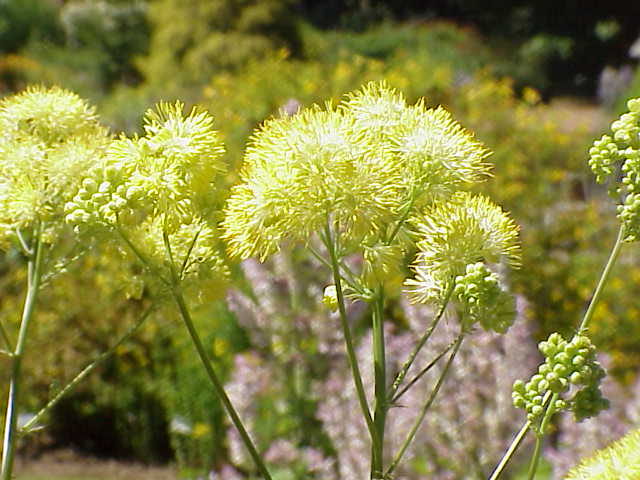 Common Meadow-RueThalictrum flavum
- Rue AnemoneThalictrum thalictroides
-
 Lesser Meadow-RueThalictrum minus
-
 Early Meadow-rueThalictrum dioicum
-
 Alpine Meadow-rueThalictrum alpinum
-
 Tall Meadow-rueThalictrum pubescens
Compare
Questions and answers
What is the scientific name of the Western Meadowrue?
The scientific name of the Western Meadowrue is Thalictrum occidentale. Written with its author, the full name is Thalictrum occidentale A.Gray.
Which family does the Western Meadowrue belong to?
Thalictrum occidentale belongs to the family Ranunculaceae, in the order Ranunculales and the class Magnoliopsida.
Where is the Western Meadowrue found?
Checklists and occurrence records place Thalictrum occidentale in 3 countries: United States, Canada and Mexico.
Does thalictrum like sun or shade?
Western Meadowrue grows in shady habitats, including forest understories, as well as in more open, moist habitats such as meadows.[8][9]
Is thalictrum native to North America?
Yes. Western Meadowrue is native to northwestern North America, ranging from Alaska and western Canada to northern California, Wyoming, and Colorado.[13]
Sources
Passages the profile rests on
- The plant is hairless to lightly hairy and has glandular features. Source passage: “It is hairless to lightly hairy and glandular.” — English Wikipedia
- The plant is an erect perennial herb that can reach approximately one meter in height. Source passage: “a perennial herb growing erect to a maximum height around a meter.” — English Wikipedia
- The flowers are arranged in upright or arching panicles. Source passage: “The inflorescence is an upright or arching panicle of flowers” — English Wikipedia
- The flower panicles often have leaflike, lobed bracts at their base. Source passage: “with leaflike, lobed bracts often growing at the base.” — English Wikipedia
- Male flowers have bell-shaped calyces consisting of four greenish-white or purple sepals. Source passage: “The male flower has a bell-shaped calyx of four sepals in shades of greenish white or purple.” — English Wikipedia
- Male flowers have numerous long, purple stamens with large anthers. Source passage: “From the calyx dangle many long, purple stamens tipped with large anthers.” — English Wikipedia
- Female flowers have clusters of immature fruits tipped with purple styles. Source passage: “The female flower has a cluster of immature fruits tipped with styles in shades of purple.” — English Wikipedia
- The species grows in shady habitats, including forest understories. Source passage: “where it grows in shady habitat types such as forest understory” — English Wikipedia
- The species also grows in more open, moist habitats such as meadows. Source passage: “and more open, moist habitat such as meadows.” — English Wikipedia
- The species is dioecious, with male and female flowers occurring on separate plants. Source passage: “The species is dioecious, with male and female flowers occurring on separate plants” — English Wikipedia
- The species is pollinated by wind. Source passage: “and is wind pollinated.” — English Wikipedia
- Fruit clusters typically contain four to nine fruits, occasionally reaching fourteen. Source passage: “A cluster has 4 to 9, at times up to 14, fruits.” — English Wikipedia
- The species is native to northwestern North America, ranging from Alaska and western Canada to northern California, Wyoming, and Colorado. Source passage: “It is native to northwestern North America from Alaska and western Canada to northern California to Wyoming and Colorado” — English Wikipedia
Data
- Catalogue of Life, 2026-10-16 XR cc by
- Global Biodiversity Information Facility CC BY 4.0
- Wikidata CC0
- GeoNames CC BY 4.0
- Wikimedia Commons per image; credit shown with each image
- Within the Catalogue of Life, this name comes from Synonymic Checklists of the Vascular Plants of the World cc by
References
- Gray, A. (1872). Proc. Amer. Acad. Arts 7: 372 (1872). where the name was published
This species in other databases
- Catalogue of Life 562DT
- Wikidata Q7709657
- iNaturalist 79343
- World Flora Online wfo-0001129469
- GRIN 456778
Page built on 27 November 2026. See how the catalog is made and all sources and licences.
Cite this page
ScientificNames.org. (2026). Thalictrum occidentale (Western Meadowrue). Retrieved November 27, 2026, from https://scientificnames.org/species/thalictrum-occidentale
“Thalictrum occidentale (Western Meadowrue).” ScientificNames.org, 2026, scientificnames.org/species/thalictrum-occidentale. Accessed 27 Nov. 2026.
ScientificNames.org. “Thalictrum occidentale (Western Meadowrue).” Accessed November 27, 2026. https://scientificnames.org/species/thalictrum-occidentale.
@misc{scientificnames_thalictrum_occidentale_western_meadowrue,
  author = {{ScientificNames.org}},
  title = {Thalictrum occidentale (Western Meadowrue)},
  year = {2026},
  url = {https://scientificnames.org/species/thalictrum-occidentale},
  note = {Accessed 2026-11-27}
}