Species · Other invertebrates
Red-lined Sea Cucumber Thelenota rubralineata
The scientific name of the Red-lined Sea Cucumber is Thelenota rubralineata. It is a species of animal in the family Stichopodidae, order Synallactida. The name dates from 1991.
- Scientific name
- Thelenota rubralineata Massin & Lane, 1991
- Common name
- Red-lined Sea Cucumber
- Genus
- Thelenota
- Family
- Stichopodidae
- Order
- Synallactida
- Class
- Holothuroidea
- Red List category
- DD Data Deficient
- Environment
- marine
- Recorded in
- 7 countries
- Name status
- accepted in the Catalogue of Life

Overview
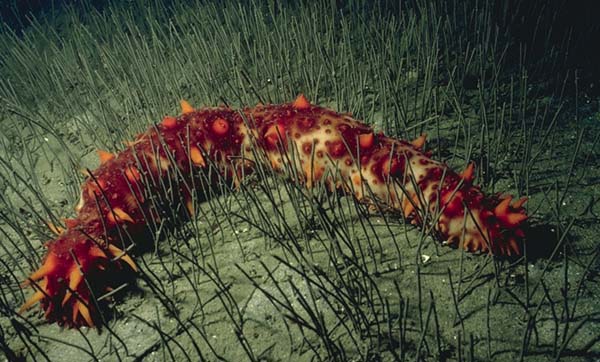
Thelenota rubralineata inhabits outer coral reef slopes with large rubble and patches of coarse sand near islands, at depths of 20 meters or greater. It has an elongated white body covered in complex red lines that form maze-like patterns.
Written 27 November 2026 from the sources listed below. Each statement was checked against the passage it cites; statements that could not be supported were removed.
Appearance
Its body has distinct dorsal and ventral surfaces. The dorsal side has papillae and pedicels, while the ventral side has randomly distributed podia.[1]
The dorsal protrusions form two rows containing 13 to 15 large conical arms, many of which terminate in spiked papillae. The papillae on these protrusions end in white peaks.[2][3][4]
Its podia are pale greenish-yellow, and its 20 tentacles are red. Its uncontracted body measures 30 to 39 cm in length and approximately 8 cm in width.[5][6]
Its body wall contains calcareous spicules in the form of granules and branched rods. These spicules provide structural support and defense against predators.[7][8]
It has five broad, V-shaped longitudinal muscles attached to its body wall, two narrow respiratory trees, and a short digestive tract. Its circulatory system is small and runs parallel to the intestines.[9][10][11][12]
Habitat
The Red-lined Sea Cucumber inhabits outer coral reef slopes with large rubble and patches of coarse sand near islands. It occurs at depths of 20 meters or greater.[13][14]
It is widespread throughout the Indo-Pacific region, including the central Indo-Pacific region.[15][16]
Behaviour
The Red-lined Sea Cucumber uses its lateral protuberances when walking. Two polian vesicles contribute to its locomotion.[17][18]
When disturbed, it bends its body helically and brings its mouth close to its anus. It can maintain this defensive posture for 10 minutes or longer before moving again.[19][20]
Reproduction and life cycle
The Red-lined Sea Cucumber is suspected to have regenerative abilities.[21]
Uses
The genus Thelenota is harvested in Micronesia, Polynesia, Melanesia, Australia, and New Zealand.[22]
Classification of the Red-lined Sea Cucumber
| Kingdom | Animalia |
|---|---|
| Phylum | Echinodermata |
| Subphylum | Echinozoa |
| Class | Holothuroidea |
| Subclass | Actinopoda |
| Order | Synallactida |
| Family | Stichopodidae |
| Genus | Thelenota |
| Species | Thelenota rubralineata Massin & Lane, 1991 |
Where the Red-lined Sea Cucumber is found
Checklists and occurrence records place Thelenota rubralineata in 7 countries. GBIF holds 117 georeferenced records of it.
Countries
- Cook Islands 5
- Indonesia 34
- Marshall Islands 7
- New Caledonia 5
- Papua New Guinea 40
- Philippines 14
- Solomon Islands 12
Regions and cities with the most records
- Madang, Papua New Guinea 9
- Western Province, Solomon Islands 7
- Avarua, Cook Islands 3
- Daanbantayan, Philippines 3
- Oro Province, Papua New Guinea 3
A number beside a place is its count of GBIF occurrence records. A place without a number comes from a checklist alone. Records show where a species has been observed or collected, which can include escapes and vagrants.
Common names
English
- Red-lined Sea Cucumber
- Candy Cane Sea Cucumber
- Lemonfish
Related species
-
 Pineapple Sea CucumberThelenota ananas
-
 AmberfishThelenota anax
-
 Japanese Sea CucumberApostichopus japonicus
-
 California Sea CucumberApostichopus californicus
-
 Greenfish Sea CucumberStichopus chloronotus
-
 Brown Sea CucumberIsostichopus fuscus
-
 Chocolate Chip Sea CucumberIsostichopus badionotus
-
 Herrmann's Sea CucumberStichopus herrmanni
Compare
Questions and answers
What is the scientific name of the Red-lined Sea Cucumber?
The scientific name of the Red-lined Sea Cucumber is Thelenota rubralineata. Written with its author, the full name is Thelenota rubralineata Massin & Lane, 1991.
Which family does the Red-lined Sea Cucumber belong to?
Thelenota rubralineata belongs to the family Stichopodidae, in the order Synallactida and the class Holothuroidea.
Where is the Red-lined Sea Cucumber found?
Checklists and occurrence records place Thelenota rubralineata in 7 countries, including Papua New Guinea, Indonesia, Philippines, Solomon Islands, Marshall Islands and Cook Islands.
What is the conservation status of the Red-lined Sea Cucumber?
The IUCN Red List category recorded for Thelenota rubralineata is Data Deficient (DD).
What other names does the Red-lined Sea Cucumber have?
Thelenota rubralineata is also known in English as Candy Cane Sea Cucumber and Lemonfish.
Sources
Passages the profile rests on
- Its body has distinct dorsal and ventral surfaces, with papillae and pedicels on the dorsal side and randomly distributed podia on the ventral side. Source passage: “Like other Thelenota, it has well marked differences between its ventral and dorsal surface, with papillae and pedicels covering its dorsal surface, and numerous podia scattered randomly on its ventral surface.” — English Wikipedia
- The dorsal protrusions form two rows containing 13 to 15 large conical arms. Source passage: “The dorsal protrusions are arranged in two rows of 13 to 15 large, conical arms” — English Wikipedia
- Many of its conical arms terminate in spiked papillae. Source passage: “many of which ending in spiked papillae.” — English Wikipedia
- The papillae on its conical protrusions end in white peaks. Source passage: “The conical protrusions are also covered in this pattern, with papillae ending in white peaks.” — English Wikipedia
- Its podia are pale greenish-yellow and its 20 tentacles are red. Source passage: “The podia are pale greenish-yellow, while the tentacles, twenty in number, are red.” — English Wikipedia
- Its uncontracted body measures 30 to 39 cm in length and approximately 8 cm in width. Source passage: “Thelenota rubralineata has an elongated, roughly trapezoidal body 30 to 39 cm long and 8 cm wide in its uncontracted state.” — English Wikipedia
- Its body wall contains calcareous spicules in the form of granules and branched rods. Source passage: “T. rubralineata contains calcareous spicules in the form of granules and branched rods.” — English Wikipedia
- Its calcareous spicules provide structural support and defense against predators. Source passage: “these structures serve as both structural support and defense from predators.” — English Wikipedia
- The species has five broad, V-shaped longitudinal muscles attached to its body wall. Source passage: “Five longitudinal muscles are broad, V-shaped, and attached to the body wall.” — English Wikipedia
- Its digestive tract is short. Source passage: “A short digestive tract, two narrow respiratory trees, and a small circulatory system running parallel to the intestines is also present.” — English Wikipedia
- It has two narrow respiratory trees. Source passage: “two narrow respiratory trees” — English Wikipedia
- Its circulatory system is small and runs parallel to the intestines. Source passage: “a small circulatory system running parallel to the intestines” — English Wikipedia
- The species inhabits outer coral reef slopes with large rubble and patches of coarse sand near islands. Source passage: “Thelenota rubralineata is found on outer coral reef slopes with large rubble and coarse sand patches near islands 20 meters and deeper.” — English Wikipedia
- It occurs at depths of 20 meters or greater. Source passage: “near islands 20 meters and deeper.” — English Wikipedia
- The species is widespread throughout the Indo-Pacific region. Source passage: “This species is widespread throughout the Indo-Pacific region.” — English Wikipedia
- Its distribution includes the central Indo-Pacific region. Source passage: “mainly located in the central Indo-Pacific region.” — English Wikipedia
- The species uses its lateral protuberances when walking. Source passage: “When in motion, the lateral protuberances play a role in walking.” — English Wikipedia
- Two polian vesicles contribute to its locomotion. Source passage: “Two polian vesicles provide the basis for locomotion.” — English Wikipedia
- When disturbed, it bends its body helically and brings its mouth close to its anus. Source passage: “When disturbed, T. rubralineata bends its body in a helical fashion, arranging its mouth close to the anus” — English Wikipedia
- It can maintain its defensive helical posture for 10 minutes or longer before moving again. Source passage: “and assumes this position for up to 10 minutes or longer, then moves again.” — English Wikipedia
- The species is suspected to have regenerative abilities. Source passage: “like other echinoderms, T. rubralineata is suspected to regenerate.” — English Wikipedia
- The genus Thelenota is harvested in Micronesia, Polynesia, Melanesia, Australia, and New Zealand. Source passage: “Thelenota is often harvested in many regions of Micronesia, Polynesia, Melanesia, Australia, and New Zealand.” — English Wikipedia
Data
- Catalogue of Life, 2026-10-16 XR cc by
- Global Biodiversity Information Facility CC BY 4.0
- Wikidata CC0
- GeoNames CC BY 4.0
- Wikimedia Commons per image; credit shown with each image
- Within the Catalogue of Life, this name comes from World Register of Marine Species cc by
References
- Massin, C., & Lane, D. J. W. (1991). Description of a new species of sea cucumber (Stichopodidae, Holothuroidea, Echinodermata) from the eastern Indo-Malayan archipelago: Thelenota rubralineata n. sp. Micronesica, 24. where the name was published
This species in other databases
- Catalogue of Life 567QR
- Wikidata Q2708493
- iNaturalist 348119
- WoRMS urn:lsid:marinespecies.org:taxname:242080
- ITIS 1078944
Page built on 27 November 2026. See how the catalog is made and all sources and licences.
Cite this page
ScientificNames.org. (2026). Thelenota rubralineata (Red-lined Sea Cucumber). Retrieved November 27, 2026, from https://scientificnames.org/species/thelenota-rubralineata
“Thelenota rubralineata (Red-lined Sea Cucumber).” ScientificNames.org, 2026, scientificnames.org/species/thelenota-rubralineata. Accessed 27 Nov. 2026.
ScientificNames.org. “Thelenota rubralineata (Red-lined Sea Cucumber).” Accessed November 27, 2026. https://scientificnames.org/species/thelenota-rubralineata.
@misc{scientificnames_thelenota_rubralineata_red_lined_sea_cucumber,
  author = {{ScientificNames.org}},
  title = {Thelenota rubralineata (Red-lined Sea Cucumber)},
  year = {2026},
  url = {https://scientificnames.org/species/thelenota-rubralineata},
  note = {Accessed 2026-11-27}
}