Species · Birds
Mountain Wren Troglodytes solstitialis
The scientific name of the Mountain Wren is Troglodytes solstitialis. It is a species of bird in the family Troglodytidae (wren), order Passeriformes. The name dates from 1859.
- Scientific name
- Troglodytes solstitialis P. L. Sclater, 1859
- Common name
- Mountain Wren
- Genus
- Troglodytes
- Family
- Troglodytidae (Wren)
- Order
- Passeriformes
- Class
- Aves
- Red List category
- LC Least Concern
- Recorded in
- 6 countries
- Name status
- accepted in the Catalogue of Life
Overview
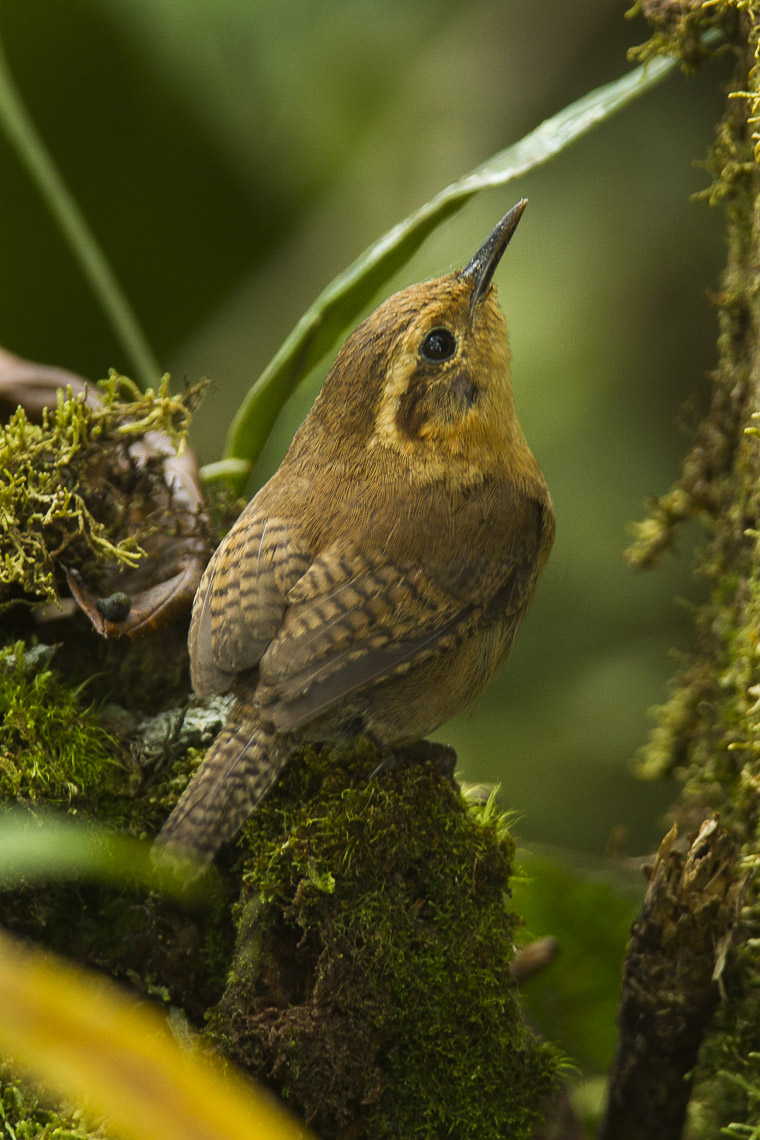
The Mountain Wren (Troglodytes solstitialis) is a bird in the family Troglodytidae, order Passeriformes, and class Aves. It occurs in the Andes of northwestern Argentina, Bolivia, Colombia, Ecuador, Peru, and western Venezuela. It measures 10.5–11.5 cm in length and has rufous brown upperparts, barred wings, and buff-colored underparts in the nominate subspecies.
Written 26 November 2026 from the sources listed below. Each statement was checked against the passage it cites; statements that could not be supported were removed.
Appearance
Adult nominate Mountain Wrens have a rufous brown forehead and crown, a less reddish brown nape, shoulders, back, and rump, and a rufous brown tail with narrow black bars. Their folded wings are barred.[1][2]
The nominate subspecies has a buffy brown supercilium, warm buff cheeks, throat, and chest, and a paler buff belly. Its flanks are buffy brown with darker bars, and its grayish vent has darker bars.[3][4]
Juveniles have less warm-colored supercilia and upperparts, with dull gray-brown underparts and darker speckles.[5]
T. s. solitarius has darker upperparts and cheeks, a paler throat, and less reddish flanks than the nominate subspecies. T. s. macrourus has a white middle breast, while T. s. frater has a whitish supercilium. T. s. auricularis has less reddish upperparts than T. s. frater.[6][7][8][9]
Habitat
The Mountain Wren inhabits humid montane forest, cloud forest, and forest edges extending to the tree line. Its habitat includes subtropical or tropical moist montane forests, and it is occasionally found in bamboo thickets.[10][11][12]
It generally occurs at elevations between 1,700 and 3,500 m. In Argentina, it occurs at elevations as low as 700 m.[13][14]
Behaviour
The Mountain Wren usually forages in pairs or family groups and occasionally joins mixed-species foraging flocks. It hunts mostly in low vegetation but also climbs into mossy trees.[15][16][17]
It can be found singly or in pairs.[18]
Reproduction and life cycle
The Mountain Wren breeds at almost any time of year in Colombia and Peru. In Bolivia, it breeds at least between November and February.[19][20]
A described nest was bulky and open-topped, with a side entrance. It was constructed from root fibers and lined with dry leaves.[21][22]
Clutches contain between two and five eggs.[23]
Conservation
The Mountain Wren was assessed as Least Concern by the IUCN. The IUCN Red List page records that it was most recently assessed in 2024.[24][25]
The Mountain Wren occurs in several protected areas.[26]
Similar species
The South American Classification Committee of the American Ornithological Society considers the Mountain Wren and four related wrens to form a superspecies.[27]
Classification of the Mountain Wren
| Kingdom | Animalia |
|---|---|
| Phylum | Chordata |
| Subphylum | Vertebrata |
| Infraphylum | Gnathostomata |
| Parvphylum | Osteichthyes |
| Megaclass | Tetrapoda |
| Class | Aves (Bird) |
| Order | Passeriformes (Passerine) |
| Family | Troglodytidae (Wren) |
| Genus | Troglodytes (Wrens) |
| Species | Troglodytes solstitialis P. L. Sclater, 1859 |
Where the Mountain Wren is found
Checklists and occurrence records place Troglodytes solstitialis in 6 countries. GBIF holds 41,439 georeferenced records of it.
Countries
Regions and cities with the most records
- Napo, Ecuador 9,248
- Caldas Department, Colombia 6,248
- Villamaría, Colombia 5,891
- Manizales, Colombia 5,854
- Pichincha, Ecuador 4,389
- Neira, Colombia 2,962
- Cuzco Department, Peru 2,883
- Jujuy, Argentina 1,715
- Chinchiná, Colombia 1,662
- Tolima Department, Colombia 1,259
- Amazonas, Peru 1,214
- Antioquia, Colombia 1,096
- Cundinamarca, Colombia 1,084
- Soacha, Colombia 886
- Zamora Chinchipe, Ecuador 851
- Mosquera, Colombia 848
- Sibaté, Colombia 842
- Madrid, Colombia 841
- Quindío Department, Colombia 768
- Anaime, Colombia 764
- Salta, Argentina 680
- Risaralda Department, Colombia 658
- Funza, Colombia 567
- Libertador General San Martín, Argentina 554
- Valle del Cauca Department, Colombia 531
- Circasia, Colombia 520
- Loja, Ecuador 514
- Tungurahua Province, Ecuador 513
- Santa Rosa de Cabal, Colombia 501
- Huánuco Department, Peru 491
- Nariño, Colombia 489
- La Paz Department, Bolivia 476
- Pelileo, Ecuador 463
- Mérida, Venezuela 442
- Junin, Peru 429
- Tucuman, Argentina 403
5 more countries have a few records outside this range
These countries hold a few records of Troglodytes solstitialis but lie outside the range the checklists give for it. Such records are often zoo or garden specimens, museum material or vagrants, so the species is not counted as occurring there.
A number beside a place is its count of GBIF occurrence records. A place without a number comes from a checklist alone. Records show where a species has been observed or collected, which can include escapes and vagrants.
Common names
English
- Mountain Wren
Names in 24 other languages
- Catalan
- cargolet de muntanya
- Chinese
- 山鷦鷯, 山鹪鹩
- Croatian
- andski palčić
- Czech
- střízlík rezavohnědý
- Danish
- Bjergskovs Gærdesmutte
- Dutch
- Bergwinterkoning
- Esperanto
- monta troglodito
- Finnish
- andienpeukaloinen
- French
- Troglodyte montagnard
- German
- Andenzaunkönig, Dickbrauen-Zaunkönig, Rostbrauenzaunkönig
- Hungarian
- rozsdabarna ökörszem
- Italian
- Scricciolo montano
- Japanese
- ヤマミソサザイ
- Lithuanian
- kalninė rusvabruvė karietaitė
- Norwegian
- andessmett
- Polish
- strzyżyk andyjski
- Portuguese
- carriça-andina, corruíra-dos-andes
- Russian
- Андский крапивник, Рыжебровый крапивник
- Slovak
- oriešok horský
- Spanish
- Chochín montañés, Ratona ceja blanca
- Swedish
- berggärdsmyg
- Turkish
- And Çıtkuşu
- Ukrainian
- волоочко гірське
- Welsh
- dryw mynydd
Subspecies and varieties
- Troglodytes solstitialis auricularis subspecies
- Troglodytes solstitialis frater subspecies
- Troglodytes solstitialis macrourus subspecies
- Troglodytes solstitialis solitarius subspecies
- Troglodytes solstitialis solstitialis subspecies
Related species
-
 Eurasian WrenTroglodytes troglodytes
-
 Northern House WrenTroglodytes aedon
-
 Winter WrenTroglodytes hiemalis
-
 Pacific WrenTroglodytes pacificus
-
 Cobb's WrenTroglodytes cobbi
-
 Tepui WrenTroglodytes rufulus
-
 Socorro WrenTroglodytes sissonii
-
 Clarión WrenTroglodytes tanneri
Compare
Questions and answers
What is the scientific name of the Mountain Wren?
The scientific name of the Mountain Wren is Troglodytes solstitialis. Written with its author, the full name is Troglodytes solstitialis P. L. Sclater, 1859.
Which family does the Mountain Wren belong to?
Troglodytes solstitialis belongs to the family Troglodytidae, in the order Passeriformes and the class Aves.
Where is the Mountain Wren found?
Checklists and occurrence records place Troglodytes solstitialis in 6 countries: Ecuador, Colombia, Peru, Argentina, Bolivia and Venezuela.
What is the conservation status of the Mountain Wren?
The IUCN Red List category recorded for Troglodytes solstitialis is Least Concern (LC).
What category of bird is a wren?
The Mountain Wren belongs to the family Troglodytidae, order Passeriformes, and class Aves.[28]
What are the different types of wrens?
The Mountain Wren has five recognized subspecies: T. s. solitarius, T. s. solstitialis, T. s. macrourus, T. s. frater, and T. s. auricularis.[29][30][31][32][33][28]
What do wren birds eat?
The Mountain Wren's diet has not been analyzed in any published study mentioned in the document.[34]
Sources
Passages the profile rests on
- Adult nominate Mountain Wrens have a rufous brown forehead and crown, a less reddish brown nape, shoulders, back, and rump, and a rufous brown tail with narrow black bars. Source passage: “The adult of the nominate subspecies has a rufous brown forehead and crown, a less reddish brown nape, shoulders, back, and rump, and a rufous brown tail with narrow black bars.” — English Wikipedia
- The nominate subspecies has barred folded wings. Source passage: “The folded wings also appear barred.” — English Wikipedia
- The nominate subspecies has a buffy brown supercilium, warm buff cheeks, and warm buff throat and chest. Source passage: “It has a buffy brown supercilium with a darker brown line behind the eye and warm buff cheeks. The throat and chest are also warm buff” — English Wikipedia
- The nominate subspecies has a paler buff belly, buffy brown flanks with darker bars, and a grayish vent with darker bars. Source passage: “the belly a paler buff, the flanks buffy brown with darker bars, and the vent grayish, also with darker bars.” — English Wikipedia
- Juveniles have less warm-colored supercilia and upperparts and dull gray-brown underparts with darker speckles. Source passage: “The juvenile's supercilium and upperparts are less warm and its underparts dull gray brown with darker speckles.” — English Wikipedia
- The subspecies T. s. solitarius has darker upperparts and cheeks, a paler throat, and less reddish flanks than the nominate subspecies. Source passage: “Subspecies T. s. solitarius differs from the nominate with darker upperparts and cheeks, a paler throat, and less reddish flanks.” — English Wikipedia
- The subspecies T. s. macrourus has a white middle breast. Source passage: “the middle of its breast is white.” — English Wikipedia
- The subspecies T. s. frater has a whitish supercilium. Source passage: “T. s. frater is similar to macrourus but has a whitish supercilium.” — English Wikipedia
- The subspecies T. s. auricularis has less reddish upperparts than T. s. frater. Source passage: “its upperparts are not as reddish.” — English Wikipedia
- The Mountain Wren inhabits humid montane forest, cloud forest, and forest edges extending to the tree line. Source passage: “The mountain wren inhabits humid montane forest, cloud forest, and their edges up to tree line.” — English Wikipedia
- The Mountain Wren is occasionally found in bamboo thickets. Source passage: “It is also sometimes found in bamboo thickets.” — English Wikipedia
- The Mountain Wren's habitat includes subtropical or tropical moist montane forests. Source passage: “habitat is subtropical or tropical moist montane forests” — inaturalist.org
- The Mountain Wren generally occurs at elevations between 1,700 and 3,500 m. Source passage: “In elevation it mostly ranges between 1,700 and 3,500 m (5,600 and 11,500 ft)” — English Wikipedia
- In Argentina, the Mountain Wren occurs at elevations as low as 700 m. Source passage: “but is found as low as 700 m (2,300 ft) in Argentina.” — English Wikipedia
- The Mountain Wren usually forages in pairs or family groups. Source passage: “The mountain wren usually forages in pairs or family groups” — English Wikipedia
- The Mountain Wren occasionally joins mixed-species foraging flocks. Source passage: “occasionally joins mixed species foraging flocks.” — English Wikipedia
- The Mountain Wren hunts mostly in low vegetation but also climbs into mossy trees. Source passage: “It hunts mostly in low vegetation but also climbs into mossy trees.” — English Wikipedia
- The Mountain Wren can be found singly or in pairs. Source passage: “Mountain Wren can be found singly or in pairs, often” — ebird.org
- The Mountain Wren breeds at almost any time of year in Colombia and Peru. Source passage: “The mountain wren breeds at almost any time of year in Colombia and Peru” — English Wikipedia
- The Mountain Wren breeds at least between November and February in Bolivia. Source passage: “and at least between November and February in Bolivia.” — English Wikipedia
- A described Mountain Wren nest was bulky, open-topped, and equipped with a side entrance. Source passage: “One of the few nests described was a bulky structure, open topped but with a side entrance” — English Wikipedia
- The described Mountain Wren nest was constructed from root fibers and lined with dry leaves. Source passage: “made of root fibers and lined with dry leaves.” — English Wikipedia
- Mountain Wren clutches contain between two and five eggs. Source passage: “Clutches of two to five have been noted.” — English Wikipedia
- The Mountain Wren was assessed as Least Concern by the IUCN in the assessment described in the document. Source passage: “The IUCN has assessed the mountain wren as being of Least Concern.” — English Wikipedia
- The IUCN Red List page records that the Mountain Wren was most recently assessed in 2024. Source passage: “Mountain Wren Troglodytes solstitialis has most recently been assessed for The IUCN Red List of Threatened Species in 2024.” — iucnredlist.org
- The Mountain Wren occurs in several protected areas. Source passage: “and occurs in several protected areas.” — English Wikipedia
- The South American Classification Committee of the American Ornithological Society considers the Mountain Wren and four related wrens to form a superspecies. Source passage: “The South American Classification Committee of the American Ornithological Society (SACC/AOS) considers the five of them to be a superspecies.” — English Wikipedia
- The Mountain Wren has five recognized subspecies listed in the document. Source passage: “The mountain wren has five subspecies:” — English Wikipedia
- The subspecies T. s. solitarius occurs in the mountains of Colombia, except the extreme south, and in western Venezuela. Source passage: “T. s. solitarius, mountains of Colombia (except in the extreme south) and western Venezuela” — English Wikipedia
- The subspecies T. s. solstitialis occurs from extreme southern Colombia through Ecuador into northwestern Peru. Source passage: “T. s. solstitialis, extreme southern Colombia through Ecuador into northwestern Peru” — English Wikipedia
- The subspecies T. s. macrourus occurs on the eastern slope of the Peruvian Andes from the Department of San Martín southward. Source passage: “T. s. macrourus, eastern slope of the Peruvian Andes from the Department of San Martín south” — English Wikipedia
- The subspecies T. s. frater occurs in extreme southeastern Peru and western Bolivia. Source passage: “T. s. frater, extreme southeastern Peru and western Bolivia” — English Wikipedia
- The subspecies T. s. auricularis occurs in northwestern Argentina south to Tucumán Province. Source passage: “T. s. auricularis, northwestern Argentina south to Tucumán Province” — English Wikipedia
- The Mountain Wren's diet has not been analyzed in any published study mentioned in the document. Source passage: “No analysis of its diet has been published.” — English Wikipedia
Data
- Catalogue of Life, 2026-10-16 XR cc by
- Global Biodiversity Information Facility CC BY 4.0
- Wikidata CC0
- GeoNames CC BY 4.0
- Wikimedia Commons per image; credit shown with each image
- Within the Catalogue of Life, this name comes from The Integrated Taxonomic Information System cc0
References
- Gill, Frank, & and Minturn Wright. (2006). Birds of the World: Recommended English Names.
This species in other databases
Page built on 26 November 2026. See how the catalog is made and all sources and licences.
Cite this page
ScientificNames.org. (2026). Troglodytes solstitialis (Mountain Wren). Retrieved November 26, 2026, from https://scientificnames.org/species/troglodytes-solstitialis
“Troglodytes solstitialis (Mountain Wren).” ScientificNames.org, 2026, scientificnames.org/species/troglodytes-solstitialis. Accessed 26 Nov. 2026.
ScientificNames.org. “Troglodytes solstitialis (Mountain Wren).” Accessed November 26, 2026. https://scientificnames.org/species/troglodytes-solstitialis.
@misc{scientificnames_troglodytes_solstitialis_mountain_wren,
  author = {{ScientificNames.org}},
  title = {Troglodytes solstitialis (Mountain Wren)},
  year = {2026},
  url = {https://scientificnames.org/species/troglodytes-solstitialis},
  note = {Accessed 2026-11-26}
}