Overview
Tsuga ulleungensis is endemic to Ulleungdo, a volcanic island approximately 80 miles east of the Korean Peninsula. It has wider needles and differently shaped cone scales than the compared Japanese hemlock species.
Written 27 November 2026 from the sources listed below. Each statement was checked against the passage it cites; statements that could not be supported were removed.
Appearance
Ulleungdo hemlock has wider needles than the two Japanese hemlock species used in its comparison. Its cone scales also have a different shape from those of the compared Japanese species.[1][2]
Habitat
Ulleungdo hemlock grows in a few patches on the northern slope of Ulleungdo's volcanic cone. Its native habitat includes dense, humid forests containing pine, maple, and beech trees.[3][4]
Conservation
Ulleungdo hemlock is considered probably critically endangered because of its rarity. The International Union for Conservation of Nature had not formally evaluated the species at the time of the document.[5][6]
The forests containing the species on Ulleungdo were declared a natural monument in 1962. These protected forests are safeguarded against logging and development.[7][8]
The species' small populations are vulnerable to pests and diseases. Inbreeding-related genetic problems are also identified as a potential threat.[9][10]
Climate change and war are identified as potential human-related threats to the species.[11]
Uses
The species is being considered for a breeding program at the U.S. National Arboretum. It may also be useful as a source of adelgid-resistance genes for efforts to restore hemlock populations.[12][13]
Similar species
Ulleungdo hemlock was formerly identified as southern Japanese hemlock (Tsuga sieboldii). Genetic evidence places it closest to southern Japanese hemlock based on nuclear DNA, while its chloroplast DNA more closely resembles that of another Japanese hemlock species.[14][15][16]
Classification of the Ulleungdo Hemlock
| Kingdom | Plantae |
|---|---|
| Subkingdom | Pteridobiotina |
| Phylum | Tracheophyta |
| Class | Pinopsida (Conifer) |
| Subclass | Pinidae |
| Order | Pinales |
| Family | Pinaceae (Pine Family) |
| Genus | Tsuga (Hemlock) |
| Species | Tsuga ulleungensis G.P.Holman, Del Tredici, Havill, N.S.Lee & C.S.Campb. |
Where the Ulleungdo Hemlock is found
Checklists and occurrence records place Tsuga ulleungensis in 1 country. GBIF holds 36 georeferenced records of it.
Countries
Regions and cities with the most records
A number beside a place is its count of GBIF occurrence records. A place without a number comes from a checklist alone. Records show where a species has been observed or collected, which can include escapes and vagrants.
Common names
English
- Ulleungdo Hemlock
Names in 2 other languages
- Chinese
- 韓國鬱陵島鐵杉
- Russian
- Тсуга Уллындо
Related species
-
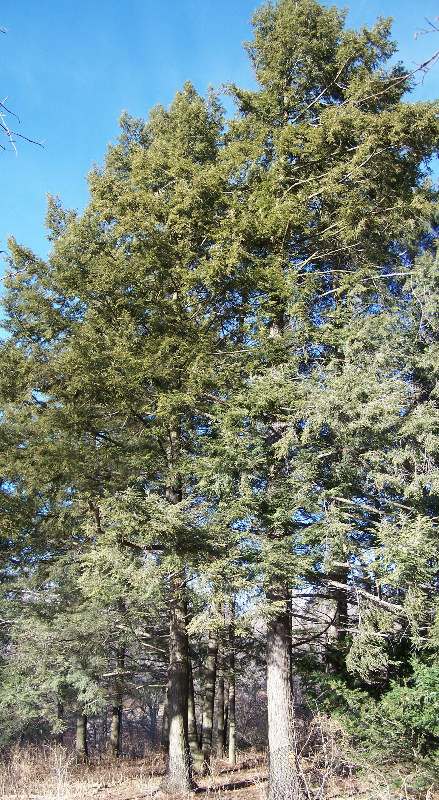 Eastern HemlockTsuga canadensis
-
 Western HemlockTsuga heterophylla
-
 Mountain HemlockTsuga mertensiana
-
 Carolina HemlockTsuga caroliniana
-
 Japanese HemlockTsuga sieboldii
-
 Northern Japanese HemlockTsuga diversifolia
-
 Himalayan HemlockTsuga dumosa
-
 Chinese HemlockTsuga chinensis
Compare
Questions and answers
What is the scientific name of the Ulleungdo Hemlock?
The scientific name of the Ulleungdo Hemlock is Tsuga ulleungensis. Written with its author, the full name is Tsuga ulleungensis G.P.Holman, Del Tredici, Havill, N.S.Lee & C.S.Campb..
Which family does the Ulleungdo Hemlock belong to?
Tsuga ulleungensis belongs to the family Pinaceae, in the order Pinales and the class Pinopsida.
Where is the Ulleungdo Hemlock found?
Checklists and occurrence records place Tsuga ulleungensis in 1 country: South Korea.
Sources
Passages the profile rests on
- The species has wider needles than the two Japanese hemlock species used in its comparison. Source passage: “The Ulleungdo tree also has wider needles and differently shaped cone scales than either Japanese species” — nationalgeographic.com
- Its cone scales have a different shape from those of the compared Japanese hemlock species. Source passage: “differently shaped cone scales than either Japanese species” — nationalgeographic.com
- The species grows in a few patches on the northern slope of Ulleungdo's volcanic cone. Source passage: “The hemlocks grow only in a few patches on the cone’s north slope” — nationalgeographic.com
- Its native habitat includes dense, humid forests containing pine, maple, and beech trees. Source passage: “amid dense, humid forests of pine, maple, and beech trees.” — nationalgeographic.com
- The species is considered probably critically endangered because of its rarity. Source passage: “Because it is so rare, the Ulleungdo hemlock is probably critically endangered” — nationalgeographic.com
- The International Union for Conservation of Nature had not formally evaluated the species at the time of the document. Source passage: “has yet to formally evaluate it.” — nationalgeographic.com
- The forests containing the species on Ulleungdo were declared a natural monument in 1962. Source passage: “the forests where the hemlock grows on Ulleungdo were declared a natural monument in 1962” — nationalgeographic.com
- The protected forests are safeguarded against logging and development. Source passage: “protected from logging or development.” — nationalgeographic.com
- The species' small populations are vulnerable to pests and diseases. Source passage: “small populations are always vulnerable to pests and disease” — nationalgeographic.com
- Inbreeding-related genetic problems are identified as a potential threat to the species. Source passage: “genetic problems due to inbreeding” — nationalgeographic.com
- Climate change and war are identified as potential human-related threats to the species. Source passage: “human threats such as climate change and war.” — nationalgeographic.com
- The species is being considered for a breeding program at the U.S. National Arboretum. Source passage: “He is considering the tree for a breeding program.” — nationalgeographic.com
- The species may be useful as a source of adelgid-resistance genes for efforts to restore hemlock populations. Source passage: “could introduce adelgid-resistance genes to trees that are still mostly native” — nationalgeographic.com
- The species was formerly identified as southern Japanese hemlock (Tsuga sieboldii). Source passage: “The trees were formerly identified as southern Japanese hemlock (Tsuga sieboldii)” — English Wikipedia
- Genetic evidence places the species closest to southern Japanese hemlock based on nuclear DNA. Source passage: “DNA in the nuclei of the tree’s cells—where most genetic material is contained—puts it closest to southern Japanese hemlock.” — nationalgeographic.com
- The species' chloroplast DNA more closely resembles that of another Japanese hemlock species. Source passage: “DNA from the tree’s chloroplasts—tiny organs in plant leaves that produce chlorophyll—more closely resembles that of a different hemlock species, also from Japan.” — nationalgeographic.com
Data
- Catalogue of Life, 2026-10-16 XR cc by
- Global Biodiversity Information Facility CC BY 4.0
- Wikidata CC0
- GeoNames CC BY 4.0
- Within the Catalogue of Life, this name comes from Pinopsida from WFO cc0
References
- Holman, G., Del Tredici, P., Havill, N., Lee, N. S., Cronn, R., Cushman, K., Mathews, S., Raubeson, L., & Campbell, C. S. (2017). A New Species and Introgression in Eastern Asian Hemlocks (Pinaceae: Tsuga). Systematic Botany, 42(4), 733–746. https://doi.org/10.1600/036364417x696474 Link where the name was published
- Conifer TEN record for Tsuga ulleungensis G.P.Holman, Del Tredici, Havill, N.S.Lee & C.S.Campb. Link
This species in other databases
- Catalogue of Life C8NF3
- Wikidata Q47820005
- iNaturalist 1001373
- World Flora Online wfo-1200027418-2026-06
- GRIN 482641
Page built on 27 November 2026. See how the catalog is made and all sources and licences.
Cite this page
ScientificNames.org. (2026). Tsuga ulleungensis (Ulleungdo Hemlock). Retrieved November 27, 2026, from https://scientificnames.org/species/tsuga-ulleungensis
“Tsuga ulleungensis (Ulleungdo Hemlock).” ScientificNames.org, 2026, scientificnames.org/species/tsuga-ulleungensis. Accessed 27 Nov. 2026.
ScientificNames.org. “Tsuga ulleungensis (Ulleungdo Hemlock).” Accessed November 27, 2026. https://scientificnames.org/species/tsuga-ulleungensis.
@misc{scientificnames_tsuga_ulleungensis_ulleungdo_hemlock,
  author = {{ScientificNames.org}},
  title = {Tsuga ulleungensis (Ulleungdo Hemlock)},
  year = {2026},
  url = {https://scientificnames.org/species/tsuga-ulleungensis},
  note = {Accessed 2026-11-27}
}