Species · Mammals
Northern Treeshrew Tupaia belangeri
The scientific name of the Northern Treeshrew is Tupaia belangeri. It is a species of mammal in the family Tupaiidae (treeshrews), order Scandentia. The name dates from 1841.
- Scientific name
- Tupaia belangeri (Wagner, 1841)
- Common name
- Northern Treeshrew
- Genus
- Tupaia
- Family
- Tupaiidae (Treeshrews)
- Order
- Scandentia
- Class
- Mammalia
- Red List category
- LC Least Concern
- Recorded in
- 10 countries
- Name status
- accepted in the Catalogue of Life

Overview
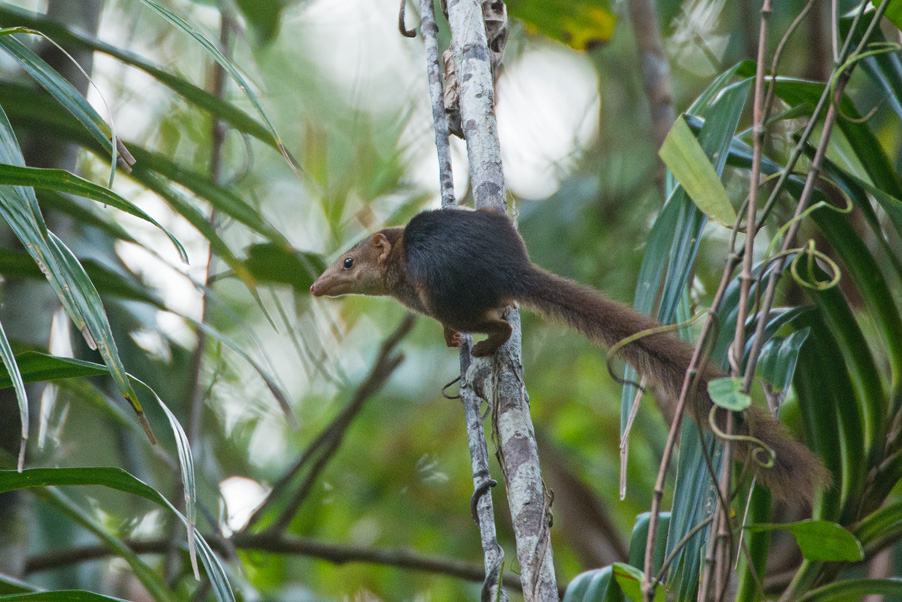
Tupaia belangeri is native to Southeast Asia, where it inhabits tropical and subtropical forests that are generally moist. It has greyish, olive-colored fur, an elongated snout, and males have a ring of white hair around their eyes.
Written 26 November 2026 from the sources listed below. Each statement was checked against the passage it cites; statements that could not be supported were removed.
Appearance
The Northern Treeshrew has greyish, olive-colored fur and an elongated snout. It has been described as resembling squirrels in appearance.[1][2]
Males have a ring of white hair around their eyes, unlike females. Male Northern Treeshrews also have broader skulls than females.[3][4]
Northern Treeshrews weigh approximately 50–270 grams. Their head-and-body length ranges from 12 to 21 centimeters, and their tails measure approximately 14–20 centimeters.[5][6][7]
Habitat
Northern Treeshrews inhabit tropical and subtropical forest environments that are generally moist. They have also been recorded in shrublands, artificial plantations, and rural gardens.[8][9]
In China, Northern Treeshrews have been recorded at elevations of up to 3,000 meters. Their recorded habitat conditions include temperatures around 25 degrees Celsius and humidity of at least 45–50%.[10][11]
Diet
Northern Treeshrews primarily eat insects and supplement their protein-rich diet with fruit. They can willingly consume spicy food because of reduced sensitivity to capsaicin.[12][13]
Behaviour
Adults of the same sex have been documented engaging in territorial fights. Northern Treeshrews mark their territories using scent secreted by a chest gland.[14][15]
Their home ranges are relatively stable and cover approximately 0.81 hectares. They produce eight distinct sounds, with four vocalization categories associated with alarm, attention, contact, and defense.[16][17][18]
Their vocalizations span frequencies from 0.4 to 20 kHz. Northern Treeshrews do not use ultrasonic localization.[19][20]
Their body temperature ranges from approximately 35 degrees Celsius at night to 40 degrees Celsius during the day. This daily variation is synchronized with their locomotor activity.[21][22]
Reproduction and life cycle
Northern Treeshrews have a monogamous mating system. Females have an estrous cycle lasting approximately 8–12 days, and ovulation is thought to be induced by copulation.[23][24][25]
They can breed throughout the year without a documented seasonal peak. Females can produce litters containing one to five young, and gestation lasts approximately 41–45 days.[26][27][28]
Newborn Northern Treeshrews are hairless and altricial, with an average birth mass of approximately 6–10 grams. Their ears open at approximately 10 days after birth, and their eyes open approximately 20 days after birth.[29][30][31][32]
Young Northern Treeshrews are weaned at approximately 35 days of age and reach puberty at approximately two months of age. Males do not participate in parental care after copulation.[33][34][35]
After the initial nursing period, mothers generally return to feed their pups once every 48 hours.[36]
Uses
Northern Treeshrews have been used as medical models for studying hepatitis C virus. They have also been used in research on photoreception and retinal cones.[37][38]
Research using Northern Treeshrews has examined eye structure, development, and vision.[39]
Classification of the Northern Treeshrew
| Kingdom | Animalia |
|---|---|
| Phylum | Chordata |
| Subphylum | Vertebrata |
| Infraphylum | Gnathostomata |
| Parvphylum | Osteichthyes |
| Megaclass | Tetrapoda |
| Class | Mammalia (Mammal) |
| Subclass | Theria |
| Infraclass | Eutheria |
| Order | Scandentia (Treeshrews) |
| Family | Tupaiidae (Treeshrews) |
| Genus | Tupaia (Tree Shrews) |
| Species | Tupaia belangeri (Wagner, 1841) |
Where the Northern Treeshrew is found
Checklists and occurrence records place Tupaia belangeri in 10 countries across Asia. GBIF holds 2,780 georeferenced records of it.
Countries
- Bangladesh 6
- Cambodia 46
- China 220
- India 87
- Laos 59
- Malaysia 21
- Myanmar 144
- Singapore 3
- Thailand 1,556
- Vietnam 638
Regions and cities with the most records
- Bangkok, Thailand 737
- Phra Nakhon, Thailand 737
- Thon Buri, Thailand 737
- Din Daeng, Thailand 729
- Huai Khwang, Thailand 729
- Pathum Wan, Thailand 728
- Phaya Thai, Thailand 728
- Pom Prap Sattru Phai, Thailand 728
- Sam Sen Nai, Thailand 728
- Ratchathewi, Thailand 727
- Samphanthawong, Thailand 727
- Sathon, Thailand 727
- Watthana, Thailand 727
- Bang Khlo, Thailand 726
- Bang Rak, Thailand 726
- Dusit, Thailand 726
- Khlong San, Thailand 725
- Khlong Toei, Thailand 723
- Bang Na, Thailand 722
- Phra Khanong, Thailand 722
- Yan Nawa, Thailand 722
- Chatuchak subdistrict, Thailand 720
- Lat Phrao, Thailand 720
- Bang Kho Laem, Thailand 719
- Chatuchak, Thailand 719
- Wang Thonglang, Thailand 719
- Bang Sue, Thailand 717
- Rat Burana, Thailand 717
- Ban Bang Bamru, Thailand 714
- Bang Kapi, Thailand 713
- Bangkok Noi, Thailand 713
- Bangkok Yai, Thailand 713
- Suan Luang, Thailand 711
- Phra Pradaeng, Thailand 710
- Bang Kruai, Thailand 709
- Bang Phlat, Thailand 709
2 more countries have a few records outside this range
These countries hold a few records of Tupaia belangeri but lie outside the range the checklists give for it. Such records are often zoo or garden specimens, museum material or vagrants, so the species is not counted as occurring there.
Range as the checklists state it
Southern Asia
A number beside a place is its count of GBIF occurrence records. A place without a number comes from a checklist alone. Records show where a species has been observed or collected, which can include escapes and vagrants.
Common names
English
- Northern Treeshrew
- Northern Scandentian
- Northern Tree Shrew
Names in 16 other languages
- Chinese
- 樹鼩
- Czech
- tana severní
- Dutch
- Belangers Toepaja
- Finnish
- kiinantupaija
- French
- Toupaye de Bélanger
- German
- Belangers Spitzhörnchen, Belangers Tupaja, Nördliches Spitzhörnchen
- Greek
- Βόρεια Δενδρομυγαλή
- Italian
- Tupaia settentrionale
- Japanese
- キタツパイ
- Khmer
- កន្ថឹក
- Korean
- 북부나무두더지
- Norwegian Bokmål
- Belangertrespissmus
- Polish
- Tupaja północna
- Russian
- Малайская тупайя
- Spanish
- Tupaya del norte
- Thai
- กระแตเหนือ
Synonyms
27 other scientific names have been used for this species and are now treated as synonyms of Tupaia belangeri.
- Cladobates belangeri Wagner, 1841
- Sciurus dissimilis Ellis, 1860
- Tupaia belangeri assamensis Wroughton, 1921
- Tupaia belangeri brunetta Thomas, 1923
- Tupaia belangeri gaoligongensis Wang, 1987
- Tupaia belangeri gongshanensis Wang, 1987
- Tupaia belangeri laotum Thomas, 1914
- Tupaia belangeri lepcha Thomas, 1922
- Tupaia belangeri pingi Ho, 1936
- Tupaia belangeri siccata Thomas, 1914
- Tupaia belangeri tonquinia Thomas, 1925
- Tupaia belangeri versurae Thomas, 1922
- Tupaia belangeri yaoshanensis Wang, 1987
- Tupaia belangeri yunalis Thomas, 1914
- Tupaia clarissa Thomas, 1917
- Tupaia concolor Bonhote, 1907
- Tupaia concolor sinus Kloss, 1916
- Tupaia dissimilis annamensis Robinson & Kloss, 1922
- Tupaia ferruginea operosa Robinson & Kloss, 1914
- Tupaia glis belangeri (Wagner, 1841) Ellerman & Morrison-Scott, 1951
- Tupaia glis cambodiana Kloss, 1919
- Tupaia glis cochinchinensis Robinson & Kloss, 1922
- Tupaia glis cognata Chasen, 1940
- Tupaia glis olivacea Kloss, 1919
- Tupaia lacernata kohtauensis Shamel, 1930
- Tupaia modesta Allen, 1906
- Tupaia peguanus Lesson, 1842
Subspecies and varieties
- Tupaia belangeri belangeri subspecies
- Tupaia belangeri chinensis subspecies
Related species
-
 Common TreeshrewTupaia glis
-
 Large TreeshrewTupaia tana
-
 Horsfield's TreeshrewTupaia javanica
-
 Mountain TreeshrewTupaia montana
-
 Nicobar TreeshrewTupaia nicobarica
-
 Pygmy TreeshrewTupaia minor
- Slender TreeshrewTupaia gracilis
-
 Painted TreeshrewTupaia picta
Compare
Questions and answers
What is the scientific name of the Northern Treeshrew?
The scientific name of the Northern Treeshrew is Tupaia belangeri. Written with its author, the full name is Tupaia belangeri (Wagner, 1841).
Which family does the Northern Treeshrew belong to?
Tupaia belangeri belongs to the family Tupaiidae, in the order Scandentia and the class Mammalia.
Where is the Northern Treeshrew found?
Checklists and occurrence records place Tupaia belangeri in 10 countries, including Thailand, Vietnam, China, Myanmar, India and Laos.
What is the conservation status of the Northern Treeshrew?
The IUCN Red List category recorded for Tupaia belangeri is Least Concern (LC).
What other names does the Northern Treeshrew have?
Tupaia belangeri is also known in English as Northern Scandentian and Northern Tree Shrew.
Sources
Passages the profile rests on
- Northern tree shrews have greyish, olive-colored fur and an elongated snout. Source passage: “Northern tree shrews have greyish, olive fur with an elongated snout” — animaldiversity.org
- Northern tree shrews have been described as resembling squirrels in appearance. Source passage: “Tree shrews look remarkably similar to squirrels.” — nationalzoo.si.edu
- Males have a ring of white hair around their eyes, unlike females. Source passage: “Male tree shrews have a larger body size and ring of white hair around the eye compared to females.” — animaldiversity.org
- Male northern tree shrews have broader skulls than females. Source passage: “Males also have a broader skull than the females (Collins and Tsang, 1987).” — animaldiversity.org
- Northern tree shrews weigh approximately 50–270 grams. Source passage: “Northern tree shrews have a mass of approximately 50 to 270 grams” — animaldiversity.org
- Their head-and-body length ranges from 12 to 21 centimeters. Source passage: “Head to Body Length of 12 to 21 cm” — animaldiversity.org
- Their tails measure approximately 14–20 centimeters. Source passage: “a tail length ranging from 14 to 20 cm” — animaldiversity.org
- Northern tree shrews inhabit tropical and subtropical forest environments that are generally moist. Source passage: “They live in tropical and subtropical areas, which are usually moist environments” — animaldiversity.org
- They have also been recorded in shrublands, artificial plantations, and rural gardens. Source passage: “They have also been recorded in shrub lands and artificial plantations and rural gardens.” — animaldiversity.org
- Northern tree shrews have been recorded at elevations of up to 3,000 meters in China. Source passage: “3000 meters as the highest known elevation for tree shrew, recorded in China.” — animaldiversity.org
- Their recorded habitat conditions include temperatures around 25 degrees Celsius and humidity of at least 45–50%. Source passage: “Tree shrews inhabit areas about 25 degrees Celsius, with at least 45 to 50% humidity” — animaldiversity.org
- Northern tree shrews primarily eat insects and supplement their protein-rich diet with fruit. Source passage: “Northern tree shrews are predominantly insectivorous, but eat fruits to obtain extra nutrients and calories to their high protein diet” — animaldiversity.org
- Northern tree shrews can willingly consume spicy food because of reduced sensitivity to capsaicin. Source passage: “This is due to a genetic mutation rendering it much less sensitive to the effects of capsaicin.” — English Wikipedia
- Adults of the same sex have been documented engaging in territorial fights. Source passage: “Territorial fights are documented between adults of the same sex” — animaldiversity.org
- Northern tree shrews mark their territories using scent secreted by a chest gland. Source passage: “Tree shrews use scent marking, excreted from a gland on their chest, to mark their territories” — animaldiversity.org
- Their home ranges are relatively stable and cover approximately 0.81 hectares. Source passage: “Northern tree shrews have relatively stable home ranges of about 2 acres or 0.81 hectares” — animaldiversity.org
- Northern tree shrews produce eight distinct sounds. Source passage: “Northern tree shrews make 8 distinct sounds” — animaldiversity.org
- Four categories of their vocalizations are associated with alarm, attention, contact, and defense. Source passage: “Of these 4 can be associated with functional categories that are described by Binz and Zimmermann (1989): alarm, attention, contact, and defense.” — animaldiversity.org
- Their vocalizations span frequencies from 0.4 to 20 kHz. Source passage: “Tree shrew noises can range from 0.4 to 20 kHz.” — animaldiversity.org
- Northern tree shrews do not use ultrasonic localization. Source passage: “Kirchhof et al. (2001) also note that tree shrews do not use ultrasonic localisations.” — animaldiversity.org
- Their body temperature ranges from approximately 35 degrees Celsius at night to 40 degrees Celsius during the day. Source passage: “their body temperature varies from 35 °C (95 °F) during the night to 40 °C (104 °F) during the day.” — English Wikipedia
- The daily variation in their body temperature is synchronized with their locomotor activity. Source passage: “the circadian rhythms of body temperature and locomotor activity are synchronized.” — English Wikipedia
- Northern tree shrews have a monogamous mating system. Source passage: “Northern tree shrews have a monogamous mating system” — animaldiversity.org
- Females have an estrous cycle lasting approximately 8–12 days. Source passage: “Females have an 8 to 12 day estrous cycle.” — animaldiversity.org
- Ovulation is thought to be induced by copulation. Source passage: “Ovulation is thought to be induced by copulation” — animaldiversity.org
- Northern tree shrews can breed throughout the year without a documented seasonal peak. Source passage: “breeding can occur at any time of the year; no peak periods were found.” — animaldiversity.org
- Females can produce litters containing one to five young. Source passage: “Northern tree shrews have a litter size of 1 to 5 young.” — animaldiversity.org
- The gestation period lasts approximately 41–45 days. Source passage: “The gestation period occurs for approximately 41 to 45 days” — animaldiversity.org
- Newborn northern tree shrews are hairless and altricial. Source passage: “females give birth to hairless, altricial young.” — animaldiversity.org
- Newborn pups have an average birth mass of approximately 6–10 grams. Source passage: “on average young will have a birth mass of 6 to 10 grams” — animaldiversity.org
- Pups open their ears at approximately 10 days after birth. Source passage: “Pups ears open at around 10 days” — animaldiversity.org
- Pups open their eyes approximately 20 days after birth. Source passage: “their eyes open at approximately 20 days after birth.” — animaldiversity.org
- Young northern tree shrews are weaned at approximately 35 days of age. Source passage: “Young will drink their mothers milk until they are around 35 days old when they wean off the liquid diet.” — animaldiversity.org
- Northern tree shrews reach puberty at approximately two months of age. Source passage: “Northern tree shrews reach puberty at about 2 months old” — animaldiversity.org
- Males do not participate in parental care after copulation. Source passage: “Males are not involved in parental care after copulation” — animaldiversity.org
- Mothers generally return to feed their pups once every 48 hours after the initial nursing period. Source passage: “thereafter only return to feed her young once every 48 hours” — animaldiversity.org
- Northern tree shrews have been used as medical models for studying hepatitis C virus. Source passage: “its primary hepatocytes could be used as a model for studying the hepatitis C virus” — English Wikipedia
- Northern tree shrews have been used in research on photoreception and retinal cones. Source passage: “It was also used in studies on the development of photo reception, investigation of retinal cones” — English Wikipedia
- Northern tree shrews have been used in research examining eye structure, development, and vision. Source passage: “Many studies have been conducted regarding eye structure, development, and vision using the northern treeshrew model” — English Wikipedia
Data
- Catalogue of Life, 2026-10-16 XR cc by
- Global Biodiversity Information Facility CC BY 4.0
- Wikidata CC0
- GeoNames CC BY 4.0
- Wikimedia Commons per image; credit shown with each image
- Within the Catalogue of Life, this name comes from The Integrated Taxonomic Information System cc0
References
- Schreber s Die Säugethiere, Suppl. vol.2 p.42 where the name was published
- Wilson, Don E., and DeeAnn M. Reeder, eds. (1993). Mammal Species of the World: A Taxonomic and Geographic Reference, 2nd Ed., 3rd Printing.
- Wilson, Don E., and F. Russell Cole. (2000). Common Names of Mammals of the World.
- Wilson, Don E., and DeeAnn M. Reeder, eds. (2005). Mammal Species of the World: A Taxonomic and Geographic Reference, 3rd Ed., Vols. 1 & 2.
- Hawkins, M. T. R. / Don E. Wilson and Russell A. Mittermeier, eds. (2018). Family Tupaiidae (Treeshrews). Handbook of the Mammals of the World. Vol. 8: Insectivores, Sloths and Colugos.
This species in other databases
Page built on 29 November 2026. See how the catalog is made and all sources and licences.
Cite this page
ScientificNames.org. (2026). Tupaia belangeri (Northern Treeshrew). Retrieved November 29, 2026, from https://scientificnames.org/species/tupaia-belangeri
“Tupaia belangeri (Northern Treeshrew).” ScientificNames.org, 2026, scientificnames.org/species/tupaia-belangeri. Accessed 29 Nov. 2026.
ScientificNames.org. “Tupaia belangeri (Northern Treeshrew).” Accessed November 29, 2026. https://scientificnames.org/species/tupaia-belangeri.
@misc{scientificnames_tupaia_belangeri_northern_treeshrew,
  author = {{ScientificNames.org}},
  title = {Tupaia belangeri (Northern Treeshrew)},
  year = {2026},
  url = {https://scientificnames.org/species/tupaia-belangeri},
  note = {Accessed 2026-11-29}
}