Species · Mammals
Pygmy Treeshrew Tupaia minor
The scientific name of the Pygmy Treeshrew is Tupaia minor. It is a species of mammal in the family Tupaiidae (treeshrews), order Scandentia. The name dates from 1876.
- Scientific name
- Tupaia minor Günther, 1876
- Common name
- Pygmy Treeshrew
- Genus
- Tupaia
- Family
- Tupaiidae (Treeshrews)
- Order
- Scandentia
- Class
- Mammalia
- Red List category
- LC Least Concern
- Recorded in
- 3 countries
- Name status
- accepted in the Catalogue of Life

Overview
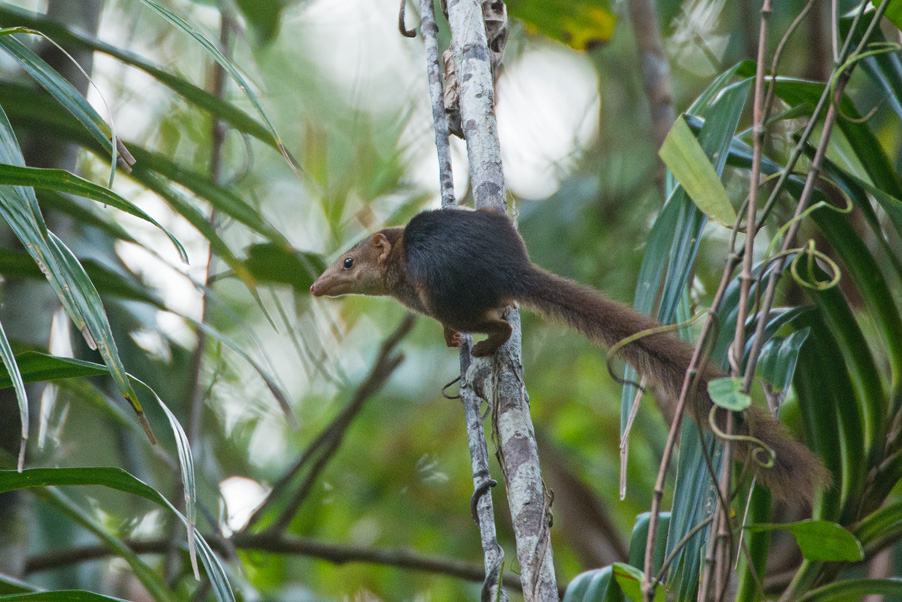
Tupaia minor occurs in peninsular Thailand and peninsular Malaysia, Sumatra, the Lingga Archipelago, Borneo, and the offshore islands of Laut, Banggi, and Balambangan. It has olive-brown, speckled upper body fur, a long thin tail, and a maximum total length of approximately 450 mm.
Written 26 November 2026 from the sources listed below. Each statement was checked against the passage it cites; statements that could not be supported were removed.
Appearance
The upper body fur has alternating light and dark bands that create a speckled olive-brown appearance. The upper body is buff-colored and often develops a reddish tinge toward the rear.[1][2]
The tail is long and thin, with a darker upper surface than the body. The limbs are approximately equal in length and have long claws.[3][4]
The maximum total body length, including the tail, is approximately 450 mm. The tail accounts for approximately half of the maximum total length.[5][6]
Habitat
Individuals are often observed 3 to 8 metres above the ground and occasionally as high as 20 metres. The species nests in tree roots and fallen timber.[7][8]
Behaviour
The species is diurnal and active during daylight hours. It travels along lianas and branches of small trees, although individuals spend most of their time on the ground and in low bushes.[9][10][11]
It moves using a semiplantigrade posture that keeps its centre of gravity close to the tree. Its hands and feet have sharp, moderately curved claws that are useful for climbing.[12][13]
Reproduction and life cycle
Females give birth to litters containing one to three young. The gestation period lasts between 45 and 55 days.[14][15]
Classification of the Pygmy Treeshrew
| Kingdom | Animalia |
|---|---|
| Phylum | Chordata |
| Subphylum | Vertebrata |
| Infraphylum | Gnathostomata |
| Parvphylum | Osteichthyes |
| Megaclass | Tetrapoda |
| Class | Mammalia (Mammal) |
| Subclass | Theria |
| Infraclass | Eutheria |
| Order | Scandentia (Treeshrews) |
| Family | Tupaiidae (Treeshrews) |
| Genus | Tupaia (Tree Shrews) |
| Species | Tupaia minor Günther, 1876 |
Where the Pygmy Treeshrew is found
Checklists and occurrence records place Tupaia minor in 3 countries across Asia. GBIF holds 477 georeferenced records of it.
Countries
Regions and cities with the most records
- Sabah, Malaysia 144
- Selangor, Malaysia 48
- Sarawak, Malaysia 47
- Ranau, Malaysia 46
- Shah Alam, Malaysia 44
- Bandar Sri Damansara, Malaysia 40
- Bandar Utama, Malaysia 40
- Bangsar, Malaysia 40
- Bukit Kerinchi, Malaysia 40
- Damansara Damai, Malaysia 40
- Desa Parkcity, Malaysia 40
- Kepong, Malaysia 40
- Mont Kiara, Malaysia 40
- Petaling Jaya, Malaysia 40
- SS2, Malaysia 40
- Taman Petaling, Malaysia 40
- Taman Sri Sinar, Malaysia 40
- Taman Tun Dr Ismail, Malaysia 40
- Tropicana Indah, Malaysia 40
- Ara Damansara, Malaysia 39
- Bukit Rahman Putra, Malaysia 39
- Elmina, Malaysia 39
- Kampung Baru Subang, Malaysia 39
- Kota Damansara, Malaysia 39
- Kuang, Malaysia 39
- Sungai Buloh, Malaysia 39
- Ladang Seri Kundang, Malaysia 38
- Batu Caves, Malaysia 37
- Denai Alam, Malaysia 37
- Kampung Setia, Malaysia 37
- Kuala Lumpur, Malaysia 37
- Rawang, Malaysia 37
- Selayang Baru Utara, Malaysia 37
- Sentul, Malaysia 37
- Seputeh, Malaysia 37
- Taman Greenwood, Malaysia 37
Range as the checklists state it
Southern Asia
A number beside a place is its count of GBIF occurrence records. A place without a number comes from a checklist alone. Records show where a species has been observed or collected, which can include escapes and vagrants.
Common names
English
- Pygmy Treeshrew
- Lesser Treeshrew
- Pygmy Tree Shrew
Names in 14 other languages
- Czech
- tana malá
- Dutch
- Kleine Toepaja
- Finnish
- pikkutupaija
- French
- Toupaye nain, Tupaja nain, Tupaïa nain
- German
- Zwergspitzhörnchen
- Indonesian
- Tupai Kecil
- Italian
- Tupaia pigmea
- Japanese
- ピグミーツパイ
- Malay
- Tupai Muncung Akar / Tupai Muncung Kecil
- Norwegian Bokmål
- Dvergtrespissmus, Pygmétrespissmus
- Polish
- Tupaja mała
- Russian
- Малая тупайя
- Spanish
- Tupaya pigmea de Lesser
- Thai
- กระแตเล็ก
Synonyms
2 other scientific names have been used for this species and are now treated as synonyms of Tupaia minor.
- Tupaia minor caedis Chasen & Kloss, 1932
- Tupaia sincepis Lyon, 1911
Subspecies and varieties
- Tupaia minor humeralis subspecies
- Tupaia minor malaccana subspecies
- Tupaia minor minor subspecies
- Tupaia minor sincipis subspecies
Related species
-
 Northern TreeshrewTupaia belangeri
-
 Common TreeshrewTupaia glis
-
 Large TreeshrewTupaia tana
-
 Horsfield's TreeshrewTupaia javanica
-
 Mountain TreeshrewTupaia montana
-
 Nicobar TreeshrewTupaia nicobarica
- Slender TreeshrewTupaia gracilis
-
 Painted TreeshrewTupaia picta
Compare
Questions and answers
What is the scientific name of the Pygmy Treeshrew?
The scientific name of the Pygmy Treeshrew is Tupaia minor. Written with its author, the full name is Tupaia minor Günther, 1876.
Which family does the Pygmy Treeshrew belong to?
Tupaia minor belongs to the family Tupaiidae, in the order Scandentia and the class Mammalia.
Where is the Pygmy Treeshrew found?
Checklists and occurrence records place Tupaia minor in 3 countries: Malaysia, Indonesia and India.
What is the conservation status of the Pygmy Treeshrew?
The IUCN Red List category recorded for Tupaia minor is Least Concern (LC).
What other names does the Pygmy Treeshrew have?
Tupaia minor is also known in English as Lesser Treeshrew and Pygmy Tree Shrew.
How long does a pygmy shrew live?
The maximum lifespan of the Pygmy Treeshrew is approximately 9 to 10 years.[16]
What do tree shrews eat?
The Pygmy Treeshrew eats a wide variety of invertebrates, including insects and worms, as well as fruit.[17]
Sources
Passages the profile rests on
- The upper body fur has alternating light and dark bands that create a speckled olive-brown appearance. Source passage: “The pygmy treeshrew's upper body hair is banded light and dark, giving a speckled olive-brown appearance.” — English Wikipedia
- Its upper body is buff-colored and often develops a reddish tinge toward the rear. Source passage: “The upper parts are buffy and often have a reddish tinge towards the rear.” — English Wikipedia
- Its tail is long and thin, with a darker upper surface than the body. Source passage: “The tail is long and thin, and its upper side is darker than the body.” — English Wikipedia
- Its limbs are approximately equal in length and have long claws. Source passage: “The limbs are equal in length and have long claws.” — English Wikipedia
- Its maximum total body length, including the tail, is approximately 450 mm. Source passage: “The maximum total length is about 450 mm, half of which is the tail.” — English Wikipedia
- The tail accounts for approximately half of the maximum total length. Source passage: “The maximum total length is about 450 mm, half of which is the tail.” — English Wikipedia
- Individuals are often observed 3 to 8 metres above the ground and occasionally as high as 20 metres. Source passage: “It is often seen 3 to 8 m above the ground, sometimes up to 20 m, travelling along lianas or branches of small trees.” — English Wikipedia
- The species nests in tree roots and fallen timber. Source passage: “nesting in tree roots and fallen timber.” — English Wikipedia
- The species is diurnal and active during daylight hours. Source passage: “Tupaia minor is diurnal (active in the daytime).” — English Wikipedia
- The species travels along lianas and branches of small trees. Source passage: “travelling along lianas or branches of small trees.” — English Wikipedia
- Despite being observed in trees, individuals spend most of their time on the ground and in low bushes. Source passage: “They spend most of their time on the ground and in low bushes” — English Wikipedia
- The species moves using a semiplantigrade posture that keeps its centre of gravity close to the tree. Source passage: “T. minor moves in a semiplantigrade posture which allows it to keep its centre of gravity close to the tree.” — English Wikipedia
- Its hands and feet have sharp, moderately curved claws that are useful for climbing. Source passage: “The claws on its hands and feet are quite sharp and moderately curved, which is useful for climbing.” — English Wikipedia
- Females give birth to litters containing one to three young. Source passage: “Litters of one to three young are born” — English Wikipedia
- The gestation period lasts between 45 and 55 days. Source passage: “after a gestation period of 45 to 55 days.” — English Wikipedia
- The maximum lifespan of the species is approximately 9 to 10 years. Source passage: “Their maximum lifespan is around 9 to 10 years.” — English Wikipedia
- Its omnivorous diet includes a wide variety of invertebrates, including insects and worms, as well as fruit. Source passage: “Its diet is comprised of a wide variety of invertebrates (including insects and worms) and fruit.” — animaldiversity.org
Data
- Catalogue of Life, 2026-10-16 XR cc by
- Global Biodiversity Information Facility CC BY 4.0
- Wikidata CC0
- GeoNames CC BY 4.0
- Wikimedia Commons per image; credit shown with each image
- Within the Catalogue of Life, this name comes from The Integrated Taxonomic Information System cc0
References
- Proc. Zool. Soc. Lond. vol.1876 p.426 where the name was published
- Wilson, Don E., and DeeAnn M. Reeder, eds. (1993). Mammal Species of the World: A Taxonomic and Geographic Reference, 2nd Ed., 3rd Printing.
- Wilson, Don E., and F. Russell Cole. (2000). Common Names of Mammals of the World.
- Wilson, Don E., and DeeAnn M. Reeder, eds. (2005). Mammal Species of the World: A Taxonomic and Geographic Reference, 3rd Ed., Vols. 1 & 2.
- Hawkins, M. T. R. / Don E. Wilson and Russell A. Mittermeier, eds. (2018). Family Tupaiidae (Treeshrews). Handbook of the Mammals of the World. Vol. 8: Insectivores, Sloths and Colugos.
This species in other databases
Page built on 28 November 2026. See how the catalog is made and all sources and licences.
Cite this page
ScientificNames.org. (2026). Tupaia minor (Pygmy Treeshrew). Retrieved November 28, 2026, from https://scientificnames.org/species/tupaia-minor
“Tupaia minor (Pygmy Treeshrew).” ScientificNames.org, 2026, scientificnames.org/species/tupaia-minor. Accessed 28 Nov. 2026.
ScientificNames.org. “Tupaia minor (Pygmy Treeshrew).” Accessed November 28, 2026. https://scientificnames.org/species/tupaia-minor.
@misc{scientificnames_tupaia_minor_pygmy_treeshrew,
  author = {{ScientificNames.org}},
  title = {Tupaia minor (Pygmy Treeshrew)},
  year = {2026},
  url = {https://scientificnames.org/species/tupaia-minor},
  note = {Accessed 2026-11-28}
}