Species · Mammals
Common Treeshrew Tupaia glis
The scientific name of the Common Treeshrew is Tupaia glis. It is a species of mammal in the family Tupaiidae (treeshrews), order Scandentia. The name dates from 1820.
- Scientific name
- Tupaia glis (Diard, 1820)
- Common name
- Common Treeshrew
- Genus
- Tupaia
- Family
- Tupaiidae (Treeshrews)
- Order
- Scandentia
- Class
- Mammalia
- Red List category
- LC Least Concern
- Recorded in
- 12 countries
- Name status
- accepted in the Catalogue of Life

Overview
Tupaia glis is native to Thailand, Malaysia, Singapore, and Indonesia. It has a long, bushy tail, bare paws with sharp nails, and a whitish belly.
Written 26 November 2026 from the sources listed below. Each statement was checked against the passage it cites; statements that could not be supported were removed.
Appearance
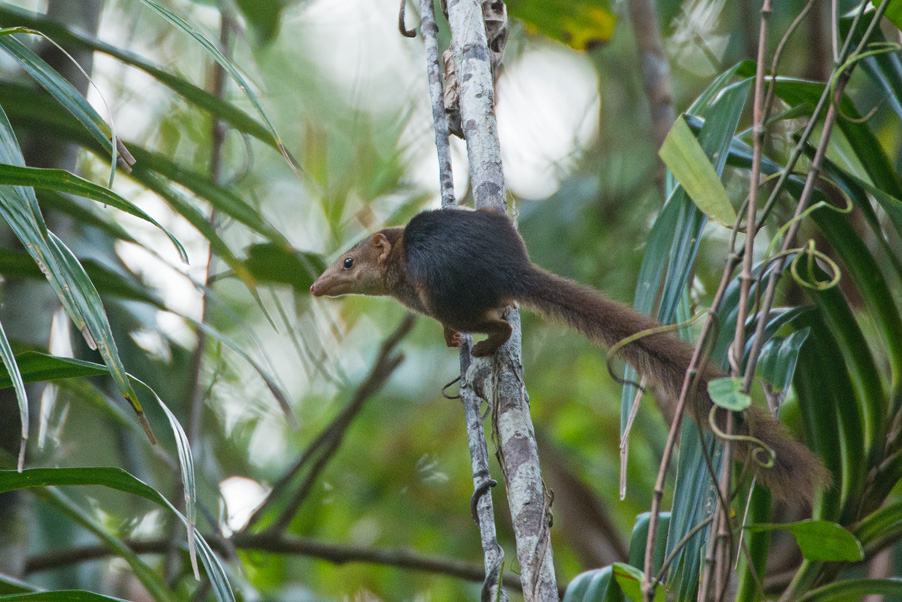
The Common Treeshrew has reddish-brown, greyish, or black upperparts and a whitish belly. Its long, bushy, dark greyish-brown tail nearly matches its body length, and it usually has a pale white stripe on each shoulder.[1][2][3]
Its dorsal fur is dense and dark brown, while its ventral fur is orange-rufous. It has small ears, moderately sized laterally positioned eyes, and a naked patch of skin above its long nose.[4][5][6]
Its paws are bare, and all digits have long, sharp claws used for climbing.[7][8]
The head and body measure 13–21 cm, while the tail measures 12–20 cm. Reported average body weights are 190 g and 142 g, and the average head and body length is 19.5 cm with an average tail length of 16.5 cm.[9][10][11][12]
Habitat
The Common Treeshrew primarily inhabits primary dipterocarp forests and deciduous tropical forests.[13][14]
It also occurs in secondary forests, plantations, fruit orchards, fruit plantations, local gardens, and trees near residential areas.[15][16]
Diet
The Common Treeshrew feeds on fruits, seeds, leaves, ants, and spiders. It also catches lizards.[17][18]
Behaviour
The Common Treeshrew is diurnal and active during the daytime. It is semi-terrestrial and spends much of its time foraging in the understory.[19][20][21]
Individuals forage alone or in pairs, mainly on the ground, among shrubs, and in tree holes. They are agile when climbing vertical tree trunks and bushes, and occasionally jump between young tree stems across distances of up to 60 cm.[22][23][24]
Individuals scent-mark territories by rubbing their chests and anogenital regions against surfaces. Individuals of the same sex engage in aggressive territorial chases.[25][26]
Adult males have larger average home ranges than adult females. Juvenile males leave their family territories earlier than juvenile females.[27][28]
Reproduction and life cycle
Both sexes reach sexual maturity at approximately three months of age. The estrous cycle lasts between 8 and 39 days, and gestation lasts between 40 and 52 days.[29][30][31]
Females give birth to litters of one to three offspring. Newborn offspring weigh approximately 10–12 g, and juveniles leave the nest between 25 and 35 days after birth.[32][33][34]
Females visit their offspring every 48 hours to nurse them for 10–15 minutes. The species has two pairs of teats and exhibits delayed implantation of the blastocyst.[35][36][37]
The male builds nests for the young in holes, trees, under roots, or hollow bamboo.[38]
Conservation
The Common Treeshrew is classified as Least Concern by the IUCN.[39]
Uses
The Common Treeshrew is used as an animal model in research on human diseases, including studies of hepatitis.[40][41]
Similar species
Tupaia splendidula and Tupaia montana are identified as similar species.[42]
Classification of the Common Treeshrew
| Kingdom | Animalia |
|---|---|
| Phylum | Chordata |
| Subphylum | Vertebrata |
| Infraphylum | Gnathostomata |
| Parvphylum | Osteichthyes |
| Megaclass | Tetrapoda |
| Class | Mammalia (Mammal) |
| Subclass | Theria |
| Infraclass | Eutheria |
| Order | Scandentia (Treeshrews) |
| Family | Tupaiidae (Treeshrews) |
| Genus | Tupaia (Tree Shrews) |
| Species | Tupaia glis (Diard, 1820) |
Where the Common Treeshrew is found
Checklists and occurrence records place Tupaia glis in 12 countries across Asia. GBIF holds 1,949 georeferenced records of it.
Countries
- Bangladesh 5
- Cambodia 11
- China 82
- Indonesia 259
- Iran 13
- Laos 47
- Malaysia 642
- Myanmar 34
- Philippines 7
- Singapore 344
- Thailand 481
- Vietnam 24
Regions and cities with the most records
- Choa Chu Kang New Town, Singapore 338
- Keat Hong Village, Singapore 338
- Marsiling, Singapore 338
- Novena, Singapore 338
- Teck Whye, Singapore 338
- Yew Tee, Singapore 338
- Anak Bukit, Singapore 337
- Ang Mo Kio New Town, Singapore 337
- Bukit Panjang New Town, Singapore 337
- Bukit Timah, Singapore 337
- Queenstown Estate, Singapore 337
- Sungai Simpang, Singapore 337
- Woodlands, Singapore 337
- Yio Chu Kang, Singapore 337
- Yishun New Town, Singapore 337
- Jurong East, Singapore 336
- Jurong Town, Singapore 336
- Jurong West, Singapore 336
- Sembawang Estate, Singapore 336
- Sengkang New Town, Singapore 336
- Boon Lay, Singapore 335
- Johor Bahru, Malaysia 332
- Kampung Pasir Gudang Baru, Malaysia 324
- Matilda Estate, Singapore 321
- Punggol, Singapore 318
- Singapore, Singapore 310
- MacPherson, Singapore 309
- Eunos, Singapore 308
- Marine Parade, Singapore 307
- Pasir Gudang, Malaysia 304
- Ulu Bedok, Singapore 304
- Kampong Pasir Ris, Singapore 303
- Bedok New Town, Singapore 299
- Bangsar, Malaysia 215
- Bukit Kerinchi, Malaysia 212
- Mont Kiara, Malaysia 209
3 more countries have a few records outside this range
These countries hold a few records of Tupaia glis but lie outside the range the checklists give for it. Such records are often zoo or garden specimens, museum material or vagrants, so the species is not counted as occurring there.
Range as the checklists state it
Southern Asia
A number beside a place is its count of GBIF occurrence records. A place without a number comes from a checklist alone. Records show where a species has been observed or collected, which can include escapes and vagrants.
Common names
English
- Common Treeshrew
- Common Scandentian
- Common Tree Shrew
Names in 17 other languages
- Bengali
- পাতি গেছো ছুঁচো
- Chinese
- 普通樹鼩
- Czech
- tana obecná
- Dutch
- Gewone Toepaja
- Finnish
- tupaija
- French
- Toupaye commun, Tupaja commun, Tupaïa commun
- German
- Gewöhnliche Spitzhörnchen
- Greek
- Κοινή Δενδρομυγαλή
- Indonesian
- Tupai Akar
- Italian
- Tupaia comune
- Japanese
- コモンツパイ
- Malay
- Tupai Muncung Besar
- Norwegian Bokmål
- Vanlig Trespissmus
- Polish
- Tupaja pospolita
- Russian
- Обыкновенная тупайя
- Spanish
- Tupaya común
- Thai
- กระแตใต้
Synonyms
One other scientific name has been used for this species and is now treated as a synonym of Tupaia glis.
- Sorex glis Diard, 1820
Related species
-
 Northern TreeshrewTupaia belangeri
-
 Large TreeshrewTupaia tana
-
 Horsfield's TreeshrewTupaia javanica
-
 Mountain TreeshrewTupaia montana
-
 Nicobar TreeshrewTupaia nicobarica
-
 Pygmy TreeshrewTupaia minor
- Slender TreeshrewTupaia gracilis
-
 Painted TreeshrewTupaia picta
Compare
Questions and answers
What is the scientific name of the Common Treeshrew?
The scientific name of the Common Treeshrew is Tupaia glis. Written with its author, the full name is Tupaia glis (Diard, 1820).
Which family does the Common Treeshrew belong to?
Tupaia glis belongs to the family Tupaiidae, in the order Scandentia and the class Mammalia.
Where is the Common Treeshrew found?
Checklists and occurrence records place Tupaia glis in 12 countries, including Malaysia, Thailand, Singapore, Indonesia, China and Laos.
What is the conservation status of the Common Treeshrew?
The IUCN Red List category recorded for Tupaia glis is Least Concern (LC).
What other names does the Common Treeshrew have?
Tupaia glis is also known in English as Common Scandentian and Common Tree Shrew.
What do tree shrews eat?
The Common Treeshrew feeds on fruits, seeds, leaves, ants, and spiders. It also catches lizards.[17][18]
Where does a tree shrew live?
The Common Treeshrew is native to Thailand, Malaysia, Singapore, and Indonesia. It primarily inhabits primary dipterocarp forests and deciduous tropical forests, and also occurs in secondary forests, plantations, orchards, gardens, and trees near residential areas.[13][15][14][16][43]
Sources
Passages the profile rests on
- The common tree shrew has reddish-brown, greyish, or black upperparts and a whitish belly. Source passage: “varying colours of reddish-brown, greyish or black upper parts and whitish belly.” — English Wikipedia
- The species has a long, bushy, dark greyish-brown tail that nearly matches its body length. Source passage: “Its long, bushy tail is dark greyish-brown and almost reaches the length of the body.” — English Wikipedia
- The common tree shrew usually has a pale white stripe on each shoulder. Source passage: “The common treeshrew usually has a white, pale stripe on each shoulder.” — English Wikipedia
- The species has a naked patch of skin above its long nose. Source passage: “with a naked patch of skin above its long nose.” — English Wikipedia
- Its dorsal fur is dense and dark brown, while its ventral fur is orange-rufous. Source passage: “Its pelage is dense and dark brown on the dorsal region of the body and orange-rufous ventrally.” — animaldiversity.org
- The species has small ears and moderately sized, laterally positioned eyes. Source passage: “Tupaia glis has small ears and moderately sized eyes compared to most small mammals such as rodents and shrews; the eyes are positioned laterally.” — animaldiversity.org
- Its paws are bare and equipped with sharp nails. Source passage: “The paws are bare with sharp nails” — English Wikipedia
- All digits have long, sharp claws used for climbing. Source passage: “All digits have long, sharp claws, which are used for climbing.” — animaldiversity.org
- The head and body measure 13–21 cm, while the tail measures 12–20 cm. Source passage: “The animal has a head and body length of 13–21 cm and a tail length of 12–20 cm.” — English Wikipedia
- The average body weight is approximately 190 g. Source passage: “average weight is around 190 g” — English Wikipedia
- The average body weight is 142 g. Source passage: “Tupaia glis has an average body weight of 142 grams” — animaldiversity.org
- The average head and body length is 19.5 cm, and the average tail length is 16.5 cm. Source passage: “a head and body length of 19.5 cm and tail length of 16.5 cm.” — animaldiversity.org
- The species primarily inhabits primary dipterocarp forests. Source passage: “Usually they are found in primary dipterocarp forest” — English Wikipedia
- The species' primary habitat includes deciduous tropical forests. Source passage: “The primary habitat of T. glis is deciduous tropical forests.” — animaldiversity.org
- The species also occurs in secondary forests, plantations, fruit orchards, and trees near residential areas. Source passage: “They have also been recorded from secondary forest, plantations, fruit orchards, and trees near housing areas.” — English Wikipedia
- The species has also been observed in fruit plantations and local gardens. Source passage: “Common tree shrews have also been reportedly seen in fruit plantations and local gardens.” — animaldiversity.org
- The common tree shrew feeds on fruits, seeds, leaves, ants, and spiders. Source passage: “They feed on fruits, seeds, leaves, and insects, especially ants and spiders.” — English Wikipedia
- The species also catches lizards. Source passage: “They are also reported to catch lizards.” — English Wikipedia
- Common tree shrews are active during the daytime. Source passage: “Common treeshrews are active during the day” — English Wikipedia
- The species is semi-terrestrial and spends much of its time foraging in the understory. Source passage: “However, most of the time it is found in the understory rustling through leaves, frequently foraging.” — animaldiversity.org
- Common tree shrews are diurnal. Source passage: “Both T. glis and squirrels are unusual for small mammals in that they are diurnal.” — animaldiversity.org
- Individuals forage alone or in pairs, mainly on the ground, among shrubs, and in tree holes. Source passage: “forage for food alone or in pairs, mainly on the ground, among shrubs and tree holes.” — English Wikipedia
- The species is agile when climbing vertical tree trunks and bushes. Source passage: “They are very agile in climbing both large vertical tree trunks and bushes” — English Wikipedia
- Individuals occasionally jump between young tree stems across distances of up to 60 cm. Source passage: “occasionally jump from stems of a young tree to that of another as much as 60 cm (24 in) away.” — English Wikipedia
- Individuals scent-mark territories by rubbing their chests and anogenital regions against surfaces. Source passage: “frequently scent-mark their territories by chest and anogenital rubbing” — English Wikipedia
- Individuals of the same sex engage in aggressive territorial chases. Source passage: “Individuals of the same sex are involved in aggressive territorial chases.” — English Wikipedia
- Adult males have larger average home ranges than adult females. Source passage: “mean home ranges of adult males were estimated at 10,174 m2 (109,510 sq ft), of adult females at 8,809 m2 (94,820 sq ft)” — English Wikipedia
- Juvenile males leave their family territories earlier than juvenile females. Source passage: “Juvenile males depart from their family's territory sooner than juvenile females.” — English Wikipedia
- Both sexes reach sexual maturity at approximately three months of age. Source passage: “Both sexes of common treeshrews are sexually mature at the age of about three months.” — English Wikipedia
- The estrous cycle lasts between 8 and 39 days. Source passage: “Their oestrus cycle is eight to 39 days” — English Wikipedia
- Gestation lasts between 40 and 52 days. Source passage: “the gestation period lasts 40 to 52 days” — English Wikipedia
- Females give birth to litters of one to three offspring. Source passage: “a litter of one to three individuals is born.” — English Wikipedia
- Newborn offspring weigh approximately 10–12 g. Source passage: “The newborn offspring weigh about 10 to 12 grams.” — English Wikipedia
- Juveniles leave the nest between 25 and 35 days after birth. Source passage: “Juveniles leave the nest between 25 and 35 days of age.” — English Wikipedia
- Females visit their offspring every 48 hours to nurse them for 10–15 minutes. Source passage: “Female common tree shrews visit their young every 48 hours to nurse them for 10 to 15 minutes.” — animaldiversity.org
- The species has two pairs of teats. Source passage: “Common tree shrews have two pairs of teats” — animaldiversity.org
- The species exhibits delayed implantation of the blastocyst. Source passage: “Reproduction in T. glis is characterized by delayed implantation of the blastocyst” — animaldiversity.org
- The male builds nests for the young in holes, trees, under roots, or hollow bamboo. Source passage: “Nests are often made by the male in holes, trees, under roots, or in hollow bamboo” — animaldiversity.org
- The common tree shrew is classified as Least Concern by the IUCN. Source passage: “It has been listed as Least Concern by IUCN” — English Wikipedia
- The species is used as an animal model in research on human diseases. Source passage: “Tupaia glis is used by researchers as animal models for human diseases” — English Wikipedia
- Research using the species has included studies of hepatitis. Source passage: “Research studies have included hepatitis.” — English Wikipedia
- Tupaia splendidula and Tupaia montana are identified as similar species. Source passage: “Similar species are Tupaia splendidula and Tupaia montana.” — English Wikipedia
- The species is native to Thailand, Malaysia, Singapore, and Indonesia. Source passage: “is native to Thailand, Malaysia, Singapore and Indonesia.” — English Wikipedia
Data
- Catalogue of Life, 2026-10-16 XR cc by
- Global Biodiversity Information Facility CC BY 4.0
- Wikidata CC0
- GeoNames CC BY 4.0
- Wikimedia Commons per image; credit shown with each image
- Within the Catalogue of Life, this name comes from The Integrated Taxonomic Information System cc0
References
- Asiat. J. Mon. Reg. vol.10 p.478 where the name was published
- Wilson, Don E., and DeeAnn M. Reeder, eds. (1993). Mammal Species of the World: A Taxonomic and Geographic Reference, 2nd Ed., 3rd Printing.
- Wilson, Don E., and F. Russell Cole. (2000). Common Names of Mammals of the World.
- Wilson, Don E., and DeeAnn M. Reeder, eds. (2005). Mammal Species of the World: A Taxonomic and Geographic Reference, 3rd Ed., Vols. 1 & 2.
- Hawkins, M. T. R. / Don E. Wilson and Russell A. Mittermeier, eds. (2018). Family Tupaiidae (Treeshrews). Handbook of the Mammals of the World. Vol. 8: Insectivores, Sloths and Colugos.
This species in other databases
Page built on 27 November 2026. See how the catalog is made and all sources and licences.
Cite this page
ScientificNames.org. (2026). Tupaia glis (Common Treeshrew). Retrieved November 27, 2026, from https://scientificnames.org/species/tupaia-glis
“Tupaia glis (Common Treeshrew).” ScientificNames.org, 2026, scientificnames.org/species/tupaia-glis. Accessed 27 Nov. 2026.
ScientificNames.org. “Tupaia glis (Common Treeshrew).” Accessed November 27, 2026. https://scientificnames.org/species/tupaia-glis.
@misc{scientificnames_tupaia_glis_common_treeshrew,
  author = {{ScientificNames.org}},
  title = {Tupaia glis (Common Treeshrew)},
  year = {2026},
  url = {https://scientificnames.org/species/tupaia-glis},
  note = {Accessed 2026-11-27}
}