Species · Fishes
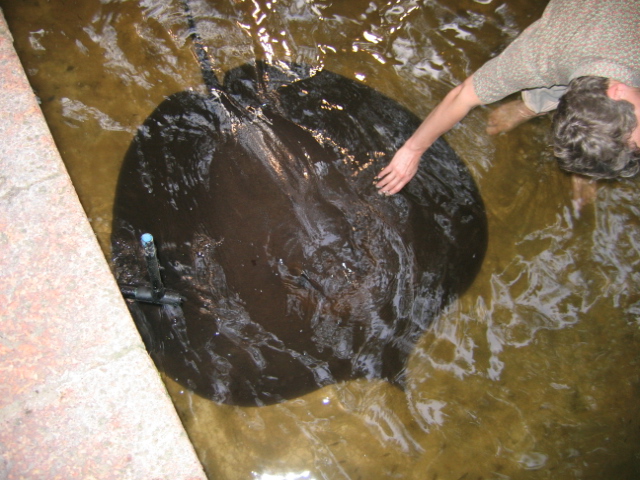
Mumburarr Whipray Urogymnus acanthobothrium
The scientific name of the Mumburarr Whipray is Urogymnus acanthobothrium. It is a species of fish in the family Dasyatidae (whiptail stingray), order Myliobatiformes. The name dates from 2016.
- Scientific name
- Urogymnus acanthobothrium Last, White & Kyne, 2016
- Common name
- Mumburarr Whipray
- Genus
- Urogymnus
- Family
- Dasyatidae (Whiptail Stingray)
- Order
- Myliobatiformes
- Class
- Elasmobranchii
- Red List category
- DD Data Deficient
- Environment
- brackish, marine
- Recorded in
- 2 countries
- Name status
- accepted in the Catalogue of Life

Overview
The mumburarr whipray (Urogymnus acanthobothrium) is a species of whipray from northern Australia and southern Papua New Guinea, described in 2016.
Classification of the Mumburarr Whipray
| Kingdom | Animalia |
|---|---|
| Phylum | Chordata |
| Subphylum | Vertebrata |
| Infraphylum | Gnathostomata |
| Parvphylum | Chondrichthyes |
| Class | Elasmobranchii |
| Subclass | Neoselachii |
| Infraclass | Batoidea |
| Order | Myliobatiformes |
| Family | Dasyatidae (Whiptail Stingray) |
| Genus | Urogymnus (Porcupine Rays) |
| Species | Urogymnus acanthobothrium Last, White & Kyne, 2016 |
Origin of the name. Etymology. A large female collected during a survey of cestode parasites of northern Australian chondrichthyan fishes yielded 4 species of cestodes of the genus Acanthobothrium (A. oceanharvestae, A. popi, A. rodmani and A. zimmeri) that are found only in this species (Fyler et al., 2009). Hence, the epithet ' acanthobothrium' is used as a noun in apposition to recognise the historical significance of the parasite project in the discovery of this whipray. The vernacular name ' Mumburarr Whipray' is used to acknowledge the assistance of Traditional Owners in locating this species, in particular the people of the Alligator Rivers region in the Northern Territory. Mumburarr is a local Limilngan language name used by the Minitja people of the West Alligator River region meaning stingray. Coastal, estuarine and riverine stingrays were traditionally hunted for food and the caudal sting was used as a traditional knife. TABLE 1. Morphometric data for the holotype of Urogymnus acanthobothrium sp. nov. (WAM P. 34488 - 001), with values (expressed in mm) and ratios expressed as percentages of disc width. mm % Disc width 672.0 Total length 2077.0 309.1 Disc length 718.0 106.8 Snout to pectoral-fin insertion 635.0 94.5 Orbit to pectoral-fin insertion 441.0 65.6 Snout to maximum disc width 356.0 53.0 Snout to origin of cloaca 611.0 90.9 Cloaca origin to tail tip 1466.0 218.2 Cloaca origin to caudal sting 386.0 57.4 Pectoral-fin insertion to caudal sting (horiz) 363.0 54.0 Disc thickness 82.0 12.2 Snout (preorbital) length 178.7 26.6 Snout (preorbital horiz.) length 166.6 24.8 Orbit diameter 30.3 4.5 Eye diameter 14.2 2.1 Spiracle length 57.5 8.6 Orbit and spiracle length 72.1 10.7 Interorbital width 86.6 12.9 Inter-eye width 108.7 16.2 Distance between spiracles 111.2 16.6 Head length 366.0 54.5 Preoral length (to lower jaw) 170.3 25.3 Prenasal length 136.1 20.2 Nostril length 24.5 3.6 Nasal curtain length 42.6 6.3 Nasal curtain width 88.1 13.1 Distance between nostrils 69.2 10.3 Mouth width 65.1 9.7 Distance between 1 st gill slits 161.0 24.0 Distance between 5 th gill slits 118.4 17.6 Width 1 st gill slit 27.0 4.0 Width 3 rd gill slit 29.0 4.3 Width 5 th gill slit 19.3 2.9 Tail width, base of caudal sting 16.5 2.5 Tail width, axil of pelvic fins 53.7 8.0 ...... continued on the next page Conservation considerations. While at present there is insufficient data available to assess the extinction risk status of Urogymnus acanthobothrium sp. nov., it should be noted that euryhaline elasmobranchs are generally of conservation concern (Lucifora et al., 2015). The limited number of existing records suggests that the new species may be naturally rare, and it is likely to possess life history characteristics of large elasmobranchs (i. e. late age at maturity, low fecundity, long lifespan, and low natural mortality) which result in low productivity and a limited ability to recover from population depletion (Musick, 1999).
Where the Mumburarr Whipray is found
Checklists and occurrence records place Urogymnus acanthobothrium in 2 countries. GBIF holds 15 georeferenced records of it.
Countries
Regions and cities with the most records
A number beside a place is its count of GBIF occurrence records. A place without a number comes from a checklist alone. Records show where a species has been observed or collected, which can include escapes and vagrants.
Common names
English
- Mumburarr Whipray
Names in 1 other language
- Portuguese
- Raia-imune
Related species
-
 Porcupine RayUrogymnus asperrimus
-
 Giant Freshwater RayUrogymnus polylepis
- Freshwater WhiprayUrogymnus dalyensis
- Tubemouth WhiprayUrogymnus lobistoma
-
 Whitetail WhiprayUrogymnus granulatus
-
 Bluespotted Ribbontail RayTaeniura lymma
-
 Common StingrayDasyatis pastinaca
-
 Pelagic StingrayPteroplatytrygon violacea
Compare
Questions and answers
What is the scientific name of the Mumburarr Whipray?
The scientific name of the Mumburarr Whipray is Urogymnus acanthobothrium. Written with its author, the full name is Urogymnus acanthobothrium Last, White & Kyne, 2016.
Which family does the Mumburarr Whipray belong to?
Urogymnus acanthobothrium belongs to the family Dasyatidae, in the order Myliobatiformes and the class Elasmobranchii.
Where is the Mumburarr Whipray found?
Checklists and occurrence records place Urogymnus acanthobothrium in 2 countries: Australia and Papua New Guinea.
What is the conservation status of the Mumburarr Whipray?
The IUCN Red List category recorded for Urogymnus acanthobothrium is Data Deficient (DD).
Sources
Data
- Catalogue of Life, 2026-10-16 XR cc by
- Global Biodiversity Information Facility CC BY 4.0
- Wikidata CC0
- English Wikipedia CC BY-SA 4.0
- GeoNames CC BY 4.0
- Wikimedia Commons per image; credit shown with each image
- Within the Catalogue of Life, this name comes from World Register of Marine Species cc by
References
- Last, P. R., White, W. T., & Kyne, P. M. (2016). Urogymnus acanthobothrium sp. nov., a new euryhaline whipray (Myliobatiformes: Dasyatidae) from Australia and Papua New Guinea. Zootaxa, 4147. https://doi.org/10.11646/zootaxa.4147.2.4 Link where the name was published
This species in other databases
- Catalogue of Life 7DV6M
- Wikidata Q26260492
- iNaturalist 607444
- WoRMS urn:lsid:marinespecies.org:taxname:1006793
Page built on 26 November 2026. See how the catalog is made and all sources and licences.
Cite this page
ScientificNames.org. (2026). Urogymnus acanthobothrium (Mumburarr Whipray). Retrieved November 26, 2026, from https://scientificnames.org/species/urogymnus-acanthobothrium
“Urogymnus acanthobothrium (Mumburarr Whipray).” ScientificNames.org, 2026, scientificnames.org/species/urogymnus-acanthobothrium. Accessed 26 Nov. 2026.
ScientificNames.org. “Urogymnus acanthobothrium (Mumburarr Whipray).” Accessed November 26, 2026. https://scientificnames.org/species/urogymnus-acanthobothrium.
@misc{scientificnames_urogymnus_acanthobothrium_mumburarr_whipray,
  author = {{ScientificNames.org}},
  title = {Urogymnus acanthobothrium (Mumburarr Whipray)},
  year = {2026},
  url = {https://scientificnames.org/species/urogymnus-acanthobothrium},
  note = {Accessed 2026-11-26}
}