Species · Fishes
Giant Freshwater Ray Urogymnus polylepis
The scientific name of the Giant Freshwater Ray is Urogymnus polylepis. It is a species of fish in the family Dasyatidae (whiptail stingray), order Myliobatiformes. The name dates from 1852.
- Scientific name
- Urogymnus polylepis (Bleeker, 1852)
- Common name
- Giant Freshwater Ray
- Genus
- Urogymnus
- Family
- Dasyatidae (Whiptail Stingray)
- Order
- Myliobatiformes
- Class
- Elasmobranchii
- Red List category
- EN Endangered
- Environment
- brackish, freshwater
- Recorded in
- 5 countries
- Name status
- accepted in the Catalogue of Life
Overview
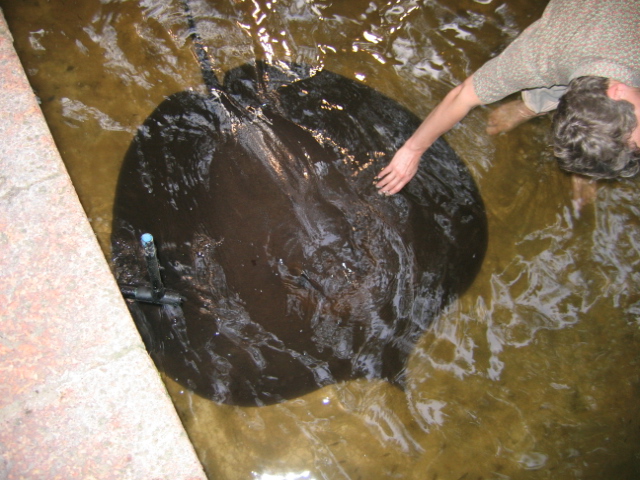
Urogymnus polylepis inhabits large rivers and their associated estuaries in Indochina and Borneo. It has a single serrated stinging spine near the base of its tail that can reach 38 cm in length.
Written 28 November 2026 from the sources listed below. Each statement was checked against the passage it cites; statements that could not be supported were removed.
Appearance
The species has a thin, oval pectoral disc that is widest toward the front. Its snout has a wide base and a sharply pointed tip that extends beyond the disc.[1][2]
Its tail is thin and cylindrical, with no fin folds. A single serrated stinging spine near the tail base can reach 38 cm in length.[3][4][5]
The upper surface is grayish brown, sometimes with yellowish or pinkish coloring near the fin margins. The underside is white, with broad dark bands along the rear margins of the pectoral and pelvic fins.[6][7]
The species has five pairs of gill slits on the underside of its disc. Its eyes are very small and widely separated, with large spiracles behind them.[8][9]
The species can reach a width of approximately 2.2 m. A documented individual measured 3.98 m in total length and weighed 300 kg.[10][11][12]
Newborn individuals measure approximately 30 cm across.[13]
Habitat
The species inhabits large rivers and their associated estuaries in Indochina and Borneo. It favors sandy or muddy river bottoms and can occur in brackish environments.[14][15][16]
Pregnant females are frequently found in estuaries, which may function as nursery areas. The species has occasionally been recorded near densely populated urban areas.[17][18]
The species occurs in the Mekong River, potentially as far upstream as Chiang Khong in Thailand. Its documented Indochinese river distribution includes the Chao Phraya, Nan, Mae Klong, Bang Pakong, and Tapi Rivers.[19][20]
In Kalimantan, the species occurs in the Mahakam River. In Sabah, it occurs in the Kinabatangan and Buket Rivers.[21][22]
The species was confirmed in the Kaladan and Mayu rivers in Myanmar in 2022. It is reported from river systems in Thailand, Cambodia, Malaysia, and Indonesia.[23][24]
Diet
The species feeds on small bottom-dwelling fishes and invertebrates, including crustaceans and molluscs. Its reported prey includes clams and crabs.[25][26][27]
Individuals have been observed at river edges, possibly feeding on earthworms. The species uses electroreceptive ampullae of Lorenzini to detect prey.[28][29]
Behaviour
The species is bottom-dwelling and can bury itself in river sediments. It is described as non-aggressive toward humans.[30][31]
Hooked individuals may bury themselves in large quantities of mud. They have also been reported dragging boats over substantial distances.[32][33]
Reproduction and life cycle
The species gives birth to live young, with females producing litters of one to four pups. Developing embryos initially receive nourishment from yolk and subsequently from maternal histotroph.[34][35][36]
Males reach sexual maturity at approximately 1.1 m across. The species does not appear to migrate between freshwater and saltwater to complete its life cycle.[37][38]
Conservation
The species is classified as Endangered by the IUCN and Critically Endangered in Thailand. Overfishing and habitat degradation are major threats.[39][40][41]
Populations in central Thailand and Cambodia are estimated to have declined by 30–50% over 20–30 years. Its low reproductive rate makes the species vulnerable to human-caused pressures.[42][43]
Discharge of cyanide-containing waste from an ethanol plant killed at least 70 individuals in Thailand's Mae Klong River in 2016.[44]
Uses
The species is caught for its meat and cartilage. It is also targeted for display in public aquariums and by the aquarium trade.[45][46][47]
Classification of the Giant Freshwater Ray
| Kingdom | Animalia |
|---|---|
| Phylum | Chordata |
| Subphylum | Vertebrata |
| Infraphylum | Gnathostomata |
| Parvphylum | Chondrichthyes |
| Class | Elasmobranchii |
| Subclass | Neoselachii |
| Infraclass | Batoidea |
| Order | Myliobatiformes |
| Family | Dasyatidae (Whiptail Stingray) |
| Genus | Urogymnus (Porcupine Rays) |
| Species | Urogymnus polylepis (Bleeker, 1852) |
Where the Giant Freshwater Ray is found
Checklists and occurrence records place Urogymnus polylepis in 5 countries. GBIF holds 64 georeferenced records of it.
Countries
A number beside a place is its count of GBIF occurrence records. A place without a number comes from a checklist alone. Records show where a species has been observed or collected, which can include escapes and vagrants.
Common names
English
- Giant Freshwater Ray
- Giant Freshwater Stingray
- Giant Freshwater Whipray
- River Stingray
Names in 16 other languages
- Chinese
- 查菲窄尾魟
- Czech
- Trnucha říční, trnucha thajská
- Danish
- Ferskvandspiskerokke
- Dutch
- Reuzenzoetwaterpijlstaartrog
- Estonian
- Hiid-nuutrai
- Finnish
- jokisiimarausku
- French
- Raie Géante d'Eau Douce
- German
- Riesen-Süßwasser-Stechrochen, Riesen-Süßwasserstechrochen
- Hebrew
- טריגון נהרות ענק
- Italian
- Pastinaca di fiume gigante
- Khmer
- Trey bawbel
- Malay
- Pari air tawar, Pari dulang sungai, Pari sungai
- Portuguese
- Raia-gigante-de-água-doce
- Thai
- ปลากระเบนราหูน้ำจืด
- bck
- Baya gawiy
- nyh
- Biya
Synonyms
6 other scientific names have been used for this species and are now treated as synonyms of Urogymnus polylepis.
- Dasyatis chaophraya (Monkolprasit & Roberts, 1990)
- Himantura chaophraya Monkolprasit & Roberts, 1990
- Himantura chaophrya Monkolprasit & Roberts, 1990
- Himantura polylepis (Bleeker, 1852)
- Trygon polylepis Bleeker, 1852
- Urogymnus laevior Annandale, 1909
Related species
-
 Porcupine RayUrogymnus asperrimus
-
 Mumburarr WhiprayUrogymnus acanthobothrium
- Freshwater WhiprayUrogymnus dalyensis
- Tubemouth WhiprayUrogymnus lobistoma
-
 Whitetail WhiprayUrogymnus granulatus
-
 Bluespotted Ribbontail RayTaeniura lymma
-
 Common StingrayDasyatis pastinaca
-
 Pelagic StingrayPteroplatytrygon violacea
Compare
Questions and answers
What is the scientific name of the Giant Freshwater Ray?
The scientific name of the Giant Freshwater Ray is Urogymnus polylepis. Written with its author, the full name is Urogymnus polylepis (Bleeker, 1852).
Which family does the Giant Freshwater Ray belong to?
Urogymnus polylepis belongs to the family Dasyatidae, in the order Myliobatiformes and the class Elasmobranchii.
Where is the Giant Freshwater Ray found?
Checklists and occurrence records place Urogymnus polylepis in 5 countries: Thailand, Indonesia, Malaysia, Bangladesh and India.
What is the conservation status of the Giant Freshwater Ray?
The IUCN Red List category recorded for Urogymnus polylepis is Endangered (EN).
What other names does the Giant Freshwater Ray have?
Urogymnus polylepis is also known in English as Giant Freshwater Stingray, Giant Freshwater Whipray and River Stingray.
Are there giant freshwater stingrays?
Yes. The Giant Freshwater Stingray is a fish that inhabits large rivers and their associated estuaries in Indochina and Borneo.[14]
What do giant freshwater stingrays eat?
They feed on small bottom-dwelling fishes and invertebrates, including crustaceans and molluscs. Reported prey includes clams and crabs, and individuals have been observed at river edges, possibly feeding on earthworms.[25][26][28][27]
Sources
Passages the profile rests on
- The species has a thin, oval pectoral disc that is widest toward the front. Source passage: “It has a relatively thin, oval pectoral fin disc that is widest anteriorly” — English Wikipedia
- Its snout has a wide base and a sharply pointed tip that extends beyond the disc. Source passage: “The elongated snout has a wide base and a sharply pointed tip that projects beyond the disc.” — English Wikipedia
- Its tail is thin, cylindrical, and lacks fin folds. Source passage: “The thin, cylindrical tail measures 1.8–2.5 times as long as the disc and lacks fin folds.” — English Wikipedia
- The species has a single serrated stinging spine near the base of its tail. Source passage: “A single serrated stinging spine is positioned on the upper surface of the tail near the base.” — English Wikipedia
- Its stinging spine can reach 38 cm in length. Source passage: “At up to 38 cm (15 in) long, the spine is the largest of any stingray species.” — English Wikipedia
- Its upper surface is grayish brown, sometimes with yellowish or pinkish coloring near the fin margins. Source passage: “This species is plain grayish brown above, often with a yellowish or pinkish tint towards the fin margins;” — English Wikipedia
- Its underside is white with broad dark bands along the rear margins of the pectoral and pelvic fins. Source passage: “The underside is white with broad dark bands, edged with small spots, on the trailing margins of the pectoral and pelvic fins.” — English Wikipedia
- The species has five pairs of gill slits on the underside of its disc. Source passage: “There are five pairs of gill slits on the ventral side of the disc.” — English Wikipedia
- Its eyes are very small and widely separated, with large spiracles behind them. Source passage: “The eyes are minute and widely spaced; behind them are large spiracles.” — English Wikipedia
- The species can reach a width of approximately 2.2 m. Source passage: “The individual weighed 661 lb (300 kg), and was measured at 3.98 m (13.1 ft) long and 2.2 m (7.2 ft) wide.” — English Wikipedia
- A documented individual measured 3.98 m in total length. Source passage: “The individual weighed 661 lb (300 kg), and was measured at 3.98 m (13.1 ft) long and 2.2 m (7.2 ft) wide.” — English Wikipedia
- A documented individual weighed 300 kg. Source passage: “The individual weighed 661 lb (300 kg), and was measured at 3.98 m (13.1 ft) long and 2.2 m (7.2 ft) wide.” — English Wikipedia
- Newborn individuals measure approximately 30 cm across. Source passage: “newborns measure around 30 cm (12 in) across.” — English Wikipedia
- The species inhabits large rivers and their associated estuaries in Indochina and Borneo. Source passage: “The giant freshwater stingray is known to inhabit several large rivers and associated estuaries in Indochina and Borneo.” — English Wikipedia
- It favors sandy or muddy river bottoms. Source passage: “This is a bottom-dwelling species that favors a sandy or muddy habitat.” — English Wikipedia
- The species can occur in brackish environments. Source passage: “though the species occurs in brackish environments, there is no evidence that it crosses marine waters.” — English Wikipedia
- Pregnant females are frequently found in estuaries, which may function as nursery areas. Source passage: “Pregnant females are frequently found in estuaries, which may serve as nursery areas.” — English Wikipedia
- The species has occasionally been recorded near densely populated urban areas. Source passage: “Unexpectedly, it can sometimes be found near heavily populated urban areas.” — English Wikipedia
- The species occurs in the Mekong River, potentially as far upstream as Chiang Khong in Thailand. Source passage: “In Indochina, it occurs in the Mekong River to potentially as far upstream as Chiang Khong in Thailand” — English Wikipedia
- Its documented Indochinese river distribution includes the Chao Phraya, Nan, Mae Klong, Bang Pakong, and Tapi Rivers. Source passage: “as well as in the Chao Phraya, Nan, Mae Klong, Bang Pakong, and Tapi Rivers” — English Wikipedia
- In Kalimantan, the species occurs in the Mahakam River. Source passage: “this species is found in the Mahakam River in Kalimantan” — English Wikipedia
- In Sabah, the species occurs in the Kinabatangan and Buket Rivers. Source passage: “and the Kinabatangan and Buket Rivers in Sabah;” — English Wikipedia
- The species was confirmed in the Kaladan and Mayu rivers in Myanmar in 2022. Source passage: “although it has been confirmed as being present in the Kaladan and Mayu rivers in Myanmar in 2022.” — English Wikipedia
- The species is reported from river systems in Thailand, Cambodia, Malaysia, and Indonesia. Source passage: “They are known to prowl river systems in Thailand, Cambodia, Malaysia, and Indonesia” — nationalgeographic.com
- The species feeds on small bottom-dwelling fishes and invertebrates. Source passage: “The diet of the giant freshwater stingray consists of small, benthic fishes and invertebrates” — English Wikipedia
- Its invertebrate prey includes crustaceans and molluscs. Source passage: “such as crustaceans and molluscs” — English Wikipedia
- Its reported prey includes clams and crabs. Source passage: “Stingrays locate prey, usually clams and crabs” — nationalgeographic.com
- Individuals have been observed at river edges, possibly feeding on earthworms. Source passage: “Individuals can often be seen at the edge of the river, possibly feeding on earthworms.” — English Wikipedia
- The species uses electroreceptive ampullae of Lorenzini to detect prey. Source passage: “which it can detect using its electroreceptive ampullae of Lorenzini.” — English Wikipedia
- The species is bottom-dwelling and can bury itself in river sediments. Source passage: “often burying themselves in sandy or silty river bottoms.” — nationalgeographic.com
- The species is described as non-aggressive toward humans. Source passage: “The giant freshwater stingray is not aggressive,” — English Wikipedia
- Hooked individuals may bury themselves in large quantities of mud. Source passage: “a hooked ray may bury itself under large quantities of mud, becoming almost impossible to lift,” — English Wikipedia
- Hooked individuals have been reported dragging boats over substantial distances. Source passage: “or drag boats over substantial distances or underwater.” — English Wikipedia
- The species gives birth to live young. Source passage: “The giant freshwater stingray is viviparous,” — English Wikipedia
- Females produce litters of one to four pups. Source passage: “Observed litter sizes range from one to four pups;” — English Wikipedia
- Developing embryos initially receive nourishment from yolk and subsequently from maternal histotroph. Source passage: “with the developing embryos nourished initially by yolk and later by histotroph ("uterine milk") provided by the mother.” — English Wikipedia
- Males reach sexual maturity at approximately 1.1 m across. Source passage: “Males mature sexually at approximately 1.1 m (3.6 ft) across;” — English Wikipedia
- The species does not appear to migrate between freshwater and saltwater to complete its life cycle. Source passage: “This species does not appear to be diadromous (migrating between fresh and salt water to complete its life cycle).” — English Wikipedia
- The species is classified as Endangered by the IUCN. Source passage: “the International Union for Conservation of Nature (IUCN) has assessed this species as Endangered overall,” — English Wikipedia
- The species is classified as Critically Endangered in Thailand. Source passage: “and as Critically Endangered in Thailand.” — English Wikipedia
- Overfishing and habitat degradation are major threats to the species. Source passage: “The major threats to the giant freshwater stingray are overfishing and habitat degradation resulting from deforestation, land development, and damming.” — English Wikipedia
- Populations in central Thailand and Cambodia are estimated to have declined by 30–50% over 20–30 years. Source passage: “In central Thailand and Cambodia, the population is estimated to have been reduced by 30–50% over the past 20–30 years,” — English Wikipedia
- The species' low reproductive rate makes it vulnerable to human-caused pressures. Source passage: “Due to its low reproductive rate, the giant freshwater stingray is not resilient to anthropogenic pressures.” — English Wikipedia
- Discharge of cyanide-containing waste from an ethanol plant killed at least 70 individuals in Thailand's Mae Klong River in 2016. Source passage: “On the Mae Klong River in Thailand, cyanide-containing waste discharged from an ethanol plant in 2016 killed at least 70 giant stingrays,” — nationalgeographic.com
- The species is caught for its meat and cartilage. Source passage: “The meat and the cartilage are used;” — English Wikipedia
- The species is targeted for display in public aquariums. Source passage: “the giant freshwater stingray is also increasingly targeted by sport fishers and for display in public aquariums.” — English Wikipedia
- The species has been targeted by the aquarium trade. Source passage: “The rays have also been targeted for the burgeoning aquarium trade,” — nationalgeographic.com
Data
- Catalogue of Life, 2026-10-16 XR cc by
- Global Biodiversity Information Facility CC BY 4.0
- Wikidata CC0
- GeoNames CC BY 4.0
- Wikimedia Commons per image; credit shown with each image
- Within the Catalogue of Life, this name comes from World Register of Marine Species cc by
This species in other databases
- Catalogue of Life 7DV7D
- Wikidata Q46608149
- iNaturalist 623876
- WoRMS urn:lsid:marinespecies.org:taxname:1011468
Page built on 28 November 2026. See how the catalog is made and all sources and licences.
Cite this page
ScientificNames.org. (2026). Urogymnus polylepis (Giant Freshwater Ray). Retrieved November 28, 2026, from https://scientificnames.org/species/urogymnus-polylepis
“Urogymnus polylepis (Giant Freshwater Ray).” ScientificNames.org, 2026, scientificnames.org/species/urogymnus-polylepis. Accessed 28 Nov. 2026.
ScientificNames.org. “Urogymnus polylepis (Giant Freshwater Ray).” Accessed November 28, 2026. https://scientificnames.org/species/urogymnus-polylepis.
@misc{scientificnames_urogymnus_polylepis_giant_freshwater_ray,
  author = {{ScientificNames.org}},
  title = {Urogymnus polylepis (Giant Freshwater Ray)},
  year = {2026},
  url = {https://scientificnames.org/species/urogymnus-polylepis},
  note = {Accessed 2026-11-28}
}