Species · Reptiles
Elliot's Earth Snake Uropeltis ellioti
The scientific name of the Elliot's Earth Snake is Uropeltis ellioti. It is a species of reptile in the family Uropeltidae (pipe snakes), order Squamata. The name dates from 1858.
- Scientific name
- Uropeltis ellioti (Gray, 1858)
- Common name
- Elliot's Earth Snake
- Genus
- Uropeltis
- Family
- Uropeltidae (Pipe Snakes)
- Order
- Squamata
- Class
- Reptilia
- Red List category
- LC Least Concern
- Recorded in
- 1 country
- Name status
- accepted in the Catalogue of Life

Overview
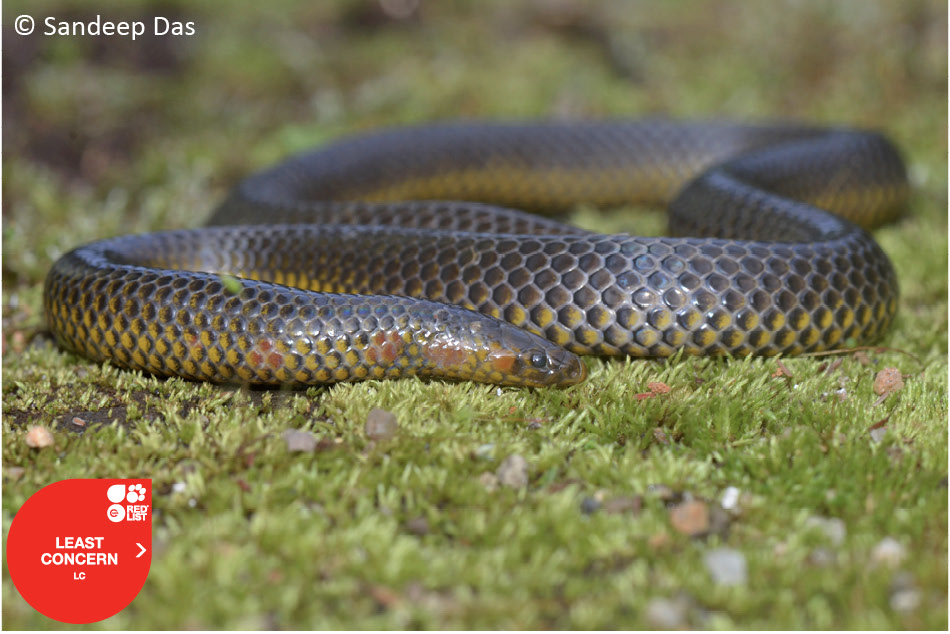
Uropeltis ellioti is endemic to India and occurs in southern India, including the Western Ghats south of the Goa Gap and several localities in the Eastern Ghats. It has a dark brown body with yellow markings, a pointed snout and a tail with a transverse ridge and two points on the terminal scute.
Written 27 November 2026 from the sources listed below. Each statement was checked against the passage it cites; statements that could not be supported were removed.
Appearance
The dorsal surface is dark brown, either uniformly coloured or marked with yellow dots. The neck has a yellow stripe on each side, and the tail has a yellow stripe along each side.[1][2][3]
The underside is dark brown with small yellow dots. A yellow transverse bar crosses the vent and joins the stripes along the tail.[4][5]
The snout is pointed, and the rostral scale is approximately one-third the length of the shielded portion of the head. The two nasal scales meet behind the rostral scale, and the eye measures less than half the length of the ocular shield.[6][7][8][9]
The dorsal scales occur in 19 rows behind the head and 17 rows at midbody. There are between 144 and 172 ventral scales and between 6 and 10 subcaudal scales.[10][11][12]
The body diameter is between one twenty-fifth and one thirty-second of the total body length. The ventral scales are nearly twice the size of the adjacent scales.[13][14]
The dorsal end of the tail is convex or somewhat flattened. The dorsal tail scales have between three and six strong keels, and the terminal scute has a transverse ridge and two points.[15][16][17]
Adults can reach a total length of 24 centimetres, including the tail.[18]
Habitat
The preferred natural habitat of Elliot's Earth Snake is forest. It inhabits elevations between 100 and 1,400 metres.[19][20]
Behaviour
Elliot's Earth Snake is terrestrial and fossorial.[21]
Diet
Elliot's Earth Snake preys on earthworms.[22]
Reproduction and life cycle
Elliot's Earth Snake is ovoviviparous.[23]
Classification of the Elliot's Earth Snake
| Kingdom | Animalia |
|---|---|
| Phylum | Chordata |
| Subphylum | Vertebrata |
| Infraphylum | Gnathostomata |
| Parvphylum | Osteichthyes |
| Megaclass | Tetrapoda |
| Class | Reptilia (Reptile) |
| Order | Squamata (Snakes) |
| Suborder | Serpentes (Snakes) |
| Infraorder | Alethinophidia |
| Family | Uropeltidae (Pipe Snakes) |
| Genus | Uropeltis (Shieldtails) |
| Species | Uropeltis ellioti (Gray, 1858) |
Where the Elliot's Earth Snake is found
Checklists and occurrence records place Uropeltis ellioti in 1 country. GBIF holds 97 georeferenced records of it.
Countries
Regions and cities with the most records
- Karnataka, India 16
- Maharashtra, India 6
- Madhya Pradesh, India 5
- Bengaluru, India 3
- Electronic City Phase I, India 3
Range as the checklists state it
S India (Gujarat, Hills of Peninsular India. Western Ghats south of the Goa Gap to Tinnevelly; Eastern Ghats: Shevaroys, Coimbatore district, South Arcot, Jalarpet, Vizagapatam distriet, Ganjam; Tamil Nadu, Karnataka, Andhra Pradesh, Maharashtra, Kerala, Telangana).
A number beside a place is its count of GBIF occurrence records. A place without a number comes from a checklist alone. Records show where a species has been observed or collected, which can include escapes and vagrants.
Common names
English
- Elliot's Earth Snake
Names in 2 other languages
- German
- Rauhschwanzschlange, Rauschwanzschlange
- Marathi
- एलियटचा खापरखवल्या
Synonyms
3 other scientific names have been used for this species and are now treated as synonyms of Uropeltis ellioti.
- Siloboura ellioti Gray, 1858
- Silybura ellioti Gray, 1858
- Silybura punctata Günther, 1875
Related species
-
 Bombay Earth SnakeUropeltis macrolepis
-
 Phipson's ShieldtailUropeltis phipsonii
-
 Shevaroy Hills Earth SnakeUropeltis shorttii
-
 Woodmason's Earth SnakeUropeltis woodmasoni
-
 Indian Earth SnakeUropeltis pulneyensis
-
 Red-spotted Earth SnakeUropeltis rubromaculata
- Jerdon’s Shieldtail SnakeUropeltis jerdoni
-
 Argus RoughtailUropeltis ocellata
Compare
Questions and answers
What is the scientific name of the Elliot's Earth Snake?
The scientific name of the Elliot's Earth Snake is Uropeltis ellioti. Written with its author, the full name is Uropeltis ellioti (Gray, 1858).
Which family does the Elliot's Earth Snake belong to?
Uropeltis ellioti belongs to the family Uropeltidae, in the order Squamata and the class Reptilia.
Where is the Elliot's Earth Snake found?
Checklists and occurrence records place Uropeltis ellioti in 1 country: India.
What is the conservation status of the Elliot's Earth Snake?
The IUCN Red List category recorded for Uropeltis ellioti is Least Concern (LC).
How big can an earth snake get?
Adults of Elliot's Earth Snake can reach a total length of 24 centimetres, including the tail.[18]
Sources
Passages the profile rests on
- The dorsal surface is dark brown, either uniformly coloured or marked with yellow dots. Source passage: “The dorsum of U. ellioti is dark brown, either uniform or with yellow dots.” — English Wikipedia
- The neck has a yellow stripe on each side. Source passage: “There is a yellow stripe on each side of the neck” — English Wikipedia
- The tail has a yellow stripe along each side. Source passage: “and a yellow stripe on each side of the tail.” — English Wikipedia
- The underside is dark brown with small yellow dots. Source passage: “The venter is dark brown with small yellow dots” — English Wikipedia
- A yellow transverse bar crosses the vent and joins the stripes along the tail. Source passage: “there is a yellow transverse bar across the vent, which connects the stripes on the sides of the tail.” — English Wikipedia
- The snout is pointed. Source passage: “The snout is pointed.” — English Wikipedia
- The rostral scale is approximately one-third the length of the shielded portion of the head. Source passage: “The rostral is about ⅓ the length of the shielded part of the head” — English Wikipedia
- The two nasal scales meet behind the rostral scale. Source passage: “The nasals are in contact with each other behind the rostral.” — English Wikipedia
- The eye is very small and measures less than half the length of the ocular shield. Source passage: “The eye is very small, less than half the length of the ocular shield.” — English Wikipedia
- The dorsal scales occur in 19 rows behind the head and 17 rows at midbody. Source passage: “The dorsal scales are in 19 rows behind the head, in 17 rows at midbody.” — English Wikipedia
- The species has between 144 and 172 ventral scales. Source passage: “The ventrals number 144–172;” — English Wikipedia
- The species has between 6 and 10 subcaudal scales. Source passage: “and the subcaudals number 6-10.” — English Wikipedia
- The body diameter is between one twenty-fifth and one thirty-second of the total body length. Source passage: “The diameter of the body goes 25 to 32 times in the total length.” — English Wikipedia
- The ventral scales are nearly twice the size of the adjacent scales. Source passage: “The ventrals are nearly twice as large as the contiguous scales.” — English Wikipedia
- The dorsal end of the tail is convex or somewhat flattened. Source passage: “The end of the tail is convex or somewhat flattened dorsally.” — English Wikipedia
- The dorsal tail scales have between three and six strong keels. Source passage: “The dorsal scales of the tail have 3 to 6 strong keels.” — English Wikipedia
- The terminal scute has a transverse ridge and two points. Source passage: “The terminal scute has a transverse ridge and two points.” — English Wikipedia
- Adults can reach a total length of 24 centimetres, including the tail. Source passage: “Adults may attain a total length (including tail) of 24 cm (9+1⁄2 in).” — English Wikipedia
- The species' preferred natural habitat is forest. Source passage: “The preferred natural habitat of U. ellioti is forest, at altitudes of 100–1,400 m (330–4,590 ft).” — English Wikipedia
- The species inhabits elevations between 100 and 1,400 metres. Source passage: “at altitudes of 100–1,400 m (330–4,590 ft).” — English Wikipedia
- The species is terrestrial and fossorial. Source passage: “U. ellioti is terrestrial and fossorial.” — English Wikipedia
- The species preys on earthworms. Source passage: “U. ellioti preys upon earthworms.” — English Wikipedia
- The species is ovoviviparous. Source passage: “U. ellioti is ovoviviparous.” — English Wikipedia
Data
- Catalogue of Life, 2026-10-16 XR cc by
- Global Biodiversity Information Facility CC BY 4.0
- Wikidata CC0
- GeoNames CC BY 4.0
- Wikimedia Commons per image; credit shown with each image
- Within the Catalogue of Life, this name comes from The Reptile Database cc by
References
- Gray, J. E. (1858). On a new genus and several new species of Uropeltidae in the collection of the British Museum. Ann. Mag. Nat. Hist. (3) 2: 376-381.
- Gray, J. E. (1858). On a new genus and several new species of Uropeltidae in the collection of the British Museum. Proc. Zool. Soc. London 1858: 260-265.
- Günther, A. (1864). The Reptiles of British India. London (Taylor & Francis), Xxvii + 452 Pp.
- Günther, A. (1875). Second report on collections of Indian Reptiles obtained bv the British Museum. Proc. Zool. Soc. London 1875: 224-234.
- Beddome, R. H. (1886). An account of the earth snakes of the Peninsula of India and Ceylon. Ann. Mag. Nat. Hist. (5) 17: 3-33.
- Boulenger, G. A. (1893). Catalogue of the snakes in the British Museum (Nat. Hist.) I. London (Taylor & Francis), 448 Pp.
- Smith, & Hobart. (1942). Mexican herpetological miscellany. Proc. US Natl. Mus. 92 (3153): 349-395.
- Smith, M. A. (1943). The Fauna of British India, Ceylon and Burma, Including the Whole of the Indo-Chinese Sub-Region. Reptilia and Amphibia. 3 (Serpentes). Taylor and Francis, London. 583 Pp.
- Kannan, P., & Bhupathy, S. (1997). Occurrence of the Elliot’s Shieldtail snake (Uropeltis ellioti) in Anaikatty Hills, Nilgiri Biosphere Reserve. Cobra 28: 34-35.
- McDiarmid, R.W.; Campbell, J.A. & Touré,T.A. (1999). Snake species of the world. Vol. 1. [type catalogue]. Herpetologists’ League, 511 Pp.
- Sharma, R. C. (2004). Handbook Indian Snakes. AKHIL BOOKS, New Delhi, 292 Pp.
- Whitaker, & Romulus and Ashok Captain. (2004). Snakes of India. Draco Books, 500 Pp., Reprinted 2007.
- Mukherjee, Debanik, & Bhupathy, S. (2004). Uropeltis ellioti in the diet of Naja naja. Hamadryad 28 (1&2): 109-110.
- Vyas, & Raju. (2007). Herpetofauna of Puma Wildlife Sanctuary, Gujarat, India. Reptile Rap (8): 10-15.
- VYAS, R. & V. PRAJAPATI. (2010). Notizen zu Reptilien aus den Salher Hills, Nord - Sahyadri, Bundesstaat Maharashtra, Indien. Sauria 32 (4): 70-74.
- Wadatkar, J.S. & M.P. Chikhale. (2010). First record of Uropeltis ellioti and study of their habits and habitat in Melghat Forest in Satpuda. Reptile Rap (9): 4-5.
- Chettri, Basundhara, & Bhupathy, S. (2010). Three little known reptile species from the Araku Valley, Eastern Ghats with notes on their distribution. Journal of Threatened Taxa 2 (8): 1109-1113.
- Murthy, T. S. N. (2010). The reptile fauna of India. B.R. Publishing, New Delhi, 332 Pp.
- Beolens, B., & Michael Watkins, a. M. G. (2011). The Eponym Dictionary of Reptiles. Johns Hopkins University Press, Baltimore, USA.
- Guptha, M. Bubesh; P.V. Chalapathi Rao, D. Srinivas Reddy, P. Madhu Babu & SRSC. Sekhar Manddala. (2013). New Record of Elliot’s Shieldtail (Gray, 1858) in Seshachalam Biosphere Reserve, Eastern Ghats, Andhra Pradesh, India. Reptile Rap (15): 7-8.
- Bhupathy, Subramanian, & Sathishkumar, N. (2013). Status of reptiles in Meghamalai and its environs, Western Ghats, Tamil Nadu, India. Journal of Threatened Taxa 5 (15): 4953-4961.
- Wallach, Van; Kenneth L. Williams, Jeff Boundy. (2014). Snakes of the World: A Catalogue of Living and Extinct Species. [type catalogue]. Taylor and Francis, CRC Press, 1237 Pp.
- Palot, M. J. (2015). A checklist of reptiles of Kerala, India. Journal of Threatened Taxa 7(13): 8010–8022.
- Ganesh, S. R.; M. Arumugam. (2016). Species Richness of Montane Herpetofauna of Southern Eastern Ghats, India: A Historical Resume and a Descriptive Checklist. Russ. J. Herpetol. 23 (1): 7-24.
- Pyron, R. A., Ganesh, S. R., Sayyed, A., Sharma, V., Wallach, V., & Somaweera, R. (2016). A catalogue and systematic overview of the shield-tailed snakes (Serpentes: Uropeltidae). [type catalogue]. Zoosystema 38 (4): 453-506.
This species in other databases
Page built on 30 November 2026. See how the catalog is made and all sources and licences.
Cite this page
ScientificNames.org. (2026). Uropeltis ellioti (Elliot's Earth Snake). Retrieved November 30, 2026, from https://scientificnames.org/species/uropeltis-ellioti
“Uropeltis ellioti (Elliot's Earth Snake).” ScientificNames.org, 2026, scientificnames.org/species/uropeltis-ellioti. Accessed 30 Nov. 2026.
ScientificNames.org. “Uropeltis ellioti (Elliot's Earth Snake).” Accessed November 30, 2026. https://scientificnames.org/species/uropeltis-ellioti.
@misc{scientificnames_uropeltis_ellioti_elliots_earth_snake,
  author = {{ScientificNames.org}},
  title = {Uropeltis ellioti (Elliot's Earth Snake)},
  year = {2026},
  url = {https://scientificnames.org/species/uropeltis-ellioti},
  note = {Accessed 2026-11-30}
}