Species · Reptiles
Bombay Earth Snake Uropeltis macrolepis
The scientific name of the Bombay Earth Snake is Uropeltis macrolepis. It is a species of reptile in the family Uropeltidae (pipe snakes), order Squamata. The name dates from 1862.
- Scientific name
- Uropeltis macrolepis (Peters, 1862)
- Common name
- Bombay Earth Snake
- Genus
- Uropeltis
- Family
- Uropeltidae (Pipe Snakes)
- Order
- Squamata
- Class
- Reptilia
- Red List category
- LC Least Concern
- Recorded in
- 1 country
- Name status
- accepted in the Catalogue of Life

Overview
The Bombay Earth Snake (Uropeltis macrolepis) is a reptile in the family Uropeltidae, order Squamata and class Reptilia. It is endemic to southern India and occurs in forest habitats at elevations between 10 and 1,350 metres. It is distinguished by its dark coloration, yellow markings and obliquely truncated tail tip.
Written 26 November 2026 from the sources listed below. Each statement was checked against the passage it cites; statements that could not be supported were removed.
Appearance
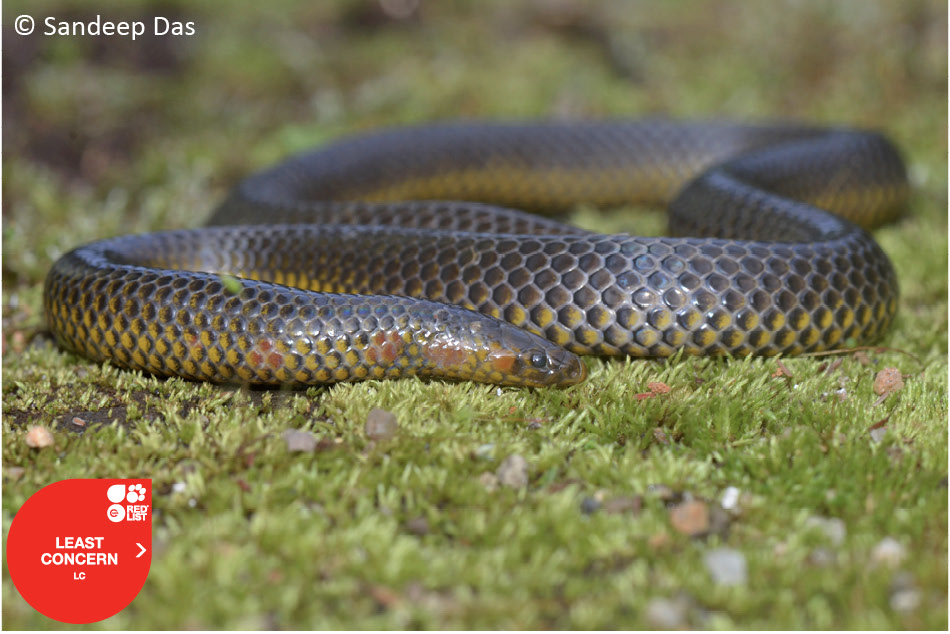
The Bombay Earth Snake is black or dark purplish brown on both its dorsal and ventral surfaces, with lighter edges on each scale. A yellow stripe runs along its lips and sides of the neck, followed by two to five large yellow spots.[1][2]
A yellow stripe runs along each side of its tail. Its dorsal scales are smooth and arranged in 15 rows at midbody and 17 rows behind the head.[3][4]
It has between 128 and 140 ventral scales and between seven and nine subcaudal scales. Its ventral scales are twice as large as the adjacent scales.[5][6][7]
Its snout is rounded, and its rostral scale is less than one-quarter the length of the shielded part of its head. Its nasal scales meet behind the rostral scale.[8][9][10]
Its frontal scale is as long as or slightly longer than it is broad. Its eye diameter exceeds half the length of the ocular shield.[11][12]
Its tail tip is obliquely truncated and flat on the dorsal surface, with strongly bicarinate scales. Its terminal tail scale has a transverse ridge and two points.[13][14]
Adults can reach a total length of 29.5 cm, including the tail. Its body diameter fits 24 to 29 times into its total length.[15][16]
Habitat
The Bombay Earth Snake prefers forest as its natural habitat. It occurs in forest habitats at elevations between 10 and 1,350 metres.[17][18]
The species is endemic to southern India. It is recorded from Maharashtra, India, including Phansad near Supegaon, Mahabaleshwar, Koyna and Lonavla.[19][20]
Diet
The Bombay Earth Snake preys upon earthworms.[21]
Behaviour
The Bombay Earth Snake is terrestrial and fossorial.[22]
Reproduction and life cycle
The Bombay Earth Snake is ovoviviparous.[23]
Classification of the Bombay Earth Snake
| Kingdom | Animalia |
|---|---|
| Phylum | Chordata |
| Subphylum | Vertebrata |
| Infraphylum | Gnathostomata |
| Parvphylum | Osteichthyes |
| Megaclass | Tetrapoda |
| Class | Reptilia (Reptile) |
| Order | Squamata (Snakes) |
| Suborder | Serpentes (Snakes) |
| Infraorder | Alethinophidia |
| Family | Uropeltidae (Pipe Snakes) |
| Genus | Uropeltis (Shieldtails) |
| Species | Uropeltis macrolepis (Peters, 1862) |
Where the Bombay Earth Snake is found
Checklists and occurrence records place Uropeltis macrolepis in 1 country. GBIF holds 154 georeferenced records of it.
Countries
Regions and cities with the most records
- Maharashtra, India 119
- Karjat, India 31
- Neral, India 29
- Badlapur, India 26
- Panvel, India 26
- Roha, India 19
- Khopoli, India 8
- Lonavla, India 8
- Maval, India 7
- Airoli, India 6
- Borivli, India 6
- Gorai, India 6
- Kalher, India 6
- Powai, India 6
- Thāne, India 6
- Bhayandar, India 5
- Mumbai, India 5
- Sāvantvādi, India 5
- Koynanagar, India 4
- Dombivali, India 3
Range as the checklists state it
S India (Gujarat, Maharashtra (Phansad – near Supegaon, Mahabaleshwar, Koyna, Lonavla) [A. Captain, pers. Comm.])
A number beside a place is its count of GBIF occurrence records. A place without a number comes from a checklist alone. Records show where a species has been observed or collected, which can include escapes and vagrants.
Common names
English
- Bombay Earth Snake
- Bomaby Earth Snake
- Large-scaled Earth Snake
Names in 3 other languages
- Czech
- krátkorep indický
- Marathi
- मोठ्या-खवल्यांचा खापरखवल्या
- Russian
- Крупночешуйная щитохвостка
Synonyms
One other scientific name has been used for this species and is now treated as a synonym of Uropeltis macrolepis.
- Silybura macrolepis Peters, 1862
Subspecies and varieties
- Uropeltis macrolepis macrolepis subspecies
- Uropeltis macrolepis mahableshwarensis subspecies
Related species
-
 Elliot's Earth SnakeUropeltis ellioti
-
 Phipson's ShieldtailUropeltis phipsonii
-
 Shevaroy Hills Earth SnakeUropeltis shorttii
-
 Woodmason's Earth SnakeUropeltis woodmasoni
-
 Indian Earth SnakeUropeltis pulneyensis
-
 Red-spotted Earth SnakeUropeltis rubromaculata
- Jerdon’s Shieldtail SnakeUropeltis jerdoni
-
 Argus RoughtailUropeltis ocellata
Compare
Questions and answers
What is the scientific name of the Bombay Earth Snake?
The scientific name of the Bombay Earth Snake is Uropeltis macrolepis. Written with its author, the full name is Uropeltis macrolepis (Peters, 1862).
Which family does the Bombay Earth Snake belong to?
Uropeltis macrolepis belongs to the family Uropeltidae, in the order Squamata and the class Reptilia.
Where is the Bombay Earth Snake found?
Checklists and occurrence records place Uropeltis macrolepis in 1 country: India.
What is the conservation status of the Bombay Earth Snake?
The IUCN Red List category recorded for Uropeltis macrolepis is Least Concern (LC).
What other names does the Bombay Earth Snake have?
Uropeltis macrolepis is also known in English as Bomaby Earth Snake and Large-scaled Earth Snake.
What is the taxonomy of a snake?
The Bombay Earth Snake belongs to the family Uropeltidae, order Squamata and class Reptilia.[24]
Sources
Passages the profile rests on
- The snake is black or dark purplish brown on both its dorsal and ventral surfaces, with lighter edges on each scale. Source passage: “Uropeltis macrolepis is black or dark purplish brown both dorsally and ventrally, with each scale lighter-edged.” — English Wikipedia
- It has a yellow stripe on its lips and sides of the neck, followed by two to five large yellow spots. Source passage: “There is a yellow stripe on the lips and sides of the neck, followed by two to five large yellow spots” — English Wikipedia
- It has a yellow stripe along each side of its tail. Source passage: “and a yellow stripe along each side of the tail.” — English Wikipedia
- Its dorsal scales are smooth and arranged in 15 rows at midbody and 17 rows behind the head. Source passage: “The smooth dorsal scales are in only 15 rows at midbody (in 17 rows behind the head).” — English Wikipedia
- It has between 128 and 140 ventral scales. Source passage: “The ventrals number 128–140” — English Wikipedia
- It has between seven and nine subcaudal scales. Source passage: “and the subcaudals number 7–9.” — English Wikipedia
- Its ventral scales are twice as large as the adjacent scales. Source passage: “The ventrals are twice as large as the contiguous scales.” — English Wikipedia
- Its snout is rounded. Source passage: “The snout is rounded.” — English Wikipedia
- Its rostral scale is less than one-quarter the length of the shielded part of its head. Source passage: “The rostral is less than ¼ of the length of the shielded part of the head” — English Wikipedia
- Its nasal scales meet behind the rostral scale. Source passage: “The nasals are in contact with each other behind the rostral.” — English Wikipedia
- Its frontal scale is as long as or slightly longer than it is broad. Source passage: “The frontal is as long as or slightly longer than broad.” — English Wikipedia
- Its eye diameter exceeds half the length of the ocular shield. Source passage: “The diameter of eye is more than ½ the length of the ocular shield.” — English Wikipedia
- Its tail tip is obliquely truncated and flat on the dorsal surface, with strongly bicarinate scales. Source passage: “The end of the tail is obliquely truncate, flat dorsally, with strongly bicarinate scales.” — English Wikipedia
- Its terminal tail scale has a transverse ridge and two points. Source passage: “The terminal scale has a transverse ridge and two points.” — English Wikipedia
- Adults can reach a total length of 29.5 cm, including the tail. Source passage: “Adults may attain a total length (including tail) of 29.5 cm (11+1⁄2 in).” — English Wikipedia
- Its body diameter fits 24 to 29 times into its total length. Source passage: “The diameter of body goes 24 to 29 times into the total length.” — English Wikipedia
- Its preferred natural habitat is forest. Source passage: “The preferred natural habitat of U. macrolepis is forest” — English Wikipedia
- It occurs in forest habitats at elevations between 10 and 1,350 metres. Source passage: “at altitudes of 10–1,350 m (33–4,429 ft).” — English Wikipedia
- The species is endemic to southern India. Source passage: “The species is endemic to southern India.” — English Wikipedia
- It is recorded from Maharashtra, India, including Phansad near Supegaon, Mahabaleshwar, Koyna and Lonavla. Source passage: “Uropeltis macrolepis is found in Maharashtra (Phansad – near Supegaon, Mahabaleshwar, Koyna, Lonavla), India.” — English Wikipedia
- It preys upon earthworms. Source passage: “Uropeltis macrolepis preys upon earthworms.” — English Wikipedia
- It is terrestrial and fossorial. Source passage: “Uropeltis macrolepis is terrestrial and fossorial.” — English Wikipedia
- It is ovoviviparous. Source passage: “Uropeltis macrolepis is ovoviviparous.” — English Wikipedia
- The species belongs to the family Uropeltidae. Source passage: “is a species of snake in the family Uropeltidae.” — English Wikipedia
Data
- Catalogue of Life, 2026-10-16 XR cc by
- Global Biodiversity Information Facility CC BY 4.0
- Wikidata CC0
- GeoNames CC BY 4.0
- Wikimedia Commons per image; credit shown with each image
- Within the Catalogue of Life, this name comes from The Reptile Database cc by
References
- Peters, W. H. C. (1862). Über eine neue Art der Schlangengattung Silybura, S. macrolepis. Mber. Königl. Preuss. Akad. Wiss. Berlin, 1861: 901-905 [1862].
- Günther, A. (1864). The Reptiles of British India. London (Taylor & Francis), Xxvii + 452 Pp.
- Beddome, R. H. (1886). An account of the earth snakes of the Peninsula of India and Ceylon. Ann. Mag. Nat. Hist. (5) 17: 3-33.
- Boulenger, G. A. (1893). Catalogue of the snakes in the British Museum (Nat. Hist.) I. London (Taylor & Francis), 448 Pp.
- Smith, & Hobart. (1942). Mexican herpetological miscellany. Proc. US Natl. Mus. 92 (3153): 349-395.
- Smith, M. A. (1943). The Fauna of British India, Ceylon and Burma, Including the Whole of the Indo-Chinese Sub-Region. Reptilia and Amphibia. 3 (Serpentes). Taylor and Francis, London. 583 Pp.
- Constable, JOHN D. (1949). Reptiles from the Indian Peninsula in the Museum of Comparative Zoology. Bull. Mus. Comp. Zool. Harvard 103: 59-160.
- Chari, V. K. (1952). Localization of the striped variety of the rough-tailed earthsnake - Uropeltis macrolepis (PETERS) - to Mahableshwar. J. Bombay Nat. Hist. Soc. 50: 950-951.
- Chari, V. K. (1953). Some more notes on Uropeltis macrolepis (PETERS) with special reference to specimens from Mahableshwar (Western Ghats, Bombay). J. Bombay Nat. Hist. Soc. 51 (2): 512.
- Chari, V. K. (1954). An addition to the list of snakes of Bombay and Salsette - Uropeltis macrolepis (PETERS) - Uropeltidae. J. Bombay Nat. Hist. Soc. 52 (1): 213- 214.
- Chari, V. K. (1955). A new form of the burrowing snake, Uropeltis macrolepis (PETERS) from Mahableshwar. J. Bombay Nat. Hist. Soc. 52 (4): 901.
- Sekar A G. Almeida M R. (1994). Range extension of the Bombay shield-tail snake Uropelitis macrolepis (Peters 1861) (Serpentes: Uropeltidae). J. Bombay Nat. Hist. Soc. 90 (3): 520-521 [1993].
- Das, I., & Chaturvedi, N. (1998). Catalogue of the herpetological types in the collection of the Bombay Natural History Society. Hamadryad 23 (2): 150-156.
- McDiarmid, R.W.; Campbell, J.A. & Touré,T.A. (1999). Snake species of the world. Vol. 1. [type catalogue]. Herpetologists’ League, 511 Pp.
- Sharma, R. C. (2004). Handbook Indian Snakes. AKHIL BOOKS, New Delhi, 292 Pp.
- Whitaker, & Romulus and Ashok Captain. (2004). Snakes of India. Draco Books, 500 Pp., Reprinted 2007.
- Lobo, A. S. (2006). Uropeltis macrolepis in the diet of Calliophis nigrescens. Hamadryad 30 (1): 200-201.
- Vyas, & Raju. (2007). Herpetofauna of Puma Wildlife Sanctuary, Gujarat, India. Reptile Rap (8): 10-15.
- Murthy, T. S. N. (2010). The reptile fauna of India. B.R. Publishing, New Delhi, 332 Pp.
- Gower, D.; Garrett, K. & Stafford, P. (2012). Snakes. Firefly Books, Buffalo, NY,144 P..
- Wallach, Van; Kenneth L. Williams, Jeff Boundy. (2014). Snakes of the World: A Catalogue of Living and Extinct Species. [type catalogue]. Taylor and Francis, CRC Press, 1237 Pp.
- Pyron, R. A., Ganesh, S. R., Sayyed, A., Sharma, V., Wallach, V., & Somaweera, R. (2016). A catalogue and systematic overview of the shield-tailed snakes (Serpentes: Uropeltidae). [type catalogue]. Zoosystema 38 (4): 453-506.
- Patel, Harshil; Raju Vyas, Vaibhav Naik, Bhautik Dudhatra & Shantilal K. Tank. (2018). Herpetofauna of the Northern Western Ghats of Gujarat, India. Zoology and Ecology, DOI: 10.1080/21658005.2018.1499237.
- Kumbar Suresh M, & Patil Satywan S and Ghadage Abhijit B. (2018). Record of Bombay shield snake Uropeltis macrolepis macrolepis (Peters, 1862) in Amba Ghats, Western Maharashtra, Southern India. Int. J. Life Sc.
- Bansode, SA and Dr. VR More. (2018). An updated list of serpent from Palghar district of Maharashtra, India. Journal of Entomology and Zoology Studies 6(1): 375-379 [Note: This Appears to Be a Predatory Journal with Little If Any Peer Review].
This species in other databases
Page built on 28 November 2026. See how the catalog is made and all sources and licences.
Cite this page
ScientificNames.org. (2026). Uropeltis macrolepis (Bombay Earth Snake). Retrieved November 28, 2026, from https://scientificnames.org/species/uropeltis-macrolepis
“Uropeltis macrolepis (Bombay Earth Snake).” ScientificNames.org, 2026, scientificnames.org/species/uropeltis-macrolepis. Accessed 28 Nov. 2026.
ScientificNames.org. “Uropeltis macrolepis (Bombay Earth Snake).” Accessed November 28, 2026. https://scientificnames.org/species/uropeltis-macrolepis.
@misc{scientificnames_uropeltis_macrolepis_bombay_earth_snake,
  author = {{ScientificNames.org}},
  title = {Uropeltis macrolepis (Bombay Earth Snake)},
  year = {2026},
  url = {https://scientificnames.org/species/uropeltis-macrolepis},
  note = {Accessed 2026-11-28}
}