Species · Reptiles
Argus Roughtail Uropeltis ocellata
The scientific name of the Argus Roughtail is Uropeltis ocellata. It is a species of reptile in the family Uropeltidae (pipe snakes), order Squamata. The name dates from 1863.
- Scientific name
- Uropeltis ocellata (Beddome, 1863)
- Common name
- Argus Roughtail
- Genus
- Uropeltis
- Family
- Uropeltidae (Pipe Snakes)
- Order
- Squamata
- Class
- Reptilia
- Red List category
- LC Least Concern
- Recorded in
- 1 country
- Name status
- accepted in the Catalogue of Life

Overview
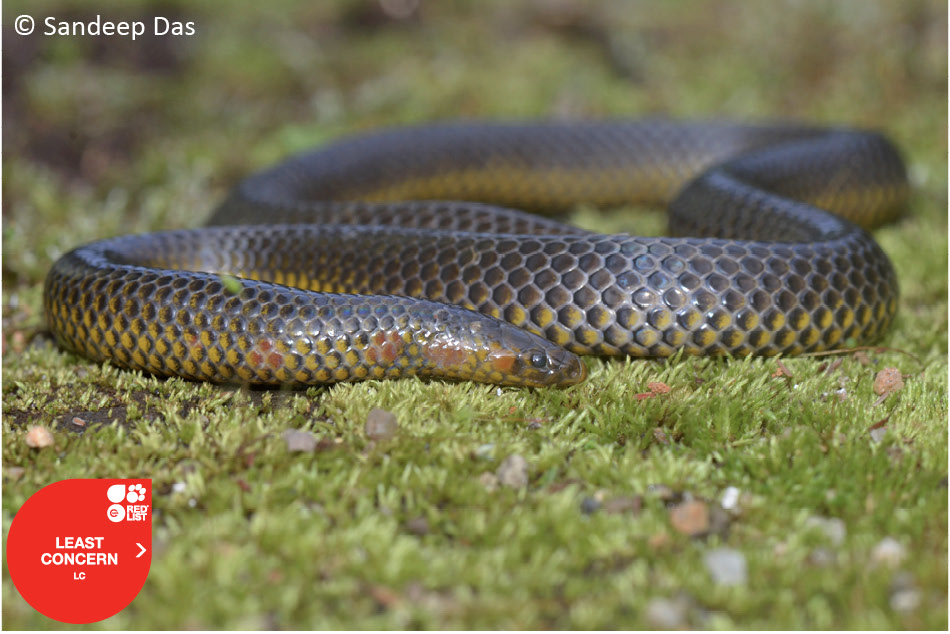
Uropeltis ocellata (Beddome, 1863), known as the Argus Roughtail, is a non-venomous shieldtail snake. It is indigenous to southern India, including the Western Ghats south of the Goa Gap and the Cardamom region of southern Kerala. Its body has transverse rows of four or five black-edged white or yellow spots resembling eyes.
Written 27 November 2026 from the sources listed below. Each statement was checked against the passage it cites; statements that could not be supported were removed.
Appearance
The terminal shield is entire or has two to three slight prongs. The tail is rounded or slightly flattened.[1][2]
Adult males are yellowish and become gradually brown near the head and tail, while adult females have a dull brownish body coloration. Young individuals are dark purplish brown.[3][4][5]
The sides of the belly have irregular transverse yellow or white blotches.[6]
A specimen described by Beddome measured 37 cm in total length. The longest specimen measured by Boulenger reached 50 cm in total length.[7][8]
The body diameter occurs 30 to 46 times within the total length. The species has eight or ten pairs of subcaudal scales.[9][10]
Habitat
The species primarily inhabits forests at elevations between 600 and 2,000 metres.[11][12]
Its type locality is Walaghat on the western slopes of the Nilgiri Hills.[13]
Diet
Earthworms constitute the predominant prey of this species.[14]
Behaviour
Reproduction and life cycle
The species is ovoviviparous. Gravid adult females have been observed in July.[17][18]
Classification of the Argus Roughtail
| Kingdom | Animalia |
|---|---|
| Phylum | Chordata |
| Subphylum | Vertebrata |
| Infraphylum | Gnathostomata |
| Parvphylum | Osteichthyes |
| Megaclass | Tetrapoda |
| Class | Reptilia (Reptile) |
| Order | Squamata (Snakes) |
| Suborder | Serpentes (Snakes) |
| Infraorder | Alethinophidia |
| Family | Uropeltidae (Pipe Snakes) |
| Genus | Uropeltis (Shieldtails) |
| Species | Uropeltis ocellata (Beddome, 1863) |
Where the Argus Roughtail is found
Checklists and occurrence records place Uropeltis ocellata in 1 country across Asia. GBIF holds 97 georeferenced records of it.
Countries
Regions and cities with the most records
- Tamil Nadu, India 35
- Valparai, India 30
- Ambattur, India 6
- Avadi, India 6
- Chennai, India 6
- Injambakkam, India 6
- Jalladiampet, India 6
- Kaikalapettai, India 6
- Kattivākkam, India 6
- Kullattūr, India 6
- Madhavaram, India 6
- Madipakkam, India 6
- Maduraivayal, India 6
- Maduravoyal, India 6
- Manali, India 6
- Mathur, India 6
- Meenambakkam, India 6
- Mugalivakkam, India 6
- Nalambūr, India 6
- Neelankarai, India 6
- Nerkunram, India 6
- Nāravārikuppam, India 6
- Pallikaranai, India 6
- Pallāvaram, India 6
- Polichalur, India 6
- Poonamalle, India 6
- Porur, India 6
- Puzhal, India 6
- Pādiyanallūr, India 6
- Ramapuram, India 6
- Reddipālaiyam, India 6
- Saint Thomas Mount, India 6
- Tiruvottiyūr, India 6
- Vīrarāghavapuram, India 6
- Kerala, India 5
- Kallamchavadi, India 4
Range as the checklists state it
S India (Western Ghats south of the Goa Gap; common in the Nilgiri and Anaimalai Hills, Kerala)
A number beside a place is its count of GBIF occurrence records. A place without a number comes from a checklist alone. Records show where a species has been observed or collected, which can include escapes and vagrants.
Common names
English
- Argus Roughtail
- Nilgiri Uropeltis
- Ocellate Shieldtail
- Ocellated Earth Snake
Names in 2 other languages
- Czech
- krátkorep perlový
- Russian
- Глазчатая щитохвостка
Synonyms
5 other scientific names have been used for this species and are now treated as synonyms of Uropeltis ocellata.
- Silybura dupeni Beddome, 1878
- Silybura ocellata Beddome, 1863
- Silybura ochracea Beddome, 1878
- Uropeltis ocellata gansi Rajendran, 1979
- Uropeltis ocellata krishnasami Rajendran, 1979
Subspecies and varieties
- Uropeltis ocellata ocellata subspecies
Related species
-
 Bombay Earth SnakeUropeltis macrolepis
-
 Elliot's Earth SnakeUropeltis ellioti
-
 Phipson's ShieldtailUropeltis phipsonii
-
 Shevaroy Hills Earth SnakeUropeltis shorttii
-
 Woodmason's Earth SnakeUropeltis woodmasoni
-
 Indian Earth SnakeUropeltis pulneyensis
-
 Red-spotted Earth SnakeUropeltis rubromaculata
- Jerdon’s Shieldtail SnakeUropeltis jerdoni
Compare
Questions and answers
What is the scientific name of the Argus Roughtail?
The scientific name of the Argus Roughtail is Uropeltis ocellata. Written with its author, the full name is Uropeltis ocellata (Beddome, 1863).
Which family does the Argus Roughtail belong to?
Uropeltis ocellata belongs to the family Uropeltidae, in the order Squamata and the class Reptilia.
Where is the Argus Roughtail found?
Checklists and occurrence records place Uropeltis ocellata in 1 country: India.
What is the conservation status of the Argus Roughtail?
The IUCN Red List category recorded for Uropeltis ocellata is Least Concern (LC).
What other names does the Argus Roughtail have?
Uropeltis ocellata is also known in English as Nilgiri Uropeltis, Ocellate Shieldtail and Ocellated Earth Snake.
Sources
Passages the profile rests on
- The terminal shield is entire or has two to three slight prongs. Source passage: “terminal shield entire, or slightly 2-3-pronged” — English Wikipedia
- The tail is rounded or slightly flattened. Source passage: “Tail rounded or slightly flattened.” — English Wikipedia
- Adult males are yellowish and become gradually brown near the head and tail. Source passage: “Colour of the body of the male yellowish, becoming gradually brown near the head and tail” — English Wikipedia
- Adult females have a dull brownish body coloration. Source passage: “of the female dull brownish” — English Wikipedia
- Young individuals are dark purplish brown. Source passage: “of the young dark purplish brown” — English Wikipedia
- The sides of the belly have irregular transverse yellow or white blotches. Source passage: “Sides of the belly with transverse, very irregular shaped, yellow or white blotches” — English Wikipedia
- A specimen described by Beddome measured 37 cm in total length. Source passage: “Total length 14.5 inches (37 cm).” — English Wikipedia
- The longest specimen measured by Boulenger reached 50 cm in total length. Source passage: “The longest specimen measured by Boulenger was 50 cm (19+5⁄8 in) in total length.” — English Wikipedia
- The body diameter occurs 30 to 46 times within the total length. Source passage: “Diameter of body 30 to 46 times in the total length.” — English Wikipedia
- The species has eight or ten pairs of subcaudal scales. Source passage: “subcaudals 8 or 10 pairs” — English Wikipedia
- The species primarily inhabits forests. Source passage: “The preferred natural habitat of U. ocellata is forest” — English Wikipedia
- The species occurs at elevations between 600 and 2,000 metres. Source passage: “at altitudes of 600–2,000 m (2,000–6,600 ft).” — English Wikipedia
- The type locality is Walaghat on the western slopes of the Nilgiri Hills. Source passage: “at Walaghat on the western slopes of the Neilgherries” — English Wikipedia
- Earthworms constitute the predominant prey of this species. Source passage: “U. ocellata preys predominately upon earthworms.” — English Wikipedia
- The species is terrestrial. Source passage: “U. ocellata is terrestrial and fossorial.” — English Wikipedia
- The species is fossorial. Source passage: “U. ocellata is terrestrial and fossorial.” — English Wikipedia
- The species is ovoviviparous. Source passage: “U. ocellata is ovoviviparous.” — English Wikipedia
- Gravid adult females have been observed in July. Source passage: “Adult females have been observed to be gravid in July.” — English Wikipedia
Data
- Catalogue of Life, 2026-10-16 XR cc by
- Global Biodiversity Information Facility CC BY 4.0
- Wikidata CC0
- GeoNames CC BY 4.0
- Wikimedia Commons per image; credit shown with each image
- Within the Catalogue of Life, this name comes from The Reptile Database cc by
References
- Beddome, & RICHARD HENRY. (1863). Descriptions of new species of the family Uropeltidae from Southern India, with notes on other little-known species. Proc. Zool. Soc. London 1863: 225-229.
- Beddome, & RICHARD HENRY. (1863). Further notes upon the snakes of the Madras Presidency; with descriptions of new species. Madras Quart. J. Med. Sci., 6: 41-48 [Reprint: J. Soc. Bibliogr. Nat. Sci., London, 1 (10): 306-314, 1940].
- Beddome, R. H. (1864). Description of new species of the family Uropeltidae from Southern India, with notes on other little-known species. Ann. Mag. Nat. Hist. (3) 13: 177-180.
- Günther, A. (1875). Second report on collections of Indian Reptiles obtained bv the British Museum. Proc. Zool. Soc. London 1875: 224-234.
- Beddome, R. H. (1878). Description of six new species of snakes of the genus Silybura, family Uropeltidae. Proc. Zool. Soc. London 1878: 800-802.
- Beddome, R. H. (1886). An account of the earth snakes of the Peninsula of India and Ceylon. Ann. Mag. Nat. Hist. (5) 17: 3-33.
- Boulenger, G. A. (1893). Catalogue of the snakes in the British Museum (Nat. Hist.) I. London (Taylor & Francis), 448 Pp.
- Wall, F. (1918). A Popular Treatise on the Common Indian Snakes. Part XXV. Callophis macclellandi and Silybura occellata (With Plate XXV and Diagram.). J. Bombay Nat. Hist. Soc. 25: 628-635.
- Wall, F. (1919). Notes on a collection of Snakes made in the Nilgiri Hills and the adjacent Wynaad. J. Bombay Nat. Hist. Soc. 26: 552-584.
- Smith, M. A. (1943). The Fauna of British India, Ceylon and Burma, Including the Whole of the Indo-Chinese Sub-Region. Reptilia and Amphibia. 3 (Serpentes). Taylor and Francis, London. 583 Pp.
- Constable, JOHN D. (1949). Reptiles from the Indian Peninsula in the Museum of Comparative Zoology. Bull. Mus. Comp. Zool. Harvard 103: 59-160.
- Williams, Ernest E. (1959). The occipito-vertebral joint in the burrowing snakes of the family Uropeltidae. Breviora (106): 1-10.
- Rajendran M V. (1979). Uropeltis ocellatus Beddome: morphology, ecology and distribution. Recording two subspecies U. ocellatus gansi and U. ocellatus krishnasami. Journal of Madurai Kamaraj University Series B Sciences 8 (1): 97-99.
- Rajendran, M. (1985). Studies in Uropeltid Snakes. Madurai University Press, Madurai.
- McDiarmid, R.W.; Campbell, J.A. & Touré,T.A. (1999). Snake species of the world. Vol. 1. [type catalogue]. Herpetologists’ League, 511 Pp.
- Sharma, R. C. (2004). Handbook Indian Snakes. AKHIL BOOKS, New Delhi, 292 Pp.
- Murthy, T. S. N. (2010). The reptile fauna of India. B.R. Publishing, New Delhi, 332 Pp.
- Wallach, Van; Kenneth L. Williams, Jeff Boundy. (2014). Snakes of the World: A Catalogue of Living and Extinct Species. [type catalogue]. Taylor and Francis, CRC Press, 1237 Pp.
- Palot, M. J. (2015). A checklist of reptiles of Kerala, India. Journal of Threatened Taxa 7(13): 8010–8022.
- Pyron, R. A., Ganesh, S. R., Sayyed, A., Sharma, V., Wallach, V., & Somaweera, R. (2016). A catalogue and systematic overview of the shield-tailed snakes (Serpentes: Uropeltidae). [type catalogue]. Zoosystema 38 (4): 453-506.
- JINS, V.J.; FILIPA L. SAMPAIO, DAVID J. GOWER. (2018). A new species of Uropeltis Cuvier, 1829 (Serpentes: Uropeltidae) from the Anaikatty Hills of the Western Ghats of India. Zootaxa 4415 (3): 401–422. Link
- Gemel, R.; G. Gassner & S. Schweiger. (2019). Katalog der Typen der Herpetologischen Sammlung des Naturhistorischen Museums Wien – 2018. Ann. Naturhist. Mus. Wien, B 121: 33–248.
- Dost, O. (2020). Die Western Ghats - Biodiversitäts-Hotspot und Froschparadies in Indien. Elaphe 2020 (2): 14-23.
This species in other databases
Page built on 27 November 2026. See how the catalog is made and all sources and licences.
Cite this page
ScientificNames.org. (2026). Uropeltis ocellata (Argus Roughtail). Retrieved November 27, 2026, from https://scientificnames.org/species/uropeltis-ocellata
“Uropeltis ocellata (Argus Roughtail).” ScientificNames.org, 2026, scientificnames.org/species/uropeltis-ocellata. Accessed 27 Nov. 2026.
ScientificNames.org. “Uropeltis ocellata (Argus Roughtail).” Accessed November 27, 2026. https://scientificnames.org/species/uropeltis-ocellata.
@misc{scientificnames_uropeltis_ocellata_argus_roughtail,
  author = {{ScientificNames.org}},
  title = {Uropeltis ocellata (Argus Roughtail)},
  year = {2026},
  url = {https://scientificnames.org/species/uropeltis-ocellata},
  note = {Accessed 2026-11-27}
}