Species · Flowering plants
Net-veined Bladderwort Utricularia reticulata
The scientific name of the Net-veined Bladderwort is Utricularia reticulata. It is a species of flowering plant in the family Lentibulariaceae (bladderwort family), order Lamiales.
- Scientific name
- Utricularia reticulata Sm.
- Common name
- Net-veined Bladderwort
- Genus
- Utricularia
- Family
- Lentibulariaceae (Bladderwort Family)
- Order
- Lamiales
- Class
- Magnoliopsida
- Red List category
- LC Least Concern
- Recorded in
- 3 countries
- Name status
- accepted in the Catalogue of Life

Overview
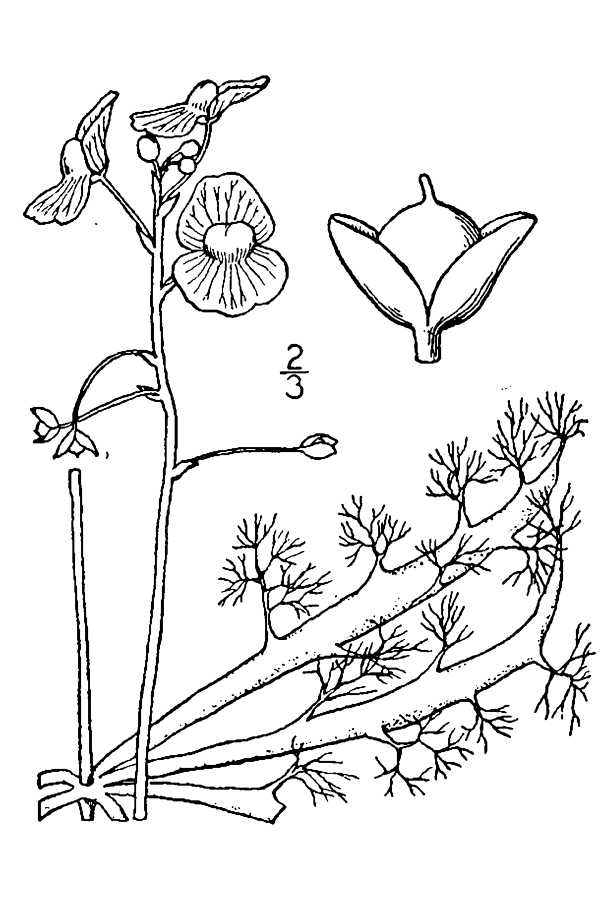
Utricularia reticulata grows terrestrially or subaquatically in marshy grasslands and in wet soils over rocks at lower altitudes, up to approximately 750 metres. It is a carnivorous plant with bluish purple flowers whose larger lips bear dark net-like veins and light-coloured centres.
Written 26 November 2026 from the sources listed below. Each statement was checked against the passage it cites; statements that could not be supported were removed.
Appearance
The leaves are narrowly linear-oblong and measure approximately 1–2 cm in length. The plant produces slender, erect, twinned flower stalks measuring approximately 15–50 cm in length.[1][2][3][4]
The bluish purple flowers are arranged in racemes and spaced apart in the upper portion. Their peduncles measure approximately 6–12 mm in length.[5][6][7]
Each flower has two lips, with the larger lip bearing dark net-like veins and a light-coloured centre. The larger lip measures approximately 1.2–1.6 cm in length, and each flower has a straight, conical spur measuring approximately 6 mm in length.[8][9][10][11]
Habitat
The species grows terrestrially or subaquatically in marshy grasslands and in wet soils over rocks at lower altitudes. It occurs at elevations up to approximately 750 metres.[12][13][14]
It is commonly found as a weed in rice fields.[15]
Diet
The species is described as carnivorous.[16]
Behaviour
The species is considered probably annual.[17]
Classification of the Net-veined Bladderwort
| Kingdom | Plantae |
|---|---|
| Subkingdom | Pteridobiotina |
| Phylum | Tracheophyta |
| Class | Magnoliopsida |
| Order | Lamiales |
| Family | Lentibulariaceae (Bladderwort Family) |
| Subfamily | Utricularioideae |
| Genus | Utricularia (Bladderwort) |
| Species | Utricularia reticulata Sm. |
Where the Net-veined Bladderwort is found
Checklists and occurrence records place Utricularia reticulata in 3 countries across Asia. GBIF holds 242 georeferenced records of it.
Countries
Regions and cities with the most records
- Maharashtra, India 48
- Karnataka, India 24
- Kerala, India 23
- Payyanur, India 21
- Cheruthazham, India 20
- Ezhome, India 20
- Kunnimangalam, India 20
- Mādāyi, India 20
- Pariyāram, India 20
- Trikarpūr North, India 19
- Trikarpūr South, India 19
- Goa, India 16
- Cherukunnu, India 14
- Gujarat, India 14
- Nīlēshwar, India 14
- Undera, India 13
- Chimbel, India 12
- Vadodara, India 12
- Bicholim, India 11
- Kanhangad, India 11
- Mapusa, India 11
- Padra, India 11
- Ratnagiri, India 11
- Vāghodia, India 11
- Calangute, India 10
- Panjim, India 10
- Penha de França, India 10
- Taleigao, India 10
- Azhikkōd, India 9
- Kalliyasshēri, India 9
- Kannapuram, India 9
- Kolaccheri, India 9
- Kurumathur, India 9
- Pāppinisshēri, India 9
- Taliparamba, India 9
- Vasco da Gama, India 9
Range as the checklists state it
India (Goa, Karnataka, Kerala, Maharashtra, Tamil Nadu); Sri Lanka
A number beside a place is its count of GBIF occurrence records. A place without a number comes from a checklist alone. Records show where a species has been observed or collected, which can include escapes and vagrants.
Common names
English
- Net-veined Bladderwort
Names in 3 other languages
- Chinese
- 網紋狸藻
- Japanese
- アミメミミカキグサ
- Marathi
- निळी पापणी
Synonyms
3 other scientific names have been used for this species and are now treated as synonyms of Utricularia reticulata.
- Utricularia oryzetorum Miq. ex C.B.Clarke
- Utricularia reticulata var. parviflora Santapau
- Utricularia spiricaulis Miq. ex Oliv.
Related species
-
 Sandersons BladderwortUtricularia sandersonii
-
 Greater BladderwortUtricularia vulgaris
-
 Floating BladderwortUtricularia gibba
-
 Fairy ApronsUtricularia dichotoma
-
 Lesser BladderwortUtricularia minor
-
 Swollen BladderwortUtricularia inflata
-
 Leaden BladderwortUtricularia livida
-
 Cape BladderwortUtricularia bisquamata
Compare
Questions and answers
What is the scientific name of the Net-veined Bladderwort?
The scientific name of the Net-veined Bladderwort is Utricularia reticulata. Written with its author, the full name is Utricularia reticulata Sm..
Which family does the Net-veined Bladderwort belong to?
Utricularia reticulata belongs to the family Lentibulariaceae, in the order Lamiales and the class Magnoliopsida.
Where is the Net-veined Bladderwort found?
Checklists and occurrence records place Utricularia reticulata in 3 countries: India, Sri Lanka and Taiwan.
What is the conservation status of the Net-veined Bladderwort?
The IUCN Red List category recorded for Utricularia reticulata is Least Concern (LC).
What does a bladderwort plant eat?
Net-veined bladderwort is described as carnivorous.[16]
Sources
Passages the profile rests on
- The leaves are narrowly linear-oblong in shape. Source passage: “The leaves are narrowly linear-oblong and about 1-2 cm long.” — English Wikipedia
- The leaves measure approximately 1–2 cm in length. Source passage: “The leaves are narrowly linear-oblong and about 1-2 cm long.” — English Wikipedia
- The plant produces slender, erect, twinned flower stalks. Source passage: “The slender scapes are about 15 cm to 50 cm long, erect and twinned.” — English Wikipedia
- The flower stalks measure approximately 15–50 cm in length. Source passage: “The slender scapes are about 15 cm to 50 cm long, erect and twinned.” — English Wikipedia
- The flowers are bluish purple and arranged in racemes. Source passage: “Flowers are bluish purple in colour, arranged in racemes” — English Wikipedia
- The flowers are spaced apart in the upper portion of the raceme. Source passage: “well-spaced in the upper part of the raceme” — English Wikipedia
- The flower peduncles measure approximately 6–12 mm in length. Source passage: “with 6-12 mm long peduncles.” — English Wikipedia
- The flowers have two lips, with the larger lip bearing dark net-like veins and a light-coloured centre. Source passage: “Flowers are 2-lipped with the 1.2-1.6 cm long larger lip, darkly net-veined, with a light colored center.” — English Wikipedia
- The larger flower lip measures approximately 1.2–1.6 cm in length. Source passage: “Flowers are 2-lipped with the 1.2-1.6 cm long larger lip” — English Wikipedia
- Each flower has a straight, conical spur. Source passage: “They each have a conical, straight spur about 6 mm long.” — English Wikipedia
- The flower spur measures approximately 6 mm in length. Source passage: “They each have a conical, straight spur about 6 mm long.” — English Wikipedia
- The species grows terrestrially or subaquatically in marshy grasslands. Source passage: “U. reticulata grows as a terrestrial or subaquatic plant in marshy grasslands” — English Wikipedia
- The species grows in wet soils over rocks at lower altitudes. Source passage: “wet soils over rocks at lower altitudes up to 750 m (2,461 ft).” — English Wikipedia
- The species occurs at elevations up to approximately 750 metres. Source passage: “lower altitudes up to 750 m (2,461 ft).” — English Wikipedia
- The species is commonly found as a weed in rice fields. Source passage: “It is also a common weed found in rice fields.” — English Wikipedia
- The species is described as carnivorous. Source passage: “probably annual carnivorous plant” — English Wikipedia
- The species is considered probably annual. Source passage: “probably annual carnivorous plant” — English Wikipedia
Data
- Catalogue of Life, 2026-10-16 XR cc by
- Global Biodiversity Information Facility CC BY 4.0
- Wikidata CC0
- GeoNames CC BY 4.0
- Wikimedia Commons per image; credit shown with each image
- Within the Catalogue of Life, this name comes from Synonymic Checklists of the Vascular Plants of the World cc by
References
- Sm. (1805). Exot. Bot. 2: 119, t. 119 (1805). where the name was published
This species in other databases
Page built on 28 November 2026. See how the catalog is made and all sources and licences.
Cite this page
ScientificNames.org. (2026). Utricularia reticulata (Net-veined Bladderwort). Retrieved November 28, 2026, from https://scientificnames.org/species/utricularia-reticulata
“Utricularia reticulata (Net-veined Bladderwort).” ScientificNames.org, 2026, scientificnames.org/species/utricularia-reticulata. Accessed 28 Nov. 2026.
ScientificNames.org. “Utricularia reticulata (Net-veined Bladderwort).” Accessed November 28, 2026. https://scientificnames.org/species/utricularia-reticulata.
@misc{scientificnames_utricularia_reticulata_net_veined_bladderwort,
  author = {{ScientificNames.org}},
  title = {Utricularia reticulata (Net-veined Bladderwort)},
  year = {2026},
  url = {https://scientificnames.org/species/utricularia-reticulata},
  note = {Accessed 2026-11-28}
}