Species · Flowering plants
American Blue Vervain Verbena hastata
The scientific name of the American Blue Vervain is Verbena hastata. It is a species of flowering plant in the family Verbenaceae (verbena family), order Lamiales.
- Scientific name
- Verbena hastata L.
- Common name
- American Blue Vervain
- Genus
- Verbena
- Family
- Verbenaceae (Verbena Family)
- Order
- Lamiales
- Class
- Magnoliopsida
- Recorded in
- 9 countries
- Name status
- accepted in the Catalogue of Life

Overview
American blue vervain (Verbena hastata L.) is a perennial flowering plant in the family Verbenaceae, order Lamiales, and class Magnoliopsida. It typically grows in moist conditions, including wet meadows, wet river bottomlands, fields, and waste areas. It is distinguished by its stiffly erect, four-angled stems and dense spikes of violet or deep purple flowers.
Written 26 November 2026 from the sources listed below. Each statement was checked against the passage it cites; statements that could not be supported were removed.
Appearance
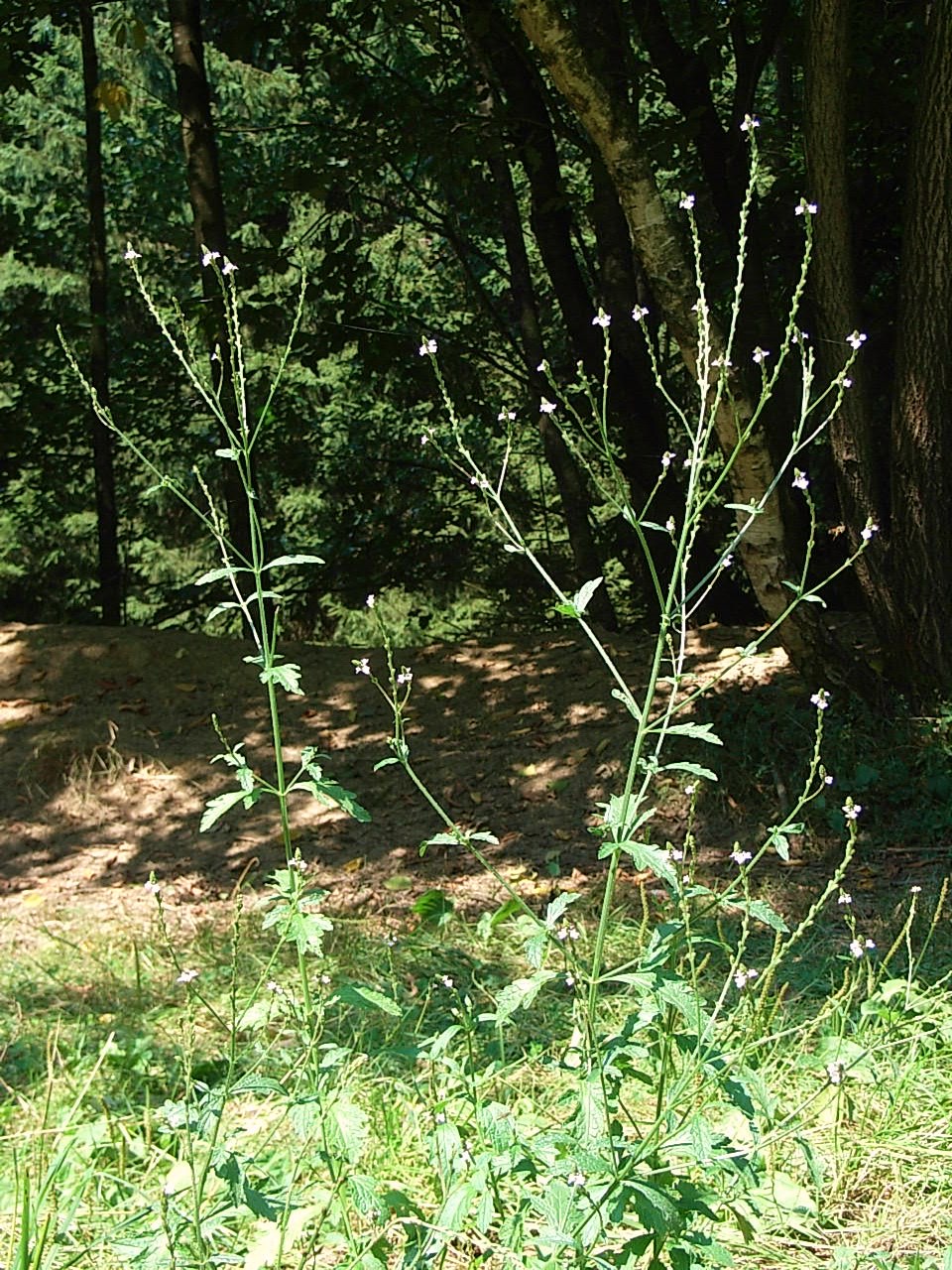
The plant has stiffly erect stems that may branch in their upper halves. Its stems are four-angled, hairy, and green to reddish in color.[1][2]
Its leaves grow in opposite pairs and have simple blades with doubly serrated edges. Their shapes range from lanceolate to ovate, and they may possess two lateral lobes.[3][4][5]
Its flowering structures consist of a panicle of flowering spikes at the ends of the upper stems. The flowers have five lobes and are densely arranged along the spikes, with violet or deep purple coloration and rare white flowers.[6][7][8]
The plant can reach a height of 1.5 metres. Its leaves can reach 15 centimetres in length and 3 centimetres in width.[9][10]
Its flowering panicles can reach 30 centimetres in length, while individual flowering spikes can reach 13 centimetres. Individual flowers can reach 0.75 centimetres in length.[11][12][13]
Habitat
American blue vervain typically grows in moist conditions and is adapted to wetland environments. Its habitats include wet meadows and wet river bottomlands.[14][15][16][17]
The species can also grow in fields and waste areas.[18]
Reproduction and life cycle
The species flowers from mid-summer through late summer. Flowers open progressively from the bottom toward the top of each flowering spike, with only a few flowers open simultaneously.[19][20][21]
Its flowers attract bees and other insect pollinators.[22]
Behaviour
The plant can spread and form small colonies.[23]
Conservation
The species can establish small colonies through spreading.[24]
Diet
Several bird species consume the plant's seeds. Cottontail rabbits sometimes feed on its leaves.[25][26]
Uses
The species contains lophirone C, lophirone B, verbenalin, verbascoside, luteolin, oleanolic acid, ursolic acid, and 4,9-dihydroxy-α-lapachone.[27]
Similar species
White vervain is identified as a possible species involved in the evolutionary hybridization history of Verbena hastata.[28]
Classification of the American Blue Vervain
| Kingdom | Plantae |
|---|---|
| Subkingdom | Pteridobiotina |
| Phylum | Tracheophyta |
| Class | Magnoliopsida |
| Order | Lamiales |
| Family | Verbenaceae (Verbena Family) |
| Tribe | Verbeneae |
| Genus | Verbena (Vervain) |
| Species | Verbena hastata L. |
Where the American Blue Vervain is found
Checklists and occurrence records place Verbena hastata in 9 countries across Asia, Europe and North America. GBIF holds 37,100 georeferenced records of it.
Countries where it is native or its origin is not stated
Countries where it has been introduced
Regions and cities with the most records
- Ontario, Canada 4,238
- Wisconsin, United States 3,222
- Minnesota, United States 2,756
- Michigan, United States 2,581
- Pennsylvania, United States 2,299
- Illinois, United States 2,227
- New York, United States 2,223
- Ohio, United States 1,821
- Massachusetts, United States 1,628
- Vermont, United States 810
- Quebec, Canada 732
- New Jersey, United States 726
- Longfellow Community, United States 690
- Minneapolis, United States 682
- Richfield, United States 668
- Roseville, United States 652
- Columbia Heights, United States 630
- Saint Louis Park, United States 628
- Waltham, United States 626
- Edina, United States 624
- Bloomington, United States 623
- Saint Paul, United States 613
- Indiana, United States 612
- Newton, United States 612
- West Saint Paul, United States 612
- Golden Valley, United States 606
- Watertown, United States 601
- Belmont, United States 592
- Lexington, United States 581
- New Brighton, United States 580
- Arlington, United States 577
- Winchester, United States 550
- Chestnut Hill, United States 549
- Medford, United States 547
- Brighton, United States 540
- Allston, United States 539
8 more countries have a few records outside this range
These countries hold a few records of Verbena hastata but lie outside the range the checklists give for it. Such records are often zoo or garden specimens, museum material or vagrants, so the species is not counted as occurring there.
Range as the checklists state it
Sweden [I]; Netherlands [I]; Germany [I]; Northern Caucasus [I]; Georgia [Caucasus] [I]; India [c]; Canada (Manitoba, New Brunswick, Nova Scotia, Ontario, Québec, Saskatchewan); USA (Alabama, Arkansas, Connecticut, District of Columbia, Delaware, Florida, Georgia, Iowa, Illinois, Indiana, Kansas, Kentucky, Louisiana, Massachusetts, Maryland, Maine, Michigan, Minnesota, Missouri, Mississippi, North Carolina, North Dakota, Nebraska, New Hampshire, New Jersey, New Mexico, New York, Ohio, Oklahoma, Pennsylvania, Rhode Island, South Carolina, South Dakota, Tennessee, Texas, Virginia, Vermont, Wisconsin, West Virginia)
A number beside a place is its count of GBIF occurrence records. A place without a number comes from a checklist alone. Records show where a species has been observed or collected, which can include escapes and vagrants.
Common names
English
- American Blue Vervain
- American Vervain
- Blue Vervain
- Simpler's-joy
- Swamp Vervain
- Wild Hyssop
Names in 15 other languages
- Chinese
- 藍花馬鞭草
- Czech
- sporýš šípovitý
- Dutch
- Blauwe verbena
- Finnish
- tähkäverbena
- French
- verveine hastée, verveine scabre
- German
- Lanzen-Eisenkraut
- Norwegian Bokmål
- tårnjernurt
- Polish
- Werbena oszczepowata
- Portuguese
- verbena
- Russian
- Вербена копьевидная
- Slovak
- železník oštepovitý
- Spanish
- Verbena azul
- Swedish
- blåverbena
- Ukrainian
- Вербена списоподібна
- oji
- Zhawaseshkoohnse
Synonyms
14 other scientific names have been used for this species and are now treated as synonyms of Verbena hastata.
- Verbena hastata f. albiflora Moldenke
- Verbena hastata f. caerulea Moldenke
- Verbena hastata f. hastata
- Verbena hastata f. rosea (Coleman) R.H.Cheney
- Verbena hastata var. hastata
- Verbena hastata var. oblongifolia Nutt.
- Verbena hastata var. paniculata (Lam.) Farw.
- Verbena hastata var. pinnatifida (Lam.) Pursh
- Verbena hastata var. rosea N.Coleman
- Verbena hastata var. scabra Moldenke
- Verbena paniculata Lam.
- Verbena paniculata Poir.
- Verbena paniculata var. pinnatifida (Lam.) Schauer
- Verbena pinnatifida Lam.
Related species
-
 Argentinian VervainVerbena bonariensis
-
 Common VervainVerbena officinalis
-
 Slender VervainVerbena rigida
-
 White VervainVerbena urticifolia
-
 Brazilian VervainVerbena brasiliensis
-
 Hoary VervainVerbena stricta
-
 Bracted VervainVerbena bracteata
-
 Brazilian VervainVerbena litoralis
Compare
Questions and answers
What is the scientific name of the American Blue Vervain?
The scientific name of the American Blue Vervain is Verbena hastata. Written with its author, the full name is Verbena hastata L..
Which family does the American Blue Vervain belong to?
Verbena hastata belongs to the family Verbenaceae, in the order Lamiales and the class Magnoliopsida.
Where is the American Blue Vervain found?
Checklists and occurrence records place Verbena hastata in 9 countries, including United States, Canada, The Netherlands, Japan, South Korea and India.
What other names does the American Blue Vervain have?
Verbena hastata is also known in English as American Vervain, Blue Vervain, Simpler's-joy, Swamp Vervain and Wild Hyssop.
Sources
Passages the profile rests on
- The plant has stiffly erect stems that may branch in their upper halves. Source passage: “V. hastata is a perennial species that grows as a stiffly erect stem, occasionally branching in the upper half” — English Wikipedia
- Its stems are four-angled, hairy, and green to reddish in color. Source passage: “The stems are four-angled (square), hairy, and green to reddish in color.” — English Wikipedia
- Its leaves grow in opposite pairs and have simple blades. Source passage: “The leaves are opposite, simple” — English Wikipedia
- Its leaves have doubly serrated edges and can range from lanceolate to ovate in shape. Source passage: “They have doubly-serrate margins and a variety of shapes, from lanceolate to ovate” — English Wikipedia
- Its leaves may possess two lateral lobes. Source passage: “and may have two lateral lobes.” — English Wikipedia
- Its flowering structures consist of a panicle of flowering spikes at the ends of the upper stems. Source passage: “The inflorescence is a panicle, or group, of flowering spikes, up to 30 cm (1 ft) long at the end of the upper stems.” — English Wikipedia
- Its flowers have five lobes and are densely arranged along the flowering spikes. Source passage: “with densely packed, numerous 5-lobed flowers” — English Wikipedia
- Its flowers are violet or deep purple, with white flowers occurring rarely. Source passage: “The flowers are violet or deep purple, rarely white.” — English Wikipedia
- The plant can reach a height of 1.5 metres. Source passage: “reaching up to 1.5 metres (5 feet) tall.” — English Wikipedia
- Its leaves can reach 15 centimetres in length and 3 centimetres in width. Source passage: “measure up to 15 centimetres (6 inches) long and 3 cm (1 in) across.” — English Wikipedia
- Its flowering panicles can reach 30 centimetres in length. Source passage: “up to 30 cm (1 ft) long at the end of the upper stems.” — English Wikipedia
- Individual flowering spikes can reach 13 centimetres in length. Source passage: “Each flowering spike in the panicle is up to 13 cm (5 in) long” — English Wikipedia
- Individual flowers can reach 0.75 centimetres in length. Source passage: “which measure up to 0.75 cm (1⁄4 in) long.” — English Wikipedia
- The species typically grows in moist conditions. Source passage: “The plant prefers moist conditions” — English Wikipedia
- Its habitats include wet meadows. Source passage: “typically grows in wet meadows, wet river bottomlands, stream banks, slough peripheries, fields and waste areas.” — English Wikipedia
- The species occurs in wet river bottomlands. Source passage: “wet river bottomlands” — English Wikipedia
- The species is adapted to wetland environments. Source passage: “It is adapted to wetlands” — English Wikipedia
- The species can grow in fields and waste areas. Source passage: “fields and waste areas.” — English Wikipedia
- The species flowers from mid-summer through late summer. Source passage: “The bloom period is from mid- to late summer.” — English Wikipedia
- Flowers open progressively from the bottom toward the top of each flowering spike. Source passage: “They open from the bottom of the spike upward” — English Wikipedia
- Only a few flowers on a flowering spike are open simultaneously. Source passage: “with a few flowers open at a time.” — English Wikipedia
- The flowers attract bees and other insect pollinators. Source passage: “The flowers attract many types of bees and other insect pollinators.” — English Wikipedia
- The plant can spread and form small colonies. Source passage: “can spread to form small colonies.” — English Wikipedia
- The species can establish small colonies through spreading. Source passage: “It is adapted to wetlands and can spread to form small colonies.” — English Wikipedia
- Several bird species consume the plant's seeds. Source passage: “Several species of birds eat the seeds” — English Wikipedia
- Cottontail rabbits sometimes feed on the plant's leaves. Source passage: “Cottontail rabbits will sometimes eat the leaves” — English Wikipedia
- The species contains the chemical compounds lophirone C, lophirone B, verbenalin, verbascoside, luteolin, oleanolic acid, ursolic acid, and 4,9-dihydroxy-α-lapachone. Source passage: “Verbena hastata contains lophirone C, lophirone B, verbenalin, verbascoside, luteolin, oleanolic acid, ursolic acid, and the naphthoquinone derivative 4,9-dihydroxy-α-lapachone.” — English Wikipedia
- White vervain is identified as a possible species involved in the evolutionary hybridization history of Verbena hastata. Source passage: “presumably between some member of a group including the white vervain (V. urticifolia)” — English Wikipedia
Data
- Catalogue of Life, 2026-10-16 XR cc by
- Global Biodiversity Information Facility CC BY 4.0
- Wikidata CC0
- GeoNames CC BY 4.0
- Wikimedia Commons per image; credit shown with each image
- Within the Catalogue of Life, this name comes from Synonymic Checklists of the Vascular Plants of the World cc by
References
- L. Sp. Pl. [Linnaeus] 20 (1753). where the name was published
This species in other databases
Page built on 28 November 2026. See how the catalog is made and all sources and licences.
Cite this page
ScientificNames.org. (2026). Verbena hastata (American Blue Vervain). Retrieved November 28, 2026, from https://scientificnames.org/species/verbena-hastata
“Verbena hastata (American Blue Vervain).” ScientificNames.org, 2026, scientificnames.org/species/verbena-hastata. Accessed 28 Nov. 2026.
ScientificNames.org. “Verbena hastata (American Blue Vervain).” Accessed November 28, 2026. https://scientificnames.org/species/verbena-hastata.
@misc{scientificnames_verbena_hastata_american_blue_vervain,
  author = {{ScientificNames.org}},
  title = {Verbena hastata (American Blue Vervain)},
  year = {2026},
  url = {https://scientificnames.org/species/verbena-hastata},
  note = {Accessed 2026-11-28}
}