Species · Flowering plants
Common Vervain Verbena officinalis
The scientific name of the Common Vervain is Verbena officinalis. It is a species of flowering plant in the family Verbenaceae (verbena family), order Lamiales.
- Scientific name
- Verbena officinalis L.
- Common name
- Common Vervain
- Genus
- Verbena
- Family
- Verbenaceae (Verbena Family)
- Order
- Lamiales
- Class
- Magnoliopsida
- Recorded in
- 118 countries
- Name status
- accepted in the Catalogue of Life
Overview
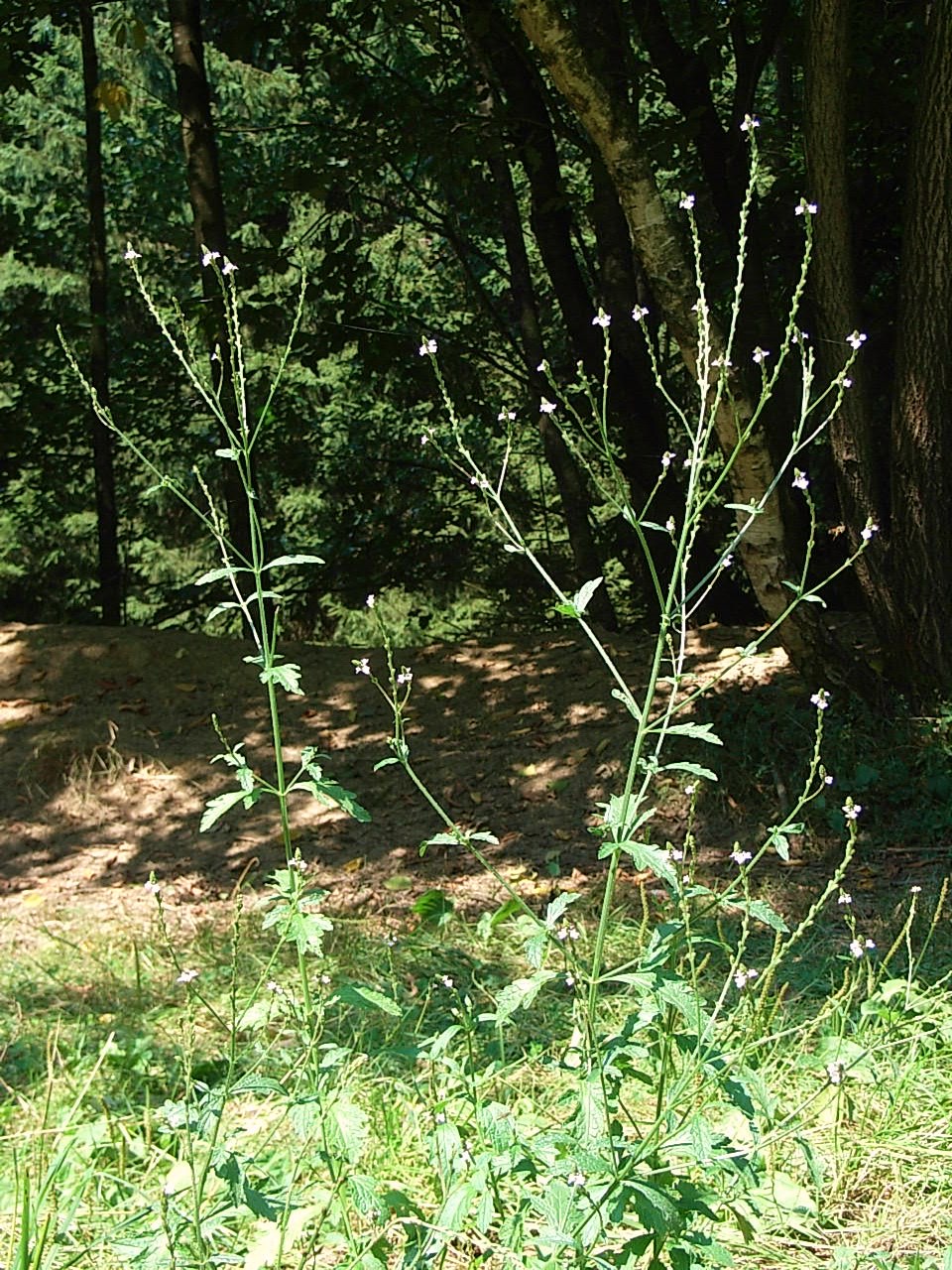
Verbena officinalis is native to Europe and has become widely naturalised outside its native range, including in North America. It has an upright growth habit, lobed and toothed leaves, and delicate flower spikes bearing clusters of two-lipped mauve flowers.
Written 26 November 2026 from the sources listed below. Each statement was checked against the passage it cites; statements that could not be supported were removed.
Appearance
Common vervain has an upright growth habit and grows to a height of up to 70 centimetres. Its leaves are lobed and toothed, and its delicate flower spikes bear clusters of two-lipped mauve flowers.[1][2][3]
Habitat
Common vervain prefers limey soils.[4]
Reproduction and life cycle
Common vervain can be propagated using root cuttings or seeds.[5]
Conservation
Common vervain is native to Europe and is not native to North America. It has become widely naturalised outside its native range and is widely distributed worldwide.[6][7][8][9]
Uses
Common vervain has a long history of use as a medicinal plant and is commonly used in folk medicine in different countries. It is commonly prepared as herbal tea.[10][11][12]
Herbal capsules containing common vervain are used as a sleep-promoting remedy. The compounds hastatoside and verbenalin identified in the plant have sleep-promoting properties.[13][14][15]
Traditional Austrian medicine uses common vervain internally as tea or liqueur to treat infections and fever.[16]
Common vervain is occasionally cultivated as an ornamental plant.[17]
Similar species
Common vervain may be closely related to a group containing Verbena urticifolia, Verbena lasiostachys and Verbena menthifolia.[18]
Classification of the Common Vervain
| Kingdom | Plantae |
|---|---|
| Subkingdom | Pteridobiotina |
| Phylum | Tracheophyta |
| Class | Magnoliopsida |
| Order | Lamiales |
| Family | Verbenaceae (Verbena Family) |
| Tribe | Verbeneae |
| Genus | Verbena (Vervain) |
| Species | Verbena officinalis L. |
Where the Common Vervain is found
Checklists and occurrence records place Verbena officinalis in 118 countries across Africa, Asia, Europe, North America, Oceania and South America. GBIF holds 253,009 georeferenced records of it.
Countries where it is native or its origin is not stated
- Afghanistan 41
- Albania 32
- Algeria 44
- Andorra 17
- Armenia 27
- Austria 3,798
- Azerbaijan 20
- Bangladesh
- Belarus 19
- Belgium 8,098
- Benin 3
- Bhutan 15
- Bosnia and Herzegovina 42
- Bulgaria 113
- Cabo Verde 7
- China 3,504
- Croatia 284
- Cyprus 46
- Czechia 598
- Democratic Republic of the Congo 15
- Denmark 233
- Egypt 16
- Eritrea 12
- Eswatini 4
- Ethiopia 79
- Finland 9
- France 140,782
- Georgia 90
- Germany 15,441
- Gibraltar 1
- Greece 710
- Guernsey 2
- Hong Kong 11
- Hungary 433
- Iran 55
- Iraq 74
- Ireland 69
- Isle of Man 68
- Israel 1,608
- Italy 4,611
- Japan 593
- Jersey 9
- Jordan 6
- Kazakhstan 19
- Kenya 34
- Kyrgyzstan 25
- Lebanon 13
- Libya 7
- Liechtenstein 52
- Luxembourg 191
- Malta 20
- Mauritania
- Moldova 19
- Montenegro 28
- Morocco 116
- Myanmar 13
- Nepal 17
- Niger 3
- Nigeria 4
- North Korea
- North Macedonia 6
- Norway 42
- Oman 5
- Pakistan 32
- Palestinian Territory 22
- Philippines 11
- Poland 449
- Portugal 3,298
- Reunion 5
- Romania 124
- Russia 535
- Rwanda 5
- San Marino
- Saudi Arabia 7
- Serbia 79
- Slovakia 804
- Slovenia 213
- Somalia 7
- South Africa 154
- South Korea 214
- South Sudan 1
- Spain 13,539
- Sudan 3
- Sweden 534
- Switzerland 12,403
- Syria 26
- Taiwan 267
- Tajikistan 6
- Tanzania 11
- Thailand 30
- The Netherlands 14,107
- Tunisia 6
- Turkey 174
- Turkmenistan 8
- Uganda 9
- Ukraine 587
- United Kingdom 18,133
- Uzbekistan 101
- Vietnam 12
- Yemen 17
- Zambia 10
- Zimbabwe 18
Countries where it has been introduced
- Australia 3,505
- Bermuda 12
- Bolivia 2
- Brazil 32
- Chile 11
- Colombia 13
- Cuba 12
- Ecuador 3
- India 94
- Mauritius 32
- Mexico 155
- New Caledonia 8
- New Zealand 218
- Niue 8
- Saint Helena 6
- United States 684
Regions and cities with the most records
- Auvergne-Rhône-Alpes, France 22,283
- Bourgogne-Franche-Comté, France 18,094
- Centre-Val de Loire, France 18,085
- Île-de-France, France 17,986
- England, United Kingdom 15,544
- Grand Est, France 13,031
- Occitanie, France 9,797
- Hauts-de-France, France 9,180
- Bavaria, Germany 6,437
- Provence-Alpes-Côte d'Azur, France 5,897
- Pays de la Loire, France 5,332
- Maastricht, The Netherlands 4,914
- Lanaken, Belgium 4,312
- Paris 13 Gobelins, France 4,282
- Salpêtrière, France 4,281
- Catalonia, Spain 4,268
- Gare, France 4,253
- Quinze-Vingts, France 4,237
- Ivry-sur-Seine, France 4,189
- Hoensbroek, The Netherlands 4,180
- Paris 05 Panthéon, France 4,169
- Paris 07 Palais-Bourbon, France 4,169
- Le Kremlin-Bicêtre, France 4,158
- Maison Blanche, France 4,154
- Paris 12 Reuilly, France 4,153
- Charenton-le-Pont, France 4,149
- Saint-Mandé, France 4,143
- Gentilly, France 4,139
- Paris 09 Opéra, France 4,137
- Maisons-Alfort, France 4,127
- Croulebarbe, France 4,124
- Paris, France 4,121
- Paris 06 Luxembourg, France 4,118
- Paris 02 Bourse, France 4,102
- Maasmechelen, Belgium 4,090
- Alfortville, France 4,084
8 more countries have a few records outside this range
These countries hold a few records of Verbena officinalis but lie outside the range the checklists give for it. Such records are often zoo or garden specimens, museum material or vagrants, so the species is not counted as occurring there.
Range as the checklists state it
England (England, Wales, Isle of Man, Scotland, Isles of Scilly); Ireland (Ireland, Northern Ireland); Denmark; Norway; Sweden (incl. Bornholm Isl.); Finland; Netherlands; Belgium; Luxembourg; Luxembourg; Germany (Brandenburg, Berlin, Baden-Württemberg, Bayern, Hessen, Hamburg, Mecklenburg-Vorpommern, Niedersachsen, Nordrhein-Westfalen, Rheinland-Pfalz, Schleswig-Holstein, Saarland, Sachsen, Sachsen-Anhalt, Thüringen); Switzerland; Liechtenstein; Liechtenstein; Austria; Poland; Czech Republic; Slovakia; Hungary; Portugal; Spain; Andorra; Gibraltar; Baleares; France; Channel Isl. (Alderney, Guernsey, Jersey); Italy; Sicily; Pantelleria; Isole Pelagie (Lampedusa); Malta; Pantelleria; San Marino; Slovenia; Croatia; Bosnia & Hercegovina; Bosnia & Hercegovina; Montenegro; Serbia; North Macedonia; Albania; Romania; Bulgaria; European Turkey; Greece (widespread lowlands, incl. most islands); Crete; Belarus; European Russia; Ukraine; Morocco; Algeria; Tunisia; Libya; Egypt (Desert Oases, Great Southwestern Desert, Nile Delta, Nile Valley); Azores (Santa Maria Isl., Sao Miguel Isl., Terceira, Graciosa, Sao Jorge, Pico, Faial, Flores Isl., Corvo Isl.); Madeira (Madeira Isl., Porto Santo Isl.); Canary Isl. (Lanzarote, Fuerteventura, Gran Canaria, Tenerife, La Gomera, La Palma); Cape Verde Isl. (Santo Antao Isl., Ilha de Sao Tiago, Ilha Brava); Mauritania; Benin; Niger; D. R. Congo [Zaire]; Sudan; Ethiopia; Eritrea; Somalia; Uganda; Kenya; Tanzania; Mauritius [I]; La Réunion [I]; Rodrigues [I]; Kazakhstan; Turkmenistan; Uzbekistan; Kyrgyzstan; Tajikistan; Northern Caucasus (incl. Daghestan); Georgia [Caucasus]; Armenia; Azerbaijan; East Aegaean Isl. (widespread, incl. Rhodos, Kastellorhizo Isl.); Turkey (E-Anatolia, Inner Anatolia, N-Anatolia, NE-Anatolia, NW-Anatolia: Bithynia, S-Anatolia, SE-Anatolia, SE-Anatolia: Mesopotamian Anatolia, SSW-Anatolia, SW-Anatolia, W-Anatolia); Iraq (NE-Iraq, SE-Iraq: Mesopotamia); Iran (EC-Iran, NE-Iran: Mts., N-Iran, Iranian Aserbaijan, S-Iran, W-Iran); Afghanistan (Badakshan, Wakhan, Baghlan, Farah, Faryab, Herat, Kabul, Kunar / Nuristan, Laghman, Parwan); Cyprus (C-Mountains, E-Cyprus, N-Cyprus, SE-Cyprus, W-Cyprus); Lebanon (Antilebanon, C-Lebanon, coastal W-Lebanon); Syria (NW-Syria, Jbel Druze); Israel (coastal W-Israel, Rift Valley, N-Israel, Judean Desert, Negev Desert); Saudi Arabia (Asir); Oman (Mascat & Oman); Yemen (N-Inner Yemen, W-Yemen); China (Anhui, Fujian, Gansu, Guangdong, Guangxi, Guizhou, Hainan, Hubei, Hunan, Jiangsu, Jiangxi, Shaanxi, Shanxi, Sichuan, Xinjiang, Yunnan, Zhejiang); Tibet; North Korea; South Korea; Japan (Honshu, Ikishima, Kyushu, Shikoku); Ryukyu Isl. (Amami Oshima, Irabu, Ishigakijima, Kurimajima, Miyakojima, Okinawa Isl., Shimoji Isl., Taketomi, Yonagunijima); Taiwan; Taiwan [I]; Pakistan (Baluchistan, N. W. Frontier Prov., Sind, Swat, Waziristan, Hazara, Pakistani Punjab); Nepal; Bhutan; India (Andhra Pradesh, Arunachal Pradesh, Assam, Bihar, Himachal Pradesh, Jammu & Kashmir, Jharkhand, ?Madhya Pradesh, Maharashtra, Manipur, Meghalaya, Mizoram, Nagaland, Punjab, Uttarakhand); Lakshadweep Isl. [Laccadives] [I]; Bangladesh; Myanmar; Thailand; Vietnam; Philippines (Luzon); Jawa; Australia [I] (Northern Territory [I], South Australia [I], Queensland [I], New South Wales [I], Victoria [I], Tasmania [I]); New Zealand (North, South); New Caledonia [I]; Niue [I]; USA [I] (Alabama [I], California [I], Colorado [I], Connecticut [I], District of Columbia [I], Delaware [I], Florida [I], Georgia [I], Kentucky [I], Louisiana [I], Massachusetts [I], Maryland [I], Michigan [I], Mississippi [I], North Carolina [I], New Jersey [I], New Mexico [I], New York [I], Oregon [I], Pennsylvania [I], Rhode Island [I], South Carolina [I], Tennessee [I], Virginia [I], Washington State [I], Wisconsin [I], West Virginia [I]); Bermuda [I]; Mexico [I]; Cuba [I]; Colombia [I]; Galápagos [I]; Bolivia [I]; SE-Brazil [I] (Rio de Janeiro [I]); Chile [I] (Coquimbo [I], Maule [I], Biobío [I], Araucanía [I], Los Rios [I]); Tristan da Cunha [I]
A number beside a place is its count of GBIF occurrence records. A place without a number comes from a checklist alone. Records show where a species has been observed or collected, which can include escapes and vagrants.
Common names
English
- Common Vervain
- European Verbena
- European Vervain
- Vervain
- Common Verbena
- Official Vervain
- Simpler's-joy
- Turkey-grass
- Wild Verbena
Names in 42 other languages
- Afrikaans
- Europese Verbena
- Arabic
- رعي الحمام الشائع, رعي الحمام الطبي
- Armenian
- Աղավնիճ դեղատու
- Azerbaijani
- Dərman minaçiçəyi
- Bulgarian
- Върбинка, Лечебна върбинка
- Catalan
- Berbena
- Chinese
- ma bian cao, 馬鞭草, 马鞭草
- Czech
- sporýš lékařský
- Danish
- Jernurt, Læge-jernurt
- Dutch
- IJzerhard
- Esperanto
- Oficina verbeno
- Estonian
- harilik raudürt
- Finnish
- rohtoverbena
- French
- Verveine sauvage, verveine officinale
- Galician
- Verxebán
- German
- Gewöhnliches Eisenkraut, echtes Eisenkraut
- Greek
- Βερβένα η φαρμακευτική
- Hebrew
- ורבנה רפואית
- Hungarian
- Közönséges vasfű
- Italian
- Verbena comune
- Japanese
- kumatsuzura, クマツヅラ, 熊葛
- Kazakh
- Дәрілік нарқайсар
- Korean
- 마편초
- Lithuanian
- Vaistinė verbena
- Persian
- وربنا آفیسینالیس
- Polish
- Werbena lekarska, Werbena pospolita, witułka pospolita
- Portuguese
- Verbena-comum, erva-de-ferro, ferraria, planta-da-sorte, verbena
- Romanian
- Sporici
- Russian
- Вербена лекарственная
- Serbian
- Обична врбена
- Slovak
- železník lekársky
- Slovenian
- Navadni sporiš
- Spanish
- verbena común
- Swedish
- Läkeverbena, järnört
- Thai
- หญ้าแส้ม้า
- Turkish
- Tıbbi mine çiçeği, güvercin otu, mine çiçeği
- Ukrainian
- Вербена лікарська
- Welsh
- Briw'r March, Cas-Gan-Gythraul, Derwen Fendigaid, Derwen y Ddaear Ferfaen, Gwaedlys Gwyn, Hudlys, Llys yr Hudol, Llysiau'r Hudol
- glv
- Vervine
- hsb
- Prawa twjerdźenka
- kin
- Umugosora
- lmo
- Erba de San Giuann
Synonyms
32 other scientific names have been used for this species and are now treated as synonyms of Verbena officinalis.
- Verbena adulterina Hausskn.
- Verbena macrostachya F.Muell.
- Verbena menthiifolia Benth.
- Verbena officinalis f. albiflora S.H.Jin & D.D.Ma
- Verbena officinalis f. anomala Moldenke
- Verbena officinalis f. fimbriata Kereszty
- Verbena officinalis f. lobata Kereszty
- Verbena officinalis f. microphylla Kereszty
- Verbena officinalis subsp. officinalis
- Verbena officinalis var. anarrhinoides Murr
- Verbena officinalis var. anatolica Kereszty
- Verbena officinalis var. eremicola Munir
- Verbena officinalis var. grandiflora Hausskn.
- Verbena officinalis var. illyrica Kereszty
- Verbena officinalis var. latiloba Sennen
- Verbena officinalis var. macrophylla Kereszty
- Verbena officinalis var. macrostachya (F.Muell.) Benth.
- Verbena officinalis var. minima Kereszty
- Verbena officinalis var. orientalis Kereszty
- Verbena officinalis var. prostrata Gren.
- Verbena officinalis var. racemosa Kereszty
- Verbena officinalis var. ramosa H.Lév.
- Verbena officinalis var. resedifolia Murr
- Verbena officinalis var. spuria (L.) Hook.
- Verbena riparia Raf. ex Small & A.Heller
- Verbena rumelica Velen.
- Verbena sororia D.Don
- Verbena spicata Gilib.
- Verbena spuria L.
- Verbena urticifolia var. riparia (Raf. ex Small & A.Heller) Britton
- Verbena vulgaris Bubani
- Vitex adulterina Hausskn.
Subspecies and varieties
- Verbena officinalis var. africana (African Common Vervain) variety
- Verbena officinalis var. officinalis (Holywort) variety
Related species
-
 Argentinian VervainVerbena bonariensis
-
 American Blue VervainVerbena hastata
-
 Slender VervainVerbena rigida
-
 White VervainVerbena urticifolia
-
 Brazilian VervainVerbena brasiliensis
-
 Hoary VervainVerbena stricta
-
 Bracted VervainVerbena bracteata
-
 Brazilian VervainVerbena litoralis
Compare
Questions and answers
What is the scientific name of the Common Vervain?
The scientific name of the Common Vervain is Verbena officinalis. Written with its author, the full name is Verbena officinalis L..
Which family does the Common Vervain belong to?
Verbena officinalis belongs to the family Verbenaceae, in the order Lamiales and the class Magnoliopsida.
Where is the Common Vervain found?
Checklists and occurrence records place Verbena officinalis in 118 countries, including France, United Kingdom, Germany, The Netherlands, Spain and Switzerland.
What other names does the Common Vervain have?
Verbena officinalis is also known in English as European Verbena, European Vervain, Vervain, Common Verbena, Official Vervain and Simpler's-joy.
What does vervain do for humans?
Common vervain has a long history of medicinal use and is commonly consumed as herbal tea. Herbal capsules containing the plant are used as a sleep-promoting remedy, and traditional Austrian medicine uses it internally as tea or liqueur to treat infections and fever.[10][13][16][11]
Sources
Passages the profile rests on
- Verbena officinalis has lobed, toothed leaves and delicate flower spikes bearing clusters of two-lipped mauve flowers. Source passage: “The lobed leaves are toothed, and the delicate spikes hold clusters of two-lipped mauve flowers.” — English Wikipedia
- Verbena officinalis grows to a height of up to 70 centimetres. Source passage: “It grows up to 70 centimetres (28 in) high” — English Wikipedia
- Verbena officinalis has an upright growth habit. Source passage: “with an upright habitus.” — English Wikipedia
- Verbena officinalis prefers limey soils. Source passage: “It prefers limey soils.” — English Wikipedia
- Verbena officinalis can be propagated using root cuttings or seeds. Source passage: “Propagation is by root cuttings or seed.” — English Wikipedia
- Verbena officinalis is native to Europe. Source passage: “The plant is native to Europe” — English Wikipedia
- Verbena officinalis has become widely naturalised outside its native range, including in North America. Source passage: “but is widely naturalised outside its native range, for example in North America.” — English Wikipedia
- Verbena officinalis is not native to North America. Source passage: “While common vervain is not native to North America” — English Wikipedia
- Verbena officinalis is widely distributed worldwide. Source passage: “Verbena officinalis (common vervain) is a medicinal plant species widely distributed in the world” — pubmed.ncbi.nlm.nih.gov
- Verbena officinalis has a long history of use as a medicinal plant. Source passage: “it has an equally long-standing use as a medicinal plant.” — English Wikipedia
- Verbena officinalis is commonly used medicinally in the form of herbal tea. Source passage: “Medical use of Common Vervain is usually as a herbal tea;” — English Wikipedia
- Verbena officinalis is commonly used in the folk medicine of different countries. Source passage: “commonly used in folk medicine of different countries,” — pubmed.ncbi.nlm.nih.gov
- Herbal capsules containing Verbena officinalis are used as a sleep-promoting remedy. Source passage: “Herbal capsules are used as a soporific drug” — English Wikipedia
- The chemical compounds identified in Verbena officinalis include verbenalin and hastatoside. Source passage: “two iridoid glucosides (verbenalin and hastatoside)” — English Wikipedia
- The compounds hastatoside and verbenalin in Verbena officinalis have sleep-promoting properties. Source passage: “Hastatoside and verbenalin have sleep-promoting (soporific) properties.” — English Wikipedia
- Traditional Austrian medicine uses Verbena officinalis internally as tea or liqueur to treat infections and fever. Source passage: “Verbena officinalis herb has been used in the traditional Austrian medicine internally (as tea or liqueur) for treatment of infections and fever.” — English Wikipedia
- Verbena officinalis is occasionally cultivated as an ornamental plant. Source passage: “It is occasionally grown as an ornamental plant” — English Wikipedia
- Verbena officinalis may be closely related to a group containing Verbena urticifolia, Verbena lasiostachys and Verbena menthifolia. Source passage: “It might be closest to a group including such species as the white vervain (V. urticifolia), V. lasiostachys or V. menthifolia” — English Wikipedia
Data
- Catalogue of Life, 2026-10-16 XR cc by
- Global Biodiversity Information Facility CC BY 4.0
- Wikidata CC0
- GeoNames CC BY 4.0
- Wikimedia Commons per image; credit shown with each image
- Within the Catalogue of Life, this name comes from Synonymic Checklists of the Vascular Plants of the World cc by
References
- L. Sp. Pl. [Linnaeus] 20 (1753). where the name was published
This species in other databases
Page built on 29 November 2026. See how the catalog is made and all sources and licences.
Cite this page
ScientificNames.org. (2026). Verbena officinalis (Common Vervain). Retrieved November 29, 2026, from https://scientificnames.org/species/verbena-officinalis
“Verbena officinalis (Common Vervain).” ScientificNames.org, 2026, scientificnames.org/species/verbena-officinalis. Accessed 29 Nov. 2026.
ScientificNames.org. “Verbena officinalis (Common Vervain).” Accessed November 29, 2026. https://scientificnames.org/species/verbena-officinalis.
@misc{scientificnames_verbena_officinalis_common_vervain,
  author = {{ScientificNames.org}},
  title = {Verbena officinalis (Common Vervain)},
  year = {2026},
  url = {https://scientificnames.org/species/verbena-officinalis},
  note = {Accessed 2026-11-29}
}