Species · Insects
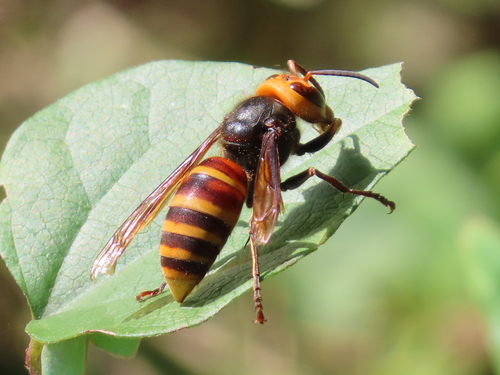
Black Shield Hornet Vespa bicolor
The scientific name of the Black Shield Hornet is Vespa bicolor. It is a species of insect in the family Vespidae (hornets), order Hymenoptera. The name dates from 1787.
- Scientific name
- Vespa bicolor Fabricius, 1787
- Common name
- Black Shield Hornet
- Genus
- Vespa
- Family
- Vespidae (Hornets)
- Order
- Hymenoptera
- Class
- Insecta
- Recorded in
- 10 countries
- Name status
- accepted in the Catalogue of Life

Overview
The species has been recorded on Hainan and is the most common large wasp in Hong Kong, alongside members of the genus Parapolybia. The species acts as a pollinator of the orchid Dendrobium sinense.
Written 26 November 2026 from the sources listed below. Each statement was checked against the passage it cites; statements that could not be supported were removed.
Appearance
The species is commonly known as the black shield wasp.[1]
Habitat
The species occurs in a wide range of environments and can occur near human dwellings.[2][3]
Diet
The species preys on honey bees and feeds them to its larvae.[4]
Behaviour
The species acts as a pollinator of the orchid Dendrobium sinense. The orchid attracts the species by producing a chemical that mimics a honey bee pheromone.[5][6]
Classification of the Black Shield Hornet
| Kingdom | Animalia |
|---|---|
| Phylum | Arthropoda |
| Subphylum | Hexapoda |
| Class | Insecta (Insect) |
| Order | Hymenoptera (Ants) |
| Suborder | Apocrita (Ants) |
| Infraorder | Aculeata |
| Superfamily | Vespoidea (Vespoid Wasps) |
| Family | Vespidae (Hornets) |
| Subfamily | Vespinae |
| Genus | Vespa (Hornet) |
| Species | Vespa bicolor Fabricius, 1787 |
Where the Black Shield Hornet is found
Checklists and occurrence records place Vespa bicolor in 10 countries. GBIF holds 1,796 georeferenced records of it.
Countries
- Bhutan 5
- Cambodia 3
- China 446
- Hong Kong 934
- India 53
- Macao 111
- Nepal 9
- Taiwan 166
- Thailand 8
- Vietnam 61
Regions and cities with the most records
- Kwai Chung, Hong Kong 800
- Discovery Park, Hong Kong 797
- Shek Lei, Hong Kong 795
- Tai Wo Hau, Hong Kong 791
- Tsuen Wan, Hong Kong 791
- Tsing Yi Town, Hong Kong 788
- Ting Kau, Hong Kong 765
- Fo Tan, Hong Kong 745
- Tai Wai, Hong Kong 742
- Keng Hau, Hong Kong 740
- Wo Che, Hong Kong 738
- Sha Tin, Hong Kong 736
- San Tin, Hong Kong 735
- Mei Foo, Hong Kong 734
- Sun Tin Wai, Hong Kong 732
- Tai Po, Hong Kong 730
- Pok Hong, Hong Kong 725
- City One, Hong Kong 724
- Mei Foo Sun Chuen, Hong Kong 724
- Sha Tin Wai, Hong Kong 723
- Sham Tseng, Hong Kong 718
- Shui Chuen O, Hong Kong 717
- So Uk, Hong Kong 715
- So Uk Estate, Hong Kong 715
- Un Chau Estate, Hong Kong 708
- Hoi Lai Estate, Hong Kong 707
- Fu Cheong Estate, Hong Kong 703
- Nam Cheong, Hong Kong 702
- Wong Tai Sin, Hong Kong 699
- Pak Tin Estate, Hong Kong 693
- Sham Shui Po, Hong Kong 691
- Pat Heung, Hong Kong 689
- Shek Kip Mei Estate, Hong Kong 685
- Tai Shui Hang, Hong Kong 684
- Shek Kip Mei, Hong Kong 677
- Siu Lek Yuen, Hong Kong 677
1 more country has a few records outside this range
These countries hold a few records of Vespa bicolor but lie outside the range the checklists give for it. Such records are often zoo or garden specimens, museum material or vagrants, so the species is not counted as occurring there.
A number beside a place is its count of GBIF occurrence records. A place without a number comes from a checklist alone. Records show where a species has been observed or collected, which can include escapes and vagrants.
Common names
English
- Black Shield Hornet
- Black Shield Wasp
Names in 3 other languages
- Chinese
- 雙色胡蜂, 雙色虎頭蜂, 黑盾胡蜂
- Dutch
- Zwartrughoornaar
- Spanish
- Avispón bicolor, Avispón de escudo negro
Synonyms
3 other scientific names have been used for this species and are now treated as synonyms of Vespa bicolor.
- Vespa auraria var. citriventris du Buysson, 1905
- Vespa citriventris Buysson, 1905
- Vespa lutea Coquebert, 1804
Related species
-
 Asian Giant HornetVespa mandarinia
-
 European HornetVespa crabro
-
 Asian HornetVespa velutina
-
 Oriental HornetVespa orientalis
- Filipino HornetVespa luctuosa
-
 Greater Banded HornetVespa tropica
-
 Lesser Banded HornetVespa affinis
-
 Yellow-vented HornetVespa analis
Compare
Questions and answers
What is the scientific name of the Black Shield Hornet?
The scientific name of the Black Shield Hornet is Vespa bicolor. Written with its author, the full name is Vespa bicolor Fabricius, 1787.
Which family does the Black Shield Hornet belong to?
Vespa bicolor belongs to the family Vespidae, in the order Hymenoptera and the class Insecta.
Where is the Black Shield Hornet found?
Checklists and occurrence records place Vespa bicolor in 10 countries, including Hong Kong, China, Taiwan, Macao, Vietnam and India.
What other names does the Black Shield Hornet have?
Vespa bicolor is also known in English as Black Shield Wasp.
Sources
Passages the profile rests on
- The species is commonly known as the black shield wasp. Source passage: “Vespa bicolor, the black shield wasp” — English Wikipedia
- The species occurs in a wide range of environments. Source passage: “It is found in a wide range of environments” — English Wikipedia
- The species can occur near human dwellings. Source passage: “can be found near human dwellings.” — English Wikipedia
- The species preys on honey bees and feeds them to its larvae. Source passage: “Vespa bicolor also preys on honey bees, which it feeds to its larvae.” — English Wikipedia
- The species acts as a pollinator of the orchid Dendrobium sinense. Source passage: “is a species of hornet which has been found to be the pollinator of an orchid, Dendrobium sinense” — English Wikipedia
- The orchid Dendrobium sinense attracts this species by producing a chemical that mimics a honey bee pheromone. Source passage: “The orchid produces a chemical that mimics a honey bee pheromone and attracts this predatory wasp.” — English Wikipedia
- Honeybees are preyed upon by this species and provided as food to its larvae. Source passage: “Vespa bicolor preys on honeybees, which it feeds to its larvae.” — inaturalist.org
Data
- Catalogue of Life, 2026-10-16 XR cc by
- Global Biodiversity Information Facility CC BY 4.0
- Wikidata CC0
- GeoNames CC BY 4.0
- Wikimedia Commons per image; credit shown with each image
- Within the Catalogue of Life, this name comes from Vespidae based on Zoological-Botanical Database cc by
References
- Fabricius, J. C. (1787) Mantissa insectorum: sistens eorum species nuper detectas, adiectis characteribus genericis, differentiis specificis, emendationibus, observationibus. Impensis C. G. Proft, Hafniae, XX + 348 pp. https: // doi. org / 10.5962 / bhl. title. 11657 where the name was published
This species in other databases
Page built on 28 November 2026. See how the catalog is made and all sources and licences.
Cite this page
ScientificNames.org. (2026). Vespa bicolor (Black Shield Hornet). Retrieved November 28, 2026, from https://scientificnames.org/species/vespa-bicolor
“Vespa bicolor (Black Shield Hornet).” ScientificNames.org, 2026, scientificnames.org/species/vespa-bicolor. Accessed 28 Nov. 2026.
ScientificNames.org. “Vespa bicolor (Black Shield Hornet).” Accessed November 28, 2026. https://scientificnames.org/species/vespa-bicolor.
@misc{scientificnames_vespa_bicolor_black_shield_hornet,
  author = {{ScientificNames.org}},
  title = {Vespa bicolor (Black Shield Hornet)},
  year = {2026},
  url = {https://scientificnames.org/species/vespa-bicolor},
  note = {Accessed 2026-11-28}
}