Species · Birds
Village Indigobird Vidua chalybeata
The scientific name of the Village Indigobird is Vidua chalybeata. It is a species of bird in the family Viduidae (whydahs and indigobirds), order Passeriformes. The name dates from 1776.
- Scientific name
- Vidua chalybeata (Statius Muller, 1776)
- Common name
- Village Indigobird
- Genus
- Vidua
- Family
- Viduidae (Whydahs and Indigobirds)
- Order
- Passeriformes
- Class
- Aves
- Red List category
- LC Least Concern
- Recorded in
- 39 countries
- Name status
- accepted in the Catalogue of Life

Overview
Vidua chalybeata is a resident breeding bird across most of Africa south of the Sahara Desert. It reproduces through brood parasitism, laying eggs in red-billed firefinch nests.
Written 26 November 2026 from the sources listed below. Each statement was checked against the passage it cites; statements that could not be supported were removed.
Appearance
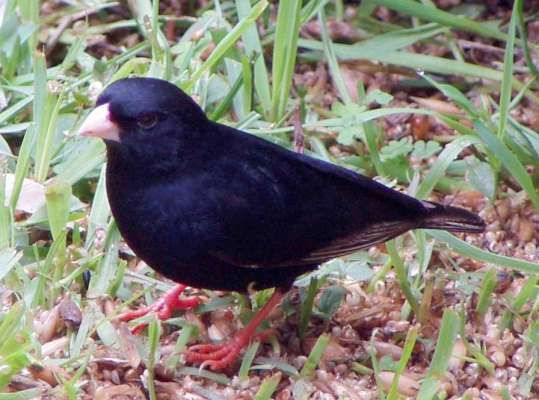
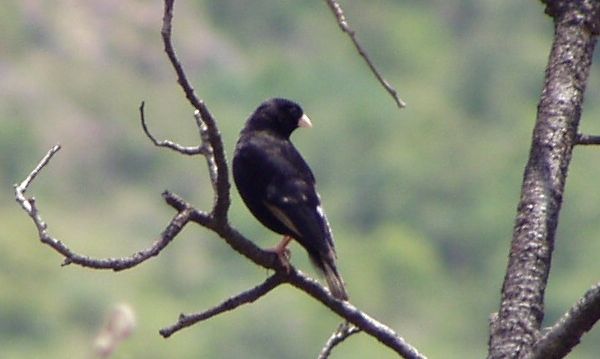
Adult males have entirely greenish-black or bluish-black plumage, orange-red legs and a conical white bill. Females have streaked brown upperparts, buff underparts, a whitish supercilium, a yellowish bill and red legs.[1][2]
Immature birds resemble females but have plainer plumage and lack a supercilium. Bill colour varies between red and white depending on the population, and male breeding plumage varies regionally in colour tone.[3][4][5]
The Village Indigobird measures 11–12 cm in length.[6]
Habitat
The species inhabits open woodland, scrub and cultivated areas. It is particularly frequently observed near villages.[7][8]
Diet
The species feeds on seeds and grain.[9]
Behaviour
Adult males defend territories. During courtship, males perform elaborate flight displays.[10][11]
Males sing from high perches using rapid sputtering and churring sounds mixed with imitations of red-billed firefinch songs.[12]
Reproduction and life cycle
The Village Indigobird reproduces through brood parasitism, laying eggs in red-billed firefinch nests. It does not destroy the eggs of its host when laying its own eggs.[13][14]
Nestling Village Indigobirds imitate the distinctive gape pattern of their host species' fledglings.[15]
Similar species
The species can be distinguished from other indigobirds by bill and leg colours, male breeding plumage, song and, to a lesser extent, nestling plumage and mouth pattern. Female and juvenile indigobirds are particularly difficult to distinguish from those of other indigobird species.[16][17]
Association with red-billed firefinches and occurrence near human habitation help identify the Village Indigobird.[18]
Conservation
The species was assessed for the IUCN Red List in 2018. Its reported abundance ranges from common to local.[19][20]
Classification of the Village Indigobird
| Kingdom | Animalia |
|---|---|
| Phylum | Chordata |
| Subphylum | Vertebrata |
| Infraphylum | Gnathostomata |
| Parvphylum | Osteichthyes |
| Megaclass | Tetrapoda |
| Class | Aves (Bird) |
| Order | Passeriformes (Passerine) |
| Family | Viduidae (Whydahs and Indigobirds) |
| Genus | Vidua (Whydahs) |
| Species | Vidua chalybeata (Statius Muller, 1776) |
Where the Village Indigobird is found
Checklists and occurrence records place Vidua chalybeata in 39 countries. GBIF holds 49,618 georeferenced records of it.
Countries
- Algeria 25
- Angola 35
- Benin 180
- Botswana 1,205
- Burkina Faso 388
- Burundi 13
- Cameroon 63
- Central African Republic 38
- Chad 128
- Democratic Republic of the Congo 87
- Eritrea 25
- Eswatini 257
- Ethiopia 1,669
- Gambia 2,560
- Ghana 440
- Guinea 106
- Guinea-Bissau 127
- Ivory Coast 33
- Kenya 5,879
- Lesotho 10
- Malawi 716
- Mali 110
- Mauritania 35
- Mozambique 269
- Namibia 785
- Niger 79
- Nigeria 4,443
- Rwanda 300
- Senegal 1,987
- Sierra Leone 22
- Somalia 14
- South Africa 17,502
- South Sudan 27
- Sudan 117
- Tanzania 2,913
- Togo 41
- Uganda 1,843
- Zambia 1,913
- Zimbabwe 3,234
Regions and cities with the most records
- Limpopo, South Africa 8,043
- North West, South Africa 3,589
- Mpumalanga, South Africa 2,767
- Imara Daima Estate, Kenya 1,794
- Nairobi, Kenya 1,783
- Nairobi County, Kenya 1,642
- Ongata Rongai, Kenya 1,553
- Livingstone, Zambia 1,456
- Ngong, Kenya 1,452
- Victoria Falls, Zimbabwe 1,434
- Kiambu, Kenya 1,428
- Karuri, Kenya 1,426
- Kikuyu, Kenya 1,426
- Matabeleland North, Zimbabwe 1,382
- Busumbala, Gambia 1,110
- Sinchu Alagi, Gambia 1,036
- Western, Gambia 1,015
- Arusha, Tanzania 1,005
- Kunkujang, Gambia 1,005
- Abuko, Gambia 1,004
- Welingara, Gambia 979
- Faji Kunda, Gambia 968
- Latri Sabiji, Gambia 959
- Talinding, Gambia 951
- Southern Province, Zambia 931
- Sukuta, Gambia 924
- Plateau State, Nigeria 915
- Serekunda, Gambia 913
- New Jeshwang, Gambia 872
- Sanchaba, Gambia 870
- Bakoti, Gambia 869
- Brikama, Gambia 852
- Dippa Kunda, Gambia 846
- Kanifing, Gambia 835
- Kiserian, Kenya 829
- Tanji, Gambia 816
2 more countries have a few records outside this range
These countries hold a few records of Vidua chalybeata but lie outside the range the checklists give for it. Such records are often zoo or garden specimens, museum material or vagrants, so the species is not counted as occurring there.
A number beside a place is its count of GBIF occurrence records. A place without a number comes from a checklist alone. Records show where a species has been observed or collected, which can include escapes and vagrants.
Common names
English
- Village Indigobird
- Steelblue Widowfinch
- VIIN
Names in 27 other languages
- Afrikaans
- Staalblouvink, Staalblouvinkie
- Catalan
- vídua del Senegal
- Chinese
- 靛蓝维达雀, 靛藍維達雀
- Croatian
- crvenonoga udovičica
- Czech
- atlásek malý
- Danish
- Atlaskfinke
- Dutch
- Staalvink
- Esperanto
- vilaĝa viduo
- Finnish
- kyläleski
- French
- Combassou bleu, Combassou du Sénégal
- German
- Rotfuß-Atlaswitwe, Rotfußatlaswitwe, Rotfußwitwe
- Hungarian
- piroslábú atlaszvida
- Irish
- Plúiríneach sráidbhaile
- Italian
- Combassou del Senegal, Combassù del Senegal, Vedova dei villaggi
- Japanese
- シコンチョウ
- Lithuanian
- raudonkojė našlytė
- Norwegian
- landsbyenke
- Polish
- wdówka atłasowa
- Portuguese
- viúva-azul, viúva-senegalesa
- Russian
- Красноногая вдовушка, Красноногий стальной ткач
- Serbian
- Crvenonoga atlas udovica
- Slovak
- vdovka zamatová
- Spanish
- Viuda de la Villa, Viuda pueblerina, Viuda senegalesa
- Swedish
- byänka
- Turkish
- Köy Çivitkuşu
- Ukrainian
- вдовичка червононога
- Welsh
- wida pentref
Synonyms
4 other scientific names have been used for this species and are now treated as synonyms of Vidua chalybeata.
- Fringilla chalybeata Müller, PLS, 1776
- Hypochera aenea Hartlaub, KJG, 1854
- Hypochera chalybeata Müller, PLS, 1776
- Vidua aeana Hartlaub, KJG, 1854
Subspecies and varieties
- Vidua chalybeata amauropteryx (Steel-blue Widow-finch) subspecies
- Vidua chalybeata centralis subspecies
- Vidua chalybeata chalybeata subspecies
- Vidua chalybeata neumanni subspecies
- Vidua chalybeata okavangoensis subspecies
- Vidua chalybeata ultramarina subspecies
Related species
-
 Pin-tailed WhydahVidua macroura
-
 Long-tailed Paradise WhydahVidua paradisaea
-
 Shaft-tailed WhydahVidua regia
-
 Exclamatory Paradise WhydahVidua interjecta
-
 Dusky IndigobirdVidua funerea
-
 Broad-tailed Paradise WhydahVidua obtusa
-
 Purple IndigobirdVidua purpurascens
-
 Steel-blue WhydahVidua hypocherina
Compare
Questions and answers
What is the scientific name of the Village Indigobird?
The scientific name of the Village Indigobird is Vidua chalybeata. Written with its author, the full name is Vidua chalybeata (Statius Muller, 1776).
Which family does the Village Indigobird belong to?
Vidua chalybeata belongs to the family Viduidae, in the order Passeriformes and the class Aves.
Where is the Village Indigobird found?
Checklists and occurrence records place Vidua chalybeata in 39 countries, including South Africa, Kenya, Nigeria, Zimbabwe, Tanzania and Gambia.
What is the conservation status of the Village Indigobird?
The IUCN Red List category recorded for Vidua chalybeata is Least Concern (LC).
What other names does the Village Indigobird have?
Vidua chalybeata is also known in English as Steelblue Widowfinch and VIIN.
What are some examples of African indigobirds?
The Village Indigobird is an example of an African indigobird. Its subspecies include Vidua chalybeata chalybeata, Vidua chalybeata neumanni, Vidua chalybeata ultramarina, Vidua chalybeata centralis, Vidua chalybeata okavangoensis and Vidua chalybeata amauropteryx.[21][22][23][24][25][26][27]
Sources
Passages the profile rests on
- Adult males have entirely greenish-black or bluish-black plumage, orange-red legs and a conical white bill. Source passage: “The adult male is entirely greenish-black or bluish-black except for his orange-red legs and conical white bill.” — English Wikipedia
- Females have streaked brown upperparts, buff underparts, a whitish supercilium, a yellowish bill and red legs. Source passage: “The female resembles a female house sparrow, with streaked brown upperparts, buff underparts, a whitish supercilium and a yellowish bill, although she also has red legs.” — English Wikipedia
- Immature birds resemble females but have plainer plumage and lack a supercilium. Source passage: “Immature birds are like the female but plainer and without a supercilium.” — English Wikipedia
- Bill colour varies between red and white depending on the population. Source passage: “The bill colour can be red or white depending on the population” — English Wikipedia
- Male breeding plumage varies regionally in colour tone. Source passage: “there is some regional variation in the colour tone of the male's plumage.” — English Wikipedia
- The Village Indigobird measures 11–12 cm in length. Source passage: “The village indigobird is 11–12 cm in length.” — English Wikipedia
- The species inhabits open woodland, scrub and cultivated areas. Source passage: “This indigobird is found in many open habitats including open woodland, scrub and cultivation” — English Wikipedia
- The species is particularly frequently observed near villages. Source passage: “but, as its name implies, it is most readily seen near villages.” — English Wikipedia
- The species feeds on seeds and grain. Source passage: “The diet of this species consists of seeds and grain.” — English Wikipedia
- Adult males defend territories. Source passage: “The male village indigobird is territorial” — English Wikipedia
- Males perform elaborate flight displays during courtship. Source passage: “he has an elaborate courtship flight display.” — English Wikipedia
- Males sing from high perches using rapid sputtering and churring sounds mixed with imitations of red-billed firefinch songs. Source passage: “The song is given from a high perch, and consists of rapid sputtering and churring intermingled with mimicry of red-billed firefinch's song” — English Wikipedia
- The Village Indigobird reproduces through brood parasitism, laying eggs in red-billed firefinch nests. Source passage: “It is a brood parasite which lays its eggs in the nests of red-billed firefinches.” — English Wikipedia
- The species does not destroy the eggs of its host when laying its own eggs. Source passage: “Unlike the common cuckoo, it does not destroy the host's egg.” — English Wikipedia
- Nestling Village Indigobirds imitate the distinctive gape pattern of their host species' fledglings. Source passage: “The nestling indigobirds mimic the unique gape pattern of the fledglings of the host species.” — English Wikipedia
- The species can be distinguished from other indigobirds by bill and leg colours, male breeding plumage, song and, to a lesser extent, nestling plumage and mouth pattern. Source passage: “It is distinguishable from other indigobird species by bill and leg colours, the colour tinge of the male's breeding plumage, song, and to lesser extent, the nestling's plumage and mouth pattern.” — English Wikipedia
- Female and juvenile indigobirds are particularly difficult to distinguish from those of other indigobird species. Source passage: “Many of the indigobirds are very similar in appearance, with the males difficult to separate in the field, and the young and females near impossible.” — English Wikipedia
- Association with red-billed firefinches and occurrence near human habitation help identify the Village Indigobird. Source passage: “Helpful pointers with the village indigobird are the association with its host species, the red-billed firefinch, and its presence near human habitation.” — English Wikipedia
- The species was assessed for the IUCN Red List in 2018. Source passage: “Village Indigobird Vidua chalybeata has most recently been assessed for The IUCN Red List of Threatened Species in 2018.” — iucnredlist.org
- The species is reported to range in abundance from common to local. Source passage: “the species is reported to be common to local.” — datazone.birdlife.org
- The species is a resident breeding bird across most of Africa south of the Sahara Desert. Source passage: “It is a resident breeding bird in most of Africa south of the Sahara Desert.” — English Wikipedia
- The nominate subspecies Vidua chalybeata chalybeata occurs in West Africa from Senegambia to central Mali. Source passage: “V. c. subsp. chalybeata (Statius Müller, 1776) – West Africa: Senegambia to central Mali” — English Wikipedia
- The subspecies Vidua chalybeata neumanni occurs from Mali to South Sudan. Source passage: “V. c. subsp. neumanni (Alexander, 1908) – Mali to South Sudan” — English Wikipedia
- The subspecies Vidua chalybeata ultramarina occurs in Ethiopia and Eritrea. Source passage: “V. c. subsp. ultramarina (J. F. Gmelin, 1789) – Ethiopia and Eritrea” — English Wikipedia
- The subspecies Vidua chalybeata centralis occurs in the Democratic Republic of the Congo, Uganda, Kenya and Tanzania. Source passage: “V. c. subsp. centralis (Neunzig, 1928) – DRC, Uganda, Kenya and Tanzania” — English Wikipedia
- The subspecies Vidua chalybeata okavangoensis occurs from western Angola to northern Botswana. Source passage: “V. c. subsp. okavangoensis Payne, 1973 – western Angola to northern Botswana” — English Wikipedia
- The subspecies Vidua chalybeata amauropteryx occurs in coastal East Africa and southeastern Africa. Source passage: “V. c. subsp. amauropteryx (Sharpe, 1890) – coastal East Africa and southeastern Africa” — English Wikipedia
Data
- Catalogue of Life, 2026-10-16 XR cc by
- Global Biodiversity Information Facility CC BY 4.0
- Wikidata CC0
- GeoNames CC BY 4.0
- Wikimedia Commons per image; credit shown with each image
- Within the Catalogue of Life, this name comes from The Integrated Taxonomic Information System cc0
References
- Gill, Frank, & and Minturn Wright. (2006). Birds of the World: Recommended English Names.
This species in other databases
Page built on 27 November 2026. See how the catalog is made and all sources and licences.
Cite this page
ScientificNames.org. (2026). Vidua chalybeata (Village Indigobird). Retrieved November 27, 2026, from https://scientificnames.org/species/vidua-chalybeata
“Vidua chalybeata (Village Indigobird).” ScientificNames.org, 2026, scientificnames.org/species/vidua-chalybeata. Accessed 27 Nov. 2026.
ScientificNames.org. “Vidua chalybeata (Village Indigobird).” Accessed November 27, 2026. https://scientificnames.org/species/vidua-chalybeata.
@misc{scientificnames_vidua_chalybeata_village_indigobird,
  author = {{ScientificNames.org}},
  title = {Vidua chalybeata (Village Indigobird)},
  year = {2026},
  url = {https://scientificnames.org/species/vidua-chalybeata},
  note = {Accessed 2026-11-27}
}