Species · Birds
Broad-tailed Paradise Whydah Vidua obtusa
The scientific name of the Broad-tailed Paradise Whydah is Vidua obtusa. It is a species of bird in the family Viduidae (whydahs and indigobirds), order Passeriformes. The name dates from 1922.
- Scientific name
- Vidua obtusa (Chapin, 1922)
- Common name
- Broad-tailed Paradise Whydah
- Genus
- Vidua
- Family
- Viduidae (Whydahs and Indigobirds)
- Order
- Passeriformes
- Class
- Aves
- Red List category
- LC Least Concern
- Recorded in
- 13 countries
- Name status
- accepted in the Catalogue of Life

Overview
Vidua obtusa inhabits woodlands and acacia savannas, including miombo woodland. The breeding male is distinguished by long, broad tail feathers and a chestnut-orange nape patch.
Written 26 November 2026 from the sources listed below. Each statement was checked against the passage it cites; statements that could not be supported were removed.
Appearance
The breeding male has long, broad tail feathers with bluntly pointed or rounded tips and a chestnut-orange patch on its nape. Breeding males measure 31–36 cm in length.[1][2][3]
The nonbreeding male has buff-coloured underparts, grey-brown streaked upperparts and black and white stripes on its head. Nonbreeding males and females measure 14–15 cm in length.[4][5][6]
The female resembles the nonbreeding male and weighs approximately 19.5 g. Immature birds resemble females but have less distinct patterns and some feathers with buff-coloured edges.[7][8][9]
Habitat
The species inhabits woodlands and acacia savannas. Miombo woodland is also a recorded habitat.[10][11]
Diet
The species feeds on seeds.[12]
Behaviour
The species feeds on the ground in small flocks and mimics the call of its host species.[13][14]
Outside the breeding season, it may associate with the long-tailed paradise whydah. Large irruptions have occasionally been recorded.[15][16]
Reproduction and life cycle
The species reproduces through brood parasitism, using the orange-winged pytilia (Pytilia afra) as its host. Its eggs are white and weigh approximately 1.6 g.[17][18][19]
Newborn chicks have loose greyish down resembling that of orange-winged pytilia chicks. The incubation and nestling periods have not been determined.[20][21]
Breeding plumage has been observed from February through July in the southeastern Congo Basin.[22]
Similar species
The Broad-tailed Paradise Whydah differs from the long-tailed paradise whydah by having broader, somewhat shorter tail feathers. The breeding male also has a more orange-brown-toned nape.[23][24]
Conservation
The IUCN Red List classifies the species as Least Concern. Its population trend is stable.[25][26]
Classification of the Broad-tailed Paradise Whydah
| Kingdom | Animalia |
|---|---|
| Phylum | Chordata |
| Subphylum | Vertebrata |
| Infraphylum | Gnathostomata |
| Parvphylum | Osteichthyes |
| Megaclass | Tetrapoda |
| Class | Aves (Bird) |
| Order | Passeriformes (Passerine) |
| Family | Viduidae (Whydahs and Indigobirds) |
| Genus | Vidua (Whydahs) |
| Species | Vidua obtusa (Chapin, 1922) |
Where the Broad-tailed Paradise Whydah is found
Checklists and occurrence records place Vidua obtusa in 13 countries. GBIF holds 1,688 georeferenced records of it.
Countries
- Angola 102
- Botswana 88
- Democratic Republic of the Congo 121
- Kenya 9
- Malawi 218
- Mozambique 92
- Namibia 8
- Rwanda 3
- South Africa 9
- Tanzania 107
- Uganda 27
- Zambia 621
- Zimbabwe 283
Regions and cities with the most records
- Matabeleland North, Zimbabwe 177
- Livingstone, Zambia 130
- Victoria Falls, Zimbabwe 129
- Southern Province, Zambia 122
- Lusaka Province, Zambia 95
- Central Province, Zambia 92
- Copperbelt, Zambia 86
- North-Western, Zambia 82
- Sofala, Mozambique 63
- Chobe, Botswana 59
- Haut-Katanga, Democratic Republic of the Congo 48
- Western Province, Zambia 47
- Morogoro, Tanzania 46
- Mashonaland West, Zimbabwe 45
- Ntandabale, Zambia 44
- Madido, Zambia 43
- Muchinga, Zambia 43
- Malanje, Angola 41
- Chisankane, Zambia 34
- Lusaka, Zambia 32
- Palabana, Zambia 32
- Lualaba, Democratic Republic of the Congo 30
- Eastern Province, Zambia 27
- Chingola, Zambia 26
- Choma, Zambia 26
- Chambishi, Zambia 25
- North-West, Botswana 23
- Huambo, Angola 21
- Mikumi, Tanzania 21
- Kabwe, Zambia 18
- Mapalo, Zambia 16
- Ndola, Zambia 16
- Chirundu, Zambia 15
- Kwanza Sul, Angola 15
- Manicaland, Zimbabwe 15
- Mashonaland Central, Zimbabwe 15
1 more country has a few records outside this range
These countries hold a few records of Vidua obtusa but lie outside the range the checklists give for it. Such records are often zoo or garden specimens, museum material or vagrants, so the species is not counted as occurring there.
A number beside a place is its count of GBIF occurrence records. A place without a number comes from a checklist alone. Records show where a species has been observed or collected, which can include escapes and vagrants.
Common names
English
- Broad-tailed Paradise Whydah
- BTPW
- Broad-tailed Paradise Widow
- Broad-tailed Paradise Widow Bird
- Broad-tailed Paradise-Whydah
Names in 25 other languages
- Afrikaans
- Breëstertparadysvink
- Catalan
- vídua cuaampla
- Chinese
- 安哥拉天堂維達雀, 宽尾维达雀
- Croatian
- širokorepa udovičica
- Czech
- vdovka širokoocasá
- Danish
- Korthalet Paradisenke
- Dutch
- Breedstaartparadijswida
- Esperanto
- larĝvosta viduo
- Finnish
- sirppiparatiisileski
- French
- Veuve de Chapin, Veuve à collier d'or
- German
- Breitschwanz-Paradieswitwe, Breitschwanzparadieswitwe, Breitschwanzwitwe
- Italian
- Vedova paradisea codalarga
- Japanese
- ミナミオビロホウオウジャク
- Lithuanian
- plačiauodegė našlytė
- Norwegian
- bredstjertenke
- Norwegian Bokmål
- bredhaleenke
- Polish
- wdówka szerokosterna
- Portuguese
- Viúva-do-paraíso-de-cauda-larga, viúva-de-cauda-larga, viúva-do-paraíso-rabilarga
- Russian
- Широкохвостая райская вдовушка
- Serbian
- Širokorepa rajska udovica
- Slovak
- vdovka širokochvostá
- Spanish
- Viuda coliancha
- Swedish
- bredstjärtad paradisänka
- Turkish
- Geniş Kuyruklu Vidya
- Ukrainian
- вдовичка широкохвоста
Synonyms
3 other scientific names have been used for this species and are now treated as synonyms of Vidua obtusa.
- Steganura aucupum obtusa Chapin, JP, 1922
- Steganura paradisea obtusa Chapin, JP, 1922
- Vidua orientalis obtusa Chapin, JP, 1922
Related species
-
 Pin-tailed WhydahVidua macroura
-
 Long-tailed Paradise WhydahVidua paradisaea
-
 Village IndigobirdVidua chalybeata
-
 Shaft-tailed WhydahVidua regia
-
 Exclamatory Paradise WhydahVidua interjecta
-
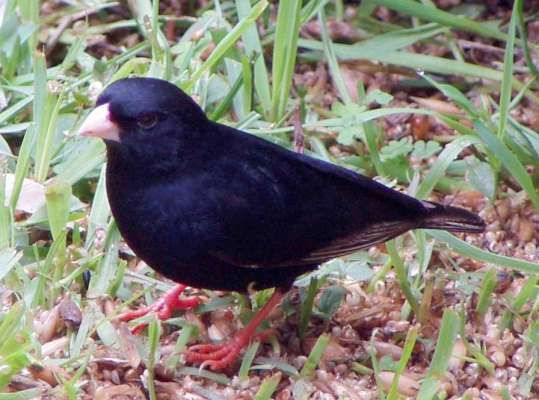 Dusky IndigobirdVidua funerea
-
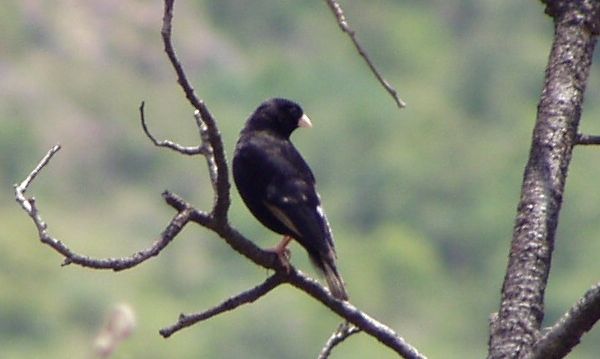 Purple IndigobirdVidua purpurascens
-
 Steel-blue WhydahVidua hypocherina
Compare
Questions and answers
What is the scientific name of the Broad-tailed Paradise Whydah?
The scientific name of the Broad-tailed Paradise Whydah is Vidua obtusa. Written with its author, the full name is Vidua obtusa (Chapin, 1922).
Which family does the Broad-tailed Paradise Whydah belong to?
Vidua obtusa belongs to the family Viduidae, in the order Passeriformes and the class Aves.
Where is the Broad-tailed Paradise Whydah found?
Checklists and occurrence records place Vidua obtusa in 13 countries, including Zambia, Zimbabwe, Malawi, Democratic Republic of the Congo, Tanzania and Angola.
What is the conservation status of the Broad-tailed Paradise Whydah?
The IUCN Red List category recorded for Vidua obtusa is Least Concern (LC).
What other names does the Broad-tailed Paradise Whydah have?
Vidua obtusa is also known in English as BTPW, Broad-tailed Paradise Widow, Broad-tailed Paradise Widow Bird and Broad-tailed Paradise-Whydah.
Sources
Passages the profile rests on
- The breeding male has long, broad tail feathers with bluntly pointed or rounded tips. Source passage: “The breeding male has long, broad tail feathers with bluntly pointed to rounded tips” — English Wikipedia
- The breeding male has a chestnut-orange patch on its nape. Source passage: “It has a chestnut-orange patch on its nape.” — English Wikipedia
- Breeding males measure 31–36 cm in length. Source passage: “The breeding male is 31–36 cm (12–14 in) long” — English Wikipedia
- The nonbreeding male has buff-coloured underparts and grey-brown streaked upperparts. Source passage: “The nonbreeding male's underparts are buffy, and its upperparts are grey-brown, with streaks.” — English Wikipedia
- The nonbreeding male has black and white stripes on its head. Source passage: “There are black and white stripes on its head.” — English Wikipedia
- Nonbreeding males and females measure 14–15 cm in length. Source passage: “the nonbreeding male and the female are 14–15 cm (5.5–5.9 in) long.” — English Wikipedia
- The female resembles the nonbreeding male. Source passage: “The female is similar to the nonbreeding male.” — English Wikipedia
- Immature birds resemble females but have less distinct patterns and some feathers with buff-coloured edges. Source passage: “The immature bird resembles the female, but some of its feathers have buffy edges, and its patterns are less distinct.” — English Wikipedia
- Females weigh approximately 19.5 g. Source passage: “Females have been measured to weigh approximately 19.5 g (0.69 oz).” — English Wikipedia
- The species inhabits woodlands and acacia savannas. Source passage: “The broad-tailed paradise whydah's habitat is woodlands, including miombo and Baikiaea plurijuga woodland, and also acacia savannas.” — English Wikipedia
- Miombo woodland is one of the species' recorded habitats. Source passage: “Found in broadleaf woodland, mainly miombo.” — ebird.org
- The species feeds on seeds. Source passage: “It feeds on the ground in small flocks, eating seeds.” — English Wikipedia
- The species feeds on the ground in small flocks. Source passage: “It feeds on the ground in small flocks, eating seeds.” — English Wikipedia
- The species mimics the call of its host species. Source passage: “It mimics the host species's call.” — English Wikipedia
- Outside the breeding season, the species may associate with the long-tailed paradise whydah. Source passage: “When the broad-tailed paradise whydah is not breeding, it may mix with the long-tailed paradise whydah.” — English Wikipedia
- Large irruptions of the species have occasionally been recorded. Source passage: “Irruptions can occur; in 1994, an "invasion" of thousands of whydahs was reported in Kasane, Botswana.” — English Wikipedia
- The species reproduces through brood parasitism. Source passage: “The broad-tailed paradise whydah is a brood parasite” — English Wikipedia
- The orange-winged pytilia (Pytilia afra) is the species' host. Source passage: “its host being the orange-winged pytilia (Pytilia afra).” — English Wikipedia
- The eggs are white and weigh approximately 1.6 g. Source passage: “The eggs are white, weighing approximately 1.6 g (0.056 oz).” — English Wikipedia
- Newborn chicks have loose greyish down resembling that of orange-winged pytilia chicks. Source passage: “Newborn chicks have loose greyish down, very similar to chicks of the orange-winged pytilia.” — English Wikipedia
- The incubation and nestling periods have not been determined. Source passage: “The incubation period and nestling period are unknown.” — English Wikipedia
- Breeding plumage has been observed from February through July in the southeastern Congo Basin. Source passage: “Breeding plumage has been observed from February to July in the southeastern Congo Basin.” — English Wikipedia
- The broad-tailed paradise whydah differs from the long-tailed paradise whydah by having broader, somewhat shorter tail feathers. Source passage: “it is distinguished from the related long-tailed paradise whydah in the tail feathers being broader and not quite so long” — English Wikipedia
- The breeding male differs from the long-tailed paradise whydah in having a more orange-brown-toned nape. Source passage: “and in the nape being orange-brown toned rather than paler buff.” — English Wikipedia
- The IUCN Red List classifies the species as Least Concern. Source passage: “the IUCN Red List has assessed the species as least concern.” — English Wikipedia
- The species has a stable population trend. Source passage: “The species has a large range and a stable population trend” — English Wikipedia
Data
- Catalogue of Life, 2026-10-16 XR cc by
- Global Biodiversity Information Facility CC BY 4.0
- Wikidata CC0
- GeoNames CC BY 4.0
- Wikimedia Commons per image; credit shown with each image
- Within the Catalogue of Life, this name comes from The Integrated Taxonomic Information System cc0
References
- Gill, Frank, & and Minturn Wright. (2006). Birds of the World: Recommended English Names.
This species in other databases
Page built on 28 November 2026. See how the catalog is made and all sources and licences.
Cite this page
ScientificNames.org. (2026). Vidua obtusa (Broad-tailed Paradise Whydah). Retrieved November 28, 2026, from https://scientificnames.org/species/vidua-obtusa
“Vidua obtusa (Broad-tailed Paradise Whydah).” ScientificNames.org, 2026, scientificnames.org/species/vidua-obtusa. Accessed 28 Nov. 2026.
ScientificNames.org. “Vidua obtusa (Broad-tailed Paradise Whydah).” Accessed November 28, 2026. https://scientificnames.org/species/vidua-obtusa.
@misc{scientificnames_vidua_obtusa_broad_tailed_paradise_whydah,
  author = {{ScientificNames.org}},
  title = {Vidua obtusa (Broad-tailed Paradise Whydah)},
  year = {2026},
  url = {https://scientificnames.org/species/vidua-obtusa},
  note = {Accessed 2026-11-28}
}