Species · Amphibians
Boca Do Mato Tree Frog Xenohyla eugenioi
The scientific name of the Boca Do Mato Tree Frog is Xenohyla eugenioi. It is a species of amphibian in the family Hylidae (hylids), order Anura. The name dates from 1998.

Overview
Xenohyla eugenioi is endemic to Brazil and occurs in the states of Bahia and Sergipe. The species retains its white stripes throughout adulthood.
Written 27 November 2026 from the sources listed below. Each statement was checked against the passage it cites; statements that could not be supported were removed.
Habitat
The Boca do Mato Tree Frog inhabits ecotones between the Atlantic Forest and the caatingas of northeastern Brazil. It prefers agrestes.[1][2]
Individuals have been observed at elevations between 128 and 960 meters above sea level.[3]
Behaviour
The species spends daytime hours hiding in bromeliads. It emerges at night to hunt and forage.[4][5]
Reproduction and life cycle
The species breeds in temporary pools formed by rainwater.[6]
Appearance
The species retains its white stripes throughout adulthood. Adult males have snout-to-vent lengths ranging from 30.9 to 31.5 mm, while adult females range from 39.5 to 45.5 mm.[7][8][9]
Diet
Whether the species consumes fruit remains unknown.[10]
Conservation
The species is not currently considered endangered.[11]
Collection of bromeliad plants and agriculture-associated habitat loss may threaten the species.[12][13]
Similar species
Xenohyla truncata is a congeneric relative of the Boca do Mato Tree Frog.[14]
Classification of the Boca Do Mato Tree Frog
| Kingdom | Animalia |
|---|---|
| Phylum | Chordata |
| Subphylum | Vertebrata |
| Infraphylum | Gnathostomata |
| Parvphylum | Osteichthyes |
| Megaclass | Tetrapoda |
| Class | Amphibia (Amphibians) |
| Order | Anura (Frogs) |
| Family | Hylidae (Hylids) |
| Genus | Xenohyla |
| Species | Xenohyla eugenioi Caramaschi, 1998 |
Where the Boca Do Mato Tree Frog is found
Checklists and occurrence records place Xenohyla eugenioi in 1 country. GBIF holds 13 georeferenced records of it.
Countries
Regions and cities with the most records
A number beside a place is its count of GBIF occurrence records. A place without a number comes from a checklist alone. Records show where a species has been observed or collected, which can include escapes and vagrants.
Common names
English
- Boca Do Mato Tree Frog
Names in 2 other languages
- Arabic
- ضفدع بوكا دو ماتو الشجري
- Czech
- rosnička Eugeniova
Related species
-
 Izecksohn's Brazilian TreefrogXenohyla truncata
-
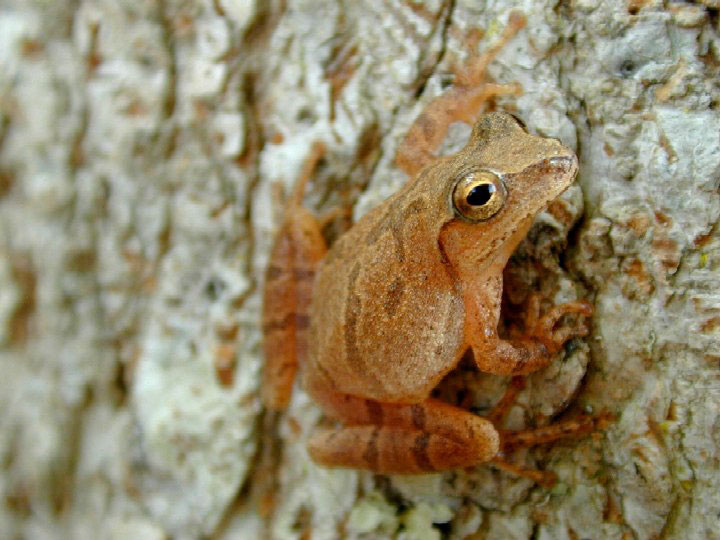 Spring PeeperPseudacris crucifer
-
 Cuban Tree FrogOsteopilus septentrionalis
-
 Pacific Tree FrogPseudacris regilla
-
 Rabbs' Fringe-limbed TreefrogEcnomiohyla rabborum
- European Tree FrogHyla arborea
-
 Mission Golden-eyed Tree FrogTrachycephalus resinifictrix
-
 Paradoxical FrogPseudis paradoxa
Compare
Questions and answers
What is the scientific name of the Boca Do Mato Tree Frog?
The scientific name of the Boca Do Mato Tree Frog is Xenohyla eugenioi. Written with its author, the full name is Xenohyla eugenioi Caramaschi, 1998.
Which family does the Boca Do Mato Tree Frog belong to?
Xenohyla eugenioi belongs to the family Hylidae, in the order Anura and the class Amphibia.
Where is the Boca Do Mato Tree Frog found?
Checklists and occurrence records place Xenohyla eugenioi in 1 country: Brazil.
What is the conservation status of the Boca Do Mato Tree Frog?
The IUCN Red List category recorded for Xenohyla eugenioi is Least Concern (LC).
Sources
Passages the profile rests on
- The species inhabits ecotones between the Atlantic Forest and the caatingas of northeastern Brazil. Source passage: “native to northeastern Brazil in ecotones between the Atlantic Forest and caatingas.” — English Wikipedia
- The species prefers to inhabit agrestes. Source passage: “the species prefers to inhabit agrestes” — English Wikipedia
- Individuals have been observed at elevations between 128 and 960 meters above sea level. Source passage: “This frog has been observed between 128 and 960 meters above sea level.” — English Wikipedia
- The species spends daytime hours hiding in bromeliads. Source passage: “this frog spends the day hiding in bromeliads” — English Wikipedia
- The species emerges at night to hunt and forage. Source passage: “emerging at night to hunt and forage.” — English Wikipedia
- The species breeds in temporary pools formed by rainwater. Source passage: “breeds in temporary pools formed by rainwater.” — English Wikipedia
- Adult males have snout-to-vent lengths ranging from 30.9 to 31.5 mm. Source passage: “Males grow from 30.9 to 31.5 mm (1.22 to 1.24 in) SVL” — English Wikipedia
- Adult females have snout-to-vent lengths ranging from 39.5 to 45.5 mm. Source passage: “females reach 39.5 to 45.5 mm (1.56 to 1.8 in) SVL.” — English Wikipedia
- The species retains its white stripes throughout adulthood. Source passage: “X. eugenioi keeps its white stripes through adulthood.” — English Wikipedia
- Whether the species consumes fruit remains unknown. Source passage: “It is currently unknown if this frog is also frugivorous like its relative.” — English Wikipedia
- The species is not currently considered endangered. Source passage: “This frog is not endangered” — English Wikipedia
- Collection of bromeliad plants may threaten the species. Source passage: “there may be some threat from the collection of bromeliad plants” — English Wikipedia
- Agriculture-associated habitat loss may threaten the species. Source passage: “habitat loss associated with agriculture” — English Wikipedia
- Xenohyla truncata is a congeneric relative of Xenohyla eugenioi. Source passage: “approximately 1,000 km away from the other species in its genus, Xenohyla truncata.” — English Wikipedia
Data
- Catalogue of Life, 2026-10-16 XR cc by
- Global Biodiversity Information Facility CC BY 4.0
- Wikidata CC0
- GeoNames CC BY 4.0
- Wikimedia Commons per image; credit shown with each image
- Within the Catalogue of Life, this name comes from The Integrated Taxonomic Information System cc0
References
- Description of a second species of the genus Xenohyla (Anura: Hylidae). (1998). Amphibia-Reptilia, 19(4), 377–384. https://doi.org/10.1163/156853898x00043 Link where the name was published
This species in other databases
Page built on 27 November 2026. See how the catalog is made and all sources and licences.
Cite this page
ScientificNames.org. (2026). Xenohyla eugenioi (Boca Do Mato Tree Frog). Retrieved November 27, 2026, from https://scientificnames.org/species/xenohyla-eugenioi
“Xenohyla eugenioi (Boca Do Mato Tree Frog).” ScientificNames.org, 2026, scientificnames.org/species/xenohyla-eugenioi. Accessed 27 Nov. 2026.
ScientificNames.org. “Xenohyla eugenioi (Boca Do Mato Tree Frog).” Accessed November 27, 2026. https://scientificnames.org/species/xenohyla-eugenioi.
@misc{scientificnames_xenohyla_eugenioi_boca_do_mato_tree_frog,
  author = {{ScientificNames.org}},
  title = {Xenohyla eugenioi (Boca Do Mato Tree Frog)},
  year = {2026},
  url = {https://scientificnames.org/species/xenohyla-eugenioi},
  note = {Accessed 2026-11-27}
}