Species · Flowering plants
Eastern Turkeybeard Xerophyllum asphodeloides
The scientific name of the Eastern Turkeybeard is Xerophyllum asphodeloides. It is a species of flowering plant in the family Melanthiaceae (bunchflower family), order Liliales.
- Scientific name
- Xerophyllum asphodeloides (L.) Nutt.
- Common name
- Eastern Turkeybeard
- Genus
- Xerophyllum
- Family
- Melanthiaceae (Bunchflower Family)
- Order
- Liliales
- Class
- Liliopsida
- Recorded in
- 1 country
- Name status
- accepted in the Catalogue of Life

Overview
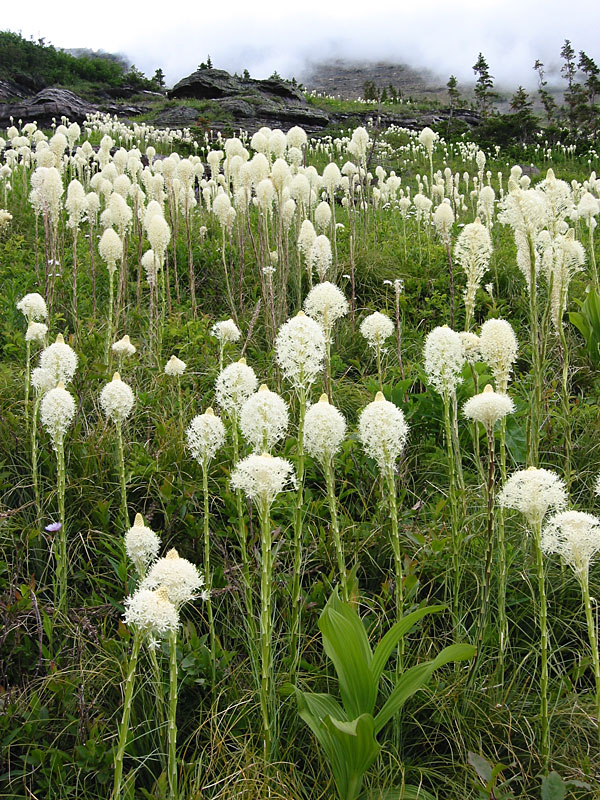
Xerophyllum asphodeloides occurs primarily in the southern Appalachian Mountains from Virginia to Alabama and disjunctly in the Pine Barrens of New Jersey. It has threadlike to linear serrated leaves and a long raceme bearing cream-white flowers.
Written 26 November 2026 from the sources listed below. Each statement was checked against the passage it cites; statements that could not be supported were removed.
Appearance
Eastern turkeybeard has basal leaves that range from threadlike to linear and have serrated edges. Its leaves can reach 50 centimeters in length.[1][2][3]
The fruit is a capsule.[4]
Habitat
Eastern turkeybeard is associated with chestnut oak, blackjack oak, shortleaf pine, and post oak.[5]
It is also associated with pink lady's-slipper, jointweed, and sweet goldenrod.[6]
Conservation
Eastern turkeybeard is threatened by habitat loss and fragmentation. Fire suppression is also identified as a threat.[7][8]
Similar species
Eastern turkeybeard can grow in the same areas as fly poison. It has narrower leaves and a typically more rounded flower cluster than fly poison.[9][10][11]
Classification of the Eastern Turkeybeard
| Kingdom | Plantae |
|---|---|
| Subkingdom | Pteridobiotina |
| Phylum | Tracheophyta |
| Class | Liliopsida |
| Order | Liliales |
| Family | Melanthiaceae (Bunchflower Family) |
| Genus | Xerophyllum (Beargrass) |
| Species | Xerophyllum asphodeloides (L.) Nutt. |
Where the Eastern Turkeybeard is found
Checklists and occurrence records place Xerophyllum asphodeloides in 1 country across North America. GBIF holds 1,730 georeferenced records of it.
Countries
Regions and cities with the most records
- New Jersey, United States 540
- North Carolina, United States 375
- Vincentown, United States 159
- Virginia, United States 146
- Jackson, United States 104
- Boone, United States 86
- Toms River, United States 82
- Sicklerville, United States 79
- Williamstown, United States 73
- Lakewood, United States 72
- Ocean Acres, United States 71
- Bayville, United States 69
- Lindenwold, United States 65
- Mount Laurel, United States 59
- Brick, United States 58
- Pleasantville, United States 41
- Cherry Hill, United States 36
- Maple Shade, United States 36
- Atlantic City, United States 35
- Point Pleasant, United States 33
- Pennsauken, United States 28
- Morganton, United States 25
- Greeneville, United States 23
- Glassboro, United States 20
- Harrisonburg, United States 20
- Salem, United States 17
- Marlboro, United States 16
- Willingboro, United States 16
- Tennessee, United States 14
- Vineland, United States 14
- Sewell, United States 13
- Asbury Park, United States 12
- South Vineland, United States 12
- Tinton Falls, United States 12
- Camden, United States 10
- Long Branch, United States 10
A number beside a place is its count of GBIF occurrence records. A place without a number comes from a checklist alone. Records show where a species has been observed or collected, which can include escapes and vagrants.
Common names
English
- Eastern Turkeybeard
- Turkey Beard
- Beartongue
- Mountain-asphodel
- Turkey-beard
Names in 1 other language
- Swedish
- liten björnlilja
Synonyms
3 other scientific names have been used for this species and are now treated as synonyms of Xerophyllum asphodeloides.
- Helonias asphodeloides L.
- Helonias tenuifolia Salisb.
- Xerophyllum setifolium Michx.
Related species
-
 Bear-grassXerophyllum tenax
-
 White TrilliumTrillium grandiflorum
-
 California Corn LilyVeratrum californicum
-
 White VeratrumVeratrum album
-
 Death CamasToxicoscordion venenosum
-
 False HelleboreVeratrum viride
-
 Herb ParisParis quadrifolia
-
 Red TrilliumTrillium erectum
Compare
Questions and answers
What is the scientific name of the Eastern Turkeybeard?
The scientific name of the Eastern Turkeybeard is Xerophyllum asphodeloides. Written with its author, the full name is Xerophyllum asphodeloides (L.) Nutt..
Which family does the Eastern Turkeybeard belong to?
Xerophyllum asphodeloides belongs to the family Melanthiaceae, in the order Liliales and the class Liliopsida.
Where is the Eastern Turkeybeard found?
Checklists and occurrence records place Xerophyllum asphodeloides in 1 country: United States.
What other names does the Eastern Turkeybeard have?
Xerophyllum asphodeloides is also known in English as Turkey Beard, Beartongue, Mountain-asphodel and Turkey-beard.
Does bear grass spread?
Eastern turkeybeard is a rhizomatous perennial herb.[1]
Sources
Passages the profile rests on
- Xerophyllum asphodeloides is a rhizomatous perennial herb with threadlike to linear leaves that have serrated edges. Source passage: “This species is a rhizomatous perennial herb growing up to 1.5 meters tall. The leaves are threadlike to linear and have serrated edges.” — English Wikipedia
- Its leaves can reach 50 centimeters in length. Source passage: “They grow up to 50 centimeters long.” — English Wikipedia
- Eastern turkeybeard has basal leaves and a long stalk bearing a plume of white flowers. Source passage: “has basal leaves and a long stalk bearing a plume of white flowers.” — nps.gov
- The fruit of this species is a capsule. Source passage: “The fruit is a capsule.” — English Wikipedia
- The species is associated with chestnut oak, blackjack oak, shortleaf pine, and post oak. Source passage: “Associated species may include Quercus prinus (chestnut oak), Quercus marilandica (blackjack oak), Pinus echinata (shortleaf pine), Quercus stellata (post oak)” — English Wikipedia
- The species is associated with pink lady's-slipper, jointweed, and sweet goldenrod. Source passage: “Aster paternus (white-topped aster), Cypripedium acaule (pink lady's-slipper), Polygonella articulata (jointweed), Solidago odora var. odora (sweet goldenrod)” — English Wikipedia
- Xerophyllum asphodeloides is threatened by habitat loss and fragmentation. Source passage: “It is threatened by the loss and fragmentation of its habitat” — English Wikipedia
- Fire suppression is identified as a threat to the species. Source passage: “and fire suppression.” — English Wikipedia
- Eastern turkeybeard can grow in the same areas as fly poison. Source passage: “The eastern turkeybeard (Xerophyllum asphodeloides) can be found growing in the same areas as fly poison” — nps.gov
- Eastern turkeybeard has narrower leaves than fly poison. Source passage: “However, turkeybeard has much narrower leaves” — nps.gov
- The flower cluster of eastern turkeybeard is typically more rounded than that of fly poison. Source passage: “and the flower cluster is typically more rounded.” — nps.gov
Data
- Catalogue of Life, 2026-10-16 XR cc by
- Global Biodiversity Information Facility CC BY 4.0
- Wikidata CC0
- GeoNames CC BY 4.0
- Wikimedia Commons per image; credit shown with each image
- Within the Catalogue of Life, this name comes from The World Checklist of Vascular Plants (WCVP) cc by
References
- Gen. N. Amer. Pl. 1: 235 (1818) where the name was published
This species in other databases
- Catalogue of Life 5CD95
- Wikidata Q3570932
- iNaturalist 170346
- World Flora Online wfo-0000751980
- GRIN 316490
Page built on 28 November 2026. See how the catalog is made and all sources and licences.
Cite this page
ScientificNames.org. (2026). Xerophyllum asphodeloides (Eastern Turkeybeard). Retrieved November 28, 2026, from https://scientificnames.org/species/xerophyllum-asphodeloides
“Xerophyllum asphodeloides (Eastern Turkeybeard).” ScientificNames.org, 2026, scientificnames.org/species/xerophyllum-asphodeloides. Accessed 28 Nov. 2026.
ScientificNames.org. “Xerophyllum asphodeloides (Eastern Turkeybeard).” Accessed November 28, 2026. https://scientificnames.org/species/xerophyllum-asphodeloides.
@misc{scientificnames_xerophyllum_asphodeloides_eastern_turkeybeard,
  author = {{ScientificNames.org}},
  title = {Xerophyllum asphodeloides (Eastern Turkeybeard)},
  year = {2026},
  url = {https://scientificnames.org/species/xerophyllum-asphodeloides},
  note = {Accessed 2026-11-28}
}